The first thing I smelled when I opened my front door was butter, garlic, lemon, and expensive seafood.
The next thing I saw was my three-year-old daughter shivering alone on a freezing balcony while six adults feasted on the food I had paid for.
They thought I would forgive them like I always had.
They had no idea that by the end of the night, every dollar keeping their comfortable lives together would be gone.
My name is Sarah Mitchell, and I had just come home after two weeks on official duty with the United States Army.
After fourteen days of exhausting work, rigid schedules, and sleeping far away from home, I wanted only one thing.
I wanted to hold my little girl.
During the drive back, I kept picturing Emma running toward me with her arms raised, calling me Mommy before I could even set down my duffel bag.
She was three years old, still small enough to fall asleep against my chest and believe that I could fix anything just by coming home.
I had missed the weight of her in my arms.
I had missed the way she mispronounced long words and insisted on telling me the same story twice because she thought I might enjoy it more the second time.
Most of all, I had missed knowing she was safe.
That was the promise Daniel and his family had made whenever my work took me away.
They would take care of Emma.
I would take care of everything else.
For three years, that arrangement had drained more from me than I wanted to admit.
I worked exhausting hours and accepted dangerous assignments while sending $35,000 every month home to support my husband and his family.
That money did not disappear into one household expense.
It carried nearly every part of their lives.
I paid the mortgage.
I paid for groceries, utilities, and Emma’s daily needs.
I covered my father-in-law’s medical bills because the family said there was no one else who could help.
I paid Daniel’s credit card debt after he promised it had only grown because he was handling things at home while I was away.
I even paid for the shopping Emily kept describing as family necessities, though those necessities often seemed to arrive in glossy bags and carefully wrapped boxes.
Every time I questioned another charge, someone had an explanation ready.
Daniel would say the family was under pressure.
Olivia would remind me that marriage meant sharing responsibility.
Emily would act wounded and ask why I was keeping score when everyone was supposedly working together.
So I stopped asking as many questions.
I told myself the money was buying stability for Emma.
I told myself that if my daughter was warm, fed, protected, and loved while I served, then the long hours and constant strain were worth it.
That belief was the only reason I kept sending the money.
When I opened the front door that evening, my duffel bag was barely across the threshold before I knew something was wrong.
The house did not sound like a home with a three-year-old inside it.
There were no little feet running across the floor.
No cartoon voices came from the living room.
No toys were scattered near the entryway where Emma usually left them, despite Daniel’s complaints.
Instead, I heard adult laughter from the dining room.
The smell of melted butter and roasted garlic filled the hallway, rich enough to belong in an expensive restaurant rather than at an ordinary family dinner.
I followed it with one hand still gripping the strap of my bag.
The dining table looked as though someone had ordered everything on the most expensive page of a seafood menu.
There were lobster tails split open across white plates.
King crab legs filled serving trays beside bowls of melted butter.
Oysters rested on crushed ice.
Shrimp had been arranged around silver dishes with lemon wedges tucked between them.
Imported wine stood open beside several glasses.
Olivia sat at the head of my table, the place where she always positioned herself when she wanted everyone to remember that she considered herself the real authority in the family.
She was cracking open a lobster tail while Daniel leaned over to refill her wineglass.
Emily and her boyfriend were taking pictures of the spread from different angles, moving plates and glasses so the meal would look even more impressive.
Three other adults sat around the table eating and laughing as though they were celebrating something.
None of them had noticed me yet.
I stood in the doorway long enough to hear Olivia speak.
“Sarah works hard,” she said. “Someone should enjoy the money she earns.”
The table erupted in laughter.
It was not the kind of laughter that follows a harmless joke.
It was comfortable laughter, the sound people make when they have repeated the same cruelty often enough that no one feels the need to hide it anymore.
Then Daniel looked up and saw me.
His hand stopped above Olivia’s glass.
“Sarah… you’re home early.”
There was no welcome in his voice.
No relief.
No surprise that turned into happiness.
Only alarm.
I did not ask why they were eating lobster.
I did not ask how much the wine cost.
I did not ask why they were joking about spending my money while I was away working for it.
I asked the only question that mattered.
“Where’s Emma?”
Daniel hesitated.
It lasted only a second, but I had spent years learning to notice the gap between a question and an answer.
“I think she’s asleep,” he said.
Emma never slept that early.
She fought bedtime even on days when she had been running around since sunrise.
She asked for water, another story, one more hug, and then another hug because she claimed the first one had been too short.
There was no reason she would be asleep while a noisy dinner continued a few rooms away.
I left my duffel bag near the dining room and went straight to her bedroom.
The room was empty.
Her blankets were smooth.
Her pillow had not been moved.
The small bed had not been touched.
I checked the bathroom, even though the light was off.
Then I checked the playroom.
It was empty too.
The adults in the dining room had stopped laughing, but none of them followed me.
That silence did not reassure me.
It made the fear in my chest sharpen.
I returned to the main room and looked toward the back of the house.
That was when I saw the balcony door.
It was shut, but the curtain beside it shifted slightly as cold air slipped through the frame.
I crossed the room and pulled the door open.
The cold hit my face immediately.
Emma was sitting outside on a tiny plastic chair.
She wore only a thin sweater.
Her knees were pulled tightly against her chest, and she held half of a stale bread roll in both hands as though she had been afraid someone might take it from her.
She looked smaller than she had two weeks earlier.
Her lips trembled.
Her little fingers were pale from the cold.
When she saw me, her eyes filled with tears.
“Mommy,” she whispered. “Can I come inside now?”
For one terrible instant, I could not understand the question.
A child should never have to ask permission to come in from a freezing balcony in her own home.
Then my body moved before my mind caught up.
I grabbed her so quickly that the bread fell from her hands and landed near the chair.
Her hands were ice cold.
I pulled her against my chest, wrapped my coat around her, and felt how little warmth there was in her body.
When I lifted her, she felt frighteningly light.
Emma buried her face against my neck.
She did not complain.
She did not cry loudly.
She clung to me with the weak, desperate grip of a child who had already learned that asking for too much could make adults angry.
That hurt more than screaming would have.
I carried her inside and turned toward the dining room.
Six adults remained seated around a table covered with hot seafood bought with my paycheck.
Steam still rose from the crab legs.
Butter shone on Olivia’s fingers.
Daniel stood beside her chair, looking irritated now that his first lie had failed.
Emily lowered her phone, though not before I saw the expensive meal still open on the screen.
I kept Emma against my shoulder and stared at them.
“What did you do to my daughter?”
Olivia wiped butter from the corner of her mouth with a napkin.
She behaved as though I had interrupted dinner over something trivial.
“Don’t be dramatic,” she said. “Children don’t need lobster.”
I looked at the plates.
No one had asked whether Emma needed lobster.
The issue was not that she had been denied a luxury meal.
The issue was that she had been put outside in the cold with stale bread while the adults responsible for her ate food purchased with the money I had sent to keep her safe.
Emily leaned back in her chair and laughed.
“A little discipline never hurts.”
Emma’s fingers tightened in the fabric near my shoulder.
I looked at Daniel.
He was her father.
Whatever resentment his family carried toward me, whatever excuses they made about money, I still expected him to defend his three-year-old daughter.
I expected him to look ashamed.
I expected him to cross the room, touch Emma’s cold hand, and ask how long she had been outside.
Instead, he sighed as though I were creating another problem for him to manage.
“My mother knows how to raise kids,” he said. “Emma has to learn she can’t always get what she wants.”
Emma pressed her face deeper into my shoulder.
I felt her breathing against my neck.
That was the moment something inside me became completely clear.
This was not a misunderstanding.
It was not one bad decision made during a stressful evening.
It was not a meal that had gotten out of hand while Emma was briefly left unattended.
Every adult at that table had seen a three-year-old child sent onto a freezing balcony.
Every one of them had continued eating.
Some had laughed.
Some had taken pictures.
Her own father had defended it.
For years, I had mistaken my willingness to provide for permission to use me.
I had confused keeping the peace with keeping my daughter safe.
I had accepted explanations because confronting the truth would have forced me to admit that the people living on my paycheck did not respect the person earning it.
But Emma’s cold hands removed every excuse I had left.
I shifted her higher against my shoulder and scanned the table.
That was when I noticed the grocery receipt beside the wine bottles.
It had been folded once and left near Daniel’s place setting.
The bottom edge showed the last four digits of the payment account.
I knew those numbers.
They matched the account where my military salary was deposited.
I picked up the receipt without setting Emma down.
The timestamp showed when the purchase had been made.
The seafood, the imported wine, and the rest of the dinner had been paid for with my money.
Receipt.
Timestamp.
My account.
I had been trained not to react before securing the facts.
That training was the only reason I did not scream.
It was the only reason I did not sweep every platter from the table or demand answers from people who had already shown me exactly who they were.
Anger would have given them a distraction.
They could have called me unstable.
They could have focused on a broken plate, a raised voice, or a threat made in rage.
Instead, I held the receipt, memorized what mattered, and placed it where I could retrieve it.
I did not touch their food.
I did not throw a plate.
I did not argue with Olivia about discipline.
I picked up my duffel bag with my free hand.
“You’re right,” I said.
Daniel frowned.
“Right about what?”
I looked at him first.
Then I looked at Olivia, Emily, and the rest of the adults around the table.
They were watching me more carefully now, but they still believed this would end the way every earlier conflict had ended.
They expected me to calm down.
They expected Daniel to say I was tired from work.
They expected Olivia to remind me how much the family depended on me.
They expected another apology from the woman whose money had paid for the meal.
“Starting tonight,” I said, “every one of you is going to learn exactly what life feels like without my paycheck.”
Daniel stared at me as though he had not understood the sentence.
Olivia’s expression hardened.
Emily stopped smiling.
I did not wait for any of them to answer.
I carried Emma toward the stairs with my duffel bag dragging beside me.
She stayed wrapped in my coat, her cheek against my shoulder, while I took out my phone.
The first priority was my daughter.
The second was making sure the people upstairs could no longer reach the money they had treated as their own.
As I moved downstairs, I began freezing every credit card connected to my accounts.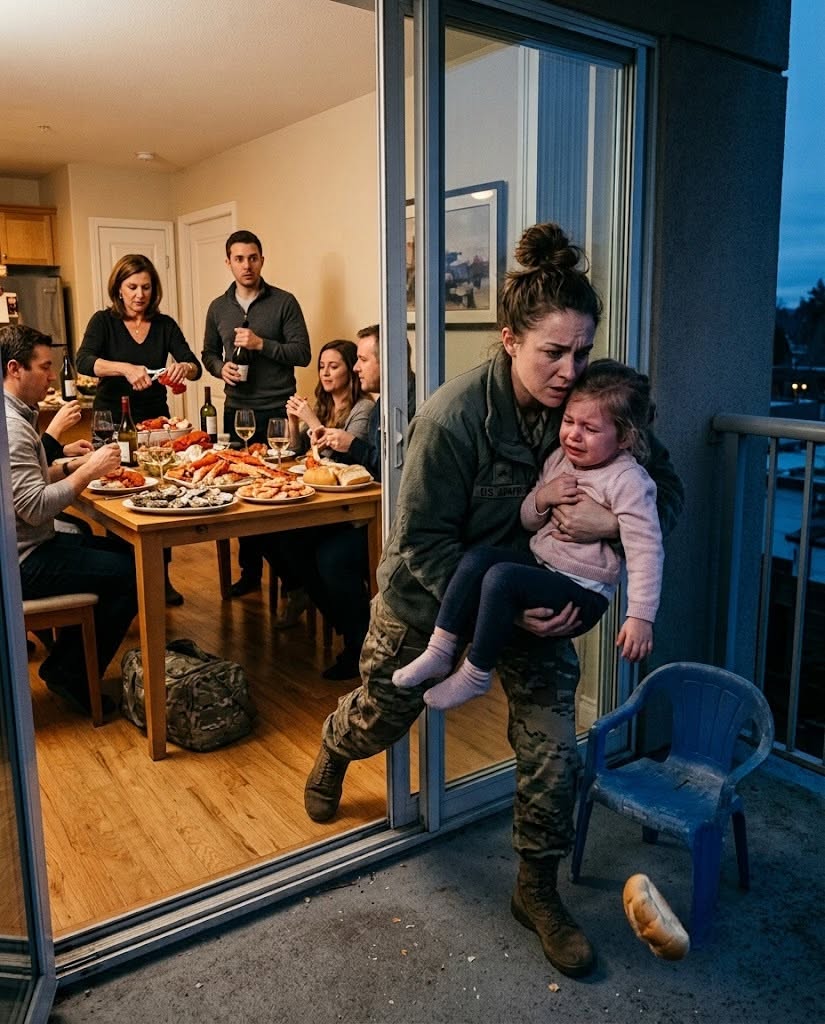 I revoked Daniel’s access.
I downloaded the available financial records before anyone could claim that charges, transfers, or spending histories had been misunderstood.
I saved copies where Daniel could not delete them.
Then I contacted my attorney.
I did not make threats.
I did not promise revenge.
I stated the facts as clearly as I could while holding my shivering child.
I had returned from official duty.
I had found my three-year-old daughter outside in freezing weather wearing a thin sweater.
Six adults were eating an expensive seafood dinner inside.
The meal had been charged to the account funded by my military salary.
My husband had defended what happened.
I was removing his access to my money and preserving the records.
Upstairs, the family remained at the table.
For a few minutes, they kept eating.
Perhaps they believed my words were another emotional reaction that would fade by morning.
Perhaps Daniel thought he could come downstairs later, tell me I was overreacting, and talk me into restoring everything before anyone noticed.
Perhaps Olivia assumed that the mortgage, medical bills, groceries, debts, and shopping would keep arriving because they always had.
They had built their comfortable lives around one belief.
No matter how badly they treated me, I would continue paying.
No matter how carelessly they treated Emma, I would accept an excuse because I was far away too often and carried enough guilt to make forgiveness easy.
They had mistaken my patience for weakness.
They had mistaken my responsibility for surrender.
They did not understand that the cold child in my arms had changed the calculation completely.
I looked down at Emma while the account controls updated on my phone.
She had stopped trembling as violently beneath my coat, but she still held herself tightly against me.
I thought about how long she might have been outside.
I thought about the stale bread roll in her hands.
I thought about the way she had asked whether she could come inside now, as though someone had told her that warmth, food, and safety were privileges she had to earn.
That question would stay with me longer than the laughter from the dining room.
The money had never been the most painful part.
Money could be tracked.
Accounts could be secured.
Cards could be frozen.
What could not be undone was the fact that Emma had looked through a glass door at six adults eating hot food and believed none of them would help her.
I could not change the minutes she had already spent outside.
I could decide what happened next.
The first confirmation appeared on my screen.
One card was frozen.
Then another.
Access had been revoked.
The records were downloading.
My attorney had the message.
Upstairs, plates continued to scrape and wine continued to pour.
They were still eating when Daniel tried to use the first card.
Dessert had not even been served.
The charge was declined.
I revoked Daniel’s access.
I downloaded the available financial records before anyone could claim that charges, transfers, or spending histories had been misunderstood.
I saved copies where Daniel could not delete them.
Then I contacted my attorney.
I did not make threats.
I did not promise revenge.
I stated the facts as clearly as I could while holding my shivering child.
I had returned from official duty.
I had found my three-year-old daughter outside in freezing weather wearing a thin sweater.
Six adults were eating an expensive seafood dinner inside.
The meal had been charged to the account funded by my military salary.
My husband had defended what happened.
I was removing his access to my money and preserving the records.
Upstairs, the family remained at the table.
For a few minutes, they kept eating.
Perhaps they believed my words were another emotional reaction that would fade by morning.
Perhaps Daniel thought he could come downstairs later, tell me I was overreacting, and talk me into restoring everything before anyone noticed.
Perhaps Olivia assumed that the mortgage, medical bills, groceries, debts, and shopping would keep arriving because they always had.
They had built their comfortable lives around one belief.
No matter how badly they treated me, I would continue paying.
No matter how carelessly they treated Emma, I would accept an excuse because I was far away too often and carried enough guilt to make forgiveness easy.
They had mistaken my patience for weakness.
They had mistaken my responsibility for surrender.
They did not understand that the cold child in my arms had changed the calculation completely.
I looked down at Emma while the account controls updated on my phone.
She had stopped trembling as violently beneath my coat, but she still held herself tightly against me.
I thought about how long she might have been outside.
I thought about the stale bread roll in her hands.
I thought about the way she had asked whether she could come inside now, as though someone had told her that warmth, food, and safety were privileges she had to earn.
That question would stay with me longer than the laughter from the dining room.
The money had never been the most painful part.
Money could be tracked.
Accounts could be secured.
Cards could be frozen.
What could not be undone was the fact that Emma had looked through a glass door at six adults eating hot food and believed none of them would help her.
I could not change the minutes she had already spent outside.
I could decide what happened next.
The first confirmation appeared on my screen.
One card was frozen.
Then another.
Access had been revoked.
The records were downloading.
My attorney had the message.
Upstairs, plates continued to scrape and wine continued to pour.
They were still eating when Daniel tried to use the first card.
Dessert had not even been served.
The charge was declined.