Yes, I told Grandma.
Every lock.
My sister’s face changed before anyone else moved, and for a second the only sound in the dining room was the refrigerator cycling behind the kitchen wall.
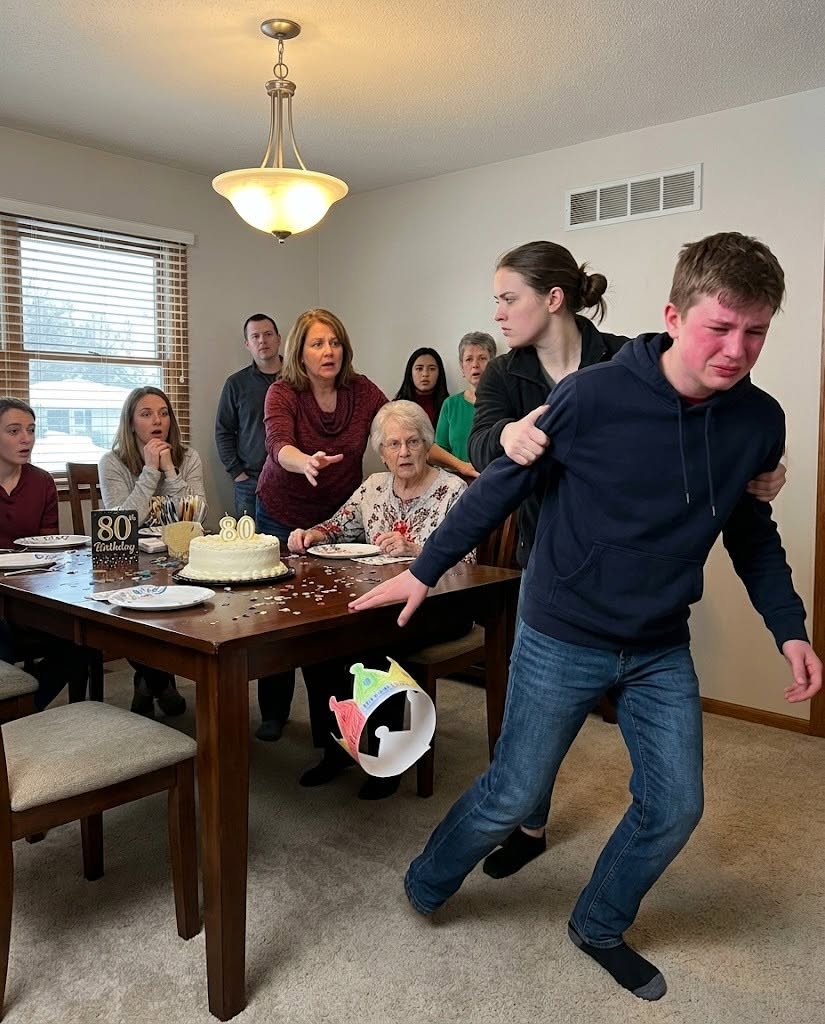
My foster son kept his hand over Grandma’s trembling fingers.
He had not touched his cake.
My sister slid the brass ring off her purse and pressed it into Grandma’s palm as if the force of the gesture could turn surrender into an insult.
“I hope you understand what you’re doing,” she said. “You’re making a permanent decision while you’re upset.”
Grandma closed her fingers around the keys.
“I understand that you kept access to my house after I asked for it back.”
My sister looked at me instead.
“You’re really going to help her throw me out?”
“I’m going to help her feel safe.”
She shook her head slowly, using the patient expression she usually saved for people she wanted others to think were unreasonable.
“She is eighty years old. She gets anxious. She forgets what she tells people.”
Grandma’s thumb moved across the narrow silver key.
“I remember asking for this three times.”
No one spoke.
A cupcake wrapper had stuck to my nephew’s sleeve, and he kept peeling it away and pressing it back down.
Grandma told my sister she could sleep in the guesthouse that night, pack the next morning, and arrange a time to collect anything she could not move immediately.
My sister called that cruel.
Grandma called it notice.
At 8:13 the next morning, my son and I returned with two new deadbolts, three knob sets, a screwdriver kit, and coffee that went cold before either of us drank it.
The air inside Grandma’s side hallway was chilly enough that my fingers stiffened around the first screw.
My son held the flashlight even though the sun was already up.
At 9:06, I removed the old side-door cylinder and installed the new one while he kept the beam steady on my hands.
The old silver key no longer opened Grandma’s house.
My sister came through the back gate ten minutes later carrying an empty laundry basket.
She stopped when she saw the old lock on the floor.
“You actually did it.”
Grandma stood in the hallway wearing slippers and the same blue cardigan she had worn at breakfast.
“You were told we would.”
My sister set the basket down.
“I came to pack. Unless I need permission to touch my own clothes now.”
Grandma handed her the guesthouse key and kept the other two.
“The guesthouse is open. The main house is not.”
My sister stared at the ring.
There were three keys.
The brass guesthouse key.
The narrow silver side-door key.
And a small flat key with a square head and a strip of faded red tape around its neck.
Grandma lifted that third key toward the window.
“I know the silver one opens my side door,” she said. “What does this one open?”
My sister picked up the laundry basket again.
“Probably an old suitcase.” Grandma did not follow her. Neither did I. My son looked from the red tape to the hallway cabinet beside the linen closet. The cabinet had been there since before I was born. Grandma kept photo albums, envelopes of negatives, school portraits, old holiday cards, and the small camcorder tapes my grandfather had labeled in his cramped handwriting. A square brass lock sat beneath its handle. My son pointed. “Does it fit that?” My sister turned too quickly. “It doesn’t.” Grandma crossed the hallway and inserted the key. It turned. The cabinet door opened six inches before a stack of photo envelopes slid forward and struck the floor. My sister put the basket down again. “I borrowed some pictures for your birthday slideshow.” “There was no slideshow,” Grandma said. “I ran out of time.” Inside the cabinet, empty spaces divided the albums like missing teeth, but Grandma did not ask what had been removed. She crouched as far as her knees allowed and picked up one envelope. The date on it was from the previous Christmas. My son had been in nearly every photograph taken that day. Grandma opened the envelope. It was empty. My sister folded her arms. “I was organizing things. You have duplicates everywhere.” Grandma straightened slowly and passed me the envelope. “Check the guesthouse.” My sister stepped into the doorway. “No. You don’t get to search where I live.” Grandma held the brass key in front of her. “It is my guesthouse.” “You gave it to me.” “I let you use it.” My sister moved closer to Grandma, softening her voice. “You are tired. Sit down before you hurt your knee. We can discuss the photographs after everyone calms down.” Grandma stayed upright. “I am calm.” My son shifted beside me, pulling his sleeves over his hands again. I wanted to send him to the kitchen, away from another conversation about whether his face belonged in our family’s pictures. Instead, I asked whether he wanted to stay. He nodded. We crossed the yard together. Sometime that morning, the clouds had cleared, but frost still clung to the shaded edge of the guesthouse steps. My sister walked ahead of us and unlocked the door. The guesthouse smelled like warm dust and the vanilla plug-in Grandma had given her after the divorce. Boxes covered half the living room. Some were packed. Most were not. A shirt hung over the back of a dining chair, and the washing machine hummed behind a folding door even though the basket beside my sister was empty. On the desk near the window sat Grandma’s small photo scanner. Beside it were six envelopes from the locked cabinet. My sister reached for them. I moved the envelopes first. She stopped. “You’re enjoying this.” “No.” “You have always wanted her to choose you over me.” Grandma entered behind us and closed the door against the cold. My son remained near the threshold. He could have gone outside. He stayed. The first envelope held photographs from Grandma’s seventy-ninth birthday. The second held Thanksgiving pictures. The third held prints from the afternoon my son had repaired the porch latch while Grandma sat nearby handing him the wrong screws. Several photographs had pencil marks along their edges. Small rectangles framed my son’s body. In one print, the line ran directly through his shoulder. My sister exhaled through her nose. “I was cropping copies. I did not damage the originals.” Grandma turned over the photograph. There was no duplicate stamp. “I wanted a clean family archive,” my sister said. “Someday, when his placement changes, these pictures could become painful for everyone.” My son looked at her. “My placement?” She spoke to him with the same careful voice. “This is not about whether we care about you. Adults have to think ahead.” He rubbed his thumb against the seam of his sleeve. “I’ve been here four years.” “I know.” “You said temporary before I even met you.” My sister’s mouth tightened. Grandma placed the marked photograph on the desk. “You entered my house, opened a locked cabinet, removed my photographs, and planned to cut a child out of them.” “I planned to preserve the originals.” “These are the originals.” My sister looked at me. I did not help her. For a few seconds, she appeared smaller in the guesthouse she had treated as permanent. Then she opened the desk drawer. A stack of freshly printed photographs sat inside. She pulled out the top one and held it toward Grandma. “Look. I was making you an album.” The photograph showed the family gathered around Grandma’s porch last summer. My son had been removed from the image. The space where he had stood beside Grandma was filled with blurred siding and part of a flowerpot repeated twice. No one moved. My sister lowered the print. “It was one version.” Grandma opened the drawer farther. There were dozens. Birthday dinners. Thanksgiving mornings. A picnic by the lake. My son’s body had been cropped, blurred, or replaced in every one. In some photographs, only his hand remained at the edge. In one, Grandma’s arm floated slightly away from her body because it had originally rested around his shoulders. My son stared at that picture longest. Grandma turned it facedown. “You will be out by Sunday evening.” My sister’s voice sharpened. “You cannot expect me to find housing in a few days.” “You have not paid rent here for two years and seven months.” “That was our arrangement.” “Our arrangement included respect.” My sister picked up one of the envelopes and shoved the marked pictures inside. “I made a mistake. I will delete the edited files.” Grandma took the envelope back. “You will leave the scanner, every photograph, and every key.” My sister laughed once. “You think she is going to protect you forever?” she asked my son. “People make promises when they’re emotional.” His face went still. Grandma stepped between them. “Pack.” My sister did not apologize. She carried the empty basket into the bedroom and shut the door hard enough to rattle the framed print above the couch. Aunt Leah arrived around lunchtime with packing tape and two flattened boxes. She had attended the birthday dinner and seen my sister pull my son from the photograph, but she still whispered to me that eviction felt excessive. “She probably only went into the house for ordinary things,” Leah said. “Coffee, laundry soap, maybe flour.” Then she noticed the altered photographs spread across the desk. She put the tape down. No one answered her. By early afternoon, my sister had filled the back of her car with clothes and kitchen equipment, but the boxes inside the guesthouse still seemed to multiply whenever we cleared a path. She packed slowly. Grandma sat at the small dining table with the brass ring beside her hand. Her knees had begun to ache, and she had not eaten since breakfast. When I brought her soup, she pushed it aside after three spoonful's. “Maybe the guesthouse lock is enough,” she said quietly. I looked at her. “The main house locks are already changed.” “I mean maybe she can stay until she finds a place.” Across the room, my sister folded towels into a box without looking up. The control Grandma had reclaimed that morning loosened again. My son carried an empty frame from the desk to the cabinet we had brought over for recovered photographs. He heard her. He said nothing. Grandma watched him place the frame down. My sister sealed her towel box. “I told you she would come to her senses.” Grandma’s hand moved away from the keys. For several minutes, the decision seemed to collapse under the weight of my sister’s practical questions. Where would she sleep? How could she work while moving? What kind of mother forced her divorced daughter out during winter? Each question arrived wrapped in concern for Grandma’s reputation. Then my phone began vibrating. The family group chat filled with messages. My sister had written that I was pressuring an elderly woman to surrender her property decisions and that my foster son’s presence had been used to create a scene at her birthday. She said she was being removed from her home without warning. She said Grandma was confused. She said I had changed the locks before anyone could discuss alternatives. The risk moved sideways. The locks were secure, but the story outside the house no longer belonged to Grandma. My sister kept folding towels. “I didn’t name him,” she said. My son’s phone vibrated inside his backpack. He had been included in the group chat the previous Christmas. He read the message himself. Grandma reached for her own phone. Her fingers shook too much to type, so she pressed the microphone button and recorded a voice message. “This is my decision,” she said. “No one pressured me. The guesthouse was offered under conditions that were broken. My side-door key was kept after I requested its return, my locked cabinet was opened, and photographs were removed from my home. Do not blame a child for an adult’s choices.” She listened once. Then she sent it. My sister dropped a towel into the box. “You just humiliated me in front of everyone.” Grandma looked at the altered porch photograph. “You sent the first message.” Replies slowed. Some relatives asked what photographs Grandma meant. Grandma did not send them. She did not need to make my son’s erased body into family entertainment. She wrote only that the matter was private and the move-out date remained Sunday evening. My sister packed faster after that. Before sunset, she carried the scanner toward her car. Grandma stopped her at the door. “That stays.” “I bought it.” “I did.” “You gave it to me.” “I lent it to you for the reunion invitations.” My sister held the scanner against her chest. Grandma waited. The temperature dropped each time the door opened, and a dead leaf kept skittering across the entry mat without making it inside. Finally, my sister set the scanner on the floor. She left with two carloads that day. For a while, it looked finished. By Sunday afternoon, the guesthouse closets were empty, the bed had been stripped, and Aunt Leah had taken the last box of dishes to my sister’s temporary apartment. Grandma stood in the doorway while I swept grit from the kitchen floor. My son found one of his missing photographs behind the desk. It showed him holding the paper crown before Grandma’s party, testing whether the staples would catch in her hair. The top point was bent even then. He handed it to Grandma. She placed it in her cardigan pocket. At 6:18, my sister returned alone. She said she had forgotten a phone charger. The guesthouse was unlocked because I was still cleaning, so she walked in without knocking and went directly to the bedroom. She returned holding no charger. Instead, she carried a small envelope. Grandma asked what was inside. “Receipts.” “For what?” “Things I paid for while I lived here.” Grandma held out her hand. My sister put the envelope into her purse. “They’re mine.” My son, standing near the empty desk, looked at the bedroom door. “The charger is on the kitchen counter,” he said. It had been there all afternoon. My sister took it without looking at him. Then she walked out through the yard gate. We locked the guesthouse at 6:31. Grandma tested the brass key once and gave it to me for the night. The false calm lasted until 7:04. A metal scrape sounded at the side door of the main house. Grandma was rinsing a soup bowl. My son was trying to fold the cardboard deadbolt packaging back into its original shape, an impossible task he kept attempting anyway. I crossed the hallway and looked through the narrow window. My sister stood outside with a new silver key in her hand. She tried it again. It did not turn. Grandma came beside me. My sister saw us and lifted the key. “I found a spare in my jewelry box. I was checking whether it was yours.” Grandma unlocked the door but left the security chain fastened. “You had another copy.” “I forgot about it.” “You tried to use it.” “To identify it.” Grandma held out her palm through the narrow opening. My sister stared at it. “This is getting obsessive.” “The key.” My sister placed the copy in Grandma’s hand. Then Grandma asked whether there were more. My sister said no. Grandma waited. My sister opened her purse and removed a second copy. The two silver keys lay across Grandma’s palm. My sister’s voice softened again. “I kept them because you live alone. What if you fell? What if there was a fire? Someone needs to be able to reach you.” Grandma closed her hand. “Someone does.” She looked at me. My sister’s eyes followed hers. Grandma shut the door. The next morning, we replaced the side-door strike plate as well, moved the recovered photographs back into the locked cabinet, and stored the duplicate keys with the old cylinders in a sealed box. My sister collected nothing else from the property. When she called Grandma during the following week, Grandma answered only when she felt rested, and she ended each call when my sister began questioning the lock changes or describing my son as the cause of the conflict. No one was arrested. No dramatic authority arrived to settle the family for us. My sister found another place to live, and the guesthouse remained empty for several weeks while Grandma considered what to do with it. My son stopped asking whether he should stand outside family photographs. At the next Sunday dinner, he sat beside Grandma rather than at the head of the table. She had reclaimed her carved chair, and he carried her plate from the kitchen because her knee was bothering her. Before dessert, Grandma brought out the altered photographs and the originals. She did not make a speech. She asked him which originals he wanted copied for his room. He selected the porch picture, the lake picnic, and the one where he was repairing the latch while Grandma handed him the wrong screws. Then he chose the photograph of the unfinished crown. Grandma converted the guesthouse into a shared family workroom that spring, with one desk for her albums and another where my son could repair small household things without covering her dining table in loose screws. She kept control of the locks. She issued two keys. One stayed with her. The other went to my son after he wrote his name on a plain paper tag and attached it to the ring himself. Above the guesthouse desk, Grandma hung a shadow box containing the bent paper crown and the old brass key that no longer opened the door.