
Rain hit Natalie’s bedroom window at 12:17 a.m. with the sharp, uneven rhythm of fingernails tapping glass.
The phone screen lit the dark ceiling blue, and she almost let the call go because the name on it made no sense.
Lizzy was six years old, and six-year-olds did not call after midnight unless an adult had failed somewhere.
“Aunt Natalie,” the little girl whispered, “please help me.”
Natalie sat upright so fast the blanket slid to the floor.
Lizzy said she was locked in, hungry, and scared, pushing each word through the phone as though someone might hear it crossing the room.
Natalie managed to say, “Where are you?” before the line went dead.
The call log remained on the screen.
Lizzy.
12:17 a.m.
Adam woke when Natalie knocked a kitchen chair sideways while pulling on jeans and a raincoat.
He had worked a double shift and looked half asleep until he saw her face.
“What happened?”
“Lizzy called.”
“At this hour?”
“She said she’s locked in.”
Adam rubbed both hands over his face, trying to force himself awake.
“Could she mean her bedroom?”
Natalie grabbed her keys.
“She was trying not to breathe too loud.”
That ended the questions.
When Lizzy lost weight, Gloria called her delicate.
When Lizzy startled at a dropped spoon, Walt called her sensitive.
When the child stopped asking to spend the night at Natalie’s house because “Grandma gets sad,” Natalie accepted the explanation even though something in Lizzy’s voice had felt rehearsed.
Family can make doubt feel like loyalty.
It can make silence feel respectful right up until silence becomes permission.
By the time Natalie reached her parents’ house, the porch light was dark and the curtains were closed.
She pounded on the front door until her palm stung.
“Mom!”
No answer.
“Dad!”
Nothing moved inside.
The first strike jarred her wrist.
The second cracked the glass.
The third sent the pane inward across the tile.
Natalie reached through carefully, unlocked the door, and stepped into a house that smelled of old dishes, damp carpet, and trapped summer heat.
Her phone flashlight moved over framed birthdays, church picnics, school pictures, and the family portraits Gloria displayed whenever she wanted the room to agree with her.
“Lizzy?”
At first, Natalie heard only rain ticking against the roof.
Then something scraped upstairs.
She climbed quickly, one wet hand sliding along the banister, and found plastic Christmas bins stacked at the end of the hall.
Behind them was the storage closet.
A metal latch had been screwed across the outside.
Natalie knew the hardware because Walt had used the same kind on the garage cabinet.
Her shoe squeaked.
The faint crying stopped.
Natalie placed her palm against the door.
“Lizzy, it’s me.”
There was no answer.
“You’re not alone.”
Small fingers scratched once against the wood.
Natalie lifted the latch and dragged one bin aside, then another.
The door opened only a few inches before catching on the plastic edge, but the gap was enough for the phone light to reach winter coats hanging above a child curled on the floor.
Lizzy raised one thin arm over her face.
Natalie did not ask for an explanation.
She wrapped the child in her jacket, carried her downstairs, and buckled her into the back seat.
The seat belt clicked in the quiet car with a sound so clean and ordinary that it almost broke Natalie’s composure.
Before leaving, she took photographs.
The call log.
The outside latch.
The bins blocking the door.
The broken pane she had entered through.
People who know how to lie well do not fear the truth.
They fear the order of it.
Time.
Object.
Witness.
Record.
At the hospital, Adam met them after arranging for Noah to remain safe with someone they trusted.
He brought a dry sweatshirt for Natalie and a paper cup of coffee she never touched.
A nurse wrapped Lizzy in a warm blanket and brought her crackers, applesauce, and water in small amounts.
Another staff member placed a white identification bracelet around her wrist and checked the printed name twice.
Lizzy kept one hand inside Natalie’s.
Each time a door opened, her shoulders rose.
Each time shoes approached, she looked toward the hallway before looking back at the food.
The nurse noticed.
She also noticed how quickly Lizzy ate until she was gently asked to slow down.
The intake process had barely begun when Gloria and Walt entered the waiting area.
Gloria’s coat was buttoned to her throat.
Her hair was still smooth.
Her expression arrived before the rest of her, arranged into the exact shape of a concerned grandmother.
Walt followed half a step behind, his jaw tight and his eyes fixed on the floor.
Gloria looked at Lizzy.
Then she looked at Natalie.
She did not ask whether the child was hurt.
She did not ask whether she had eaten.
She did not ask why she had called for help.
Instead, Gloria leaned close enough for Adam and the nurse to hear every word.
“Return her, or we’ll accuse you of kidnapping and make sure you lose your own child.”
The waiting room stopped.
The nurse’s pen hovered above the intake sheet.
Adam’s hand tightened around his coffee cup until the plastic lid folded.
A man across the room lowered his magazine without turning the page.
Walt stared at one square of tile as though he could disappear into it.
Natalie felt anger rise so fast that her vision narrowed.
She pictured the closet.
She pictured the latch.
She pictured dragging her mother back through the rain and making her stand in that dark space while someone blocked the door.
For one ugly heartbeat, rage offered itself as relief.
Then Natalie looked at Lizzy’s hand inside hers.
Rage was loud.
Evidence was patient.
Natalie said nothing.
She opened the call log and turned the screen toward the nurse.
Lizzy’s name appeared beside 12:17 a.m.
The nurse rotated the hospital bracelet until its barcode faced the scanner.
A soft beep passed through the waiting room.
Gloria’s pointing hand froze.
Walt lowered himself into a chair.
The nurse compared the bracelet, the intake chart, the call log, and the photographs of the outside latch.
Then she opened Lizzy’s chart and looked directly at Gloria.
“Why does a six-year-old child under your guardianship have to call for help from a closet locked on the outside?”
Gloria’s expression changed by less than an inch.
The concern left her eyes first.
“She wanders at night,” Gloria said. “We were protecting her.”
“With bins blocking the door?” the nurse asked.
“They were being stored.”
“In front of a latched closet?”
Gloria drew herself taller.
“You don’t understand her behavior.”
The double doors opened before she could finish.
A hospital social worker entered with a security officer beside her.
The nurse had contacted them after hearing the threat against Natalie.
Gloria’s mistake was not simply that she had threatened the wrong person.
It was that she had mistaken a hospital hallway for a family kitchen, a place where everyone would lower their voices and protect her from the consequences of her own words.
The social worker crouched several feet from Lizzy, leaving enough space that the child did not feel surrounded.
“You don’t have to answer anything right now,” she said. “Can you tell me whether you could open that door from the inside?”
Lizzy shook her head.
Gloria stepped forward.
“She’s confused.”
The security officer raised one hand.
“Ma’am, please step back.”
Gloria stopped, but the smile she forced onto her face looked painful.
“Natalie has been filling her head with things.”
Natalie still did not argue.
She handed the phone to the social worker.
The woman scrolled through the photographs in order, pausing at the close image of the latch and then at the wider image showing the bins.
She asked who had installed the hardware.
Walt folded and unfolded his hands.
Gloria whispered, “Don’t.”
That single word did more damage than any speech could have done.
Walt looked at Lizzy’s white bracelet, then at the photograph on the phone.
“I installed it,” he said.
The room stayed quiet.
Gloria turned toward him so sharply that the collar of her coat shifted.
“You installed a safety latch,” she said.
Walt did not answer her.
The security officer asked whether the latch could be opened from inside.
“No.”
“Why was it there?”
Walt pressed his lips together.
Gloria answered for him.
“Because Lizzy gets into things.”
The social worker asked, “Why were storage bins placed against the door?”
Gloria’s voice hardened.
“I already said they were being stored.”
Walt covered his face with both hands.
When he lowered them, he looked older than he had fifteen minutes earlier.
“She cried at night,” he said.
Gloria’s mouth opened.
Walt kept talking.
“She asked for Ian. She asked for Natalie. Gloria said she needed to learn that crying wouldn’t change the rules.”
Natalie felt Lizzy’s fingers tighten.
The social worker did not react dramatically.
She simply wrote down the statement, the time, and the names of everyone who had heard it.
That calmness frightened Gloria more than shouting would have.
The nurse moved Lizzy to a quieter examination area and asked that Gloria and Walt remain in the waiting room.
Natalie went with the child.
Adam stayed near the doorway, close enough to be seen but not crowding her.
Several hours later, a responding officer took Natalie’s statement.
She began with the phone call and gave the exact time.
She described the unanswered door.
She explained the broken side window before anyone could use it as proof that she had acted secretly.
She showed every photograph in sequence.
The officer asked why she had not called emergency services before entering.
Natalie answered honestly.
“I heard her on the phone, and then the call died. I thought she was in immediate danger. I was afraid that waiting outside would mean leaving her locked in.”
The officer wrote that down too.
Truth did not require Natalie to make herself look perfect.
It required her to make the order clear.
Later that morning, officers went to the house and photographed the closet as Natalie had found it.
The latch remained on the outside.
The bins remained in the hall.
The broken glass remained on the side-door tile.
Nothing in that house erased the call.
Nothing erased the child behind the coats.
Gloria tried to turn the conversation toward Natalie’s entry.
She called it destruction.
She called it a family misunderstanding.
She called Natalie unstable.
But every accusation had to pass through the same timeline.
At 12:17 a.m., Lizzy called for help.
Natalie arrived to a dark house.
No guardian answered.
A child was found behind an externally latched door.
The hospital bracelet documented when Lizzy entered care.
Staff members heard Gloria demand the child’s return and threaten Natalie’s custody of Noah.
Walt admitted installing the latch.
The story could be decorated, but it could not be reordered.
Ian was contacted through his treatment program later that morning.
Natalie dreaded the call because shame had already taken so much from her brother, and she did not know how much more he could hold.
For several seconds after she explained, Ian said nothing.
Then he asked one question.
“Did Lizzy call you herself?”
“Yes.”
He breathed out slowly.
“Then she knew who would come.”
Natalie closed her eyes.
Ian did not defend their parents.
He did not ask Natalie to keep the matter private.
He said he would cooperate with every review and sign whatever temporary paperwork was necessary to keep Lizzy safe while he continued treatment.
That choice did not erase his absence, but it was the first stable thing he had been able to give his daughter in months.
The hospital social worker helped coordinate the next steps without promising outcomes she could not control.
Lizzy was discharged later with instructions, follow-up care, and a temporary safety plan.
She left wearing the same white bracelet until a nurse clipped it away at the door.
The plastic band had looked ordinary when it was fastened around her wrist.
By morning, it had become a timestamp, an identity record, and the first independent proof that Natalie had brought a frightened child to safety before her parents could rewrite the night.
At Natalie and Adam’s house, Noah had left a stuffed animal on the guest bed.
Adam put a night-light near the door and removed the lock from the inside before Lizzy saw the room.
He did not make a speech about it.
He simply showed her that the door opened with one push.
For the first two nights, Lizzy slept with the hallway light on.
On the third night, she asked whether Natalie could sit beside the bed until she fell asleep.
Natalie sat on the floor with her back against the wall and listened to the child’s breathing become slower.
Weeks passed before Lizzy stopped hiding crackers in the pocket of her pajamas.
Natalie found them during laundry and placed a small basket of snacks on the kitchen counter where Lizzy could reach it.
She did not ask for an explanation.
She said, “These are here whenever you’re hungry.”
Lizzy stared at the basket for a long time.
Then she took one packet and left the rest.
Healing did not arrive as a dramatic speech.
It arrived as a door left open.
It arrived as food that did not have to be earned.
It arrived as an adult answering on the first ring.
The guardianship review eventually removed Gloria and Walt from control of Lizzy’s care.
Natalie accepted temporary responsibility while Ian continued treatment and worked toward a safer, supervised path back into his daughter’s life.
Months later, Lizzy returned to school.
She still startled at abrupt sounds, but she no longer watched every doorway while eating.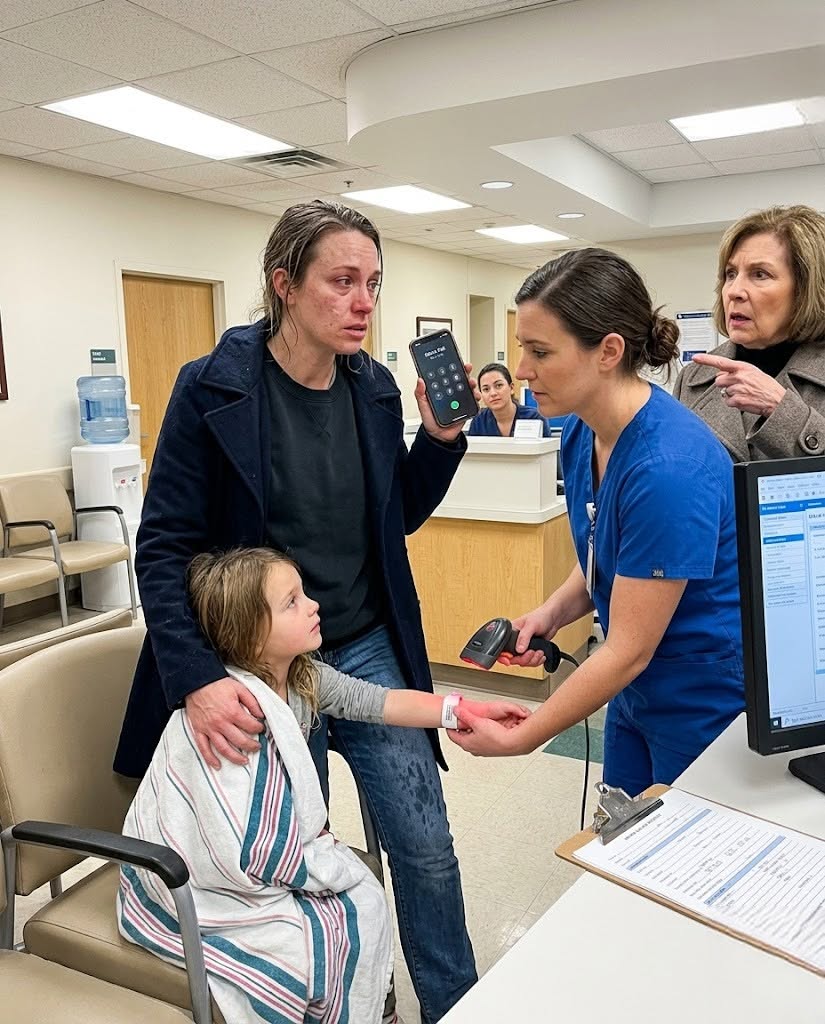 She began drawing houses with bright windows.
In every picture, the doors were open.
One evening, Natalie found the old hospital bracelet inside a small box in her desk.
She had kept it with copies of the intake sheet, the call log, and the photographs from that night.
People who know how to lie well do not fear the truth.
They fear the order of it.
Time.
Object.
Witness.
Record.
Natalie closed the box and went downstairs, where Lizzy and Noah were arguing over which movie to watch while Adam carried a bowl of popcorn into the living room.
The sound was ordinary.
That was what made it beautiful.
Lizzy looked up when Natalie entered.
“You came,” she said, as though Natalie had only stepped out for a minute.
Natalie sat beside her.
“I said I would.”
She began drawing houses with bright windows.
In every picture, the doors were open.
One evening, Natalie found the old hospital bracelet inside a small box in her desk.
She had kept it with copies of the intake sheet, the call log, and the photographs from that night.
People who know how to lie well do not fear the truth.
They fear the order of it.
Time.
Object.
Witness.
Record.
Natalie closed the box and went downstairs, where Lizzy and Noah were arguing over which movie to watch while Adam carried a bowl of popcorn into the living room.
The sound was ordinary.
That was what made it beautiful.
Lizzy looked up when Natalie entered.
“You came,” she said, as though Natalie had only stepped out for a minute.
Natalie sat beside her.
“I said I would.”