The boy’s hand was still shaking when the dead bolt finally moved.
It made a dry scraping sound inside the door, the kind of ordinary household noise that would not have meant anything to me on another afternoon.
He pushed the door open only a few inches and slipped one shoulder through the gap.
Warm, stale air pressed onto the porch.
There was a sharp trace of bleach beneath it, mixed with old cooking grease and the closed-up smell of a house that had not let fresh air in for a long time.
The boy did not call for his father.
He did not announce that he was home.
He set his backpack against the wall with both hands, placing it so carefully that I noticed the bottom seam had been repaired with gray tape.
Then he looked at me and pointed toward the kitchen.
Two younger children sat at a small table beneath a buzzing ceiling fixture.
One looked about five.
The other might have been six.
Worksheets had been placed in front of them in neat stacks, but neither child was writing.
Their pencils rested across the pages as if they had heard us coming and understood that moving without permission might make things worse.
A chain had been threaded through the pantry handles.
It was secured with a small brass padlock.
Beside it hung a clipboard covered with thick black writing.
Wake up.
School.
Chores.
Dinner.
Lights out.
Every part of the day had a time next to it, and every line ended with a mark that looked less like a schedule than a warning.
The boy’s father appeared in the hallway wearing work pants and an old T-shirt.
He was not holding a weapon.
He was not shouting when I first saw him.
For half a second, he simply looked irritated that someone had entered his house without his permission.
Then he noticed my uniform.
“What is this?” he asked.
The boy moved behind my arm.
It was not a dramatic motion.
He did not grab me or cry out.
He just placed one adult body between himself and his father, and that small choice told me more than a speech could have.
The father looked from him to me.
“They’re fine,” he said. “I’m teaching them responsibility.”
I asked him to keep his hands where I could see them.
My voice stayed level while I keyed my radio and requested a supervisor and a child-welfare response to the address.
The dispatch time stamp was 3:47 p.m.
That time would later appear on the welfare-check report, the body-camera file, the school office note, and the emergency placement paperwork.
At that moment, it was just a set of numbers glowing on my radio screen while three children watched to see whether an adult would finally take them seriously.
The father’s face tightened.
“You don’t need to call anybody,” he said. “This is a family matter.”
Children do not usually ask for rescue in the language adults expect.
They ask whether you can walk them home.
They ask whether you will look.
They ask whether, after they tell the truth, someone will force them to live inside the lie again.
The younger child at the table lowered her pencil.
The father heard the dispatcher repeat the address and request, and the color drained from his face.
His shoulders dropped.
He caught himself against the kitchen counter as though the room had shifted under him.
But the seven-year-old was not looking at the chained pantry.
He was staring down the hallway.
“That’s not the thing,” he whispered.
He raised one trembling finger toward a door at the far end.
A padlock hung from a metal hasp on the outside.
“That’s what I needed you to see.”
I told the father not to move toward the hallway.
He started to explain before I had asked a question.
He said the room was used for storage.
He said the lock kept the younger children away from cleaning supplies.
He said the boy had a habit of lying when he did not get his way.
Every explanation arrived too quickly.
I asked who had the key.
He said he did not know.
The boy looked down at the floor.
“It’s on his belt loop,” he said.
The father’s right hand moved an inch toward his hip before he stopped himself.
A small key ring hung from a clip beside his pocket.
By then my supervisor was less than two blocks away.
I could hear the update through my radio, along with the clipped, controlled voices that take over when a routine call becomes something else.
I asked the father to remove the key ring slowly and place it on the counter.
His fingers fumbled with the clip.
The keys struck the laminate with a bright metallic sound.
One of the younger children flinched.
I took the ring, chose the smallest key, and walked toward the hall.
The boy followed until I told him he could stay where he felt safest.
He stayed behind me anyway.
The padlock opened on the second try.
The door pulled inward against something soft.
At first I thought a box had been left on the floor.
Then I saw the edge of a thin foam mattress folded against the wall.
The room had once been a laundry or utility space.
The washer and dryer hookups were still visible behind a sheet of plywood.
There was no bed frame.
No dresser.
No window large enough for a child to climb through.
A battery alarm clock sat on an overturned plastic bin.
Two school shirts had been folded on top of it.
A blanket lay in one corner beside a plastic bucket and two empty granola-bar wrappers.
On the wall, written in black marker on printer paper, were more rules.
No leaving after lights out.
No food without permission.
No talking through the door.
The boy stopped breathing normally.
I could hear each breath catch in his throat before it came out.
“How often do you sleep in here?” I asked.
He looked at his father before answering.
The father said, “Don’t.”
It was the first time his voice sounded afraid.
The boy’s eyes moved back to me.
“When I cause problems,” he said.
“What counts as a problem?”
He rubbed his thumb against the edge of his fingernail.
“Getting food.”
The younger children were still seated at the kitchen table.
The five-year-old had put both hands over her ears.
My supervisor entered through the front door, took one look down the hallway, and stopped speaking mid-sentence.
There are rooms that change the meaning of every object inside them.
A folded shirt becomes evidence that a child expected to wake there.
A plastic bucket becomes evidence that a locked door was not opened when it should have been.
A cheap alarm clock becomes evidence that a seven-year-old was expected to manage his own confinement on schedule.
The father kept insisting that the room was discipline, not abuse.
He said his own father had done worse.
He said the children had food, clothes, and a roof.
He said no one understood how hard it was to raise three kids alone.
Some of those statements may have been true.
None of them made the lock disappear.
The child-welfare worker arrived with an intake bag and a stack of forms.
A second officer photographed the door, the hasp, the key ring, the pantry chain, the clipboard, and the handwritten rules.
Each photograph received a file number.
Each room was documented before anything was moved.
The process was slow because careful work often is.
The children were offered water and packaged snacks from the worker’s bag.
The seven-year-old did not open his right away.
He turned it over in his hands and asked, “Is this for now?”
The worker told him yes.
“All of it?”
“Yes.”
He looked at me before peeling back the wrapper.
That glance was not gratitude.
It was verification.
He was still testing whether the rules of the world had actually changed.
The father sat in a kitchen chair while my supervisor read him the temporary safety instructions.
He had stopped arguing.
His elbows rested on his knees, and he stared at the padlock on the counter as if it belonged to someone else.
At 5:12 p.m., the school office confirmed that the boy had not been signed out early and that he had approached me during regular dismissal.
At 5:26, the child-welfare worker completed the initial safety assessment.
At 6:03, an emergency placement request was approved.
The children left the house carrying almost nothing.
The younger two had small grocery bags with clothes.
The boy wore his backpack.
When the worker asked whether he wanted to bring anything else, he looked toward the locked room and said no.
Outside, the late sun had dropped behind the neighboring roofs.
The same mailbox still leaned beside the driveway.
The same dog barked behind the same fence.
Nothing on the street looked different, yet the entire meaning of the block had changed for me.
The boy stopped beside the worker’s vehicle.
“You said I wouldn’t face it alone,” he said.
“I meant it.”
“Do I have to come back tonight?”
“No.”
He nodded once.
Then his knees gave slightly, not enough for him to fall, but enough that the worker reached out and steadied his shoulder.
That was the first time all afternoon he looked seven years old.
The next several days turned the house into a collection of records.
There was the patrol report.
The body-camera time line.
The child-welfare intake.
The photographs of the padlocks.
The school attendance records.
The emergency placement order.
There were interviews conducted separately so the children did not have to watch one another decide what was safe to say.
The younger children described the pantry schedule.
The boy described the utility room.
He said the lock was used when he took food after dinner, woke the others, asked about their mother, or told a teacher too much.
He said he had learned my name because I had been around the school for years and had once knelt in the rain to help a kindergartner gather spilled crayons from the curb.
I barely remembered doing it.
He remembered because children study adults for evidence.
They notice who gets impatient.
They notice who laughs.
They notice who lowers their voice instead of raising it.
Trust is rarely built in the moment it is needed.
It is built in all the small moments no one realizes are being counted.
The father’s explanation changed over time.
First, the door was only for storage.
Then the boy had slept there once.
Then it had happened a few times, but only when he was “out of control.”
The photographs and time-stamped interviews made those changes impossible to ignore.
A county hearing was held to decide where the children could safely stay while the case continued.
No grand speech fixed anything.
A judge reviewed the safety assessment, the photographs, the school records, and the father’s own statements.
The children remained out of the home.
The father was ordered into supervised contact, parenting services, and a formal evaluation before any reunification could be considered.
The court process did not turn him into a cartoon villain.
He was a tired man with a job, bills, anger, and a history he had never confronted.
But hardship can explain how a person reached a line.
It does not erase the moment he chose to cross it.
The children were first placed in temporary care while workers searched for a safe relative.
A maternal aunt was located in another part of the state.
She had not known about the locks.
She had been told the children were doing well and that the boy was “difficult.”
Her home had to be inspected.
Background checks had to be completed.
School records had to be transferred.
Nothing happened as fast as the children deserved.
Still, for the first time, the delays were part of a process designed to protect them rather than silence them.
The aunt came to meet them in a plain sweater and worn sneakers.
She brought no dramatic gifts.
She brought three paper grocery bags.
One held clothes.
One held toothbrushes, socks, and hairbrushes.
The third held snacks.
The boy stared at that bag longer than the others.
“You don’t have to ask before eating one,” she told him.
He did not reach for anything.
Not then.
Later, the worker found him sitting on the edge of the guest-room bed with a granola bar beside him, still unopened.
Trauma does not leave when a lock opens.
Sometimes it remains in the hand that waits for permission no one requires anymore.
The children eventually moved into their aunt’s home under a court-approved placement.
Their father continued supervised visits.
Some went badly.
Some went quietly.
He apologized once, but the boy did not answer.
The adults in the room did not force him to.
An apology can be part of accountability, but it cannot be used as another order a child must obey.
Months passed.
I kept working around Evergreen Elementary.
The pickup line remained noisy.
Minivans still idled along Cedar Street.
Kids still lost lunch boxes, argued over tablets, and treated scraped knees like national emergencies.
Then one afternoon I saw the boy near the school doors.
His hair had grown out enough to lie flat on one side.
His shoes fit.
The backpack on his shoulders was smaller, and the zipper closed without strain.
He was carrying a paper lunch bag in one hand.
He saw me and walked over.
For a second, neither of us said anything.
Then he held up the lunch bag.
“My aunt puts too much in here,” he said.
It was the closest thing to a joke I had ever heard from him.
I smiled.
“That sounds like a pretty good problem.”
He nodded.
A teacher called his name from the pickup line.
He turned to go, then stopped.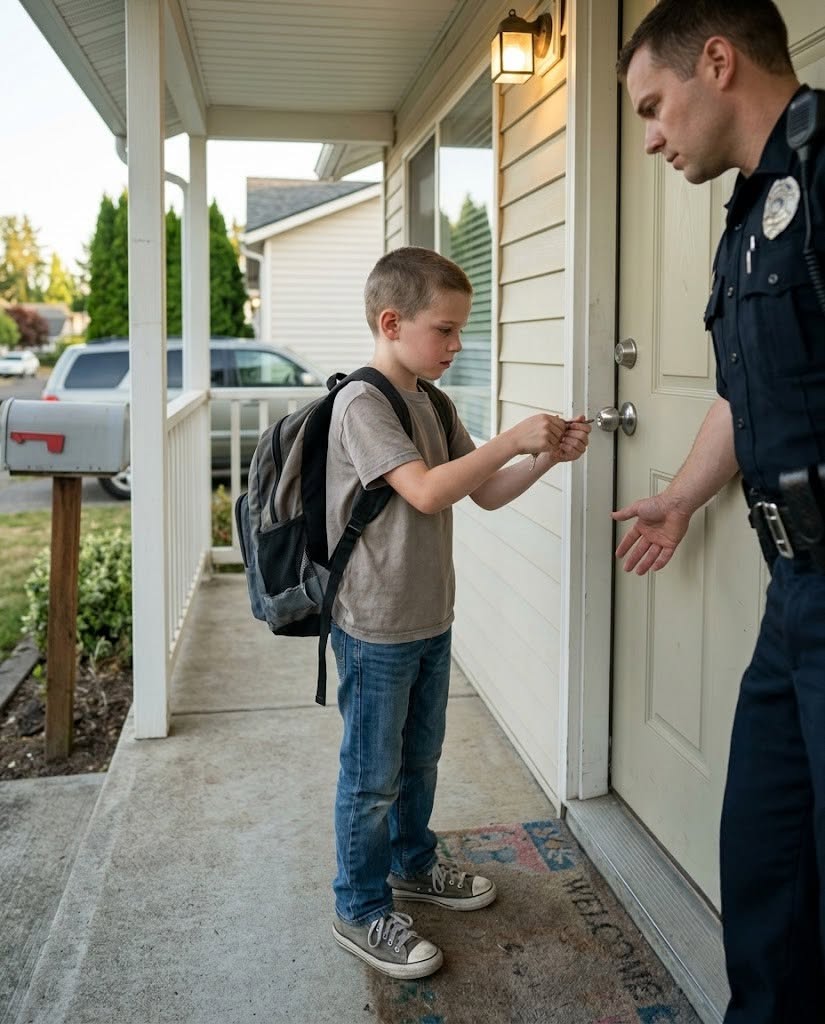 “Officer Dunham?”
“Yeah?”
“You did look.”
Three words.
That was all.
He ran toward the waiting SUV before I could answer.
I stood there listening to the brakes squeak, the teachers calling names, and the ordinary noise of children going home.
For years, I had thought the most important part of the job was knowing what to do after a door opened.
That boy taught me something harder.
Sometimes the work begins earlier.
It begins when a child is standing silently beside you, waiting to learn whether you are the kind of adult who will notice.
“Officer Dunham?”
“Yeah?”
“You did look.”
Three words.
That was all.
He ran toward the waiting SUV before I could answer.
I stood there listening to the brakes squeak, the teachers calling names, and the ordinary noise of children going home.
For years, I had thought the most important part of the job was knowing what to do after a door opened.
That boy taught me something harder.
Sometimes the work begins earlier.
It begins when a child is standing silently beside you, waiting to learn whether you are the kind of adult who will notice.