The circled dates were the nights Mark had increased what he poured into Sophie’s cup and timed how long she could keep her face in the water without calling for me.
An officer read the cramped notes beside each circle while another photographed the bottle, the paper cup, and the kitchen timer.
The entries began at twenty seconds.
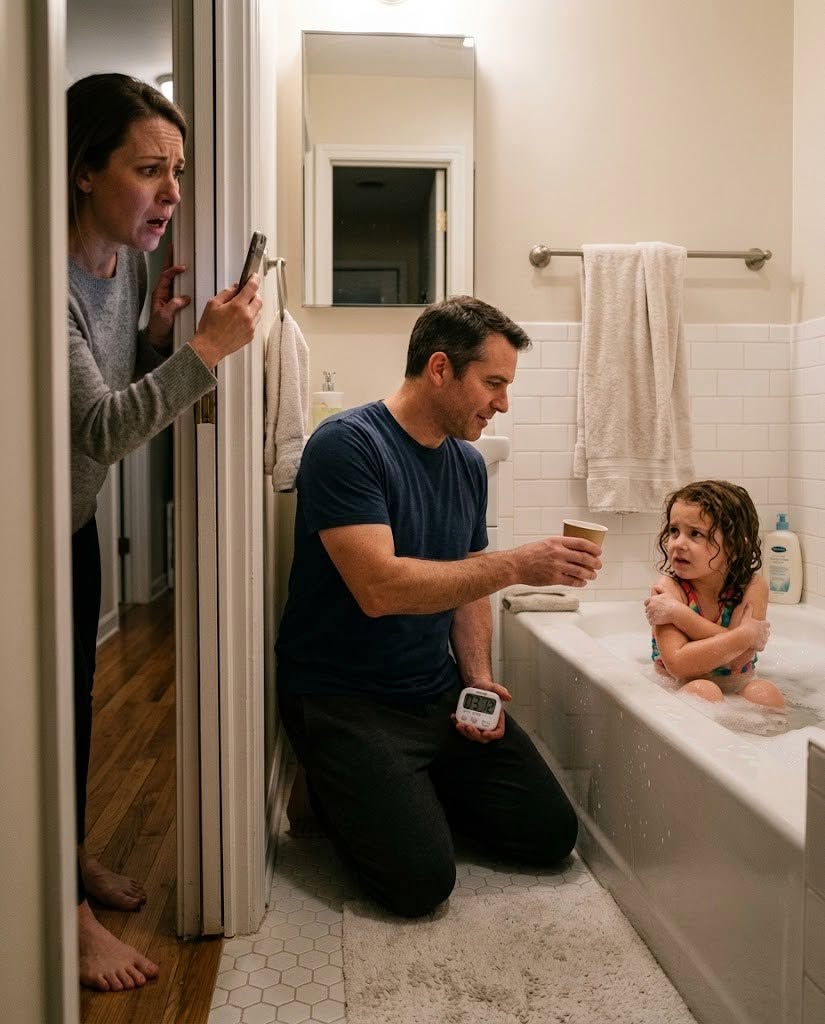
By that night, Mark had written ninety beside Sophie’s name and underlined RETRY twice.
From downstairs, he kept speaking in the same measured voice.
He said the notebook documented breathing exercises recommended for anxious children, although he could not name the doctor who had recommended them.
When the officer asked why the bottle had no label, Mark said labels made Sophie nervous.
Nobody answered him.
Sophie sat against my chest beneath two towels while water from her curls soaked through my shirt.
Her stomach made a small sound because she had barely touched dinner, and I realized I had not eaten either.
Before the ambulance left, an officer asked Sophie whether the timer told her when the game ended.
She stared at the floor.
Then she whispered, “The bell means I can breathe.”
The bathroom suddenly felt too warm.
Mark stopped explaining.
At the hospital, the staff separated us from him and placed Sophie in a room with paper fish stuck crookedly along one wall.
A nurse brought heated blankets, collected blood and urine samples, and asked me not to question Sophie about the bathroom again.
I nodded until my neck hurt.
Sometime before midnight, I bought a child-sized toothbrush from the pharmacy downstairs even though Nina had already packed one in Sophie’s overnight bag.
The toothbrush stayed sealed.
Mark called my phone fourteen times before an officer took it and switched it off.
His last message said he forgave me for panicking and wanted us to solve the misunderstanding privately.
I handed the officer my passcode.
Before dawn, I signed an emergency no-contact affidavit, authorized the hospital to preserve Sophie’s test results, and wrote that I would testify even if Mark never forgave me.
I signed.
The first laboratory report came back later that morning.
Sophie had a sedating antihistamine in her system that had never been prescribed to her, and the amount was inconsistent with an accidental taste.
The doctor would not guess how much Mark had given her or how often he had done it.
She only said Sophie needed observation because the medicine could suppress alertness and interfere with her ability to protect her airway.
My hands went cold.
Across the room, Sophie pushed a plastic bead along the wire track of a hospital toy and asked whether she had school that day.
I told her no.
She asked whether Daddy would be angry about the bathroom door.
I said he was not coming into the room.
That was all she needed then.
By afternoon, the police had obtained permission to search the bathroom, Mark’s bedside drawer, and the locked cabinet in the garage.
They found unopened bottles of the same medication, disposable cups matching the one beside the tub, and packages with the labels removed.
They did not find a doctor’s instructions.
Mark was arrested before dinner on suspicion of child endangerment and administering medication without lawful authority, but the officer warned me that an arrest was not a conviction.
The words sounded clinical against the squeak of Sophie’s hospital socks.
Nina brought clean clothes and parked herself in a vinyl chair near the door.
She had packed two different shoes for Sophie, one pink and one blue, and neither of us mentioned it.
At 4:18, a social worker explained that Sophie would be interviewed at a child advocacy center after she had rested.
I would not be allowed in the room.
The interviewer would ask open questions, and I was not to rehearse answers with her.
That instruction became the hardest thing I had ever followed.
When Sophie asked why Mark had made her play the game, I said, “I don’t know.”
When she asked whether she had lost, I said, “There was no game to win.”
She studied my face for several seconds, then returned to twisting the rabbit’s ear.
The emergency family-court hearing happened two days later in a room that smelled faintly of old coffee.
Mark appeared by video from the county jail wearing a gray shirt and the patient expression he used during disagreements.
His attorney said I had misinterpreted a swimming exercise, frightened Sophie, and turned an ordinary supplement into evidence of abuse.
The attorney also said Mark had always been the calmer parent.
Mark lowered his eyes.
When the judge asked why the exercises happened behind a nearly closed door, Mark said Sophie was embarrassed by my anxiety.
When asked about the notebook, he said QUIET referred to meditation, RETRY meant repeating a breathing pattern, and CUP FIRST reminded him to keep Sophie hydrated.
The judge looked at the photograph of the peeled bottle.
Then she listened to twelve seconds of my recording.
Mark’s voice filled the courtroom.
“Drink the rest, and then we’ll do the quiet game.” His attorney asked the recording to be stopped. The judge granted me temporary sole custody and ordered Mark to have no contact with Sophie while the criminal investigation continued. For the first time since the bathroom door opened, I believed the immediate danger had passed. It had not. Three days later, Mark was released on bond. He could not contact Sophie, but his attorney filed a motion claiming I had coached her and contaminated her memory before the formal interview. The filing quoted my question about whether anyone had touched her somewhere that hurt. I had asked it before I understood how easily a frightened child’s answers could be challenged. The prosecutor did not scold me. She simply said Mark’s defense would use every mistake available. That sentence kept me awake. At Nina’s apartment, the radiator clicked even though the rooms were already too warm, and Sophie refused to enter the bathroom unless I stood inside with her. For several nights, she washed her hands at the kitchen sink and slept in yesterday’s socks. I let her. When she finally agreed to take a bath, I filled the tub with only a few inches of water and placed the rabbit on the closed toilet lid. Sophie climbed in wearing her bathing suit. She watched my hands. I kept them on my knees. After less than a minute, she climbed out without washing her hair, and I wrapped her in the largest towel Nina owned. Nothing improved that night. The advocacy-center interview took place sometime the following week. Sophie entered the room with her rabbit and a paper bracelet from the hospital still looped around one wrist. I waited behind a one-way window with professionals who did not react when she went silent. The room was cool enough that I rubbed my palms along my sleeves. At first, Sophie talked about kindergarten, noodles, and a boy who ate glue during art time. Then the interviewer asked what happened when Mark brought the paper cup upstairs. Sophie said the drink made her arms heavy. She said Mark filled the tub higher after I went downstairs. She said he placed the timer where she could see it and told her to put her face in the water until it rang. If she lifted her head early, he pressed RETRY and started again. The interviewer asked what Mark did when Sophie cried. “He says crying wastes air,” she answered. Nobody moved. When asked why she had kept the games secret, Sophie rubbed the rabbit’s ear against her mouth. “Daddy said Mommy would go away if I told wrong.” The interview ended soon afterward. I made it to the parking lot before my knees gave out beside Nina’s car. Nina held my elbow while a grocery cart rolled slowly across the far end of the lot and struck a curb. I did not cry. I vomited behind a hedge, rinsed my mouth with warm water from a bottle, and returned inside to sign the release forms. The interview strengthened the case, but it did not settle everything. Mark’s attorney argued that Sophie’s words had developed after days in my care and that the medication might have come from our shared kitchen cabinet. The police had found no usable fingerprints on the peeled bottle because the bathroom moisture and repeated handling had damaged the surface. The paper cup carried both Mark’s and Sophie’s DNA, which proved contact but not what the cup had contained that night. For a while, the case stopped moving. Mark remained away from Sophie, yet the temporary custody order had an expiration date, and his attorney requested supervised visits before the criminal charges were resolved. The request described him as a devoted father separated from his daughter by an unproven allegation. I read those words at Nina’s kitchen table while Sophie arranged crackers into two uneven rows. One cracker had a corner missing. She refused to eat it. At the next hearing, Mark wore a navy sweater and spoke directly to the judge. He said he accepted responsibility for poor judgment but denied forcing Sophie beneath the water. He offered to attend parenting classes, use only prescribed medication, and allow another adult to supervise bath time. Every promise sounded reasonable when separated from the timer. The judge postponed her decision until the laboratory work was complete. Outside the courtroom, Mark passed within several feet of me under the supervision of a deputy. He did not look angry. He smiled sadly and said, “You can still stop this before she remembers it forever.” I kept walking. That afternoon, the school nurse provided attendance notes showing that Sophie had arrived unusually drowsy on mornings following seven of the nine circled dates. It did not prove what happened in the bathroom, but it placed the effects beyond our house. Her teacher had also documented that Sophie avoided water-play activities and became distressed when a classroom timer rang. The teacher had assumed she disliked transitions. So had I. A week later, the laboratory tested the towel I had sealed in the freezer bag. The chalky smear contained residue from the same sedating antihistamine found in Sophie’s system, mixed with the powdered drink Mark claimed was harmless. Unlike the cup from the final night, the towel had been hidden behind the hamper before I confronted him. It connected the medication to an earlier bath. Then the prosecutor called about the notebook. Under angled light, technicians had recovered impressions from a page Mark had torn out before wrapping the notebook in plastic. The missing page had been pressed hard enough to leave partial words on the sheet beneath it. Most of the writing was fragmented, but three lines could be read. S — NO CALLING MOM. NEXT GOAL — 120. REMOVE LABELS. The final line ended Mark’s claim that the bottles had arrived that way. The second line showed that ninety seconds had not been the end of his plan. The first line explained the secrecy. Even with the recovered page, Mark did not plead guilty. His attorney requested an independent review, challenged the impression analysis, and argued that 120 might have referred to a meditation timer measured in seconds. The prosecutor prepared for trial. For months, my life became appointments, copied records, locked folders, and calls I took in Nina’s hallway so Sophie would not hear her name. I learned to answer only what was asked. I learned not to fill silence. During one preparation meeting, the prosecutor placed a clean paper cup on the conference table and asked me to describe exactly where Mark’s fingers had been. I could not remember. I remembered his wet socks, his smile, and the way Sophie’s bare feet had pressed against my thighs, but not his fingers. The prosecutor wrote that down without changing her expression. Memory did not become clearer because the truth mattered. Sometime that winter, Sophie began seeing a therapist who let her choose whether the office door stayed open. She rarely discussed Mark directly. Instead, she practiced saying stop while building towers, washing dolls, and taking turns with a toy kitchen. At home, she started sleeping without the rabbit beneath her chin. The ear remained twisted flat. One evening, she asked whether Mark knew the games were dangerous. I dried a plate and set it in Nina’s cabinet. “Yes,” I said. She nodded once and asked for applesauce. The trial was scheduled for early spring. Two weeks before jury selection, Mark’s attorney received the completed timeline comparing the notebook entries, Sophie’s school records, the toxicology results, and the audio from my phone. On each circled date, Mark had recorded a longer interval than the date before it. On the final night, my recording captured the timer sounding faintly beneath Sophie’s crying less than a minute before I opened the door. The notebook listed RETRY beside the same time. The pattern left little room for his breathing-practice explanation. Mark accepted a plea agreement three days later. In court, he admitted giving Sophie a medication that had not been prescribed to her and directing her to remain beneath the bathwater while impaired. He still called it an exercise. The judge stopped him and required him to use the language in the agreement. He read the sentence again. His voice shook only when the judge explained that the plea would permanently restrict his contact with Sophie and remain part of any future custody decision. The court imposed jail time, probation, mandatory treatment, and a prohibition against unsupervised contact with minors. The family court later made my sole custody order permanent. Any future request from Mark would require professional supervision, documented treatment, and a separate review focused on Sophie’s safety. No one asked Sophie to forgive him. After the hearing, I sat on a courthouse bench while people moved around us carrying folders and paper coffee cups. Sophie was at school drawing insects for a science project. She did not know the plea had happened that morning. Her therapist had advised me to tell her only what affected her life. That evening, I said Mark would not be coming home and could not take her anywhere. She asked whether he could make her play the quiet game again. “No,” I said. She pressed both hands against the kitchen table and breathed out. Then she asked whether we could make pancakes for dinner. Months later, the police returned several items that were no longer needed as evidence. The kitchen timer came back inside a clear plastic bag marked with a case number. I placed it in a drawer and left it there. For a while, Sophie avoided every timer, including the one on Nina’s oven and the cheerful digital bell at school. Her therapist never forced the sound. They began with a silent hourglass that Sophie could turn over whenever she wanted. Later, she used a phone screen that changed color without making noise. By summer, she could hear a soft bell from another room without covering her ears. Progress came unevenly. Some baths lasted three minutes. Others did not happen. She stopped wearing her bathing suit in the tub, but the door stayed open, and I sat on the hallway floor where she could see my knees. One Saturday morning, Sophie found the evidence bag while searching for a wooden spoon. She held up the timer and asked whether it still worked. I told her it probably did. She removed it from the bag, wiped the plastic with a damp cloth, and carried it to the kitchen table. We were making pancakes again. Sophie turned the dial to one minute, watched the red section shrink, and flipped the first pancake before the bell sounded. She laughed because the pancake folded over itself. When the timer finally rang, Sophie pressed the button herself.