The champagne flutes made a bright, delicate sound in Patricia and Robert’s kitchen, the kind of sound that should have belonged to a toast.
Vanilla frosting sweetened the air, perfume lingered near the doorway, and late-afternoon sunlight kept flashing off the polished counters as people shifted around the cake.
A gold birthday banner hung above the dining room opening.
Pink balloons crowded the ceiling.
Madison spun once in glitter shoes while the photographer adjusted his lens.
Everything looked expensive, controlled, and cheerful enough to survive in a framed photograph.
That was what Patricia cared about most.
She had always cared about how a family looked from the outside, especially when the outside included neighbors, church friends, or anyone she believed might repeat what they saw.
The lawn was trimmed in perfect stripes.
The flower beds had fresh mulch.
Even the family SUV had been moved to the side of the driveway so the front of the house would appear unobstructed in the birthday pictures.
My old SUV sat near the curb instead.
Robert noticed it before he noticed Lily.
“That thing still running?” he asked.
He looked at the vehicle, then at me, and finally at the yellow unicorn dress my six-year-old daughter had chosen because the skirt shimmered when she moved.
His expression made all three seem connected.
The old car.
My money problems.
My child.
Patricia looked Lily up and down.
“You let her wear that?”
Lily’s hand tightened around mine, but she smiled anyway.
She had spent most of the drive talking about Madison’s present, a small craft set we had wrapped at our kitchen table with paper left over from Christmas.
She had practiced saying happy birthday without rushing the words.
She had asked whether the cousins could sit together for cake.
I had told her yes because I still thought ordinary kindness could be expected from grandparents.
That belief had survived years of small humiliations.
Patricia had forgotten Lily’s preschool recital but never missed Madison’s dance competitions.
Robert had once handed Madison a thick birthday envelope in front of Lily, then given Lily a plastic bracelet from a checkout display and called the two gifts “basically the same.”
When I objected, Patricia said I was jealous of a child.
When I stayed quiet, she called me ungrateful.
Families like mine rarely begin with one unforgivable moment.
They train you with smaller ones until your silence starts to feel like a personality.
I had spent too many years smoothing over Patricia’s remarks and translating Robert’s contempt into something harmless.
He was tired.
She was stressed.
They were old-fashioned.
They did not understand how sensitive Lily was.
The truth was simpler.
They understood exactly where their words landed.
They just believed they were entitled to throw them.
The party made that plain.
Madison had a three-tier cake with pale pink roses, a rented balloon arch, and a professional photographer Patricia kept calling “necessary.”
Lily received a warm juice box, a paper plate, and a chair near the wall.
Whenever the photographer lifted his camera, Patricia moved Madison toward the center and Lily toward the edge.
“Just the birthday girl now,” she said.
Then, “Immediate family for this one.”
Then, “Maybe Lily can stand by the end.”
Each sentence was delivered brightly, with the smooth confidence of someone who expected obedience to look like good manners.
Lily did not protest.
She smoothed the skirt of her dress and smiled whenever Madison glanced toward her.
That hurt more than tears would have.
A crying child tells you the cruelty reached her.
A smiling child may already be trying to help the adults pretend it did not.
By the time the cake was carried in, Lily’s eyes had begun to close.
She leaned against my side while people rearranged chairs for another round of pictures.
I lifted her and carried her upstairs.
The guest room smelled like dust and the old floral perfume Patricia used to keep in a glass bottle on the dresser.
The blanket was stiff.
The curtains were so white they made the room feel colder than it was.
Lily curled around her stuffed rabbit.
A glitter barrette held one side of her brown hair away from her face.
“Don’t let them start without me,” she whispered.
“I won’t.”
I kissed her forehead.
I left the door open.
That detail stayed with me because I looked back twice.
The first time, Lily had already closed her eyes.
The second time, the stuffed rabbit’s worn ear had fallen across her wrist.
Downstairs, Patricia was complaining about the angle of the cake.
The photographer changed position.
David, my brother, began cutting slices.
Karen gathered paper plates.
Madison stood beneath the banner, still smiling because she had not yet understood what kind of party the adults had built around her.
For several minutes, the room behaved normally.
Forks touched plates.
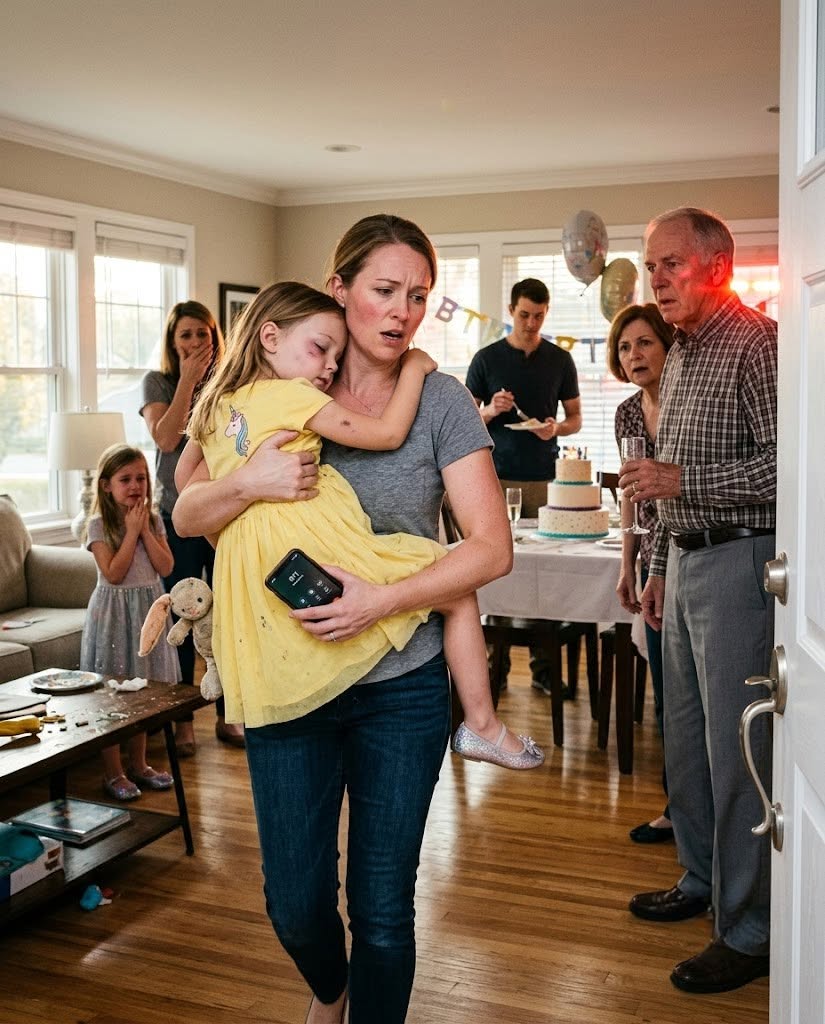
Ice shifted in glasses. Someone laughed too loudly near the kitchen island. Then the atmosphere changed. It was not silence at first. It was the absence of ordinary sound, as if several people had stopped moving at the same time. The photographer lowered his camera. David stopped cutting. Karen stared at a ribbon curling from one of the balloons. Nobody asked why Patricia and Robert had disappeared upstairs. Nobody looked toward the staircase. That was when Robert’s voice carried through the hallway. “Finally she’ll look as worthless as she is.” A champagne flute touched another flute. Patricia laughed. The sound was small. It was almost cheerful. For one second, my body refused to understand what my ears had heard. My hand locked around the edge of the counter. A glass pitcher stood within reach. I imagined grabbing it. I imagined throwing it into the wall beside them. I imagined the whole perfect room finally reacting to something. But rage would have given them a different story. They would have said I arrived angry. They would have said I broke things. They would have said Lily was frightened because of me. My daughter needed the truth, not a spectacle they could rearrange. Madison stopped smiling. David did not move. Karen kept staring at the ribbon. No one ran. So I did. The stairs were polished hard enough to shine. My palm burned along the banister as I took them too fast. One shoe slipped. My shoulder struck the wall. The guest room door was closed. I had left it open. I pushed inside. Lily lay too still on the pillow. Her stuffed rabbit was trapped beneath one limp arm. The glitter barrette had loosened and twisted into her hair. One side of her face was swollen. A dark red stain marked the white pillowcase where her cheek had rested. The room felt colder than before. I touched her shoulder with two fingers. “Lily.” She did not answer. “Baby, wake up.” Her breath was faint, but it was there. I pulled out my phone. The screen shook because my hand shook. I missed the 9 the first time. The 911 operator asked for the address. She asked Lily’s age. She asked whether Lily was breathing, whether I could see an injury, and whether the people who might have hurt her were still in the house. “Six,” I kept saying. “She’s six. Please. She’s six.” The operator’s voice stayed level. She told me help was on the way. She told me not to move Lily unless I believed she remained in immediate danger. The call timer climbed past 4:12. Then I heard Patricia’s shoes in the hallway. She was not running. She was approaching at the same measured pace she used when walking toward a restaurant manager. The knob turned. “What are you doing?” she asked. Her voice carried irritation, not fear. I stepped between her and the bed. “Do not touch her.” Patricia looked past me at Lily’s face. Then she looked back at me. “She must have fallen.” “While she was asleep?” “Don’t be dramatic.” Robert appeared behind her. He was still holding his champagne flute. “Put the phone away before you embarrass this family.” That sentence ended something in me. There are moments when a family bond stops being a bond and becomes evidence. I raised the phone closer to my mouth. “She is breathing,” I told the operator. “Both of them are outside the room now. They are telling me to hang up.” Robert’s expression changed. Only slightly. But for the first time that day, he understood there was another adult listening. I slid one arm beneath Lily’s shoulders and the other beneath her knees. The operator reminded me to support her carefully. Her head rested against my chest. Her rabbit dangled from her arm, one worn ear brushing my wrist. When I carried her downstairs, the party had not moved. The cake still glittered beneath the chandelier. The balloons still bobbed. A ribbon curled toward the floor. David stood with a fork suspended over his plate. Karen covered her mouth. Madison had backed against the wall. The photographer’s hands hung at his sides. Nobody looked at Patricia or Robert. Nobody looked at me. They looked at the child they had all chosen not to protect. “They did this,” I said. “They hurt her while she was sleeping.” Robert straightened his shoulders. “That’s absurd.” Patricia sighed as if I had made a mess she expected someone else to clean. The 911 operator asked whether I could hear sirens. Not yet. I adjusted Lily’s weight and looked around the room. Every adult there had heard the glasses clink. Every adult had heard Robert’s sentence. Every adult had accepted silence as the safest side to choose. “You could have told me not to bring her,” I said. “She is a child. I would have kept her home.” Patricia’s mouth curved into a small, satisfied smile. “What fun would that be?” She looked at the people gathered around Madison’s cake. “I wanted the whole family to know only my real grandchild matters.” The room froze. David’s fork slipped and struck his plate. Karen stared at the floor. The photographer placed his camera on the counter with deliberate care. Birthday candles kept burning while wax ran into the frosting. Nobody moved. Then the sirens reached the driveway. Red and white light swept across the front windows, over the gold banner, and across Robert’s face. His confidence drained before the first knock. Patricia’s smile disappeared before the second. The front door opened. Two paramedics entered first, followed by two police officers. Robert stepped forward as if he intended to manage the room. One officer put up a hand. “Stay where you are.” A paramedic asked me to lower Lily onto the living room rug so they could examine her. My arms did not want to release her. For a few seconds, holding her felt like the only thing keeping her connected to me. Then the paramedic said, gently, “Mom, we need space to help her.” I knelt. I laid Lily down. Her stuffed rabbit slipped beside her with one ear folded underneath. The second paramedic checked her breathing and spoke her name. Patricia began talking. “This is a misunderstanding.” No one answered. “She fell upstairs.” The older officer looked toward the staircase. Then he looked at the swelling on Lily’s face. “Nobody leaves this room.” Robert set his champagne flute on the nearest table. He did it too carefully. The base clicked once against the wood because his hand was shaking. The 911 call timer read 6:03 when the photographer reached for his camera. He did not raise it. He turned the screen toward the officer. “I switched to video before the cake,” he said. “I forgot to stop it when they went upstairs.” Patricia’s face emptied. David sat hard in the nearest chair. Karen covered her mouth with both hands. Madison began crying against the wall, whispering Lily’s name. The officer took the camera. A red playback bar moved across the screen. The kitchen filled with a muffled recording of itself. There was the scrape of a chair. The sound of footsteps crossing the hallway. The guest-room door closing. Then Robert’s voice, farther from the camera but still recognizable. A smaller sound followed. Lily’s voice. “Grandma, stop.” The paramedic beside her looked up. On the recording, there was a dull thud. Then Patricia said, very clearly, “Now take the picture before she wakes up.” Robert moved toward the officer. “Turn that off.” The officer did not. He listened until the recording reached the champagne toast downstairs. “Finally she’ll look as worthless as she is.” The glasses clinked. Patricia laughed. The sound filled the room a second time. It was uglier on playback because nobody could pretend they had misunderstood it. The officer paused the video. “Do you still want to say she fell?” Patricia opened her mouth. Nothing came out. Robert tried a different defense. He said families handle private matters privately. He said the recording lacked context. He said I had always been unstable. He said Lily was difficult. Each sentence made the officers’ expressions colder. The paramedics lifted Lily onto a stretcher. As they raised the rails, her eyelids moved. I bent close. “Mom?” she whispered. That one word nearly took my knees out. “I’m here.” Her fingers searched weakly until they found mine. I walked beside the stretcher through the front door. Outside, the lawn looked exactly as it had an hour earlier. The stripes were straight. The flower beds were neat. The balloons inside still glowed through the windows. But the sirens had made the house honest. Neighbors stood at the edges of their driveways. No one needed Patricia’s explanation. No one needed Robert’s version. The perfect front lawn was full of emergency lights, and the child they had tried to crop out was now the only person anyone cared about. At the hospital, Lily was kept for observation while doctors treated the swelling and checked her carefully. I sat beside her bed with the stuffed rabbit in my lap. The glitter barrette rested inside a clear belongings bag on the counter. It looked impossibly small. A nurse brought me water. I could not remember drinking it. A police officer took my statement in the hallway. I gave him the timeline as precisely as I could. We arrived shortly before the party photographs began. I carried Lily upstairs after she became sleepy. I left the door open. About twenty minutes later, I heard Robert’s sentence and the champagne glasses. The 911 call began seconds after I found her. The officer wrote down the times. He asked about earlier incidents. I told him there had been insults, favoritism, and years of humiliation, but nothing that prepared me for that room. David and Karen gave separate statements. The photographer provided the original video file. The 911 recording preserved Patricia and Robert telling me to hang up. The physical room preserved the rest. The closed door. The pillowcase. The champagne flute. The birthday photographs that showed Lily awake and uninjured earlier. Forensic truth rarely arrives as one dramatic object. It builds through ordinary things people assumed would never be compared. Patricia had always believed appearances protected her. That night, appearances became a timeline. Robert had always believed authority belonged to whoever spoke with the most confidence. That night, his own voice became evidence. I did not return to the house. I did not answer Patricia’s calls. I did not read the messages Robert sent through relatives asking me to consider what an investigation would do to the family. They had already decided what the family could survive. They had decided it could survive a six-year-old being hurt, but not the adults who hurt her being exposed. That was not family loyalty. It was organized cowardice. Lily came home with me after the doctors cleared her. For several nights, she would not sleep unless the bedroom door stayed open and the hallway light remained on. I sat on the floor beside her bed until her breathing settled. Sometimes she woke and touched her cheek. Sometimes she asked why Grandma was angry. I never told her she had caused it. I never said Patricia was having a bad day. I never asked Lily to forgive anyone so the adults could feel comfortable. I told her the truth in words a six-year-old could carry. “What happened was wrong.” “You did nothing to deserve it.” “I called for help because protecting you is my job.” The yellow unicorn dress stayed folded in a bag for weeks. Eventually Lily asked for it. I expected her to throw it away. Instead, she put it on, stood in front of our hallway mirror, and smoothed the skirt with both hands. “Do I still look like me?” she asked. I knelt beside her. “Exactly like you.” She studied her reflection. Then she clipped a new glitter barrette into her hair. It was not a grand recovery. There was no speech. There was a child deciding that something cruel adults had done would not be allowed to rename her. Madison sent Lily a card through David. Inside was a drawing of two girls holding hands beneath a crooked rainbow. No adult had told Madison what to write. The message said, “You are my real family too.” I cried over that card in the kitchen after Lily went to bed. Not because it fixed anything. It did not. But because one child had understood what the adults at that party refused to understand. Family is not a ranking decided by the person holding the camera. It is not a place at the center of a photograph. It is the person who moves when someone small is in danger. My own parents hurt my sleeping six-year-old and raised champagne glasses afterward. They laughed because they believed shame belonged to Lily and silence belonged to me. They were wrong. I did not argue with them. I called 911. And when the sirens filled their perfect front lawn, every person in that house finally had to look at the child they had chosen not to protect. The photograph Patricia wanted was never taken. The truth was.