My son told me not to undress my two-month-old grandson.
“Keep that onesie shut,” Thomas said, his voice low enough that Ellie could pretend not to hear it. “Or you’re done seeing him.”
I did not shout.
I did not argue in his perfect apartment with the lemon-clean counters and the pillows sitting at angles so precise they looked measured.
I just looked at the baby in my arms and felt something old inside me go still.
Thomas had always been the child who cleaned up before anyone arrived.
When he was ten, his room looked like a picture in a catalog, even though other boys his age had socks under the bed and toys underfoot.
His school papers were stacked by subject.
His blanket was pulled tight enough that his father used to joke a quarter could bounce off it.
Back then, I thought it was discipline.
I thought it was pride.
By the time Thomas was thirty-four, that habit had hardened into something colder.
His apartment outside Columbus looked less like a home with a newborn and more like a room staged for a showing.
The counters shined.
The throw pillows sat untouched.
There were no burp cloths draped over chair backs, no half-finished bottles on side tables, no evidence that a new baby had turned two adults inside out from lack of sleep.
The air smelled like lemon cleaner and baby lotion.
Under it was something sharper, something chemical and nervous, the way a room smells when somebody has scrubbed too hard and still feels exposed.
Ellie stood near the kitchen island with her purse already on her shoulder.
She was pale in a way I had noticed before and ignored because families teach women to ignore things all the time.
She smiled at me, but it did not touch her eyes.
“We’ll only be gone about an hour,” she said.
Thomas held Mason against his chest.
His palm covered almost the whole back of the baby’s onesie.
Mason was two months old.
He was still at that age where his body felt like a promise you were afraid to hold wrong.
His head fit perfectly in the bend of my elbow.
His feet barely made lumps under the blanket.
Every breath seemed like something you should thank God for out loud.
Thomas lowered him into my arms with exaggerated care.
Too careful.
Too slow.
His fingers lingered near the snaps by Mason’s stomach.
Then he leaned close.
“Don’t take his onesie off,” he said.
I gave a small laugh because that was what grandmothers do when grown children act as if they invented babies.
“Thomas, I know how to change a diaper.”
He did not smile.
He did not look at Mason.
He looked at the row of snaps, then away.
“He just got out of the bath,” he said. “Keep it shut.”
Then his voice dropped again.
“Or you’re done seeing him.”
That should have been the moment.
I know that now.
But mothers carry history in their bones, and sometimes history makes you hesitate.
I remembered Thomas at five, standing in the driveway with his lunchbox, crying because the neighbor’s dog had scared him.
I remembered him at twelve, asleep on the couch with a fever while I wiped his forehead with a wet washcloth.
I remembered him at seventeen, angry and proud and too big to hug in public.
That is the cruelty of loving a difficult child.
You keep meeting the little boy behind the grown man’s eyes long after the grown man has learned how to frighten people.
The apartment door closed behind Thomas and Ellie at 6:18 p.m.
At 6:22, Mason began to cry.
Not fuss.
Cry.
It was a hard, sharp sound that did not belong in that spotless living room.
I warmed a bottle in the kitchen while the faucet ran too loud and the microwave clock glowed green.
Mason would not take it.
He turned his face away and screamed harder.
I checked his diaper from the outside as best I could without opening the onesie.
Dry.
I checked his temperature with the back of my fingers against his cheek.
Warm from crying, not fever-hot.
I rocked him in the blue chair beside the window.
The blinds made pale lines across the carpet.
Cars moved through the apartment complex parking lot below, headlights sliding over bumpers and mailboxes like nothing urgent was happening anywhere.
I hummed the song I used to sing to Thomas when he had colic.
Back then, I had walked the kitchen at two in the morning with him pressed against my shoulder, whispering nonsense because I had no wisdom yet, only love and exhaustion.
Mason’s back stayed rigid.
His fists were clenched so tight the tiny knuckles looked white.
His legs pulled in and pushed out.
His cry climbed until it thinned into something ragged.
That was when fear entered the room.
Not worry.
Fear.
There is a difference.
Worry lets you make lists.
Fear makes the list disappear.
I shifted him against me and my hand brushed his stomach through the cotton.
I felt something under the fabric.
At first, I told myself it was a diaper fold.
Then I touched it again.
It was not a fold.
It was not a bunched undershirt.
It felt thick and swollen beneath the soft cotton.
Thomas’s warning came back so clearly I could hear the air around his words.
Keep that onesie shut.
Some people confess by accident.
They think they are giving a command.
What they really give you is a map.
I laid Mason on the couch with a receiving blanket beneath him.
The apartment was so clean that the couch still had vacuum lines on it.
My fingers shook as I opened the first snap.
Then the second.
Mason’s crying changed.
I had raised three children and held more babies than I could count in church nurseries, family kitchens, school fundraisers, and hospital waiting rooms.
I knew hungry cries.
I knew gas cries.
I knew overtired cries, scared cries, angry cries.
This was different.
This was pain.
I pulled the fabric open only far enough to see his stomach.
For one second, my mind refused to make sense of what my eyes were seeing.
Then the room tilted.
Purple and black shadowed the soft skin of his belly.
Inside the dark swelling were four deeper marks.
They were too evenly spaced.
Too clear.
Too much like fingers.
No bath did that.
No blanket did that.
No grandmother’s imagination did that.
I stopped breathing for a moment.
Then I did the only thing I still thank myself for every morning.
I did not call Thomas first.
I took out my phone and photographed the open snaps.
I photographed the time on the screen.
I photographed the blanket and the way the onesie lay open without moving Mason more than necessary.
At 6:31 p.m., I wrapped him in the softest blanket from the diaper bag, grabbed my purse, and walked out.
The hallway smelled like carpet cleaner and somebody’s dinner.
My shoes sounded too loud on the stairs.
For one second, I looked back at Thomas’s apartment door.
It was closed, smooth, and ordinary.
That made it worse.
The drive to St. Vincent’s Pediatric Emergency Department felt endless.
Every red light was cruel.
Every car in front of me seemed to move as if the world had no idea a baby was losing strength in my back seat.
I kept one hand on the wheel.
Whenever traffic stopped, I reached back with the other hand and touched the blanket.
“Stay with me, sweetheart,” I whispered.
My voice sounded like someone else’s.
“Grandma’s here.”
Mason’s cries grew weaker before I reached the hospital.
That scared me more than the screaming had.
Screaming meant his little body still had fight in it.
Quiet meant he was getting tired.
I pulled under the emergency entrance and carried him in so fast my purse slipped down my arm.
A woman in the waiting area looked up from a paper coffee cup.
A man near the vending machines paused with his hand in his pocket.
The triage nurse looked up with the trained smile hospital workers use before they know what kind of day is walking toward them.
“What seems to be the problem today?”
I opened my mouth.
Nothing came out.
So I pulled back the blanket.
Her smile disappeared.
It did not fade.
It stopped.
The whole desk changed around us.
Another nurse came from behind the glass.
The first nurse leaned closer, and when she lifted her eyes to mine, I saw recognition there.
Not panic.
Recognition.
She had seen something like this before.
“Who brought him in?” she asked carefully.
“I did.”
“Are you his parent?”
“Grandmother.”
“Where are his parents?”
“I don’t know. They left him with me.”
She slid a clipboard toward me but kept her body angled between Mason and the room.
“I need his full name.”
“Mason Reed,” I said, though in that moment my own last name nearly vanished from my mind.
“Date of birth?”
I gave it to her.
She wrote 6:47 p.m. in the corner of the intake form.
That detail has never left me.
There are moments in your life when a number becomes a nail in the wall.
Everything else hangs from it.
The second nurse picked up the desk phone.
Her voice was low, but I heard pieces.
Pediatric room.
Security.
Non-accidental marks.
Document everything.
The first nurse looked at me again.
“Did you remove his clothing?”
“Only the snaps,” I said. “I saw swelling. I didn’t know what else to do.”
“You did the right thing.”
I nearly collapsed when she said it.
Not because it fixed anything.
Because until that sentence, I had been fighting the voice in my head that sounded like Thomas.
Dramatic.
Overreacting.
You always make things worse.
My cell phone started vibrating in my palm.
Thomas.
His name lit up the screen like an accusation.
The nurse saw it.
“Do not answer that in the waiting room,” she said.
Her hand moved toward the security phone mounted near the desk.
The phone stopped vibrating.
Then it started again.
Thomas.
Again.
Mason made a small broken sound on the counter, and the nurse’s face tightened.
“Save everything,” she said. “Calls, texts, voicemail. Don’t delete anything.”
I nodded because I could not speak.
The nurse guided us through a side door before Thomas’s third call came in.
The pediatric room was too bright, too white, too clean in a different way from Thomas’s apartment.
This clean did not feel like hiding.
It felt like people were about to fight for my grandson with gloves on and paperwork ready.
A doctor came in.
Then another nurse.
A hospital security guard stood outside the partially open door.
They asked me questions gently but precisely.
When did I arrive at the apartment?
Who handed me the baby?
What exactly did Thomas say?
Did Ellie say anything?
Had Mason cried immediately?
Had I fed him?
Had I dropped him?
The last question hit me in the chest even though I knew they had to ask it.
“No,” I said.
My voice shook.
“I have never dropped that baby.”
The doctor nodded as if my hurt did not offend him.
He had the calm of someone who knew the truth was not always found in one answer, but in the way all the answers lined up.
They examined Mason.
They took photographs under hospital protocol.
They logged the time.
They placed a tiny hospital band around his wrist.
The band looked too big for him.
That is one of the details that broke me later.
Not the medical words.
Not the forms.
The wristband.
A baby should not have to wear proof.
Thomas left a voicemail at 7:03 p.m.
The nurse asked me to play it on speaker.
I pressed the button with my thumb shaking so badly I hit the wrong part of the screen twice.
Thomas’s voice filled the small room.
“Mom, where are you?”
There was a pause.
Then his tone changed.
“Do not tell me you took him somewhere. I told you not to touch that onesie. You had one job. One. Call me back before you make this worse.”
The nurse looked at the doctor.
The doctor looked at the security guard.
Nobody said anything for a second.
That silence was not empty.
It was collecting weight.
Then Ellie appeared in the doorway.
She was alone.
Her purse strap had fallen down her arm.
Her hair was coming loose from its clip.
She looked younger than she was, or maybe just more tired than I had let myself see.
The moment she saw Mason on the exam bed with his onesie open, her face changed.
All the color drained from it.
The nurse stepped toward her like she might faint.
Ellie gripped the doorframe.
“Please,” she whispered. “Tell me you saw it too.”
No one moved.
The doctor asked, “Mrs. Reed, what do you mean by too?”
Ellie covered her mouth.
Her eyes went to me, and for the first time since I had known her, she looked at me without the careful smile.
“I thought I was crazy,” she said.
That sentence did more damage to me than anger would have.
Because I heard the history in it.
I heard weeks of being corrected.
Weeks of being told she was hormonal, tired, anxious, not careful enough, not grateful enough.
Weeks of a woman being trained not to trust her own eyes.
The doctor pulled a chair near her.
“Sit down,” he said gently.
Ellie did.
Then she started talking.
Not all at once.
Not cleanly.
Her words came in pieces.
Mason had cried after Thomas changed him.
Thomas got angry when she checked too often.
Thomas said she was making the baby weak by picking him up every time he fussed.
Thomas said babies learned manipulation early.
Thomas said his mother had spoiled him and he would not let Ellie do the same to Mason.
I felt something inside me break open and burn.
For one ugly moment, I wanted to defend the boy Thomas had been.
Then Mason whimpered on the bed.
The baby decided for me.
The doctor asked Ellie whether she felt safe going home.
She did not answer.
That was answer enough.
Hospital security moved Thomas’s calls to the record.
A social worker arrived with a folder and a soft voice.
She introduced herself by first name and title, then asked Ellie if Thomas knew she had come to the hospital.
Ellie shook her head.
“He thinks I’m still at the store,” she said.
At 7:26 p.m., Thomas walked through the emergency doors.
I did not see him come in, but I heard the change outside the room.
Voices lowered.
A security guard said, “Sir, I need you to stop right there.”
Thomas’s voice came sharp and familiar.
“That’s my son.”
The nurse closed the door most of the way.
Ellie flinched.
I saw it.
So did everyone else.
That small movement did what no speech could have done.
It told the room exactly who had been living in fear.
Thomas demanded to see Mason.
He demanded to see Ellie.
He demanded to know what I had said.
The security guard kept his voice even.
The social worker stepped into the hall.
The doctor stayed beside Mason.
I sat in a chair with my purse clutched in both hands and realized my son had become someone I would not leave alone with a child.
There are truths a mother should never have to say.
There are also truths a grandmother must say anyway.
When the social worker asked me to repeat Thomas’s warning, I did.
Word for word.
“Keep that onesie shut, or you’re done seeing him.”
My voice did not break.
I thought it would.
It did not.
Ellie began crying then.
Not loudly.
Just a quiet collapse, shoulders folding inward, one hand pressed against her mouth.
“I should have brought him sooner,” she said.
The doctor turned to her.
“You are here now.”
It was not forgiveness.
It was a handhold.
Sometimes that is the first thing a person needs before she can climb out.
The next hours became a blur of forms, photographs, phone calls, and careful voices.
A police report was opened.
The hospital documented Mason’s injuries.
Child protective services were contacted through the proper channel.
Ellie gave a statement.
I gave a statement.
Thomas gave three different versions in less than twenty minutes.
First, he said Mason had rolled against the side of the crib.
Then he said Ellie must have held him wrong.
Then he said I had panicked and caused the marks by opening the onesie.
That last version made the nurse look at him in a way I will never forget.
Cold.
Professional.
Finished.
The body tells the truth even when a person lies for it.
By 10:14 p.m., Thomas was no longer allowed into the pediatric treatment area.
By midnight, Ellie had agreed not to return to the apartment alone.
I drove her to my house after Mason was admitted for observation.
She sat in the passenger seat with both hands around a hospital folder, staring out the windshield as the city lights passed over her face.
Neither of us said much.
Words would have made the night too small.
At my house, I made tea neither of us drank.
Ellie sat at my kitchen table under the small American flag magnet Mason’s older cousin had stuck to my refrigerator after a school project.
She looked at it for a long time.
Then she said, “I thought if I was calmer, he would be calmer.”
I sat across from her.
“So did I,” I said.
That was the hardest thing I admitted that night.
Not to the hospital.
Not to the police.
To her.
I had made excuses for Thomas because he was mine.
I had called his control neatness.
I had called his temper stress.
I had called Ellie’s fear new-mom nerves because the alternative would have forced me to look directly at my own son.
But Mason was two months old.
He did not owe any of us time to become brave.
The next morning, I went back to the hospital before sunrise.
Mason was sleeping in a tiny crib with wires taped gently where they needed to be and a nurse checking him every few minutes.
His face looked peaceful for the first time since I had held him in that apartment.
Ellie stood beside him.
She had not slept.
Neither had I.
When she saw me, she stepped aside so I could put my hand near his foot.
Not on the injury.
Not near the wires.
Just close enough to feel the warmth of him.
“Grandma’s here,” I whispered.
This time, my voice did not shake.
In the weeks that followed, the apartment stopped being a place anyone pretended was normal.
Statements became reports.
Photos became evidence.
Voicemails became part of a file.
Thomas’s warning became more than a sentence I could not stop hearing.
It became the thing that proved he knew exactly where not to let me look.
There were court dates later.
There were supervised conversations, protective orders, and hard family phone calls with people who wanted a softer version because the real one made them uncomfortable.
Some relatives asked whether I was sure.
Some asked whether Thomas had been under stress.
Some asked whether I understood what this would do to his life.
I learned to answer with one sentence.
“Mason is two months old.”
That usually ended the conversation.
And if it did not, I ended it myself.
Ellie moved into a small place of her own months later.
It had mismatched furniture, laundry on the couch, bottles in the sink, and a stroller by the door.
In other words, it looked like life.
Mason grew.
Slowly at first.
Carefully.
He became a baby who reached for faces again.
He became a toddler who laughed with his whole body when someone pretended to sneeze.
He became a little boy who ran down my driveway with untied sneakers and a juice stain on his shirt, yelling, “Grandma, look!”
I look every time.
I will look every time for the rest of my life.
People sometimes ask how I knew that night.
I tell them I did not know everything.
I knew enough.
I knew a warning should not sound like a threat.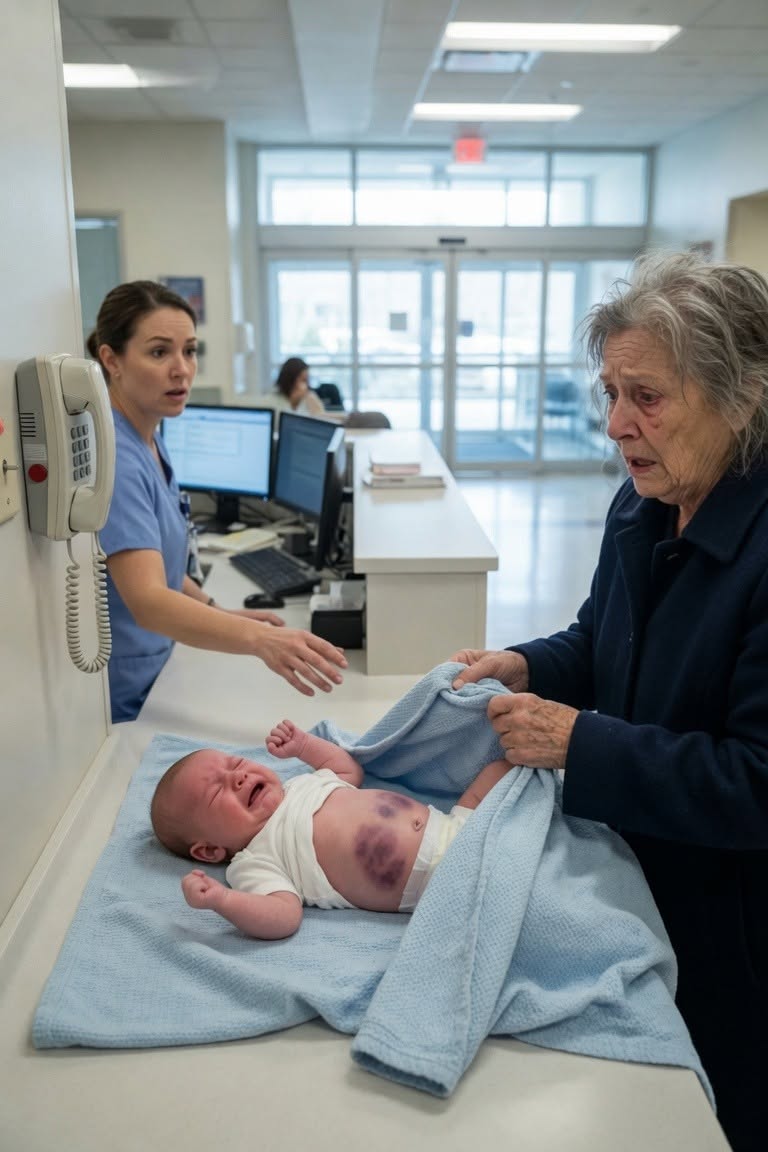 I knew a baby should not scream when fabric moved over his stomach.
I knew no bath leaves finger-shaped bruises.
And I knew that love without proof can get buried, so I took the pictures, saved the voicemail, gave the statement, and let the record show what my heart could barely survive.
The truth is, I did not save Mason because I was fearless.
I saved him because I was scared enough to stop obeying the wrong person.
That is the part I still carry.
The moment my cell lit up with Thomas’s name and the nurse reached for security, I understood something I should have understood sooner.
The warning I had ignored was not just a warning.
It was a confession.
And the baby in my arms was the only truth that mattered.
I knew a baby should not scream when fabric moved over his stomach.
I knew no bath leaves finger-shaped bruises.
And I knew that love without proof can get buried, so I took the pictures, saved the voicemail, gave the statement, and let the record show what my heart could barely survive.
The truth is, I did not save Mason because I was fearless.
I saved him because I was scared enough to stop obeying the wrong person.
That is the part I still carry.
The moment my cell lit up with Thomas’s name and the nurse reached for security, I understood something I should have understood sooner.
The warning I had ignored was not just a warning.
It was a confession.
And the baby in my arms was the only truth that mattered.