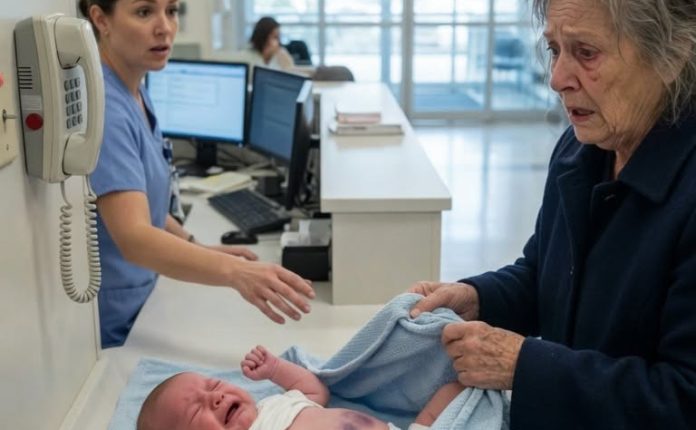
The daycare locked my toddler in a dark laundry room and told me she had slept all afternoon.
One motion alert from her bracelet exposed what happened during the missing three hours.
The first thing I noticed that afternoon was the smell.
Bleach hung in the front hallway, mixed with warm dryer lint and the sour edge of milk from a forgotten plastic cup.
The second thing I noticed was how quiet the building felt.
Pickup at Emma’s daycare was normally loud enough to make conversation difficult.
Children dragged backpacks across the floor.
Cubbies slammed.
Teachers called out reminders about jackets, water bottles, and tomorrow’s show-and-tell.
That afternoon, the front room seemed to be holding its breath.
Megan, the director, stepped away from the sign-in tablet before I had even finished entering my code.
“She had a wonderful nap,” she said.
Her voice was too bright.
“Almost three hours. She must have been exhausted.”
My daughter was two years old, and Emma had never slept for three hours at daycare.
At home, she fought naps like they were personal insults.
At daycare, according to the daily reports, she usually slept forty minutes, maybe an hour on a rare day.
I looked through the half-open classroom door.
The nap mats were already stacked against the wall.
A paper cup of crackers sat untouched on the child-sized table.
Emma’s pink sweater hung from her cubby hook, one sleeve turned inside out.
But Emma was not in the room.
“Where is she?”
Megan gave me a small professional smile.
“One of the teachers is bringing her out.”
I had heard that sentence before.
Usually it meant Emma was washing her hands or putting away a toy.
That day, the words landed differently.
There was a delay behind them.
A calculation.
My phone buzzed inside my coat pocket.
I almost left it there.
The bracelet Emma wore was not a medical device, and I had never treated it like one.
My sister had given it to her because Emma loved numbers and had become fascinated with counting steps.
The band was soft, child-safe, and simple.
It recorded movement, rest periods, and basic activity patterns.
Most alerts were harmless.
A cheerful badge for reaching a movement goal.
A reminder that the battery was low.
A notice that the band had not synced.
This alert filled the screen in plain black letters.
UNUSUAL MOTION DETECTED — 3:47 P.M.
A second line appeared underneath.
LOW MOVEMENT PERIOD ENDED AFTER 2 HOURS, 51 MINUTES.
I opened the graph.
From 12:56 p.m. until 3:47 p.m., the line was nearly flat.
Not completely flat.
There were tiny movements spaced far apart.
Then came a sudden cluster of sharp, repeated spikes.
Move.
Stop.
Move.
Stop.
Move again.
The pattern did not look like a child waking naturally from a nap.
It looked like someone trying to make noise.
My thumb went cold against the screen.
I turned the phone toward Megan.
“What room was she sleeping in?”
Her expression changed for less than a second.
Her eyes flicked toward the back hall.
Then the smile returned.
“She was with the other toddlers.”
“No,” I said. “The bracelet says she barely moved for almost three hours. Now it says she’s moving hard. Where is my daughter?”
A teacher wearing a gray daycare T-shirt stepped into the hallway.
She saw the phone in my hand.
She stopped.
Megan lowered her voice.
“Sarah, you’re upsetting everyone.”
There were four children left in the front room.
One little boy had been pushing a wooden truck along the baseboard.
He stopped with his hand still on the roof.
Another teacher held a stack of construction paper against her chest.
Her fingers tightened until the corners folded.
The wall clock above the sign-in tablet kept ticking.
A cartoon song played softly from a speaker near the cubbies.
No one spoke.
Then I heard a dull little thump from behind the employee-only door near the back hall.
It was not loud.
It was not even clearly a cry for help.
But I knew it.
Emma made the same sound at home when she was scared and trying not to call too loudly.
She would tap the wall with the heel of her hand.
Then she would wait.
Then she would tap again.
Thump.
Pause.
Thump.
I started toward the back hall.
Megan stepped in front of me.
“You can’t go back there.”
For one ugly heartbeat, I imagined shoving her into the cubbies.
I imagined tearing open every door until I found Emma.
My hands were already shaking, and anger kept pushing against the inside of my ribs.
But anger was not evidence.
Anger could be used against me.
So I lifted the phone and showed Megan the motion graph again.
“Move.”
She did not.
The teacher in gray whispered her name.
“Megan…”
That was when I saw the toe of a tiny pink sneaker beneath the employee-only door.
Just an inch of rubber and fabric.
Barely visible in the gap.
I had tied that sneaker myself that morning while Emma sat on the kitchen counter eating half a banana.
I pushed past Megan.
The hallway beyond the door was narrower than the front area.
The fluorescent lights hummed overhead.
A rolling cart stacked with folded towels stood against one wall.
The air grew warmer as I ran.
Behind me, Megan kept repeating my name.
She said it as if I were creating the emergency.
My phone buzzed again.
3:49 P.M. — RAPID MOVEMENT.
At the end of the hall were two doors.
One led to the staff restroom.
The other had a handwritten label taped above the handle.
LAUNDRY.
I grabbed the knob.
It would not turn.
Locked.
I hit the door with my palm.
“Emma? Baby, it’s Mommy.”
The motion stopped.
Everything on the other side went silent.
Then I heard a small scrape across the floor.
A breath.
And my daughter’s voice came through the door.
“Mommy… dark.”
That sentence changed the temperature of the hallway.
Megan arrived behind me carrying a ring of keys.
The gray-shirted teacher stood a few feet back.
Her face had gone pale.
I turned to Megan.
“Open it.”
She started with an explanation.
“The latch sticks sometimes.”
“Open it.”
“She may have wandered in.”
“Open the door.”
Her fingers fumbled through the keys.
The metal pieces clicked against one another.
Then the front entrance opened in the lobby.
A man’s voice called my name.
It was Michael, Emma’s father.
I had called him while running down the hallway, not because I needed permission and not because I could not handle Megan alone.
I called him because I wanted another witness.
He crossed the hallway in three strides.
When he saw the locked laundry-room door, his face changed.
“What is our daughter doing in there?”
Megan’s confidence disappeared.
The key trembled between her fingers.
I raised one hand before Michael could touch the handle.
“Record everything.”
It was the only sentence I trusted myself to say.
Michael pulled out his phone and started recording.
He stated the time.
He filmed the locked door.
He filmed Megan holding the keys.
He filmed the activity graph on my phone showing the nearly three-hour period of almost no movement followed by the sudden bursts.
Proof is rarely one dramatic object.
Most of the time, it is a collection of small things that refuse to agree with the lie.
Megan unlocked the door.
It opened six inches and stopped.
Something behind it scraped across the floor.
Michael moved closer with the phone.
I pushed the door carefully until the gap widened.
Emma was sitting between a rolling hamper and the dryer.
Her knees were tucked under the hem of her pink shirt.
One sock was missing.
Her cheeks were wet, and damp curls clung to her forehead.
The activity bracelet flashed on her wrist as she lifted her hand and tapped the metal vent beside her.
She had been making the motion alert herself.
The room had no window.
The overhead light was off.
Warm air from the dryer pressed against my face.
The space smelled of detergent, hot metal, and the plastic cup of milk lying on its side near the washer.
A folded nap sheet rested on top of a storage bin.
Emma’s name was written across it.
I picked her up.
She wrapped both arms around my neck and held on so tightly I could feel her fingers trembling through my coat.
Megan began talking quickly.
“She wandered in.”
No one answered.
“We thought she was asleep.”
Michael kept the camera steady.
“The latch must have caught.”
The gray-shirted teacher looked down at the floor.
Emma pressed her face against my shoulder.
I rubbed the back of her shirt and asked the simplest question I could manage.
“Baby, how did you get in here?”
She lifted her head.
Her voice was hoarse from crying.
“Megan put me here.”
The hallway went silent.
Megan’s mouth opened.
Nothing came out.
Emma pointed toward the director with one small finger.
“I cried.”
I felt Michael’s free hand close around the back of a chair.
He did not speak.
Neither did I.
A parent learns very quickly that rage can feel protective while still making a child less safe.
So I held Emma.
I listened.
I let the phone record.
On the wall beside the dryer was a clipboard.
The afternoon room-check sheet listed the times staff were supposed to verify every child’s location.
There were three empty boxes.
Under them were three signatures written in the same dark ink.
The strokes were identical.
The ink looked fresh.
Michael moved his camera closer.
Megan reached for the clipboard.
I took it first.
“You can’t remove daycare records,” she said.
“I’m not removing it,” I replied. “He’s recording it.”
The teacher in gray finally looked at us.
Her eyes were wet.
“She didn’t wander in.”
Megan snapped her head toward her.
“Stop.”
The teacher’s hands tightened around the construction paper she had carried from the classroom.
The paper bent down the middle.
“She was crying during nap,” the teacher said. “Megan said Emma was keeping the others awake.”
Megan took one step forward.
“That is not what happened.”
The teacher backed away.
“She put her in the laundry room and said it would be for five minutes.”
Michael asked the teacher to repeat the statement.
She did.
He asked what time it happened.
“Just before one.”
The activity graph began its low-movement period at 12:56 p.m.
That was the second piece of proof.
The teacher said she had asked twice whether Emma had been brought back.
Megan had told her to focus on the other children.
At 2:15, the teacher checked the hallway.
The laundry door was still closed.
At 3:10, Megan told her Emma was asleep and not to wake her.
At 3:40, the teacher heard tapping but thought it was the dryer.
Then I arrived.
The daycare’s digital sign-in tablet showed my pickup code at 3:45 p.m.
My bracelet alert arrived at 3:47.
Michael’s recording began at 3:51.
The wall clock, the tablet, the bracelet, and his phone all told the same story.
Megan’s version did not.
We did not argue with her in the hallway.
That would have given her room to change the details.
Michael photographed the room-check sheet while it remained on the wall.
He recorded the handwritten laundry sign, the locked handle, the tipped cup, the folded nap sheet, and Emma’s missing sock beneath the hamper.
The gray-shirted teacher stated her name and repeated what she had seen.
The other teacher from the front room came closer.
She said she had been told Emma’s parents had approved “separate quiet time.”
We had approved nothing.
That lie was now on video too.
I carried Emma to the front room.
She refused to let go of my neck.
The little boy with the wooden truck watched us pass.
His teacher looked away.
Megan followed, insisting there had been a misunderstanding.
She said the room was safe.
She said no one intended harm.
She said Emma had only been alone because staff were busy.
Every sentence tried to make the problem smaller.
None of them opened the door sooner.
Michael asked for a copy of Emma’s attendance record, the staff schedule, the afternoon room-check sheet, and the written incident report.
Megan said she needed time to prepare them.
He asked her to say that again while recording.
She refused.
So he narrated the refusal himself, along with the time.
Back home, Emma would not enter our laundry room.
She stood in the hallway and pulled her hands into her sleeves.
When the dryer buzzer sounded, she cried.
I turned the machine off and sat with her on the floor.
For dinner, she ate crackers and half a banana.
She kept the bracelet on.
Every few minutes, she checked the light.
That night, she woke twice and called, “Mommy, door.”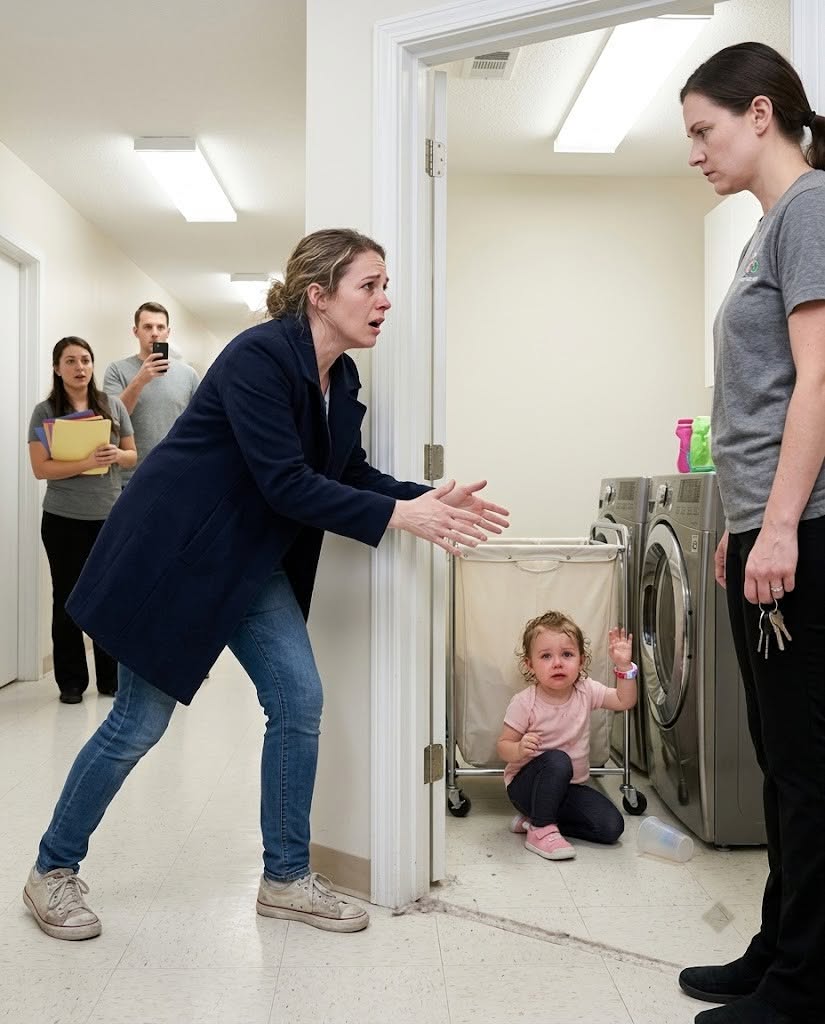 I left the hall light on.
Michael slept on the floor beside her bed.
The next morning, the daycare emailed an incident report.
It described the event as an “unintentional room separation.”
It claimed Emma entered the laundry area without staff noticing.
It said she remained there for “an undetermined short period.”
The report did not mention the locked door.
It did not mention Megan’s keys.
It did not mention the teacher’s statement.
It did not mention the nap sheet in the laundry room.
It did not mention the three missing room checks.
And it did not mention that the bracelet had recorded two hours and fifty-one minutes of near-total inactivity.
We answered with facts.
The motion graph began at 12:56 p.m.
The teacher placed Emma in the room just before one.
The digital pickup log showed I entered at 3:45 p.m.
The motion alert arrived at 3:47.
Michael’s video showed the locked door at 3:51.
The room-check sheet contained three signatures in matching fresh ink.
The incident report called the period “short.”
The timestamps called it nearly three hours.
Megan tried to say the bracelet could not prove location.
She was right about one narrow point.
The bracelet alone could not prove which room Emma had been in.
But the bracelet did not stand alone.
The teacher’s statement placed her there.
The nap sheet carried her name.
The sneaker was under the door.
The missing sock was beneath the hamper.
The locked handle was on video.
Megan held the keys.
The story was not built from one perfect piece of evidence.
It was built from every small fact lining up in the same direction.
Within days, other parents asked to review their own pickup notes and daily reports.
One mother found that her son had been marked asleep on a day she had picked him up early.
Another parent said her daughter had repeatedly called the back hallway “the quiet place.”
No one needed to invent a larger scandal.
The truth we already had was serious enough.
The daycare sent a second letter.
This one admitted that Emma had been placed in the laundry room “as a temporary calming measure.”
The wording was cleaner.
The act was not.
Megan was removed from direct contact with children while the daycare reviewed the incident.
The gray-shirted teacher provided a written statement matching what she had said on Michael’s video.
The afternoon room-check procedure was changed so one person could no longer fill in missed checks after the fact.
Parents were given access to clearer pickup records.
The laundry-room lock was removed.
Those changes mattered.
But they did not erase what Emma remembered.
For weeks, she asked whether doors were locked before entering a room.
She wanted the bathroom light on.
She did not like the sound of the dryer starting.
We did not force her to be brave.
We let her be careful.
We let her watch us open doors.
We let her turn lights on herself.
We praised her every time she told us something felt wrong.
The bracelet stayed on her wrist until the band wore soft at the edges.
Some people asked whether I regretted giving a toddler a device that tracked movement.
I did not.
The bracelet did not save Emma by itself.
It gave me one signal.
The sound behind the door gave me another.
The sneaker gave me another.
The teacher’s face gave me another.
I still had to notice.
I still had to ask.
I still had to refuse the easy explanation.
That afternoon taught me something I wish no parent had to learn.
A lie often arrives polished, reasonable, and smiling.
The truth may arrive as one strange alert on a phone.
Emma is older now.
She does not remember every detail of that room.
She remembers the dark.
She remembers tapping the dryer vent.
She remembers hearing my voice outside the door.
And she remembers the moment the light came in.
For a long time, I thought the most important part of the story was the bracelet.
It was not.
The most important part was that when the alert did not match the explanation, I believed the alert.
When my daughter’s voice did not match the daycare’s story, I believed my daughter.
And when the people in charge asked me to stay calm, I stayed focused instead.
That difference opened the door.
I left the hall light on.
Michael slept on the floor beside her bed.
The next morning, the daycare emailed an incident report.
It described the event as an “unintentional room separation.”
It claimed Emma entered the laundry area without staff noticing.
It said she remained there for “an undetermined short period.”
The report did not mention the locked door.
It did not mention Megan’s keys.
It did not mention the teacher’s statement.
It did not mention the nap sheet in the laundry room.
It did not mention the three missing room checks.
And it did not mention that the bracelet had recorded two hours and fifty-one minutes of near-total inactivity.
We answered with facts.
The motion graph began at 12:56 p.m.
The teacher placed Emma in the room just before one.
The digital pickup log showed I entered at 3:45 p.m.
The motion alert arrived at 3:47.
Michael’s video showed the locked door at 3:51.
The room-check sheet contained three signatures in matching fresh ink.
The incident report called the period “short.”
The timestamps called it nearly three hours.
Megan tried to say the bracelet could not prove location.
She was right about one narrow point.
The bracelet alone could not prove which room Emma had been in.
But the bracelet did not stand alone.
The teacher’s statement placed her there.
The nap sheet carried her name.
The sneaker was under the door.
The missing sock was beneath the hamper.
The locked handle was on video.
Megan held the keys.
The story was not built from one perfect piece of evidence.
It was built from every small fact lining up in the same direction.
Within days, other parents asked to review their own pickup notes and daily reports.
One mother found that her son had been marked asleep on a day she had picked him up early.
Another parent said her daughter had repeatedly called the back hallway “the quiet place.”
No one needed to invent a larger scandal.
The truth we already had was serious enough.
The daycare sent a second letter.
This one admitted that Emma had been placed in the laundry room “as a temporary calming measure.”
The wording was cleaner.
The act was not.
Megan was removed from direct contact with children while the daycare reviewed the incident.
The gray-shirted teacher provided a written statement matching what she had said on Michael’s video.
The afternoon room-check procedure was changed so one person could no longer fill in missed checks after the fact.
Parents were given access to clearer pickup records.
The laundry-room lock was removed.
Those changes mattered.
But they did not erase what Emma remembered.
For weeks, she asked whether doors were locked before entering a room.
She wanted the bathroom light on.
She did not like the sound of the dryer starting.
We did not force her to be brave.
We let her be careful.
We let her watch us open doors.
We let her turn lights on herself.
We praised her every time she told us something felt wrong.
The bracelet stayed on her wrist until the band wore soft at the edges.
Some people asked whether I regretted giving a toddler a device that tracked movement.
I did not.
The bracelet did not save Emma by itself.
It gave me one signal.
The sound behind the door gave me another.
The sneaker gave me another.
The teacher’s face gave me another.
I still had to notice.
I still had to ask.
I still had to refuse the easy explanation.
That afternoon taught me something I wish no parent had to learn.
A lie often arrives polished, reasonable, and smiling.
The truth may arrive as one strange alert on a phone.
Emma is older now.
She does not remember every detail of that room.
She remembers the dark.
She remembers tapping the dryer vent.
She remembers hearing my voice outside the door.
And she remembers the moment the light came in.
For a long time, I thought the most important part of the story was the bracelet.
It was not.
The most important part was that when the alert did not match the explanation, I believed the alert.
When my daughter’s voice did not match the daycare’s story, I believed my daughter.
And when the people in charge asked me to stay calm, I stayed focused instead.
That difference opened the door.