The heat had turned the supermarket parking lot into a sheet of white glare by the time Emily pushed through the automatic doors with two paper grocery bags against her chest.
The smell of hot asphalt rose around her, mixing with spilled soda, rubber, and the faint chemical breath of gasoline from the far end of the lot.
She was seventeen, old enough to know when something felt wrong and still young enough to hope she was imagining it.
Her little brother Noah was seven.
Their mother, Sarah, was working a double shift at a nursing home that day, which meant Michael was supposed to be watching them.
Michael had married Sarah two years earlier.
At first, he seemed careful in all the ways exhausted people mistake for kindness.
He fixed the loose porch rail, remembered which cereal Noah liked, and offered to handle bills when Sarah came home too tired to look at another envelope.
Sarah gave him the garage code, access to the family file box, and permission to pick Noah up from school.
She thought she was sharing the weight.
She did not understand that Michael was learning where every weak hinge in the family was.
The trouble began with a word.
Noah called him Michael.
Michael wanted to be called Dad.
At first, he made a joke of it.
“Come on, buddy,” he would say, tapping the kitchen table. “You’ve got a dad right here.”
Noah would study the wood grain and answer quietly, “You’re Michael.”
The answer embarrassed Michael more than any insult could have.
He started treating the word as a test of loyalty.
If Noah refused to say it, Michael took away his tablet.
Then he canceled a trip to the park.
Then he made the boy sit at the dinner table after everyone else had finished, repeating, “Say it right,” while the kitchen lights hummed overhead and the food went cold.
Emily noticed the change before Sarah did.
Noah stopped asking Michael for help.
He flinched when the garage door opened.
He began keeping his shoes beside his bed instead of by the front door.
One night, Emily asked why.
“So I can go fast,” he said.
She wanted to tell their mother immediately, but Sarah was carrying more bills than sleep and Michael was good at appearing reasonable.
He never yelled when Sarah was in the room.
He corrected.
He explained.
He said Emily was dramatic and Noah was testing boundaries.
Control rarely introduces itself honestly.
It arrives dressed as order, responsibility, and concern.
On the afternoon everything broke open, Michael drove Emily and Noah to the supermarket in the family SUV.
The dashboard clock read 2:02 p.m. when they pulled into the lot.
Michael told Emily to go inside for milk, bread, eggs, pasta, and the coffee Sarah drank before early shifts.
“I’ll stay with Noah,” he said.
Emily hesitated because Michael’s voice was too flat.
Noah sat in the rear seat with his knees together and his hands tucked beneath his thighs.
“What happened?” Emily asked.
“Nothing,” Michael said.
Noah looked at her and then looked down.
Emily went inside because the list was short and because Michael had learned how to make hesitation feel childish.
The checkout receipt later showed 2:18 p.m.
She walked back into the heat and saw the SUV three rows away.
Michael was not beside it.
He was not in the driver’s seat.!–nextpag–!>
He was not leaning against a cart corral with his phone.
The vehicle sat sealed beneath the sun.
Emily started walking faster.
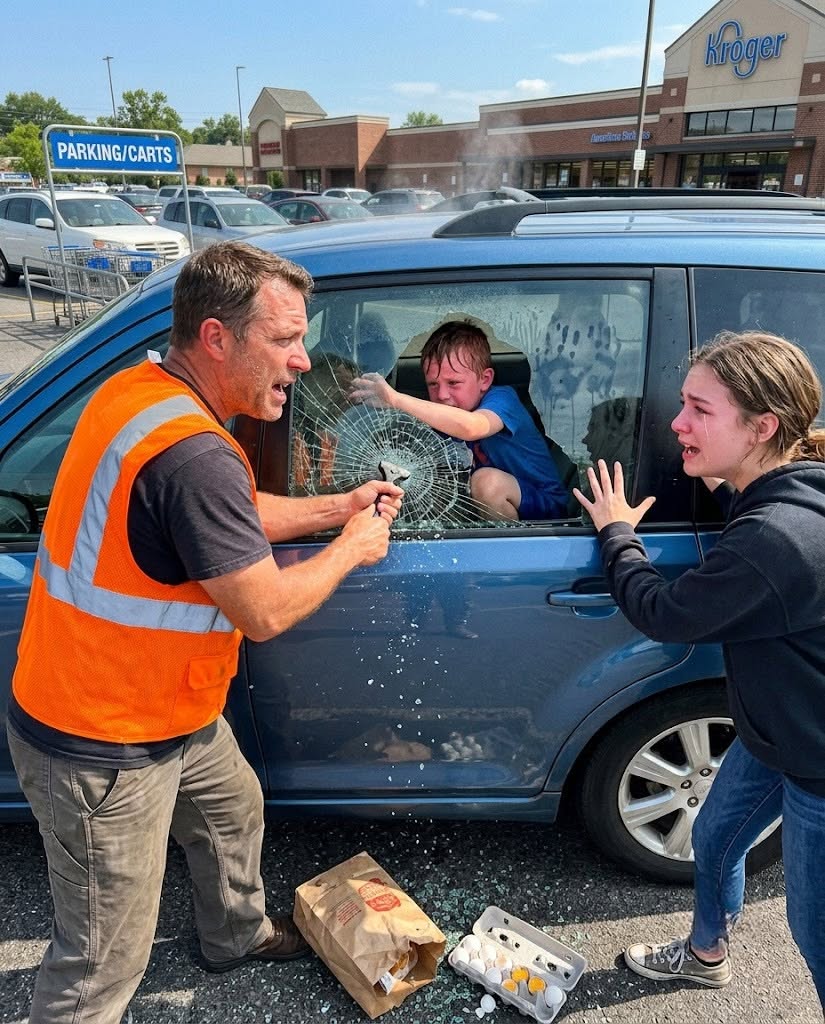
Then she saw Noah’s hand drag weakly across the inside of the rear window.
One grocery bag split against her forearm.
A carton of eggs hit the pavement behind her, but she did not stop.
She pulled the rear door handle.
Locked.
She pulled again hard enough to shake the SUV.
“Noah!”
His head lifted from the seat.
His face was red, his hair pasted to his forehead, and his T-shirt clung darkly to his chest.
For a moment, his eyes did not settle on her.
Then his lips moved.
Emily pressed her ear to the glass.
“Emily.”
She ran to the driver’s door.
Locked.
She tried the passenger door.
Locked.
She struck the window with the heel of her hand until pain shot into her wrist.
That was when she saw the mark on Noah’s cheek.
It was not dramatic.
It did not need to be.
The shape of Michael’s hand was enough.
Rage rose through Emily so quickly that she tasted metal.
For one heartbeat, she imagined Michael standing in front of her.
She imagined hitting him once for every time Noah had gone quiet at the dinner table.
Then Noah’s head rolled back against the seat.
Rage became useless.
Emily screamed for help.
Daniel, a parking attendant working the rows near the cart return, heard her from halfway across the lot.
He was in his late forties, wearing a reflective vest over a gray T-shirt, and carrying a radio clipped to his belt.
He ran toward the SUV.
“What happened?”
“He’s locked in,” Emily said. “My stepfather took the keys.”
Daniel looked through the glass, saw Noah, and immediately called for someone to dial 911.
A customer already had her phone out.
Daniel checked each door.
He called to Noah, but the boy barely moved.
Then Daniel braced himself beside the rear passenger window.
“Back up if you can, buddy,” he shouted.
Noah curled toward the middle seat and covered his face.
Daniel struck the lower corner of the window.
A white star appeared in the glass.
He struck again.
Cracks spread outward in a web.
On the third hit, the safety glass gave way.
Hot air rushed from the SUV.
Daniel cleared the opening with his vest, reached inside, unlocked the door, and pulled it open.
The smell that came out was thick with heated vinyl, sweat, and the sugary drink Noah had spilled onto the floor mat.
Noah recoiled from Daniel’s hands.
Then he grabbed the man’s wrist.
“Easy,” Daniel said. “You’re safe.”
The parking lot froze around them.
A woman stood beside her cart with one hand over her mouth.
A teenage cart attendant stopped pushing a long line of carts.
The supermarket doors opened and closed, releasing cool air that vanished almost instantly in the heat.
Daniel lifted Noah from the seat and carried him into the narrow strip of shade beside the building.
Emily knelt beside her brother.
His skin felt too hot.
His breathing came fast and shallow.
She kept saying his name because it was the only useful thing she could think to do.
Sirens reached the lot a few minutes later.
Paramedics placed damp towels around Noah’s neck and under his arms.
They checked his pulse, asked him questions, and moved him into the ambulance’s shade without taking him away from Emily.
A police officer asked where Michael was.
Emily said she did not know.
Another officer photographed the shattered window, the locked doors, the broken eggs, the torn grocery bag, and the mark on Noah’s face.
At 2:31 p.m., the first incident number was written across the top of a police report.
Sarah arrived from work still wearing navy scrubs.
There was a brown coffee stain near one pocket and a loose strand of hair stuck to her cheek.
She saw Noah on the stretcher and stopped so abruptly that the officer behind her nearly walked into her.
“What happened?”
Emily tried to answer, but Noah spoke first.
“He wanted me to say Dad.”
Sarah’s face changed.
Not because she had never heard Michael push for the word.
Because she suddenly understood the price he had attached to it.
She sat beside Noah and took his hand.
“Did he hit you?”
Noah nodded once.
“Did he put you in the car?”
Another nod.
“Where did he go?”
Noah looked toward the SUV.
Then he reached down and pulled off one sneaker.
From inside his sock, he removed a small brass key with a blue plastic tag.
“I took it from the garage,” he said.
The nearest officer crouched beside him.
“What does it open?”
“The room Michael said nobody could know about.”
Emily felt Sarah’s fingers tighten around Noah’s hand.
The key tag had a storage company logo and a unit number but no address.
Sarah had never seen it.
Emily had never seen it.
Michael kept a metal cabinet locked in the garage and called it work stuff.
He had told everyone not to touch it.
Noah said he had opened the cabinet that morning after Michael left the garage door standing open.
Inside, he found the key beside an envelope with Sarah’s name.
Michael caught him holding it.
That was when the argument began.
“He asked why I was snooping,” Noah said.!–nextpag–!>
“I told him I wanted Mom.”
“And then?”
“He said if I called him Dad, he’d forget it.”
Noah had refused.
Michael struck him.
Then he drove to the supermarket, waited for Emily to go inside, and locked Noah in the SUV.
Sarah bent forward until her forehead touched Noah’s hand.
The apology that came out of her was almost soundless.
Emily had never seen her mother collapse before.
She had seen her exhausted, sick, angry, and afraid of bills.
This was different.
This was a woman realizing that the person she trusted with the locks had been building rooms inside her life.
The officers searched the SUV with Sarah’s consent.
In the glove compartment, beneath the registration and service receipts, they found a folded storage agreement in Michael’s name.
The payment history showed monthly cash deposits.
The access log went back eleven months.
No exact city name was printed on the copy the family kept, only an address on the industrial edge of town.
At 4:06 p.m., Sarah, Emily, and Noah stood in a fluorescent hallway at the storage facility with an officer and the manager.
Daniel’s witness statement had already been attached to the report.
The concrete floor smelled like dust and hot metal.
An old air conditioner rattled behind a vent but did little to cool the corridor.
Sarah held Noah against her side.
Emily stood on his other side with her fingers around his wrist, feeling his pulse jump.
The officer inserted the brass key.
It turned.
The roll-up door groaned as it lifted.
A strip of light slid across the floor inside.
The first thing they saw was a twin mattress.
Beside it sat a child’s backpack with Noah’s name written on masking tape.
Plastic bins lined the wall.
One was labeled SARAH.
One was labeled EMILY.
One was labeled NOAH.
Taped above the backpack was a sealed envelope.
Across the front, Michael had written three words.
EMILY AND NOAH — LEAVE FRIDAY.
Sarah gripped the metal door track until her knuckles whitened.
The officer photographed the envelope before opening it.
Inside was a checklist.
Birth certificates.
School records.
Medication.
Cash.
New phones.
Beside Noah’s name, Michael had added another instruction.
PRACTICE CALLING ME DAD.
The first plastic bin contained copies of the children’s identification documents, Sarah’s banking information, and three months of unopened mail.
The second held clothes in their sizes with store tags still attached.
There were bottled waters beside the mattress, a flashlight, packaged snacks, and a battery fan.
Noah stared at the fan.
“He made me sit here once,” he whispered.
Sarah turned toward him slowly.
“When?”
“Last week.”
“For how long?”
“I don’t know.”
He pointed at the blank wall.
“He said I had to look at it until I understood who was in charge.”
The facility manager lowered his clipboard.
Until that moment, he had been professional and distant.
Then he opened the digital access record.
Michael’s code had opened the front gate at 9:47 p.m. the previous Tuesday.
The security video showed the family SUV entering.
A child was visible in the passenger seat.
The manager’s face lost color.
He told the officer there were more recordings.
The officer asked Noah whether Michael had ever brought Emily to the unit.
Noah shook his head.
Then he pointed to the last bin.
“No,” he said. “But he said that one was for her.”
The officer photographed the sealed lid and pulled on gloves.
Before opening it, he asked Sarah whether Michael had access to her signature.
She closed her eyes.
“Yes.”
Inside the bin were blank school withdrawal forms, photocopies of Sarah’s signature, a prepaid phone, and a notebook of dates.
Some dates matched Sarah’s double shifts.
Others matched evenings when Emily had stayed late at school.
Michael had been tracking the hours when the children were easiest to isolate.
There was no grand criminal empire.
No secret second family.
No dramatic fortune.
What they found was smaller and more frightening because it was practical.
Michael had prepared to control the family’s movement, documents, money, and communication.
He had built a place where he could frighten Noah and threaten Emily without Sarah seeing.
The storage unit was not a mystery anymore.
It was a plan.
Police located Michael that evening after he tried to return to the house through the garage.
He told officers the incident had been misunderstood.
He said Noah had been left in the car for only a minute.
He said Emily was emotional.
He said the storage unit was for emergency supplies.
But the timestamped receipt showed Emily had been inside the store for sixteen minutes.
The supermarket camera showed Michael walking away from the SUV shortly after she entered.
Daniel’s statement described the doors locked, the windows closed, and Noah barely responsive.
The storage facility log showed repeated late-night visits.
The video showed Noah with him.
The notebook showed planning.
The documents showed access.
Michael had always relied on sounding calmer than everyone else.
Paper did not care how calm he sounded.
Sarah changed the locks before midnight.
She gave the police the garage cabinet, the family file box, and every device Michael had used in the house.
Emily photographed each room before anything was moved.
The officer cataloged the documents from the storage unit.
A hospital intake form recorded Noah’s condition and the mark on his cheek.
A follow-up interview was scheduled with a child specialist.
The next morning, Sarah sat at the kitchen table in the same stained scrubs because she had not slept.
Noah came in wearing clean pajamas and stopped several feet away.
“Are you mad at me for taking the key?”
Sarah stood.
“No.”
“I wasn’t supposed to touch his stuff.”
“It was never more important than you.”
Noah stared at the floor.
Sarah crossed the room slowly, giving him time to move away if he wanted.
When he did not, she knelt and held out her arms.
He stepped into them.
“I should have listened sooner,” she said.
Noah rested his head against her shoulder.
“You listened now.”
That sentence broke something open in Sarah.
She cried without hiding it.
The case moved through court over the following months.
The family did not get a movie-scene ending.
There was no single speech that repaired everything.
There were interviews, forms, waiting rooms, and mornings when Noah refused to get into any parked car.
There were nights when he slept in Emily’s room because the sound of the garage door made him shake.
Sarah attended every appointment.
Emily kept copies of every report in a blue folder.
The court reviewed the parking lot footage, the storage records, the witness statement, the hospital intake notes, and the documents found in the unit.
A no-contact order kept Michael away from the family while the case proceeded.
Later, the judge extended those protections after reviewing the full evidence.
Daniel never called himself a hero.
When Sarah thanked him, he looked uncomfortable and said he had only done what anyone should do.
But not everyone had done it.
People had walked past the SUV before Emily reached it.
Some had glanced at Noah and assumed someone else was responsible.!–nextpag–!>
Daniel looked once and acted.
Weeks later, Noah asked to visit the supermarket.
Sarah almost said no.
Then she understood that avoiding the place forever would let Michael keep one more thing.
They went together on a cool morning.
The parking lot looked ordinary.
Carts rattled.
Doors opened and closed.
Daniel was working near the entrance.
Noah stopped in front of him.
“Mr. Daniel?”
Daniel turned.
Noah held out a folded picture he had drawn.
It showed a blue SUV, a broken window, and three stick figures standing outside beneath a huge yellow sun.
One figure wore an orange vest.
At the bottom, Noah had written, YOU HEARD ME.
Daniel read it twice.
Then he crouched so they were eye level.
“I’m glad I did,” he said.
Noah looked at Sarah.
“I get to decide what I call people, right?”
Sarah nodded.
“Yes.”
He looked back at Daniel.
“Can I call you my friend?”
Daniel smiled.
“I’d like that.”
The storage unit was emptied under supervision.
The mattress was discarded.
The documents were returned.
The blue-tagged key went into an evidence bag and then into a file.
For Emily, the key never felt small again.
It represented the moment Noah stopped protecting the secret he had been forced to carry.
It represented the moment strangers believed him before Michael could explain him away.
It represented a door opening in a family that had spent too long living around locked ones.
An entire household had taught Noah to wonder whether peace depended on saying the right word.
In the end, safety began when the adults around him finally accepted that his own words mattered.
Months later, Sarah replaced the broken porch rail Michael had once repaired.
She and Emily did it together.
The screws were uneven and the stain did not match perfectly.
Noah sat on the front step handing them tools.
When they finished, Sarah pushed against the rail.
It held.
She looked at her children and said, “This house belongs to the people who feel safe in it.”
Noah leaned against the new rail.
He did not call anyone Dad.
Nobody corrected him.
And for the first time in a long time, the silence that followed was not fear.
It was peace.