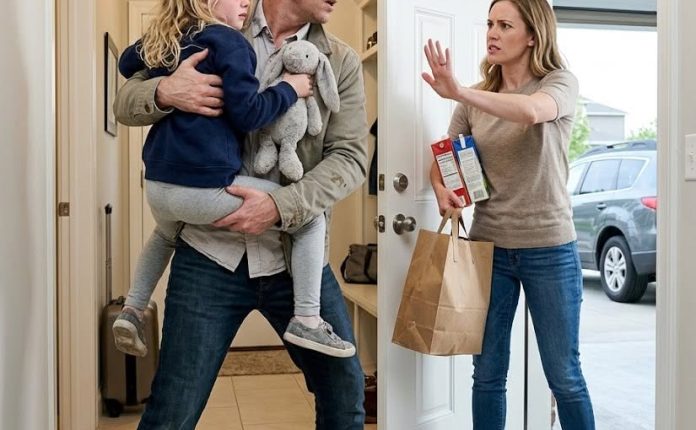
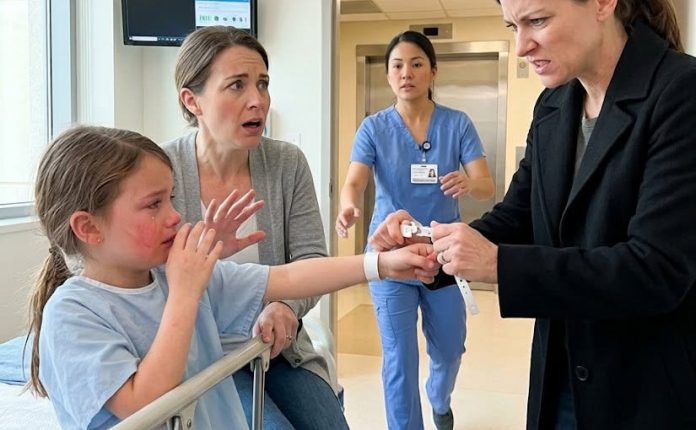
That Tuesday morning smelled like burned toast and strawberry shampoo.
The toaster had been set too high again, and the bitter smoke hung above the kitchen counter while I fastened two silver clips into my ten-year-old daughter’s hair.
Emma usually talked through breakfast.
She read cereal boxes like they were mystery novels, asked for extra strawberry jam, and dragged her pink backpack down the hallway before I could remind her about lunch.
That morning, half a slice of toast sat untouched on her plate.
The butter melted into a dull shine while she pushed one crumb in a slow circle with her fingertip.
“Your stomach again?” I asked.
“I’m just tired, Mom.”
The kitchen light felt too bright, and the tile under my bare feet was cold enough to make me curl my toes.
Michael had already left for another meeting.
That was the word he used for everything by then.
Meetings.
Contracts.
Emergency calls.
Portland trips.
Late clients.
Saturday work.
The excuses sounded different, but they all accomplished the same thing: they kept my husband away from home.
His phone stayed face down at dinner.
His answers got shorter.
The chair beside Emma remained empty so often that she had stopped glancing toward it when we sat down.
I told myself he was working for us.
I had been married to Michael for twelve years, long enough to remember the apartment with the broken heater, the used couch we carried up three flights of stairs, and the night he sat beside me while I studied for my nursing exams.
Trust does not usually vanish in one dramatic moment.
It gets spent in small amounts, one ordinary excuse at a time, until the account is empty and you are still writing checks.
By 7:38 a.m., Emma was in the school pickup line with her backpack slipping off one shoulder.
By 8:12, I was at St. Mary’s checking IV lines in the pediatric ward and smiling at frightened parents while my own hands felt too cold inside my scrub pockets.
Madison Elementary had called twice that month.
Headaches.
Dizziness.
A stomachache that came and went.
Dr. Williams had said stress could do strange things to a child, and I wanted to believe him because stress sounded safer than anything else.
Michael’s absences had become a quiet pressure inside our home.
Emma noticed more than he thought she did.
She once asked whether adults could forget where they lived if they worked too much.
I laughed because I did not know what else to do.
At 12:46 p.m., my phone rang.
The school nurse did not waste words.
“Mrs. Johnson, Emma collapsed in class. She’s conscious, but she needs a hospital now.”
I do not remember hanging up.
I remember a blood pressure cuff rolling off the counter.
I remember Linda grabbing my elbow.
I remember the hospital corridor stretching white and endless in front of me.
When I reached Madison Elementary, Emma was on the cot in the nurse’s office with her lips so pale that I started bargaining with God before I even knew what I was bargaining for.
A paper cup of water sat untouched beside her.
Her little fingers were curled into the sheet.
“Mom,” she whispered when she saw me.
That was all.
At St. Mary’s, they moved fast because they knew me.
Blood work.
Urine test.
IV.
Oxygen.
Monitors.
A hospital intake form was clipped to the foot of the bed with EMMA JOHNSON, AGE 10 printed across the top like paperwork could make any of this ordinary.
I had completed those steps for other families a hundred times.
When it is your child, every beep sounds like an accusation.
I called Michael from the hallway at 1:17 p.m.
Voicemail.
Again at 1:22.
Voicemail.
At 1:29, I left a message that did not sound like me.
“Emma is in the hospital. Come now.”
Then Dr. Martinez came back with his face changed.
Nurses learn that face before they learn half the machines in an emergency room.
“Sarah,” he said quietly, forgetting for one second that I was not on shift, “there are abnormal substances in Emma’s blood, and we need to contact the police.”
“Police?”
The word did not fit my daughter.
It did not fit her pink backpack, her library books, her glitter pencil case, or the tiny silver clips still holding her hair away from her damp forehead.
Dr. Martinez looked through the glass wall toward Emma’s bed.
“The toxicology screen indicates an arsenic-based poison.”
The room tilted.
Not stress.
Not a sensitive stomach.
Not a little girl being dramatic because her father kept disappointing her.
Poison.
Dr. Martinez explained that the amount was not enough to kill Emma all at once, but repeated exposure could weaken her and become fatal.
The report used clinical language.
ARSENIC-BASED TOXIC EXPOSURE.
REPEATED DOSING SUSPECTED.
IMMEDIATE TREATMENT REQUIRED.
The words looked clean on the page.
What they meant was that someone had been hurting my child slowly enough to make us doubt her.
Some truths do not arrive screaming.
They walk in wearing a doctor’s quiet voice and stand beside your child’s hospital bed.
Michael arrived thirty-two minutes later with his shirt wrinkled and his face gray.
He asked how Emma was, but his eyes moved too quickly around the room.
They landed on Detective Brown’s badge and slipped away before they settled on our daughter.
Detective Brown was gentle with Emma and careful with me.
She wrote everything in a small notebook and asked about school lunches, drinks, neighbors, birthday parties, weekend visits, and anyone who had given Emma food.
I handed her the school nurse’s call log, the discharge notes from Emma’s earlier clinic visit, and the list of dates Madison Elementary had called.
There were three timestamps that mattered immediately.
Monday, 10:18 a.m.
The previous Thursday, 1:03 p.m.
And that Tuesday, 12:46 p.m.
Each episode had followed a Saturday outing with Michael.
The pattern sat on Detective Brown’s notepad before I was willing to see it.
Michael stood near the foot of the bed with both hands shoved into his pockets.
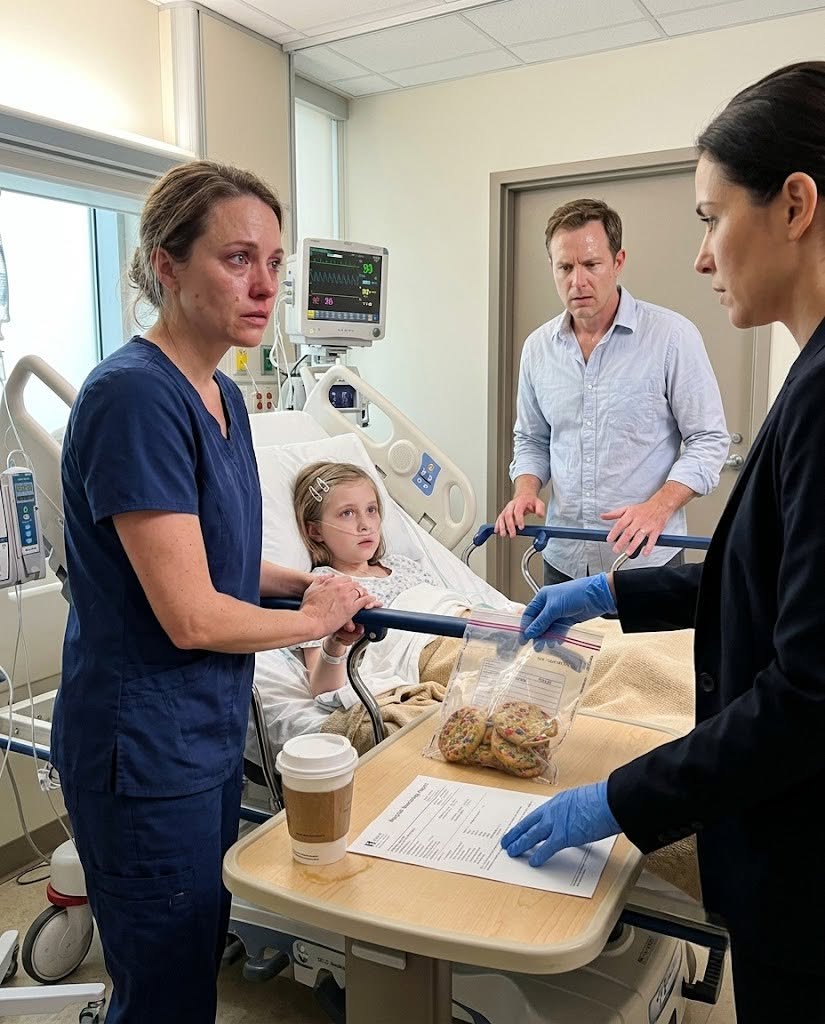
He stared at the monitor like it might hand him a script. Detective Brown leaned closer to Emma. “Sweetheart, did anyone give you anything unusual? Candy, cookies, juice, anything your mom didn’t pack?” Emma’s eyelids fluttered. Her voice came out small under the oxygen mask. “Dad’s friend.” Every adult in the room went still. Even the monitor seemed louder. “What friend?” Detective Brown asked. “The woman from the park,” Emma whispered. “She was nice. She gave me cookies when Dad took me on Saturdays.” Saturdays. Urgent work. Contracts. Clients. All those afternoons Michael said he was catching up, then came home with Emma sleepy in the back seat and a faint perfume on his jacket that did not belong to our laundry room. Detective Brown turned toward my husband. “What’s her name?” Michael swallowed once. Then again. “Jessica.” The name landed beside my daughter’s hospital bed like another poison. I wanted to scream. I wanted to ask how long, how often, and how many times he had placed our child beside a woman I had never met. I wanted to tear every Saturday out of the calendar and lay it on the floor between us. But Emma’s fingers were wrapped around mine. So I stayed a mother before I became a wife whose whole marriage had cracked open in public. Detective Brown asked Michael to step into the hallway. Through the glass, I watched his shoulders fold inward while she questioned him. Dr. Martinez adjusted Emma’s IV and told me the treatment had already started. “She’s young,” he said. “She’s strong. We caught it early enough to fight this.” Hope is strange in a hospital. Sometimes it is not bright. Sometimes it is simply the cleanest instrument left on the tray. At 9:04 p.m., Emma was asleep in the ICU with one hand tucked beneath her cheek and the hospital wristband loose around her thin wrist. I had not eaten. I had not cried. The paper coffee cup in my hand had gone cold hours earlier. That was when Detective Brown returned carrying a sealed evidence bag. Inside were small cookies with rainbow sprinkles, the kind any child would trust. Michael saw them before I did, and all the color drained from his face. Detective Brown set the bag on the rolling tray beside Emma’s toxicology report. Michael stared at the printed words, then at the cookies, and something ugly rose through his fear. “Don’t destroy my life over a few cookies,” he snapped. For one hot second, I pictured throwing the cold coffee in his face. I pictured the paper cup collapsing against his shirt. I pictured him feeling one small piece of the helplessness he had handed our daughter. I did not move. Detective Brown did. She stepped between Michael and Emma’s bed, closed the door behind him, and told him he was not leaving the floor. Then she touched one gloved finger to the evidence label. “Michael’s fingerprints were inside the fold,” she said, “where the bag had been opened and resealed.” He answered too quickly. “Of course they were. Emma had them in my car.” Detective Brown placed a second clear sleeve on the tray. Inside was a printed screenshot from Michael’s phone, time-stamped 11:08 a.m. that morning. The sender was Jessica. SHE ATE TWO. DON’T BRING HER NEXT SATURDAY. Michael’s reply sat beneath it. DELETE THIS. The monitor beside Emma kept its steady rhythm while my husband stared at those two words. His mouth opened, but no sound came out. The man who always had an explanation had finally met a sentence too small to hide behind. Detective Brown asked whether he had known Jessica was giving Emma something that made her sick. Michael said no. Then he said he thought it was “just something to keep her home.” Then he stopped talking because he heard himself. Dr. Martinez froze with one hand on the IV line. I felt Emma’s fingers move weakly inside mine. Michael looked at me. “Sarah, I never wanted this.” That was the first time he said my name all day. Detective Brown slid one more item from her folder. It was a parking-garage receipt from St. Mary’s dated three weeks earlier, with Jessica’s name printed beneath the payment line. She had been inside the hospital before Emma collapsed. She had stood in the same building where I worked, learned my schedule, and watched me leave. On the back of the receipt, in blue ink, were six handwritten words. KEEP SARAH LATE. I’LL HANDLE EMMA. Michael grabbed the bed rail. “She promised she wouldn’t—” He stopped. Detective Brown waited. “She promised she wouldn’t what?” she asked. Michael looked through the glass at our daughter. For a moment, I saw the calculation happen in his face. He was not deciding whether to tell the truth. He was deciding which version might cost him less. That was the moment something inside me went quiet. Not forgiveness. Not peace. Clarity. Michael finally admitted that Jessica had complained Emma asked too many questions about their Saturday meetings. He said Jessica had offered to give Emma something that would make her tired and nauseated so she would stay home the following weekend. He claimed he believed it was a harmless herbal remedy. Detective Brown asked why he had written DELETE THIS. Michael said he panicked. She asked why he had not called me when Emma’s symptoms began. He said he thought they would pass. She asked why the hospital receipt contained my work schedule. He had no answer. A person can spend years mistaking cowardice for confusion. The difference becomes obvious when a child is lying in an ICU bed. Detective Brown collected Michael’s phone and asked another officer to escort him to a separate interview room. He turned toward me before he left. “Sarah, please.” I looked at Emma. I did not look back. At 10:31 p.m., Michael’s phone began vibrating inside the evidence pouch. The same name appeared three times. Jessica. Detective Brown let the fourth call ring while another officer documented the screen. Then she answered. She did not identify herself immediately. Jessica’s voice came through sharp and breathless. “Did Emma tell them?” Nobody in the room moved. Detective Brown asked, “Tell them what?” The line went silent. Then Jessica whispered, “Michael?” Detective Brown identified herself. Jessica hung up. That call did not prove everything by itself, but it changed the room. It turned suspicion into direction. It gave the detectives a reason to move quickly, secure the remaining cookies, preserve the message thread, and locate Jessica before she could destroy anything else. By midnight, officers had recovered a second container from Jessica’s apartment. I learned that later. At the time, all I knew was that Detective Brown returned to the ICU and told me Jessica had been found and was being questioned. She did not give me details. She did not make promises. She said, “We have enough to keep going.” In a hospital, those words can be a kind of mercy. Emma’s treatment continued through the night. Dr. Martinez called it chelation therapy and explained only what I needed to understand in that moment: the medicine would help pull the poison from her body, and they would keep checking her heart, kidneys, and nervous system. I sat beside her until sunrise. At 4:18 a.m., she woke and asked whether she had missed school. At 4:21, she asked whether her backpack was safe. At 4:26, she asked where her father was. I told her he was speaking with the police. She watched my face for a long time. “Did I do something bad?” The question broke what the poison had not. I bent over the bed and pressed my forehead against her hand. “No, baby. You told the truth.” She looked toward the door. “Dad said not to tell you about Jessica because you’d get mad.” I kept my voice steady. “What else did he say?” “He said the cookies were medicine for my stomach.” The cruelty of it was so ordinary that it felt impossible. A familiar adult. A bright cookie. A lie told in a calm voice. Children trust the people who teach them what danger looks like. Michael had used that trust as cover. The detectives later recovered the full message thread between him and Jessica. Some messages were about hotel rooms and excuses. Others were about Emma. SHE ASKS TOO MANY QUESTIONS. JUST KEEP HER QUIET. NOTHING PERMANENT. THEN STOP BRINGING HER. SARAH CHECKS THE MILEAGE. There it was. Not one impulsive mistake. Not one bad afternoon. A process. A plan. A child reduced to a scheduling problem between two adults who wanted the convenience of betrayal without the inconvenience of being discovered. Jessica eventually admitted she had put arsenic into the cookies in small amounts. She claimed she never intended to kill Emma. She said she wanted the girl sick enough to stay home and quiet enough not to talk. Michael insisted he had not known the substance was arsenic. The messages showed he knew the cookies were making Emma ill and told Jessica to continue until their Saturday routine became easier. That distinction mattered to lawyers. It did not matter to me. My daughter had said she was tired, and her father had known why. Emma spent two nights in the ICU and five more days on the pediatric floor. Her color returned slowly. First her lips. Then her cheeks. Then the impatient little crease between her eyebrows when the hospital oatmeal arrived without enough brown sugar. The first time she asked for extra jam, I went into the bathroom and cried so hard I had to grip the sink. Linda covered my shifts. Dr. Martinez stopped by even when he was not assigned to Emma. Detective Brown brought updates without pretending the legal process would be quick. The county prosecutor filed charges connected to the poisoning, child endangerment, and the attempt to conceal evidence. Jessica remained in custody. Michael was also held while the case developed, and family court suspended his contact with Emma. I filed for divorce from a plastic chair beside a vending machine. There was no dramatic music. No speech. Just my signature, a cheap black pen, and a paper coffee cup cooling beside my elbow. That was enough. Michael sent letters through his attorney. In the first, he said he loved Emma. In the second, he blamed Jessica. In the third, he said I had been working too much to notice what was happening. I stopped reading after that. Blame is the last shelter of people who have run out of lies. Detective Brown kept every letter in the case file. Months later, Jessica accepted a plea agreement that required her to admit what she had done. Michael also entered a guilty plea to charges tied to knowingly allowing Emma to be harmed and trying to erase evidence. Neither result restored the Saturdays they had stolen from my daughter. Neither result made the kitchen smell clean again. But consequences mattered. The court orders mattered. The locked doors mattered. The fact that Emma could sleep without wondering whether her father’s “friend” would appear at the park mattered. Recovery did not look heroic. It looked like blood tests. Therapy appointments. Missed schoolwork spread across the dining table. A night-light left on in the hallway. It looked like Emma asking me three times whether a cookie from a classmate’s birthday was safe. It looked like me reading every label, then sitting beside her while she took one careful bite. For months, she would not wear the silver hair clips from that morning. She said they reminded her of the hospital. I put them in the back of my dresser drawer and did not argue. One Saturday in early spring, she asked if we could go to the park. The question surprised me. We packed sandwiches, apple slices, and store-bought cookies still sealed in their wrapper. Emma checked the package herself. Then she slipped her hand into mine as we walked past the bench where Michael used to meet Jessica. We did not stop there. We kept walking until we reached the pond. The air smelled like wet grass and coffee from the paper cup in my other hand. A family SUV rolled slowly through the parking lot. Somewhere behind us, a child laughed near the swings. Emma sat on the edge of a picnic table and opened her cookie. “Mom?” “Yeah?” “You believe me, right?” I set down the coffee. “Every time.” She nodded and took a bite. That evening, I made toast for dinner because neither of us wanted anything complicated. The toaster burned the first slice. Emma laughed. It was the old laugh, quick and surprised, the one I had not heard since before the headaches began. Then she opened the jam and asked for extra. I used to think being a good nurse meant noticing every symptom. Now I know love also means believing the person who says something is wrong, even when the truth threatens the life you built around not seeing it. I had spent weeks explaining away the bleeding at my own table. I do not do that anymore. The final toxicology report arrived six months after Emma collapsed. Her arsenic level had returned to the normal range. I read that sentence twice. Then I placed the report beside the silver hair clips I had kept in my dresser. Emma found them later that afternoon. She held them in her palm, looked at me, and asked whether I could put them in her hair again. My hands shook as I fastened the first clip. Not from fear. From the weight of getting something back. Hope had started as the cleanest instrument left on a hospital tray. By then, it looked like strawberry shampoo, warm toast, and my daughter standing in our kitchen asking for more jam.