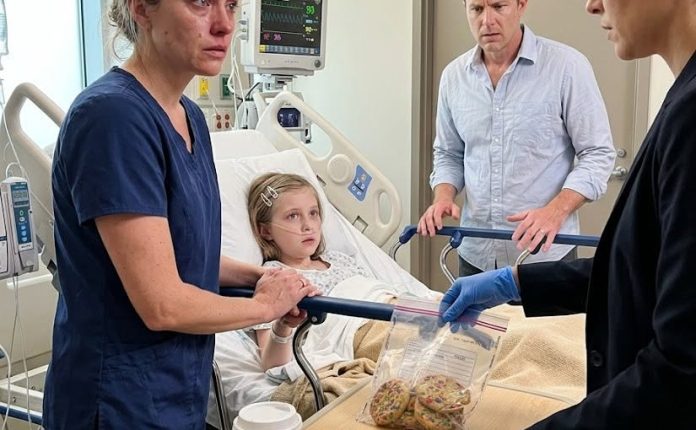
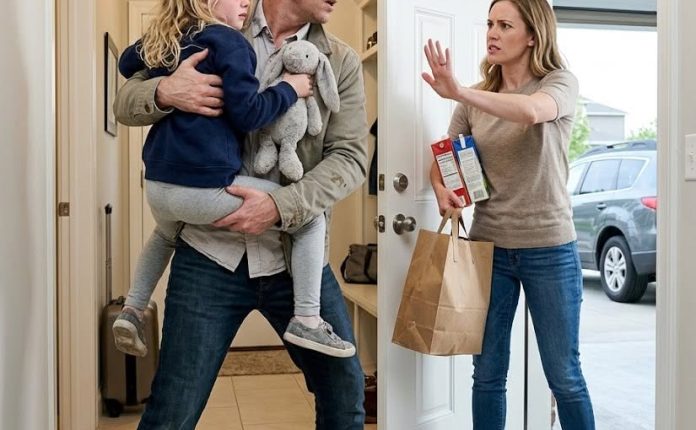
When my husband violently shoved me to the floor, breaking my leg, I gave my 4-year-old daughter the secret signal. She ran to the phone and called the one number he didn’t know about: “Grandpa, Mom looks like she’s going to die!”
My husband broke my leg on a Tuesday night while our four-year-old daughter watched from the stairs in pink pajamas.
The kitchen smelled like bourbon, expensive cologne, and the lemon cleaner I had sprayed after dinner because some stubborn part of me still believed a clean house could hold chaos outside for one more evening.
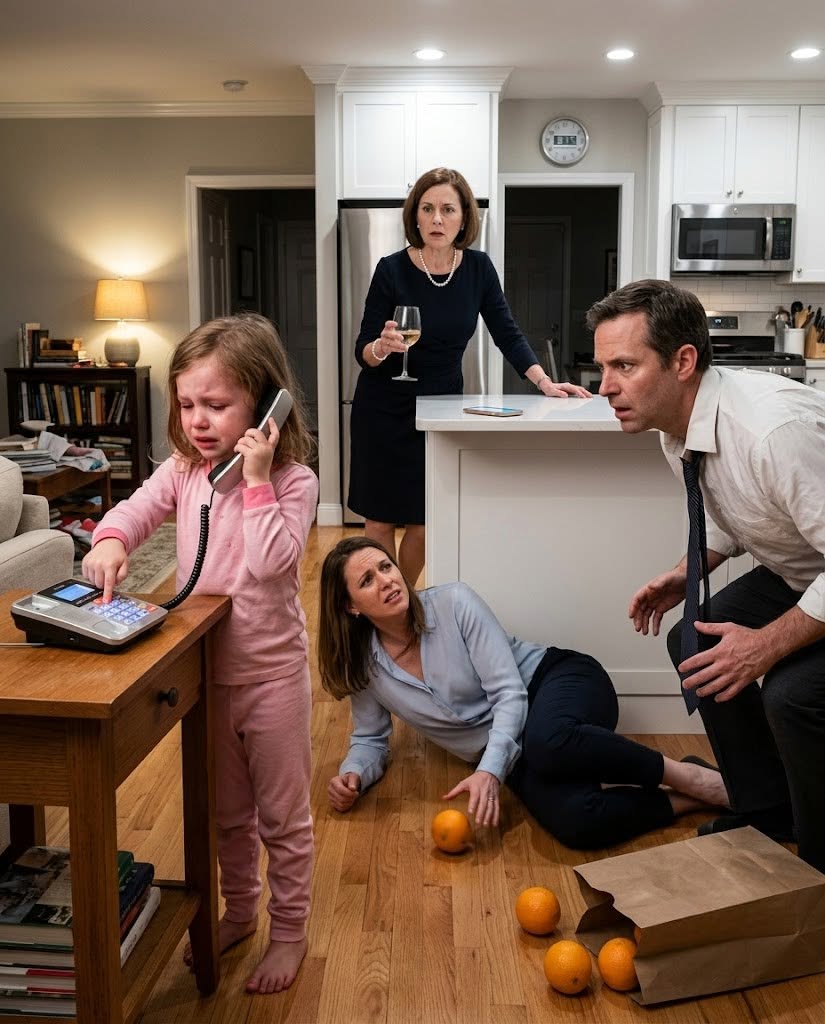
The overhead lights were too bright.
They picked out every detail I would later remember: David’s loosened silk tie, Margaret’s pearls, the open paper grocery bag on the counter, and the bank alert glowing on the phone in my hand.
I had read the alert three times before I spoke.
“You transferred the money.”
David did not ask what I meant.
He looked at me with the tired, burdened expression he used whenever he wanted to seem inconvenienced instead of caught.
“Our money, Sarah.”
“My inheritance.”
His mouth curved into the small private smile I had learned to fear.
“Your father’s charity.”
The money had come from my mother’s estate, and my father had helped place it in an account that was supposed to remain mine.
David had spent three years insisting that marriage turned every boundary into an insult.
At first, it had been little things.
He wanted the passwords to my accounts because married people should not have secrets.
He wanted to approve large purchases because he was supposedly better with numbers.
He wanted his name added to paperwork because he said it made him feel secure.
The first time I refused, he did not yell.
He went quiet for two days, slept in the guest room, and told anyone who asked that I was having another emotional episode.
That was how he worked.
He made punishment look like patience.
Margaret helped.
At family dinners, she would tilt her head over a glass of wine and ask whether I had remembered to take care of myself that week.
In front of friends, she called me sensitive.
When I corrected David about a date, an amount, or something he had promised, she smiled as though she were watching a confused child struggle with a simple lesson.
For three years, they taught me that remembering correctly was a form of aggression.
Control does not always begin with a locked door. Sometimes it begins with someone making you apologize for noticing what happened. That Tuesday, Margaret stepped into the kitchen behind David as if she had been waiting for her cue. Pearls rested at her throat. A wineglass hung loosely from her fingers. Pity was arranged across her face as carefully as makeup. “Don’t make this ugly, Sarah,” she said. “You know you’ve never handled financial pressure well.” I looked past them toward the stairs. Emma’s bare feet were visible between the banisters. She wore pink pajamas with one sleeve pulled over her hand, and her other palm was pressed over her mouth. She was four years old. She did not understand inheritance, wire confirmations, or how adults could dress theft in the language of concern. But she understood David’s shoulders when they went rigid. She understood Margaret’s soft voice when it became too soft. She understood danger. “Put it back,” I said. David laughed. Then the laugh vanished. He crossed the kitchen in three hard steps. His hand closed around the front of my blouse, and he shoved me backward into the heavy island. The edge caught my hip first. Pain flashed white through my side. Then I hit the floor wrong, my right leg twisting beneath me with a sharp crack that made Emma scream. The room froze. Ice clicked once in Margaret’s glass. The refrigerator kept humming. A paper grocery bag leaned open on the counter while three oranges rolled across the marble, slow and bright, as if the ordinary world had decided to keep moving without us. One orange dropped to the floor and spun beside my hand. Margaret watched it slow. Then she took a sip of wine. “Now look what you made him do.” For one ugly second, I imagined dragging myself up and throwing her glass against the wall. I imagined screaming until every porch light on the street came on. I wanted Emma to see a mother who was fearless. But fearlessness was not the job. Keeping her safe was. David crouched over me. Bourbon burned through every word when he leaned close to my ear. “Nobody is coming for you.” He had said versions of that sentence before. Quietly in the car after dinner. Casually in the laundry room with the door half closed. Smiling beside his mother when she wanted to see how far he could go and still be called a good husband. At 8:17 p.m., with my phone lying faceup beside the pantry and my leg burning so badly I could not tell where the pain began, David forgot one thing. He thought I had only been surviving. I had also been preparing. Two months earlier, the first unexplained transfer had disappeared from the account. David told me I had misread the statement. When I showed him the alert, he said the bank had made an error. When the money did not return, he said I had probably authorized something and forgotten. That night, after he went to sleep, I printed the alert. The next morning, I placed it in a plain folder and drove it to my father’s house. I did not call it evidence then. I called it a copy. That word felt less frightening. Over the next eight weeks, the folder grew. There was the March 14 account notice. There was the April 2 wire confirmation. There were photographs of the SUV title showing my name before David’s sister began introducing the vehicle as hers. There was a notebook with dates, times, amounts, and the names of people who had been present when David threatened me or Margaret explained my own memory away. I kept the folder at my father’s house because paper has a way of telling the truth when people become tired of listening. My father never pushed me to leave. He knew pressure could sound too much like control, even when it came from love. Instead, he asked one question every Sunday. “Do you still know what you would do in an emergency?” For weeks, I said yes without having an answer. Then I bought a simple phone for the living-room side table. It had oversized buttons and one large red speed-dial key. David thought I had bought it for Emma to practice calling family. He never asked which number the red button reached. I taught my daughter one thing. Not a speech. Not a secret she had to carry. Just a signal. If Mommy ever holds up two fingers, run to the phone. Press the red button. Say exactly what you see. Do not argue. Do not come closer. I prayed she would forget the lesson because she would never need it. Children remember what frightens their parents. David’s hand closed around my wrist. “Tell your father you slipped,” he said. “Tell everyone the floor was wet.” Emma sobbed into her sleeves. I lifted my right hand. Two fingers. For half a breath, she was still just my little girl standing barefoot on the stairs, cheeks wet, body too small for the terror filling the kitchen. Then her face changed. She ran. David’s head snapped up. “Where is she going?” The keypad beeped from the living room. Once. Twice. Margaret’s wineglass lowered. Emma’s voice shook, but it carried through the house. “Grandpa,” she whispered. “Mom looks like she’s going to die! There’s a bad accident!” For the first time in our marriage, David looked genuinely afraid. Then my father’s voice came through the speaker. “Sarah, I heard her. Keep the line open.” His voice was calm, but I knew that calm. It was the voice he used when panic had to wait because someone else needed him steady. David lunged toward the living room. Emma grabbed the phone with both hands and backed behind the couch. “Don’t hang up, sweetheart,” my father said. “Stay where I can hear you.” Margaret set down her wineglass too hard. A thin crack appeared near the base. “This is a family misunderstanding,” she called toward the speaker. My father ignored her. “David,” he said, “I have the March 14 notice in front of me. I have the April 2 wire confirmation. I have the copy of the SUV title with Sarah’s name on it. Do not touch my daughter again.” David looked at the phone beside the pantry. Then he looked at me. Then he looked toward the front windows as if he were measuring how much time remained to rebuild his version of the night. “Tell him you fell,” he whispered. I pressed my palm into the floor and forced air into my lungs. “Emma told him what she saw.” Margaret stepped away from David. Her face lost the polished concern she had worn for years. “You said she would never keep records,” she whispered. That was the first honest sentence she had spoken all night. Headlights swept across the blinds. A car door slammed. Three hard knocks shook the front door. David did not move. My father’s voice came from the porch. “Open the door.” David straightened his tie. Even then, even with me on the floor and our daughter crying behind the couch, he believed appearance might still save him. He opened the door halfway. My father pushed it wider with one hand and stopped when he saw me. His face changed in a way I will never forget. Not rage first. Grief. The kind that arrives when a parent sees the cost of every warning they were afraid to make too forcefully. He moved toward me, but David stepped into his path. “She slipped.” Emma answered from behind the couch. “No, Daddy pushed Mommy.” The words were small. They landed harder than anything else in the room. My father did not argue with David. He did not raise a fist. He took out his phone, told the dispatcher exactly what he saw, and kept his body between David and Emma until help arrived. Margaret began talking before anyone asked her a question. She said I had been upset. She said the floor had just been cleaned. She said David had reached for me because I was losing my balance. Then she forgot one of the details she had already given and changed the story. People who rehearse lies often prepare the center and neglect the edges. The edges are where truth gets in. The emergency crew placed a brace around my leg and lifted me carefully. A responder asked where the pain was worst. Another asked Emma whether she felt safe going with Grandpa. David tried to follow the stretcher outside. My father blocked the doorway with an open hand. “No.” It was one word. David finally understood that the room no longer belonged to him. At the hospital, imaging confirmed the break. The doctor explained the treatment while my father sat beside the bed with both hands around a paper coffee cup he never drank from. Emma slept curled in a chair under my coat. Every time she stirred, her fingers moved as if she were pressing the red button again. I wanted to tell her she had saved me. A child should not have to carry that sentence. So when she woke, I said something else. “You did exactly what Mommy taught you. Now the grown-ups will do the rest.” The next morning, my father brought the folder. He placed it on the hospital tray beside the untouched gelatin and plastic water pitcher. The March 14 notice was on top. The April 2 confirmation sat beneath it. The SUV title photographs were clipped together. My notebook filled the back pocket. A police officer took my statement. I told the truth in order. Not the polished version. Not the version that protected David from embarrassment. Not the version Margaret preferred. The truth. He shoved me. My leg broke. My daughter saw it. He told me to lie. His mother blamed me. The money transfers had started months earlier. The officer photographed the bruising on my wrist and the torn seam of my blouse. My father handed over copies, not originals. Preparation had made me look calm. I was not calm. I was finally too tired to keep making their behavior easier to hear. A temporary protective order came next. Then came meetings with lawyers, bank representatives, and an accountant who traced the transfers through accounts David had treated like private drawers. Some of the money had gone toward his sister’s SUV expenses. Some had covered debts he had never disclosed. Some had been moved simply because he believed access was the same thing as ownership. Margaret called my father twice. The first time, she said David was under stress. The second time, she said families should not destroy one another over a single terrible mistake. My father answered with a question. “Which mistake do you mean?” She hung up. David sent apologies through his attorney. They were full of passive verbs. Things had gotten out of hand. Money had been moved. Feelings had been hurt. My leg had been broken. He wrote as though the night had happened by itself. I stopped reading after the second page. In court, he wore a dark suit and the same burdened expression he had used in the kitchen. Margaret sat behind him in pearls. For years, that image would have made me doubt myself. That morning, it only looked rehearsed. The financial records mattered. The photographs mattered. The timestamps mattered. But the detail that changed the room was Emma’s call. The recording captured her frightened voice. It captured my father telling her to stay back. It captured David ordering me to say I had fallen. It captured Margaret saying he had promised I would never keep records. When that line played, Margaret looked down at her hands. David closed his eyes. Nobody in the room needed me to explain what it meant. The protective order remained in place. The disputed accounts were frozen while the transfers were reviewed. The remaining inheritance funds were returned to my control. The SUV title was corrected. The divorce took months, because endings built through paperwork are slower than the moments that make them necessary. I spent those months learning how much energy I had used to predict David’s moods. Without him in the house, silence felt loud at first. Then it began to feel like rest. My leg healed slowly. The first time I walked through the kitchen without crutches, Emma stood by the living-room table and clapped. The red-button phone was still there. I had considered throwing it away. Instead, I kept it. Not as a monument to fear. As proof that a plan could be small enough for a child to remember and strong enough to break an adult’s lie. Emma met with a child counselor. She drew the kitchen over and over. In the first pictures, David was enormous and I was a tiny shape on the floor. In later pictures, the room changed. Grandpa appeared at the door. The phone became bright red. I became taller. One afternoon, she drew herself holding up two fingers. “That was your signal,” I said. She shook her head. “No. Now it means we’re safe.” I went into the laundry room and cried where she could not see me. Not because I was ashamed. Because she had taken the worst symbol in our house and changed its meaning. Margaret never apologized to me. She sent one letter saying she hoped time would soften everyone’s perspective. Time did not soften mine. It sharpened it. What happened was not a misunderstanding. It was not a bad night floating free from the years before it. It was the final visible act in a long campaign to make me distrust my own eyes. Control does not always begin with a locked door. Sometimes it begins with someone making you apologize for remembering correctly. And freedom does not always begin with a dramatic escape. Sometimes it begins with a printed alert. A folder at your father’s house. A large red button. Two fingers raised in a bright kitchen. A four-year-old girl doing exactly what her mother taught her to do. David had told me nobody was coming. He was wrong. My father came. Help came. The truth came with dates, copies, photographs, and a child’s trembling voice. Most importantly, I came back to myself. The house did not become peaceful because I cleaned it better. It became peaceful because the people who turned fear into a routine no longer had permission to enter. Emma still wears pink pajamas. She still leaves one sleeve pulled over her hand. Some nights she asks whether Grandpa can stay on the phone until she falls asleep. He always does. And every Tuesday, before bed, I check the locks, turn off the kitchen light, and look once toward the little phone on the side table. The red button does not frighten me anymore. It reminds me that survival was never the whole story. I had been preparing. Then, when the moment came, my daughter pressed the truth into motion.