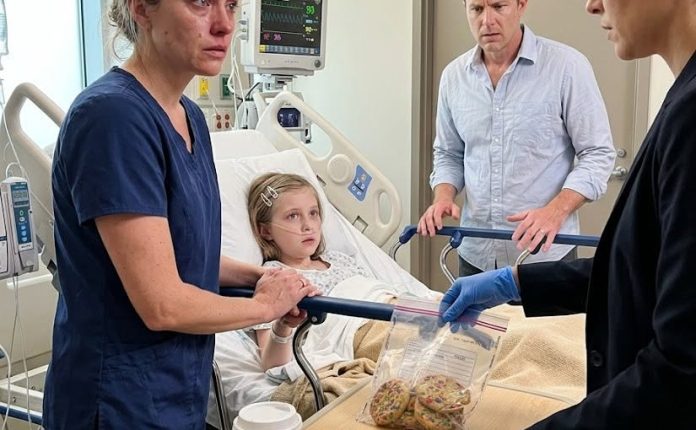
The morning of Lily’s surgery began with a paper cup of coffee I never got to drink and a silence that felt too careful.
She was six years old, small for her age, and trying hard to act brave because she had heard every adult around her use that word.
Brave.

The word had followed her through pre-op appointments, insurance calls, bloodwork, and the long week when every meal somehow tasted like worry.
Mark sat beside her hospital bed tying and retying the laces on one sneaker because he needed something for his hands to do.
He had been Lily’s father in every way that mattered since she was two.
He knew which cartoon she watched when she was sick, how she hated jelly near the edge of her sandwich, and why thunderstorms made her crawl into the hallway instead of our room.
He had signed the adoption papers the previous year, but his mother, Diane, never accepted what the papers confirmed.
To Diane, Lily was always “Claire’s girl.”
Never Mark’s daughter.
She had said it at birthdays, family dinners, and once in a grocery store parking lot while Lily stood close enough to hear.
Mark had confronted her every time, but Diane had a way of making each insult sound like a misunderstanding after the fact.
She would say she was old-fashioned.
She would say everyone was too sensitive.
She would say blood mattered, then act offended when anyone repeated her exact words.
Two nights before the surgery, Diane called Mark and asked how much the procedure would cost.
He told her our insurance was handling most of it and that the rest was our responsibility.
Diane said he was “spending his life proving something to a child who wasn’t really his.”
Mark ended the call.
He did not tell me about that sentence until much later.
What he did tell me was that he had asked the hospital to add an extra security code before releasing information to anyone outside our household.
He said his mother had been asking too many questions and he wanted to be careful.
I thought that was enough.
It was not.
Diane arrived at the hospital carrying Lily’s overnight bag and a pink fleece blanket she had bought years earlier.
She hugged Mark in the hallway, kissed the air beside my cheek, and told Lily she looked pale.
Lily pulled the blanket over her knees.
Mark tried to keep the morning moving.
He checked the admission forms, talked with the nurse, and made a joke about the parking garage charging more than our electric bill.
Then a staff member stepped into the room and told him our car was blocking part of a service lane.
He looked at me.
“I’ll be five minutes.”
Diane smiled immediately.
“I’ll stay with them.”
I should have said no.
The thought has followed me ever since, even though I know the blame belongs to the person who chose cruelty, not the person who failed to predict it.
Mark left with the parking receipt in one hand.
The nurse stepped out to confirm a medication time.
For a few seconds, the room held only the soft beeping of the monitor and the hum of the overhead lights.
Diane looked at Lily’s wrist.
“What is that?”
Lily touched the white plastic band.
“My bracelet.”
Diane read the name, then the date of birth, then the barcode.
Her mouth tightened.
“You understand this is serious, don’t you?”
Lily looked at me.
I said, “She understands enough.”
Diane ignored me.
She leaned closer to Lily and lowered her voice as though she were offering advice.
“You can still tell them you don’t want it.”
Lily shook her head.
“I do want it.”
Diane’s hand moved so quickly I did not understand what was happening until the slap had already landed.
Lily’s head turned toward the bed rail.
The sound was flat and hard.
Then Diane grabbed the bracelet, yanked it over Lily’s hand, and tore the plastic clasp apart.
“Only my biological grandchildren deserve this surgery.”
For half a second, the room went strangely narrow.
I saw Lily’s palm rise to her cheek.
I saw the broken bracelet between Diane’s fingers.
I saw my own coffee cup tip off the side table and roll under the chair.
Then I moved.
I put myself between Diane and the bed.
“Don’t touch her again.”
Diane lifted her chin.
“I’m protecting my son from a decision he’ll regret.”
The nurse came back before I could answer.
She took in Lily’s face, the torn band, Diane’s posture, and my body blocking the bed.
She did not raise her voice.
She crouched, picked up the bracelet, and turned it over.
On the inside fold was a four-digit safety code linked to Lily’s chart.
The nurse entered it at the workstation.
Her expression changed.
She stepped into the doorway and pressed the small button beneath her badge.
One soft alarm sounded.
The elevator doors locked open.
The stairwell handles clicked.
Two security officers appeared at opposite ends of the corridor before Diane could reach the elevator.
Diane stared at them as if the hospital had insulted her.
“This is ridiculous,” she said. “I’m her grandmother.”
The nurse looked at Lily.
“Did she remove the bracelet after you told her no?”
Lily nodded.
Diane reached toward her purse.
One officer told her to keep her hands visible.
A transport aide stopped with both hands on an empty wheelchair.
A man in the hall lowered his paper coffee cup and looked at the floor.
The monitor beside Lily kept tracing her heartbeat while the adults around her finally stopped pretending this was a family disagreement.
The nurse opened the visitor restriction tied to the code.
Then she opened the access history.
Someone had called the hospital at 6:12 that morning, used Mark’s family passcode, and tried to remove me as Lily’s decision-maker.
The request had been denied because the caller failed one final verification question.
Diane stopped talking.
I looked at the side pocket of her purse.
Her phone was visible just enough for me to see the hospital number at the top of the recent-call screen.
“You tried to cancel it.”
“I tried to slow this down,” she said.
Her voice sharpened.
“Mark is spending his life proving something to a child who isn’t his blood.”
Lily made a small sound behind me. It was not a cry. It was the sound of a child trying to disappear inside herself. The security officer asked whether I wanted Diane removed from the unit. Before I answered, Mark came running through the locked elevator doors. He still had the parking receipt in his hand. He saw Lily’s cheek first. Then he saw the broken bracelet. Then he saw his mother standing between two officers. “What did you do?” Diane pointed at me. “Ask your wife why she thinks her daughter gets to take everything from your real family.” Mark did not argue with her. He went to Lily, dropped to his knees, and held out both hands without touching her. Lily leaned forward. He wrapped his arms around her carefully. That was the first choice he made. The second came when he looked at the nurse and said, “Remove my mother from every contact list.” Diane’s face tightened. “Mark.” “Permanently.” Lily lifted her head from his shoulder. “Grandma said you already agreed I shouldn’t have the surgery.” Mark went still. The nurse looked back at the access log. “There’s something else.” She turned the monitor toward us. The cancellation request had been submitted under Mark’s electronic authorization. He stared at the screen. “I never canceled anything.” The audit trail showed the request had come through an active patient-portal session at 5:54 that morning. Mark recognized the device listed beneath it. It was a tablet at Diane’s house. Weeks earlier, he had used that tablet to show her Lily’s appointment schedule. He had never logged out. Diane’s mouth tightened. Mark looked at her. “You used my account?” “I used the access you gave me.” “That is not the same thing.” “It is when you are too weak to make the right decision.” Lily shifted against him. Then she said, very quietly, “She made me practice saying I didn’t want the surgery.” The room changed again. The nurse moved closer to the bed, but she kept her voice gentle. “Did you say that because you wanted to, or because someone told you to?” “Because Grandma said Dad would leave if I cost too much.” Mark closed his eyes for one second. When he opened them, he handed his phone to the nurse and asked her to document Lily’s words exactly. He changed his portal password. He revoked every outside contact. Then he told security to remove Diane. She stepped backward. “You are throwing away your mother for someone else’s child.” Mark’s voice stayed low. “No. I’m protecting my daughter from the person who keeps calling her someone else’s child.” Security began escorting Diane down the corridor. She had taken three steps when the nurse stopped us. The cancellation request included an attachment. It looked like a consent withdrawal form. The first line carried my name. The signature at the bottom looked like mine. I had never seen the document. Diane turned around. For the first time that morning, she looked uncertain. Mark opened the attachment on his phone and zoomed in. The form had been created from an image of my signature copied from an older school document that had once been emailed to him. The nurse could not make a legal conclusion, and she did not try. She simply marked the form as disputed, preserved it in the access record, and notified the hospital’s internal administrator responsible for patient access and safety. That was all she needed to do. No dramatic speech. No instant punishment. Just a record that could no longer be explained away. Diane began talking faster. She said she had only wanted more time. She said she had been afraid Mark would regret spending so much money. She said she had not known the bracelet would trigger security. Every explanation made the truth clearer. This had not been a sudden outburst. She had called. She had used the portal. She had uploaded a form. She had coached a six-year-old to reject treatment. The slap and torn bracelet were only the moment she stopped hiding what she had already decided to do. Mark asked one question. “Why?” Diane looked at Lily, then at me. “Because this family keeps pretending blood means nothing.” Mark stood up slowly. “No. You keep pretending love means nothing unless you control it.” He did not raise his voice. He did not insult her. He simply told the officers he wanted no further contact between Diane and Lily inside the hospital. Then he asked the nurse whether the surgery could still proceed. The nurse checked the chart, confirmed our valid consent, and said the disputed request had not changed the schedule. Lily heard only the part she needed. “It’s still mine?” Mark crouched beside her again. “Yes.” She looked at the broken bracelet on the counter. “Even without that?” The nurse brought in a replacement band. She let Lily choose which wrist. Lily picked the same one Diane had grabbed. Mark held her hand while the nurse fastened the new bracelet. He did not say anything grand. He just kept his thumb over Lily’s knuckles until her breathing slowed. The surgery proceeded that afternoon. I spent the hours in the waiting room with Mark beside me and two untouched cups of coffee cooling on the table. At one point he said, “I should have told you what she said on the phone.” I answered honestly. “Yes.” He nodded. There was no defense. No request that I make him feel better. He told me he had spent years believing he could manage Diane by giving her less information, ending calls early, and correcting her privately. He thought boundaries were warnings. That day taught him a boundary only matters when it changes access. While Lily was in surgery, he removed Diane from the school pickup list, the emergency contact sheet, and every shared account she could reach. He logged out of every device. He changed passwords. He sent one message to his mother. It did not call her evil. It did not invite an argument. It said Lily was his daughter, contact would remain suspended, and any future relationship required full responsibility for what happened. Diane replied with five messages in ten minutes. She blamed me. She blamed the hospital. She blamed stress. She said Lily had misunderstood. Mark did not answer. When the surgeon finally came into the waiting room and told us the procedure had gone as planned, Mark bent forward and covered his face with both hands. I had seen him cry before, but never like that. There was relief in it. There was shame too. Not shame for choosing Lily. Shame for every earlier moment when he had treated Diane’s cruelty like something that could be managed instead of stopped. Lily woke groggy and sore. The first thing she asked for was the pink blanket Diane had brought. Mark hesitated. Then he handed it to her. The blanket had done nothing wrong. Lily pulled it to her chin and studied the new bracelet. “Does this mean the hospital knows I belong here?” The nurse adjusted the bed rail. “It means we know exactly who you are.” Lily looked at Mark. He understood the question beneath the question. He sat on the edge of the chair and tucked the blanket around her feet. “I knew exactly who you were a long time ago.” That was enough. In the weeks that followed, Diane tried to turn the rest of the family into a jury. She told them I had exaggerated. She said security had overreacted. She claimed Mark had been manipulated. Mark refused to debate the entire family. He shared one factual statement with the relatives who contacted him. Diane had struck Lily, removed her patient bracelet, accessed the portal without permission, and attempted to stop treatment. Anyone who wanted a relationship with us had to stop minimizing those facts. Some relatives went quiet. Two defended Diane. One apologized for having ignored earlier comments about blood. None of those reactions changed the boundary. Diane sent Lily a card six weeks later. The envelope was addressed to “Claire’s daughter.” Mark returned it unopened. Months passed. Lily healed. The scar faded from angry red to a thin line she sometimes traced through her shirt when she was nervous. The hospital bracelet stayed in a small box in her dresser. Not the broken one. The replacement. One evening, while Mark was helping her with a school project, she brought it downstairs. “Can I throw this away now?” He asked if she wanted to. She thought for a moment. Then she placed it in the trash herself. The bracelet had once been proof that a hospital knew her name. She did not need it to prove who her father was. Mark was still there, sitting beside her at the kitchen table, holding the tape while she finished the project. That was the answer Diane never understood. Family was not the word someone shouted while trying to control a child. It was the person who stayed after the shouting ended.