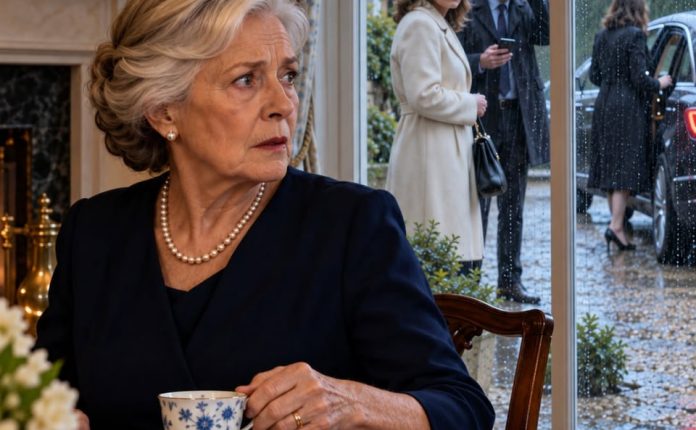
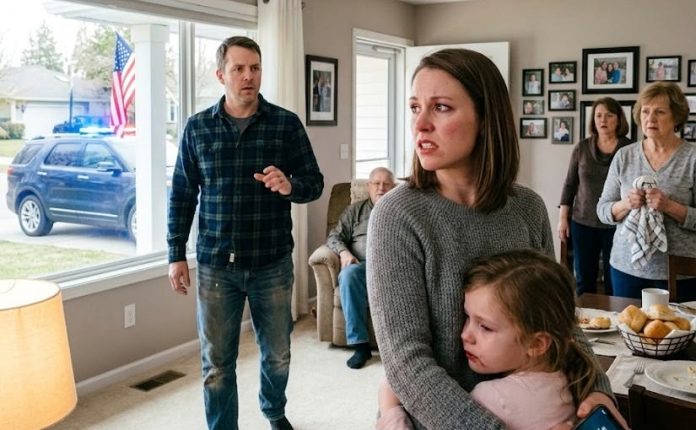
At 6:18 on Thursday evening, my son canceled an invitation I was already dressed to accept.
His second message made it clear that the first had been a courtesy.
“You weren't invited. My wife doesn't want you there.”
I had one pearl earring fastened and the other lying in my palm. For a moment, I kept trying to find the little hole in my ear, as though finishing that ordinary task would make the rest of the evening ordinary too.
Then I put the earring down.
On the refrigerator, beneath a magnet shaped like a pear, was a cream card.
Thursday. Seven o'clock. Come hungry, Mom.
Benjamin had written that last sentence himself. His handwriting still leaned downhill, the way it had when he was twelve and rushing through his homework.
I looked from the card to the phone.
The kettle gave a small metallic click behind me.
That was the sound I remembered afterward. Not a sob. Not a glass breaking. Just the kettle finishing its business while mine had apparently been canceled.
The rain had begun around five. It worked steadily against the kitchen window, blurring the garden and the old birdbath Thomas had insisted was level, despite the evidence every time it rained.
I was seventy-seven. I had buried my husband three years earlier. I knew that an unpleasant evening was survivable.
What I did not understand was why my hands had become so cold.
The navy dress had been hanging outside my wardrobe since morning. I had brushed the shoulders, steamed the skirt, and changed my shoes twice because the first pair looked too sensible.
At lunch, I had wrapped a small housewarming present.
Not another expensive thing. A wooden recipe box containing copies of Thomas's Sunday pancake recipe and the chicken casserole Benjamin used to request on his birthday.
Lucy had asked for the pancake recipe.
“Daddy says yours are different.”
“That's because your daddy lifts the lid too often.”
She had laughed so hard that she dropped her pencil.
I had expected to tell her that again over dinner.
Instead, I stood holding my phone while the recipe box waited by the door, tied with blue ribbon.
There had to be an explanation, I thought.
Perhaps someone was ill. Perhaps the dinner had become a work occasion. Perhaps Genevieve's parents had arrived unexpectedly.
But none of those explanations required the words my son had chosen.
I typed, You invited me on Sunday.
Then I erased it.
I typed, Is Lucy expecting me?
I erased that too.
I was not going to submit evidence in support of my right to eat with my own family.
That thought surprised me. It had more backbone than the thoughts I usually allowed myself where Benjamin was concerned.
I sat down.
Across the room, Thomas's anniversary photograph caught the lamplight. He was laughing at something to the left of the camera, his tie crooked, my hand resting against his chest.
Fifty years married when it was taken.
Fifty-three before I lost him.
I carried the frame to the table and wiped a thumbprint from the silver edge.
“What would you do?” I asked.
The room offered its usual answer.
I had become familiar with that silence. Some evenings it was companionable. Other evenings it waited for me to make decisions I had spent half a century discussing with someone else.
On the table lay the townhouse brochure Benjamin had sent in March.
I had taken it out that afternoon because I wanted to check the street number before ordering a taxi. The houses all looked alike in the picture: pale brick, black railings, clipped shrubs in identical square pots.
He had marked one with an arrow.
For you too, Mom, he had written on a sticky note.
On the telephone he had explained that the ground-floor study could become a bedroom if I ever wanted to stay.
“No more driving home in the dark after Christmas.”
I no longer drove in the dark anyway. Thomas had been the one who liked driving, who could navigate a strange city by looking once at a folded map.
But the offer had pleased me.
There was a downstairs bathroom. Space for my books. A small courtyard where Lucy said we could grow strawberries.
I had helped with the deposit.
After that came the first uncomfortable month, then an insurance payment, then an emergency repair, then the standing transfer Benjamin said would be easier than calling whenever something came due.
By October, I had paid ninety-three thousand six hundred dollars toward their expenses that year.
I knew the figure exactly.
Two weeks earlier, my accountant had asked why my withdrawals had increased so sharply.
“Family,” I had said.
He had waited for something more specific.
I had changed the subject.
Now I rose and opened the bottom drawer of my mother's old writing desk.
The folder inside was thick enough to resist when I tried to lift it with one hand.
BENJAMIN, Thomas had written across the tab.
Fifteen years earlier, our son had lost his job just before Christmas. He and Genevieve were newly married, frightened, and trying very hard to sound otherwise.
Thomas and I had sat with them at this same table.
“Six months,” Benjamin had promised. “Just until I get another position.”
Thomas had drawn columns on yellow paper.
What we could afford. What they needed. When we would review the arrangement.
He had been a practical man, but not a suspicious one. He wanted figures because figures made problems manageable.
The yellow sheet was still there.
Beneath it lay tuition receipts, insurance statements, a mortgage shortfall, and a bill for a car repair that had somehow become a replacement car.
Lucy's preschool invoice was farther down.
Two thousand eight hundred dollars.
I remembered Benjamin's relief when I paid it. He had kissed the top of my head and called me their lifesaver.
It was an affectionate word.
It was also difficult to stop being one once people got accustomed to staying afloat.
Thomas had tried, in small ways, to keep the arrangement visible.
“Let's ask Ben where things stand,” he would say.
Then there would be another reason to wait. A new position. A difficult quarter. Genevieve changing jobs. Lucy coming along after years of trying.
By the time Thomas became ill, I was handling the payments.
After he died, Benjamin handled the online arrangements for me.
It had seemed kind.
He sat beside me at the desk, explaining screens I could barely concentrate on while my husband's dressing gown still hung behind the bedroom door.
“Just approve it here, Mom.”
I approved many things that winter.
I could not have said, three years later, which of them I was still approving every month.
My phone lit up at 6:47.
Lucy.
Grandma, are you coming?
I rested both elbows on the table before answering.
Not tonight, sweetheart. I love you.
The little typing dots came and went.
Did I do something?
I called her.
She answered in a whisper.
“I'm in the hallway.”
“No, darling,” I said. “You haven't done anything.”
“Daddy said you were tired.”
Behind her I heard someone asking for serving spoons. Glasses touched. A man laughed.
The dinner had not been canceled.
Only my place at it.
“I'll explain when we can talk properly,” I said. “For tonight, you enjoy your supper.”
“I made yours with the blue flowers.”
“I know.”
“Should I save it?”
“Yes,” I said. “Please save it.”
After we hung up, I sat without moving until the screen went dark.
I could have called Wesley next door. He would have arrived in his gardening shoes, furious on my behalf and pretending he had only come to return a screwdriver.
I could have called Serena, my niece. She had offered often enough to help me sort the paperwork.
I had always told her everything was under control.
There was something I needed to do before I could bear either conversation.
I found the bank's number on a statement.
The emergency representative introduced herself as Denise. She asked whether anyone was threatening me or had taken my card.
“No.”
“Are you concerned about access to your account?”
“Yes,” I said. “I want to stop paying expenses connected with my son.”
She did not gasp. She did not tell me how families ought to behave.
She asked me to verify my identity.
My birthdate. The last four digits. The security phrase Thomas and I had chosen when the bank introduced such things.
I got every answer right.
Then I explained that I wanted the authorizations associated with Benjamin Kelley reviewed and stopped.
“Some scheduled transfers can be canceled now,” Denise said. “Merchant payments may require individual blocks or direct cancellation. We'll need to go through those carefully.”
“Then let's do that.”
She asked which payments belonged to my own home.
I took a clean sheet of paper and wrote down the gas company, the electricity provider, my insurance, and the regular transfers I made to savings.
Denise worked patiently.
I had expected my voice to shake.
It did not.
Being asked precise questions helped. Which account? Which recipient? Did I recognize this reference?
No one was asking whether I loved my son.
At 7:03, while Denise placed me briefly on hold, I sent Benjamin one message.
Then you and your wife can start paying your own way.
I finished the call, switched off my phone, and took off the remaining earring.
There was no grand sense of victory.
I ate toast standing at the kitchen counter because I had prepared nothing for myself, expecting dinner elsewhere.
Then I put the recipe box in the cupboard.
At eleven, I went upstairs.
At midnight, I was still awake.
I thought of Benjamin at six, arriving home from school with one mitten missing and refusing to admit he had given it to a smaller boy.
I thought of him at twenty-three, asleep in a chair beside Thomas after his first operation.
Those memories remained true.
So did the message on my phone.
For years, I had used the good memories to soften whatever was happening in front of me. That night I let them exist beside each other.
By sunrise, the scheduled instructions Denise could cancel were gone from the pending list. Other payments were blocked for review.
The money already spent remained spent.
My first decision of the morning was that I would stop pretending otherwise.
I dressed in gray trousers and a cardigan with proper pockets.
The navy dress went back into the wardrobe.
At 8:11, Clara opened the side door of First National Bank and ushered me inside before the main entrance opened.
She had managed Thomas's retirement account and known us for twenty-two years.
After his funeral, she sent white chrysanthemums because she remembered that lilies gave me headaches.
She offered coffee.
“Tea, if it's no trouble.”
“It isn't.”
Her office smelled faintly of paper and the orange she had peeled at her desk.
I placed the folder between us.
“I need to understand what I've been doing.”
She nodded and turned her screen so we could both see it.
For the next hour, she asked questions and I answered them as honestly as I could.
Some authorizations I recognized immediately.
Others brought back conversations I had forgotten: a temporary subscription for Lucy's school, a payment for an appliance warranty, an insurance installment Benjamin had asked me to cover while changing banks.
There were active merchant instructions attached to an additional card I had once authorized for household purchases. There were scheduled transfers and recurring bills, some monthly, some quarterly, some annual.
Clara explained that the same underlying expense could leave more than one active instruction in the system.
“One hundred seventy-four items,” she said when she had finished assembling the list.
I stared at her.
“Not one hundred seventy-four separate monthly bills,” she added. “But one hundred seventy-four active instructions and authorizations associated with their expenses. All needing review.”
Eight pages emerged from the printer.
I smoothed them with my palms.
The large amounts were bad enough. It was the little ones that undid me.
A music service I did not use.
A storage plan.
A club charge.
Something called premium home monitoring for a home whose front door code had changed without anyone telling me.
I had become a place where bills went to disappear.
Clara did not say that.
She gave me a ruler to keep my place.
Halfway down the fifth page, I stopped.
“Kelley Residential Services.”
She checked the transfer reference.
“That recipient receives a regular payment.”
“For what?”
“The memo says reserve contribution.”
Benjamin had described a monthly reserve for home insurance.
I remembered asking why the insurer did not collect it directly.
“It's easier this way,” he had said.
“How long?”
Clara gave me the date.
I wrote it down.
“Is that his employer?” she asked.
“His employer is another company.”
She waited.
“I think,” I added.
Clara placed a small yellow flag beside the line.
We made a separate list of questions I needed answered.
Then she reviewed account access, canceled the additional card, and explained how to establish fresh instructions for anything I later chose to support.
My own bills remained in place.
My son would no longer have a working route through my accounts.
Before I signed the final forms, she asked whether I understood the changes.
I repeated them back.
“Are you certain, Mrs. Kelley?”
The question was gentle, but I was tired of hearing certainty treated as something that could not belong to me.
“Yes.”
The pen scratched across the paper.
Clara gathered the signed forms.
“Do you want someone with you today?”
“Not yet.”
She wrote her direct number on a card.
“Call if anything is unclear.”
Outside, the rain had stopped. Water dripped from the bank's striped awning.
I stood beneath it for a moment, breathing the damp morning air.
Then I took a taxi home.
I made tea in the cup with the thin gold rim.
Thomas had bought the set from an antique shop during a holiday when we could barely afford the holiday itself.
“Use them,” he used to say.
I always saved them.
That morning, there was no company coming and nothing to celebrate, which seemed as good a reason as any.
At 11:26, Benjamin called.
I watched his name move across the screen.
Then Genevieve called.
Then Benjamin again.
The first missed payment had reached him.
More accurately, the first payment he had expected me to make had failed to arrive.
A message followed.
Don't do anything else. We're coming over.
I did not answer.
I wanted to finish my tea while it was hot.
I had managed half the cup when tires sounded on the gravel.
Through the curtain, I saw Genevieve step from the car in a cream coat that had never encountered a muddy chair or an uncooperative child.
Benjamin emerged behind her.
He held his phone in one hand and kept looking at it, as though an explanation might appear there if he checked often enough.
Then the rear door opened.
Arthur Bell got out carrying a leather folder.
I set my cup down carefully.
Arthur had helped Thomas prepare our wills. I remembered him standing at the church door after the funeral, trying to close an umbrella that would not collapse.
I had not seen him since.
Now my son had brought him to my house because I had stopped paying bills.
I opened the door before anyone knocked.
“Eleanor,” Arthur said.
“Were you invited to dinner?”
Genevieve glanced toward the road.
Benjamin's jaw tightened.
Arthur looked from one of them to the other.
“I was asked to help clear up a financial misunderstanding.”
“Come in, then.”
In the sitting room, Genevieve started toward Thomas's chair.
I stopped beside it, and she moved to the sofa instead.
Arthur took the straight-backed chair nearest the window.
Benjamin remained standing.
“The mortgage transfer didn't go through.”
“I know.”
“And the school account has a payment warning.”
“Then you'll need to contact the school.”
Genevieve folded her coat over her knees.
“Surely you can see how disproportionate this is.”
“Explain that to me.”
“One unpleasant exchange shouldn't threaten Lucy's stability.”
I looked at Benjamin.
“Tell Arthur what you wrote.”
He rubbed his cheek.
“Mom, I handled it badly.”
“Read it.”
“I know what I said.”
“Arthur doesn't.”
The lawyer's expression changed.
I brought my phone from the kitchen and opened the messages.
Arthur leaned forward.
He read them slowly.
“You told me your mother canceled because she was unwell,” he said.
Benjamin looked at the carpet.
“She was upset.”
“Afterward,” I said.
Genevieve shifted her handbag.
“There were business guests. Eleanor doesn't enjoy that kind of evening.”
“I enjoy deciding what I enjoy.”
Arthur closed his folder, then opened it again more deliberately.
“Perhaps we should establish why I was asked to attend.”
Benjamin sat down.
“We've been concerned that the financial arrangements have become difficult for Mom to manage.”
I looked at him.
“The arrangements became difficult for you to manage at eleven twenty-six.”
“That's unfair.”
“Is it inaccurate?”
He had no answer.
Arthur drew out a document.
My name appeared across the top.
Benjamin began speaking quickly. It was only a practical measure. It would simplify things. I would not have to worry about technical details or get distressed over payment schedules.
“What is it?” I asked.
“A draft financial power of attorney,” Arthur said.
The refrigerator hummed from the kitchen.
Somewhere above us, a pipe clicked as the heating came on.
I watched my son trying to arrange his face into concern.
“Only so I can help,” he said.
“Did I ask for this?”
“We discussed making things easier.”
“With whom?”
He glanced at Genevieve.
Arthur slid the document back toward himself.
“Eleanor, nothing can proceed without your instructions and informed agreement. This is a draft for discussion.”
“Did you prepare it believing I wanted the discussion?”
“I was told you did.”
I waited.
“I can see there has been a significant misrepresentation of the circumstances,” he said.
Benjamin lifted both hands.
“Nobody misrepresented anything.”
Arthur looked at the phone on the table.
My son lowered his hands.
I fetched the eight pages.
“Before we discuss anyone helping with my money, let's discuss where it has gone.”
I laid the first page beside Arthur's folder, the remaining sheets underneath.
Genevieve looked at the thickness of the stack.
“That includes things you've always offered.”
“Yes. And things I agreed to without understanding that they would continue indefinitely.”
“You could have asked.”
“I am asking now.”
I found the marked line.
“What is Kelley Residential Services?”
Benjamin reached toward the paper.
I kept my palm over it.
“What does it do?”
“Small property projects.”
“Whose projects?”
“Ours.”
I waited.
“Mine and Genevieve's.”
“Your own business.”
“Yes.”
“You told me you worked for Northgate Management.”
“I do.”
“Both?”
“It's been difficult getting something independent started.”
The answer came with an old familiar expression: the worried son, trying his best, hoping his mother would recognize the effort before noticing the facts.
I had recognized that expression for forty-eight years.
This time I looked at the paper.
“Why have I been contributing to its reserve?”
“It wasn't originally set up that way.”
“That isn't an answer.”
Genevieve leaned forward.
“Household money moves around. Benjamin handles the accounts.”
Arthur spoke before I could.
“Are you saying Eleanor knew she was supporting a business?”
Neither of them answered.
I went back to the desk and took out the invoice for the repair.
Six thousand four hundred dollars.
Genevieve had called me about it in April.
A leak, she said. Water near electrical fittings. The contractor could start that week if they paid promptly.
I had been anxious about Lucy sleeping in a house with unsafe wiring.
I remembered asking whether the work would disturb her bedroom.
“No, no,” Genevieve had said. “It's contained.”
Now I placed the invoice in front of Benjamin.
“Was this the townhouse?”
He looked at it for too long.
“No.”
Genevieve drew a breath.
“It was the apartment.”
“What apartment?”
“A rental property,” Benjamin said.
I felt the edge of the chair against the back of my knees and sat down.
Not because I was frail.
Because I wanted to hear the rest without needing to think about standing.
“You own another property.”
“The company does.”
“And you told me you couldn't pay for repairs where my granddaughter lived.”
“I didn't say those exact words.”
“No,” I said. “You let me supply them.”
Arthur's hands rested flat on his folder.
For the first time since he arrived, he looked old.
“Eleanor should have independent advice,” he said.
Benjamin turned toward him.
“That's why I brought you.”
“No. You brought me after giving me an account of events that was incomplete.”
The words were measured. The silence after them was not.
Arthur placed the draft back in his folder.
“There will be no discussion of this document today.”
Genevieve stood.
“Then we're making a private family disagreement into something much larger.”
I looked at the invoice again.
“It was already larger. I was the last person told.”
Benjamin asked Arthur whether they could speak outside.
Arthur agreed, but paused beside my chair.
“If you need a referral for independent counsel, I can provide one. I won't advise you about a matter in which your interests and Benjamin's may conflict.”
“Thank you.”
He left his card.
I did not reach for it.
I was still looking at the contractor's address on the invoice, which I had somehow managed never to read properly.
Genevieve remained by the sofa.
“You understand what happens if everything stops.”
“I understand what happens if it doesn't.”
“We have commitments.”
“So do I.”
“To whom?”
The question came out before she could polish it.
I looked around my sitting room.
The worn arm of Thomas's chair. The shelves we built ourselves. A patch on the rug where sunlight had faded the red nearly to pink.
“To the person who lives here.”
She looked away.
For years I had hoped she might someday like me. I had bought thoughtful presents, remembered her mother's operation, praised her curtains, and left before I became inconvenient.
None of those things had given us a relationship in which I could tell the truth.
I began to wonder whether liking me had ever been the point.
Benjamin came back inside without Arthur.
“The school payment,” he said. “Can we at least separate that?”
“Yes.”
His shoulders loosened.
“You can contact the school and explain your arrangements. I won't discuss Lucy's future while you're using her to end this conversation.”
“She is my daughter.”
“Yes,” I said. “She is.”
He sat down again.
For a moment, he looked tired enough to be honest.
“We're stretched.”
“How stretched?”
He stared at his hands.
Genevieve answered.
“New businesses have periods of restricted cash flow.”
“I asked my son.”
Benjamin swallowed.
“The apartment needs a tenant. We put more into the renovation than we planned. The townhouse payment is higher than we expected.”
“Before or after you bought the dining chairs?”
“Mom.”
“I paid for those too.”
He nodded.
The nod hurt more than an argument would have.
It said he knew. He had known while sending the message, while sitting down at seven, while telling Lucy I was tired.
“Why wasn't I welcome?”
Genevieve reached for her coat.
“It was complicated.”
“Make it simple.”
Benjamin looked toward the window.
“There were people there who might invest.”
“In your business.”
“Yes.”
“And I would have interfered with that?”
“You ask questions.”
I sat back.
For seventy-seven years, I had been praised for being agreeable.
Apparently my few questions had become a business risk.
“What questions?”
“About the payments. About the house. You sometimes mention things without realizing how they sound.”
“How would it sound,” I asked, “if your guests knew your mother paid the mortgage?”
He closed his eyes.
There it was.
Genevieve put on her coat.
“This is humiliating enough.”
I looked up at her.
“For whom?”
She said nothing.
Benjamin asked whether we could meet again on Monday, after everyone had calmed down.
“I'll decide after I've reviewed the papers.”
“We have an event Sunday.”
“What event?”
“A small presentation. At the townhouse.”
“Another dinner?”
“No. An open house for the business.”
I remembered Lucy telling me there would be pastries on Sunday, and that she was supposed to stay upstairs while the adults talked.
Benjamin rubbed his forehead.
“We need to avoid more disruption before then.”
“Then don't make any more arrangements involving me.”
He nodded too quickly.
I noticed.
After they left, I locked the door.
Then I stood in the hall with my hand on the key, listening to their car reverse.
The house did not feel triumphant.
It felt ransacked, although nothing had been taken.
I called Serena.
When she answered, I said, “You offered to help with the paperwork.”
She was quiet for a second.
“I'm coming.”
“Bring something for lunch.”
“I was going to.”
“And please don't say you told me so.”
“Aunt Eleanor, I have enough manners to wait at least an hour.”
I laughed.
It hurt my throat.
Serena arrived with soup, bread, and a large canvas bag she used for library books.
She worked at the county library and had a librarian's talent for making disorder feel temporary.
She did not begin with the statements.
She put bowls on the table.
“Eat first.”
I obeyed because it was the first instruction that day offered for my benefit.
After lunch, we sorted documents by date.
Not by how grateful Benjamin had sounded. Not by what the money had meant at the time.
Date. Amount. Description.
The first stack was household support.
The second was payments I had knowingly made as gifts.
The third contained things I no longer understood.
The repair invoice went there.
So did the business transfers.
Serena read the townhouse brochure, then the sticky note.
“Did you ever stay in that room?”
“No.”
“Was it made into a bedroom?”
“It's their office.”
She put the note carefully beside the brochure.
I nearly defended them.
There was still time, I wanted to say. Perhaps they had meant it when they offered.
Instead, I asked her for another folder.
By five, we had a list of unanswered questions and a plate of untouched biscuits.
Serena did not look shocked by the total.
That helped.
She looked angry about the explanations.
That helped more.
“What do you want?” she asked.
“My money back,” I said automatically.
Then I considered it.
Some of it had bought things I had freely wanted to give. Schooling. Christmas. A roof during a bad year.
I would not turn all my love into a bill because I had finally recognized where it had been abused.
“I want to know what I paid for,” I said. “I want it to stop. And I want Lucy to know I didn't stay home because of her.”
Serena nodded.
“Those are three clear things.”
At six, Benjamin sent an email.
The subject was Sunday arrangements.
I opened it expecting an apology.
Instead, there was a short message about preventing confusion, an invitation to the presentation, and an attachment.
He said I might feel better if I saw how important I was to what they were building.
Serena stood behind my chair.
I opened the attachment.
The first page showed the company name above a photograph of the renovated apartment.
The second showed Benjamin and Genevieve in the townhouse courtyard.
On the third page, beneath the words FAMILY FOUNDATION, was a photograph of me.
It had been taken at Lucy's birthday party.
I was holding a paper plate.
Someone had cropped out the cake.
I read the paragraph underneath once.
Then again.
Kelley Residential Services, it said, had been established with family capital and enjoyed the continuing support of its founding family partner, Eleanor Kelley.
Farther down was a statement describing my house as an unencumbered family asset supporting the company's growth.
I gripped the desk.
My house.
The place Thomas and I had paid off one ordinary month at a time.
Serena bent closer to the screen.
“Have you signed anything about this?”
“No.”
On the final page was the Sunday schedule.
At eleven thirty, after the presentation, there would be remarks from the founding family partner.
My name followed.
For a long moment, neither of us spoke.
Then I opened Benjamin's email again.
You might feel better if you saw how important you are.
There it was, written with the same confidence as the invitation on my refrigerator.
Another place had been prepared for me.
Another part had been assigned.
This time I was expected to stand in it and say whatever kept the money moving.
Serena reached toward my shoulder, then stopped.
“What are you going to do?”
I looked at my photograph on the screen.
“I'm going on Sunday.”
END PART 1