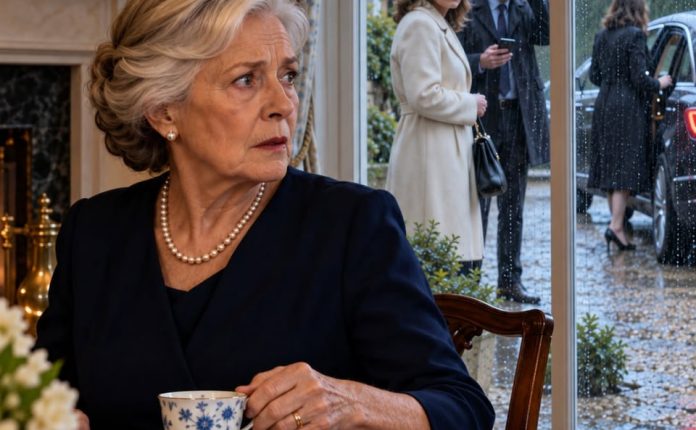
Serena pulled out the chair beside me.
“Then we're going to make sure you understand every page before you do.”
She said it without excitement.
I was grateful. I had no appetite for a scene, and even less for the sort of courage that depended on being angry enough not to think.
We printed the presentation.
I wrote the date and time Benjamin's email had arrived across the top.
Then I replied.
I have received the presentation. I have not agreed to be a partner, provide security, or speak on behalf of your company. Do not describe my property as supporting the business.
Serena watched me read it twice.
“Do you want to add anything?”
I thought about the photograph.
Use a picture of someone who actually works there, I wanted to write.
“No.”
I sent it.
Benjamin called within a minute.
I let the call finish.
Then another message appeared.
You're misunderstanding the language. It's not a legal document.
I read it aloud.
Serena folded her arms.
“It's still telling people something.”
That was what had troubled me before I could put a name to it.
The presentation did not need to mortgage my house to make it useful to them. It only needed other people to believe my house was available.
My years of helping had become a description of what I would always do.
I did not sleep well that night.
At three in the morning, I went downstairs and checked the old metal box where Thomas and I kept the house documents.
The deed was there.
So were our wills, insurance papers, and the little list of telephone numbers Thomas had typed because he distrusted his own handwriting.
Arthur's number was near the top.
I sat at the kitchen table in my dressing gown.
The kitchen was cold. I could hear the refrigerator switching on and the rainwater ticking through the downpipe.
I had almost let the sight of a familiar lawyer in a familiar room persuade me that I was the difficult person.
That frightened me more than the presentation.
Not because Arthur had tried to force me. He had stopped the moment he understood.
Because Benjamin had counted on the arrangement.
My house. My table. An old professional acquaintance.
A document presented as help.
At four, I wrote a list of decisions I did not have to make before morning.
Whether to forgive him.
Whether to see Genevieve again.
Whether there would ever be a Christmas like the ones I remembered.
Then I wrote the things I did have to do.
Protect the accounts.
Correct the statements about me.
Speak to Lucy.
I went back to bed.
On Saturday, Serena drove me to meet Miriam Holt, a lawyer whose office was above a pharmacy.
She had agreed to a short appointment after Serena explained that my name and property had appeared in a business presentation without my agreement.
Miriam wore a plain watch and had three pencils sharpened to different lengths.
She asked me to tell the story from the beginning.
Not from the hurtful message.
From the first arrangement I had made with Benjamin.
It took longer than I expected.
She listened, occasionally asking for a date or a document.
When I finished, she tapped the printed presentation.
“Have you ever signed a guarantee for this company?”
“No.”
“Authorized anyone to use your house as security?”
“No.”
“Agreed to be an owner?”
“No.”
She nodded and made notes.
Then she explained what she could establish from the papers and what still needed checking.
The presentation itself did not make me an owner or automatically give the business rights over my property. It was nevertheless a serious misstatement that needed correcting promptly.
She would review the records and send written notice of my position.
We would also check whether any actual documents existed that I had not seen.
I felt my shoulders lower for the first time since opening the attachment.
“So the house isn't already gone.”
“Nothing you've shown me says that.”
She did not offer promises beyond the evidence.
I trusted her more for it.
We discussed the payments separately.
Much of the money had been given willingly, even if I now regretted the pattern. Recovering every gift was not a reasonable starting point.
The repair payment was different enough to investigate because I had been told a specific purpose.
The company transfers needed an explanation.
“Do you want punishment?” Miriam asked.
The question irritated me until I realized she genuinely needed to know.
“I want to stop being volunteered.”
She wrote that down.
“That's useful.”
I showed her Benjamin's message about misunderstanding the language.
Miriam read it without changing expression.
“Do you still intend to attend tomorrow?”
“Yes.”
“What do you want to accomplish by going?”
“I don't want anyone leaving that house believing I've promised them mine.”
She set down her pencil.
“Then keep to what you know. What you authorized. What you didn't. Don't argue about their motives in front of a room.”
I thought of Genevieve's soft voice.
“That may be difficult.”
“Yes,” Miriam said. “It may.”
Before we left, she asked to speak with me alone.
Serena rose at once.
Miriam waited until the door closed.
“Are these decisions yours?”
“Yes.”
“Do you feel pressured by your niece?”
“No.”
“Do you understand that stopping support may have consequences for your son and granddaughter?”
“I understand that continuing it has consequences for me.”
She nodded.
There was no praise in the gesture.
Only recognition.
I needed that more than praise.
Outside, Serena asked what the private conversation had been about.
“Whether you were bullying me.”
“Were you persuasive?”
“Apparently.”
We went to the bakery downstairs and bought sandwiches.
For the first time in two days, I was hungry.
Benjamin called while we were eating.
I answered.
“Mom.”
“Yes.”
“I got your email.”
“I know.”
“The wording in the presentation was aspirational.”
I put down my sandwich.
“My house is not an aspiration.”
He exhaled sharply.
“You know what I mean.”
“For once, Benjamin, I would like you to say what you mean.”
A bus passed outside, rattling the bakery window.
He waited until the noise faded.
“We wanted people to understand that this was a family business.”
“Then you should have asked your family.”
“I thought your support was obvious.”
“My support was expensive. That doesn't make it unlimited.”
He went quiet.
I could hear Genevieve speaking somewhere behind him.
“Is she coming?” she asked.
Benjamin covered the phone imperfectly.
I waited.
Then he said, “It's probably better if we postpone seeing each other until next week.”
“You invited me yesterday.”
“I know, but things are tense.”
“Have you canceled the event?”
“No.”
“Have you corrected the presentation?”
“We're working on it.”
“Send me the corrected copy.”
“We can't redo everything overnight.”
“You found time to put my photograph in it.”
He said my name then.
Not Mom.
Eleanor.
He sounded like someone speaking to an uncooperative supplier.
I felt the familiar urge to make the conversation easier for him.
Instead, I waited.
Finally he said, “What exactly do you want?”
“A written correction. My name removed as a partner. My house removed as support. A clear statement that you have no promise of future money from me.”
“That will worry people.”
“Yes,” I said. “It may.”
After the call, I finished my sandwich.
Serena did not ask how it had gone.
She had heard enough from my side.
That afternoon, Wesley came over with the recipe box.
For a moment, I stared at it.
“I left it in your cupboard,” I said.
“Serena asked me to bring it down while you were out.”
He held it toward me.
“She thought you might want to give it to Lucy yourself.”
I took it.
The blue ribbon was slightly crooked.
“Everyone seems to be organizing me.”
“Only the useful bits.”
Wesley had lived next door for twenty-six years. He was a retired carpenter who could make a shelf fit an uneven wall and make almost any conversation last longer than he intended.
He glanced at the papers on the table.
“Do you need a lift tomorrow?”
“Serena's taking me.”
“Good.”
He stood there another moment.
Then he said, “Thomas would have hated this.”
“I know.”
“He would also have hated people telling you what he'd have wanted. So that's all I'm saying.”
After he left, I put the recipe box beside my handbag.
At five, Lucy called.
“Are you still tired?”
“No, sweetheart.”
“Can I come on Sunday?”
I closed my eyes briefly.
“Where are you?”
“In my room.”
“Are your parents nearby?”
“Downstairs.”
I chose my words carefully.
“Your father and I have something to sort out. It isn't about anything you've done, and it isn't your job to fix it.”
“Did you fight?”
“We disagreed.”
“About me?”
“No.”
There was a pause.
I heard something rustling.
“I saved your card.”
“I was hoping you would.”
“Mommy said there wasn't room.”
The kitchen seemed to shrink around me.
I pictured the brochure's dining room.
Eight chairs.
I had bought six of them.
“Sometimes adults make decisions they need to explain themselves,” I said. “I'm not going to ask you to explain them.”
“Do you still want to come here?”
“I still want to see you.”
It was the truest answer I could offer.
Before we hung up, she asked about the pancake recipe.
“I have it ready.”
“With the part about the lid?”
“Especially that part.”
When the call ended, I cried.
Not elegantly.
I cried into a clean dish towel because it was closer than the tissues, and because the gentleness I had managed for Lucy had nowhere else to go.
Serena found me like that when she came back with groceries.
She put the bags down and sat beside me.
She did not tell me I was strong.
She handed me a tissue and stayed.
On Sunday morning, I woke before the alarm.
The sky had cleared.
Sunlight lay across the bedroom floor, showing dust I had ignored all week.
I took out the navy dress.
For several minutes, I held it against myself in the mirror.
Then I put it on.
I was not trying to reclaim Thursday. That evening was gone.
But I liked the dress, and I was tired of allowing other people to decide which parts of my life had been spoiled permanently.
I fastened both pearl earrings.
Downstairs, I ate an egg and toast.
I put Miriam's letter, the printed presentation, and my short statement into a plain folder.
The folder marked BENJAMIN stayed in the drawer.
I did not need fifteen years of receipts to establish that I had not pledged my house.
At ten forty-five, Serena arrived.
She looked at my shoes.
“Can you stand comfortably in those?”
“For a reasonable length of time.”
“Then we'll make it reasonable.”
We left at eleven.
The townhouse was twenty minutes away, in a development where the trees still wore support stakes and every front door seemed to have been chosen by the same committee.
Benjamin's house had white flowers in two tall pots.
A discreet sign on the pavement announced the company event.
Through the front window, I saw people holding coffee cups.
For a moment, I could not get my hand to release the car door.
Serena turned off the engine.
“We can sit.”
“No.”
She waited.
“I want to get inside before I make this harder than it is.”
At the door, a young woman with a clipboard asked for our names.
“Eleanor Kelley.”
Her face brightened.
“Oh, of course. We're so pleased you're here.”
She checked a box.
There was my name.
Printed.
Expected.
Useful again.
I asked whether my niece could accompany me.
“Certainly.”
Inside, the house smelled of coffee, warm pastry, and the sharp sweetness of cut flowers.
The chairs I had bought stood around the dining table.
A plate had been placed on every polished surface where a plate could possibly fit.
Genevieve saw me from beside the kitchen island.
Her smile held for one second after the rest of her expression changed.
“Eleanor.”
“You invited me.”
“Benjamin invited you.”
“Then perhaps you'd better find him.”
Serena stood quietly beside me.
Genevieve looked at her.
“This is a private event.”
“My name is on your list,” I said. “And your presentation.”
A man near the window turned slightly.
Genevieve lowered her voice.
“Can we speak upstairs?”
“No.”
The word surprised both of us.
I did not add anything to soften it.
Benjamin came from the hallway carrying a stack of brochures.
When he saw me, he stopped so abruptly that the top sheet slid sideways.
“Mom.”
“Have you sent the correction?”
“We should talk.”
“We've been talking since Friday.”
He looked past me at Serena.
I stepped slightly into his line of sight.
“She isn't answering for me.”
He lowered his eyes.
Behind him, on a narrow table, stood a framed photograph of the renovated apartment.
Beside it was the presentation, printed on thick paper.
My photograph was still there.
I walked over and lifted a copy.
The paragraph had changed by three words.
Founding family partner was now founding family supporter.
My house was still described as an available family asset.
I looked at Benjamin.
“You changed the title.”
“We tried to address your concerns.”
“You changed the title,” I repeated, “and kept the promise.”
A woman in a dark green jacket approached us.
“You must be Mrs. Kelley.”
She offered her hand.
“Ruth Alvarez.”
I shook it.
“I'm Eleanor.”
“We heard a great deal about you Thursday.”
Benjamin's face tightened.
“Ruth, could you give us a moment?”
She glanced between us.
“Certainly.”
I kept my hand lightly against hers for a second before releasing it.
“Were you at dinner?”
“Yes.”
“What were you told about my absence?”
Benjamin said, “Mom.”
Ruth answered carefully.
“That you weren't feeling well.”
I nodded.
“And that you'd be here today to discuss the family backing.”
There it was.
Not a misunderstanding that had occurred in one private conversation.
A statement made to people who were considering what to do with their own money.
I set the brochure down.
“Mrs. Alvarez, there is something I need to clarify before anyone relies on that.”
Genevieve came toward us.
“Eleanor, this is neither the time nor the place.”
I looked around the room.
People had begun to notice.
Coffee cups paused halfway to mouths. A man near the dining table lowered his pastry onto a napkin.
I could feel my heartbeat in the hollow above my collar.
“This is where the statement is being made,” I said.
Benjamin put the brochures down.
For the first time, he did not look angry.
He looked caught between two decisions.
I knew that expression too.
As a child, he had worn it when a lie had become harder to maintain than the punishment he feared.
I wished, with a force that nearly bent me, that he would choose the truth before I had to keep going.
Ruth spoke.
“Perhaps we should all hear the clarification.”
Genevieve's lips parted.
Then she looked at Ruth's husband, who had come to stand beside her, and said nothing.
Benjamin drew a breath.
I waited.
When he did not speak, I opened my folder.
“I have provided substantial personal financial support to my son and his household,” I said. “That support does not make me a partner in this company.”
My voice sounded smaller in the room than it had in my kitchen.
I kept going.
“I have not pledged my house. I have not agreed to guarantee business debts. I have not promised further investment or continuing payments.”
Someone put a cup down too hard.
“I asked for these statements to be corrected before today. They have not been adequately corrected.”
I placed Miriam's letter beside the brochures.
“That is my position in writing.”
There was a long silence.
It was not theatrical.
It was uncomfortable and ordinary, full of breathing and the distant sound of a car passing outside.
Ruth picked up the letter only after asking me.
I nodded.
She read it.
Then she looked at Benjamin.
“Is this accurate?”
He swallowed.
Genevieve answered.
“Eleanor has been upset over a family matter, and we were trying—”
“Is it accurate?” Ruth asked him again.
Benjamin stared at the dining table.
“Yes.”
I felt something in my chest loosen and ache at the same time.
Ruth continued.
“Did you tell us Thursday that her property was available to support the next stage?”
“Yes.”
“Had she agreed?”
He shook his head.
“I thought she would.”
Genevieve looked sharply at him.
He did not look back.
“I thought she'd agree once it was underway.”
The room seemed to recede.
That was the answer beneath fifteen years of temporary arrangements.
Not that he had misunderstood.
Not that I had failed to explain.
He had believed my eventual agreement could be spent in advance.
Ruth set down the letter.
“We won't be proceeding on that basis.”
Her husband nodded.
A man beside the window asked for an updated financial statement before any further discussion.
Another guest quietly removed his coat from the banister.
Nobody applauded.
Nobody called me brave.
The consequences arrived as practical questions for which my son had no prepared answers.
What income supported the household expenses?
Which funds belonged to the company?
What other support had been assumed?
Had any commitment been made elsewhere in my name?
I did not answer for him.
I moved to a chair and sat down.
Serena brought me water.
For years, I had mistaken rescuing Benjamin from every difficult question for standing beside him.
That morning, I sat six feet away while he answered his own.
Genevieve remained near the kitchen island.
She straightened a stack of napkins, though they were already straight.
When she finally spoke to me, her voice was so low that nobody else could hear.
“You could have told us privately.”
“I did.”
Her hand stopped on the napkins.
Then she turned away.
The event ended before noon.
Guests left politely, which somehow made the collapse more complete.
There was no shouting to blame.
No disorder that could be described afterward as the reason things went wrong.
Only a claim that had been made and the person it concerned saying it was untrue.
Ruth paused at the door.
“I'm sorry you were put in that position.”
“Thank you.”
“You should know I wouldn't have wanted your house involved even if you'd agreed.”
I nodded.
After she left, Benjamin stood beside the dining table.
The chairs looked smaller than they had in the brochure.
“Can we talk now?”
“Yes.”
Genevieve began gathering cups.
“Not here,” she said.
Benjamin looked at her.
“Here is fine.”
She set a cup down and went upstairs.
I heard a door close.
For a moment, I worried Lucy had heard everything.
“Where is she?” I asked.
“With Genevieve's mother. Since this morning.”
I let out a breath.
“Good.”
Benjamin sat opposite me.
Serena moved toward the hallway.
“Stay,” I said.
He nodded.
“I didn't think it would get this far.”
“What did you think would happen?”
He looked at his hands.
“That the apartment would rent. That we'd get the next investment. That the business would cover things before you needed to ask.”
“Needed?”
“Before you asked.”
I waited.
He tried again.
“Before I had to tell you how much depended on you.”
The answer was clumsy.
It was also the first one I believed.
“Why wasn't I invited Thursday?”
His face changed.
We had reached the question he wanted the financial trouble to bury.
“Genevieve didn't want you discussing the payments.”
“And you?”
He pressed his thumb into a faint mark on the tabletop.
“I didn't either.”
I looked at him for a long time.
He did not defend himself.
That was something.
It was not enough.
“You let her carry the blame in your message.”
“Yes.”
“You told Lucy I was tired.”
“Yes.”
“You brought Arthur to my house.”
“I thought if we could keep the payments organized—”
“No.”
He stopped.
“Tell me why you brought him.”
His eyes filled.
I had seen my son cry from pain, disappointment, and once from relief so fierce he could not speak.
This time I made myself wait.
“I wanted you to think someone responsible agreed with me.”
The words came slowly.
“I thought you'd listen to him.”
I looked down at my wedding ring.
It had turned loose again.
I straightened it with my thumb.
“Your father trusted Arthur.”
“I know.”
“You used that.”
Benjamin nodded.
For a few moments, all I could hear was the clock in the kitchen.
Then he said, “I'm sorry.”
I believed he was sorry.
I did not yet know what the sorrow would survive.
A changed budget. Genevieve's anger. A smaller home. My continued refusal.
Those would tell me more than the tears.
“I need complete records of the business payments,” I said. “And the repair invoice. My lawyer will contact you.”
He nodded.
“The other money,” he began.
“Much of it was given. I'm not going to pretend otherwise. But I will not give more because you've built obligations around the expectation.”
“What about Lucy?”
“She is not a payment arrangement.”
“I didn't mean—”
“I know you love her. So stop bringing her into conversations where you're asking me for money.”
He rubbed his eyes.
“All right.”
I stood.
He stood too, automatically, as Thomas had taught him.
That small surviving courtesy nearly broke me.
At the door, I handed him the recipe box.
“For Lucy.”
He looked at the ribbon.
“She asked about this.”
“I know.”
His hand tightened around the box.
“Will you still see her?”
“If she wants to see me. If you and Genevieve can arrange it without using her to carry messages.”
“Yes.”
“Tell her I wasn't tired Thursday.”
He looked up.
“You don't need to give her details. Tell her the truth belongs to the adults, and she did nothing wrong.”
“I will.”
On the drive home, Serena asked whether I wanted lunch.
“In a minute.”
She took the longer road through the park.
The trees had begun to turn, each one doing it at its own pace.
I watched a woman teaching a small boy to ride a bicycle.
She ran beside him with one hand hovering behind the seat.
Then, when he was balanced, she let the hand fall.
I looked away before Serena could notice.
The following weeks were quieter than the Sunday event and considerably harder.
Stopping a pattern took one night.
Living differently required decisions every morning.
Benjamin sent the company records.
Miriam reviewed them with me.
The repair payment had funded work on the rental apartment. Benjamin acknowledged in writing that I had been allowed to believe it concerned the townhouse.
He agreed to repay the six thousand four hundred dollars.
The regular company transfers had also been described misleadingly. Their treatment became part of a written repayment arrangement after the records were reconciled.
The rest did not transform neatly into debt.
There were gifts I regretted, gifts I did not, and support that had become excessive without ever being honestly discussed.
I had to accept those distinctions.
Miriam helped me insist on accuracy without pretending accuracy could restore every dollar.
Checks of the relevant records found no actual charge over my house arising from the company.
No guarantee bearing my signature appeared.
Benjamin confirmed that the claim in the presentation had been an assumption, not a right he possessed.
The correction went to everyone who had received the material.
I read the final wording myself.
It named no illness, no confusion, no unfortunate family disagreement.
It said the company had inaccurately represented my participation and financial backing.
I kept a copy.
Clara helped me establish a simpler account structure.
When I wanted to give someone something, I would choose the amount and make the payment myself.
There would be no additional card attached to my household account.
No vague reserves.
No arrangement described as easier if I could not explain what it did.
The first month felt strange.
Money remained where I expected it to be.
I found myself checking twice, almost suspicious of the quiet.
Benjamin and Genevieve sold the apartment after finishing the necessary paperwork and accepting a lower return than they had imagined.
The proceeds went toward its obligations.
There was no new investment round.
Benjamin kept his job at Northgate and stopped introducing himself as the head of a growing property business.
The townhouse went on the market before winter.
I heard about it from him, not from a request to cover another month.
They moved into a smaller rented place near Lucy's school.
Genevieve took on additional work.
For several weeks, she communicated with me only through Benjamin.
I did not chase her.
That was new too.
In December, an envelope arrived containing the first repayment and a short note in her handwriting.
We should not have used your name.
I read it twice.
Then I filed it.
I was learning that acknowledging a sentence did not require adding a warmer one in return.
Lucy's visits began again in November.
The first time Benjamin brought her, she carried the place card with the blue flowers.
One corner had folded over.
“I kept it flat in a book,” she said.
“You did a good job.”
She stood in the hallway, uncertain about whether she could run past him into the kitchen.
I held out my hand.
She took it.
Benjamin remained by the door.
“I'll be back at five.”
“Five is fine.”
He looked toward the kitchen.
For an instant, I saw him wanting an invitation.
I did not offer one.
He nodded and left.
Lucy and I made pancakes for lunch.
She put the recipe box on the counter and read every instruction aloud.
When I reached toward the lid too soon, she slapped the back of my hand very gently.
“Grandma.”
“You're right.”
We laughed.
Later, while she colored at the table, she asked whether grown-ups could apologize and still be in trouble.
I dried my hands.
“Yes.”
“For how long?”
“That depends on what needs putting right.”
She considered that.
Then she chose a blue pencil.
“Daddy said he told you something that wasn't true.”
I sat beside her.
“He did.”
“He said you didn't stop loving me.”
“No.”
“Not even a little?”
“Not even a little.”
She leaned against my arm and continued coloring.
I let the answer stay that simple.
Benjamin came at five.
He did not ask whether I had reconsidered any payments.
He asked whether Lucy had remembered her coat.
She had not.
He found it, helped her into it, and thanked me for the afternoon.
At the door, he said, “I meant what I told her.”
“I hope so.”
He accepted that.
There were more visits.
Some went well.
At others, he reached instinctively for an excuse and had to stop himself halfway through.
I noticed the effort.
I also noticed when it failed.
Forgiveness did not arrive as one generous decision made over tea.
It came in smaller measures, sometimes followed by retreat.
I could enjoy hearing about his day and still remember Thursday at 6:18.
I could believe he loved me and refuse to place my accounts within reach.
The relationship became less comfortable for him.
It became more honest for me.
In January, I paid to have the gutter repaired.
Wesley had been telling me for months that the bracket was pulling away from the wood.
The contractor asked whether I wanted the cheapest temporary repair or the proper replacement.
“The proper one.”
It cost less than one of Benjamin's old club payments.
That comparison occurred to me once.
Then I let it go.
Not every pleasure needed to be measured against what I had stopped giving away.
I bought a good reading lamp.
I joined a small local history group.
I invited Serena and Wesley for Sunday lunch and used the gold-rimmed cups without making an announcement about it.
One afternoon, Benjamin came alone to fix a stubborn cupboard latch.
He had offered. I had accepted.
We stood in the kitchen while he tested it.
“Dad would have had a better screwdriver.”
“Your father would have used a butter knife and denied it afterward.”
Benjamin smiled.
Then the smile faded.
“I miss him.”
“So do I.”
He tightened the final screw.
“I've thought a lot about what I put you through.”
I waited.
“I keep wanting to explain how it happened.”
“You've explained some of it.”
“Not well.”
“No.”
He placed the screwdriver on the counter.
“I was embarrassed that I couldn't manage the life we had. And then I got used to you making sure nobody noticed.”
I looked at him.
“That is closer.”
He nodded.
“I don't expect that to fix it.”
“Good.”
The cupboard closed cleanly when he tested it again.
Before leaving, he asked whether I might come for dinner the following month.
“Just the three of us,” he said. “No presentation. No guests.”
I nearly said yes.
Then I pictured myself getting dressed too early, reading his message too often, waiting for permission to belong.
“I'm not ready.”
His face fell.
He did not argue.
“All right.”
That mattered.
In March, I did go.
The rented house had a narrow kitchen and chairs that did not match.
Genevieve opened the door.
For once, she seemed unsure what to do with her hands.
“Thank you for coming.”
“Thank you for inviting me.”
Lucy had made another place card.
Blue flowers again.
My chair was beside hers.
Nobody mentioned money over dinner.
Benjamin served too much pasta. Genevieve admitted she had burned the first batch of bread. Lucy told a long story about a class hamster that turned out not to belong to her class at all.
The evening was awkward.
It was also real.
When I left, Benjamin walked me to the taxi.
“We can do this again,” he said.
“We can ask each other.”
He understood the difference.
I watched the house recede through the rear window.
There were still things I would never recover.
Money, certainly.
But also the easy belief that love naturally made people careful with one another.
I missed that belief.
I did not need it back badly enough to surrender what I had learned in its place.
At home, I hung up my coat and put the kettle on.
Thomas's photograph stood on the mantel.
Beside it, in a small wooden frame, was Lucy's first place card.
The crease remained visible.
I had considered smoothing it with a warm iron, then decided against it.
I liked knowing it had been kept.
The tea was ready.
I took down the cup with the gold rim, carried it to my chair, and sat by the window.
For once, there was nothing I needed to sign, send, explain, or quietly make right for someone else.
I drank my tea while it was hot.
END PART 2
Disclaimer: This fictional story was created with AI assistance for entertainment. Names, characters, dialogue, and events are fictional. Any resemblance to actual people or events is coincidental.