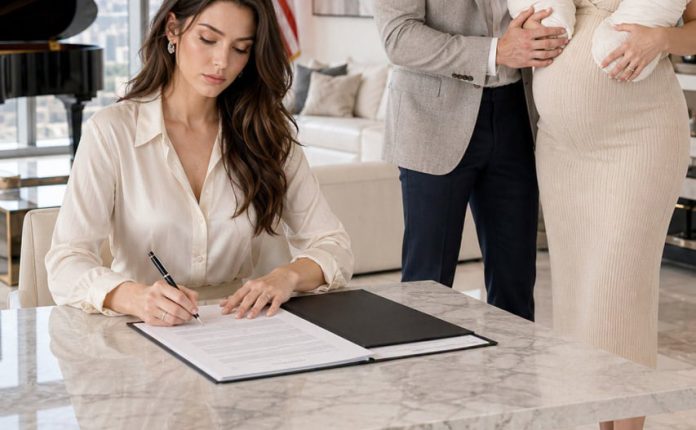
Gwen covered the SUV keys with her handbag before I finished asking.
My mother stood beside the coat rack, ready for the hospital, while my wife told me to find somebody else’s car.
“Your mother isn’t my responsibility, Brandon.”
Mom adjusted the handles of her little overnight bag. She wasn’t being admitted, but she called it her hospital bag because everything she might need was inside: prescriptions, medical records, water, tissues, and a pair of socks in case her feet got cold.
Her blue cardigan was buttoned wrong at the bottom.
I noticed that and wanted, absurdly, to fix it before answering Gwen.
“We discussed this yesterday,” I said.
“We discussed that your car was broken.”
“And that Mom’s appointment was this morning.”
Gwen took a drink of iced coffee. Condensation ran between her fingers onto the stone console table.
“I have plans.”
My mother had arrived at eight because I had asked her to. Her downstairs neighbor had dropped her off on the way to work. We needed to leave by half past eight, allowing time for traffic and the long walk from the parking garage.
The appointment had taken three months to obtain.
Gwen’s brunch reservation was at ten.
“I can drop you off afterward,” I said. “Or order you a car. Whatever works.”
“I don’t want a stranger driving me.”
The contradiction hung between us. She appeared perfectly content to make an elderly woman solve the same problem.
Mom lifted a small parcel wrapped in foil.
“I brought you some banana bread, Gwen. Two pieces separately, so you can take one along.”
“Just put it in the kitchen.”
Mom lowered her hand.
There had been seventeen years of moments like that. Not all of them, certainly. Our marriage had contained good trips, long conversations, ordinary laughter over burnt dinners. Remembering those things had helped me explain away what came afterward.
I told myself Gwen was overwhelmed.
Her boutique, Willow House, occupied a narrow storefront downtown. She loved the opening hours, the window displays, the women who trusted her to find something flattering.
She hated the bills.
Whenever a bill frightened her, the rest of us seemed to become inconvenient.
“Brandon, we can telephone them,” Mom said. “Someone else might need the appointment more.”
She was offering Gwen a graceful escape. She had been giving people those all her life.
I looked at the foil package.
My mother had been awake before sunrise, worrying about test results, and had still remembered my wife’s breakfast.
“No,” I said gently. “We’re going.”
Gwen’s eyebrows rose.
I called Mr. Garrison.
He lived two doors away in a brick house with an immaculate garden and a porch light he left on until the last neighbor came home. During his years as a paramedic, he had helped more frightened people than he could count.
He listened without interrupting.
“Five minutes,” he said. “Is she comfortable walking to the car?”
“Yes.”
“Then we’re sorted.”
I put my phone away.
Gwen shifted her handbag.
“You really needed to involve him?”
“I needed transportation.”
“You could have asked without making this ugly.”
For a second, I considered reciting the conversation back to her.
Instead, I took Mom’s bag.
Mr. Garrison arrived before I found her coat. He stood on our front step in a faded green pullover, carrying an umbrella because the morning looked uncertain.
Mom thanked him three times before reaching his car.
He asked which seat position suited her.
“Most people decide that for me,” she said.
“Well, they’re not sitting in it.”
She gave him a small, surprised laugh.
I was opening the rear door when Gwen called from the hallway.
“Don’t put her parking on my card again. I’m not covering hospital expenses.”
Mom’s laugh disappeared.
I could see Gwen through the open front door. Behind her, the keys lay beside the handbag now, unobstructed.
The SUV belonged to both of us. My salary made the payments. I handled its insurance and maintenance.
The credit card she meant was an additional card on our household account. The previous hospital parking charge had been seven dollars.
I closed the car door carefully.
“We’ll manage,” I said.
Gwen seemed dissatisfied with that. She had expected resistance she could argue against.
I got into the back beside Mom.
We were three streets away before she spoke.
“You shouldn’t be cross with her on my account.”
“I’m not cross with you.”
“That isn’t what I said.”
“I know.”
Mr. Garrison kept his eyes on the road.
At the hospital entrance, he refused the money I offered for fuel.
“You can help me shift some garden pots next week.”
“All right.”
“And you can stop looking as if you’ve asked for a kidney.”
Mom smiled again.
Inside, the familiar smells of disinfectant and warm paper met us. I checked her in while she sat near a window with her bag upright between her shoes.
The receptionist asked whether her address had changed.
“No,” Mom said firmly. “Still in my own place.”
I thought nothing of her emphasis then.
We waited forty minutes. Mom read the same page of a magazine without turning it. I watched the corridor doors.
When the specialist finally called us, I carried the bag and my notebook.
The results were better than we had feared. There were adjustments to make, symptoms to watch, and another appointment to arrange, but no immediate hospital admission.
The doctor explained everything twice, patiently, while Mom asked sensible questions.
Could she keep walking to the library?
Yes, at a comfortable pace.
Could she keep baking?
He smiled.
“As long as you don’t expect me to prescribe cake.”
She laughed, a real laugh this time.
He advised her to rest when she needed to and avoid unnecessary strain. I wrote down the medication changes and repeated the instructions back.
Mom put her hand over mine.
“See? All that worrying.”
For a few minutes, I believed the worst part of our day had passed.
Then she stopped in the waiting area and asked to sit.
Her hands were trembling.
“Are you feeling faint?”
“No. Just sit with me, love.”
She took a folded statement from her purse.
The paper had softened at the creases. Several lines were marked in pencil.
“I should have asked sooner,” she said.
“Asked what?”
“Whether you were managing.”
I studied her face.
My mother had spent thirty-six years working in a school office. She could find a missing permission slip while answering two telephones and reminding a child to eat his lunch.
She had never been helpless.
Age had slowed her knees and made small print troublesome. It hadn’t taken away her judgment.
Yet she was watching me as if she expected a reprimand.
She laid the statement across her lap.
Four hundred dollars had left her account on the fifth of the month.
The recipient was Willow House.
The same payment appeared on the previous statement she unfolded beneath it.
Then another.
“What are these?”
“Gwen said it would help.”
“With what?”
Mom’s thumb moved along the edge of the page.
“The cost of having me.”
I glanced toward the corridor, unable to bear the casual movement around us.
“You have your own apartment.”
“I know.”
“You buy your groceries. You pay your bills.”
“I know, Brandon.”
Her voice sharpened slightly. I stopped.
She wasn’t confused. She was embarrassed.
“I’m asking badly,” I said. “Please tell me what happened.”
She found the messages on her phone.
Six months earlier, Gwen had contacted her about rising household expenses. According to Gwen, I was worried about the money we spent taking Mom to appointments and helping with errands.
I was too proud to ask.
Four hundred dollars monthly would ease the pressure.
The transfers should go into the boutique account, where Gwen supposedly organized family reimbursements.
Mom had asked whether I was angry.
Gwen had replied that discussing it would upset me further.
Please don’t put him in that position.
I read that sentence until the screen dimmed.
“Did you believe I wouldn’t want to speak to you?”
“I thought you were tired.”
“Of you?”
She said nothing.
There had been small changes I had noticed without understanding.
She had stopped attending the Thursday church lunches. She had said the room was noisy.
She had postponed replacing her glasses because the frames were still good.
At Christmas, she had insisted we didn’t need presents.
I had admired her thrift. I hadn’t asked enough questions.
“How many payments?”
“Six.”
Twenty-four hundred dollars.
I put her phone on the empty chair between us.
“Mom, I didn’t ask for this. I didn’t know.”
She smoothed the statement with her palm.
“I thought I was becoming expensive.”
A nurse passed with a tray. I waited for her footsteps to fade.
“You can need things without owing me money.”
Mom stared at the pencil circles.
“And you can tell me if helping gets difficult,” she said. “I don’t want a beautiful answer that isn’t true.”
That was fair.
“Then here’s the true one. Sometimes I need to arrange my work around appointments. Sometimes I get tired. I have never wished you would pay to be my mother.”
Her face changed slowly.
Not relief exactly.
First came the effort of setting down something she had carried for months.
I asked permission to photograph the statements and save the messages.
“Yes,” she said. Then she caught my wrist. “But no shouting.”
“I won’t shout.”
“And don’t decide everything while you’re angry.”
“I’ll try.”
That was the more difficult promise.
Before we left, I called the repair shop. My car would be ready at four.
I told Mom I would stay at her apartment that night.
“You don’t need to look after me.”
“I’d like your company.”
She considered that distinction.
“All right.”
At the elevator, my phone lit up.
Gwen wanted to know whether I remembered the twelve thousand dollars for her new stock order.
I had offered the money several weeks earlier, when she showed me the plans for a Saturday preview at Willow House. New autumn inventory. Refreshments. Invitations to regular customers.
She had been excited.
I had wanted her to succeed.
The funds were in an account in my name, saved from a work bonus. Nothing had been transferred or signed.
I need that transfer tomorrow morning. Please don’t embarrass me.
There was no question about Mom’s results.
I put the phone away.
Mr. Garrison dropped us at Mom’s building, then drove me to collect my car later. He didn’t ask about Gwen.
When I thanked him again, he looked across the roof of his sedan.
“How did the appointment go?”
“Better than expected.”
“Good. Hold on to that part.”
I tried.
Upstairs, Mom made tomato soup while I checked the new prescription instructions. Her apartment smelled of onions and furniture polish. Dad’s reading lamp stood beside the chair nobody else ever found comfortable.
On the dining table was a pair of glasses held together at one hinge with clear tape.
I looked away before she saw me staring.
Gwen called shortly after five.
I answered in the kitchen.
“Where are you?”
“At Mom’s.”
“I went home. You weren’t there.”
“I said I’d collect my car.”
“You didn’t say you were staying out.”
I closed the kitchen door.
“She showed me the payments.”
Silence.
Then a short breath.
“What payments?”
“The six transfers to Willow House.”
“Oh, for heaven’s sake.”
“Why did you tell her I wanted money?”
“Because you never address practical things with her.”
“I never asked you to.”
“She offered to contribute.”
“After you told her I was worried about her expenses.”
“We are worried about expenses, Brandon.”
“Then talk to me.”
“You always turn this into something personal.”
I looked through the glass panel in the door. Mom was setting two soup bowls on the table, taking care not to make noise.
“You made it personal when you used my name.”
Gwen’s voice grew harder.
“So she’s been showing you our private conversations.”
“They concern money you took from her.”
“Took? Listen to yourself.”
I could feel the argument arranging itself into its familiar shape: Gwen objecting to my tone, me defending it, the original issue disappearing.
I stopped.
“I’m not transferring the twelve thousand tomorrow.”
“You promised.”
“I offered to help. I’m not putting more money into the boutique until we understand what has happened.”
“The order is already arranged.”
“Then tell the supplier the funding isn’t confirmed.”
“Do you have any idea what you’re doing?”
“Yes. I’m asking for records.”
She hung up.
I remained in the kitchen until my hand stopped shaking.
At dinner, Mom asked whether Gwen was upset.
“Yes.”
“I could explain—”
“You already did.”
She put down her spoon.
“Don’t speak to me as if I’m a child.”
The rebuke landed cleanly.
“You’re right. I’m sorry.”
She nodded.
“I mean that I can speak for myself. I don’t mean that I want another evening apologizing to her.”
“You don’t have to.”
After dinner, she brought out an envelope from her desk.
Inside was the agreement for the eighteen thousand dollars she had lent us three years earlier.
I remembered that money arriving during the boutique’s worst season. Household funds had gone toward wages and overdue business costs. Mom’s loan had covered three mortgage payments while we recovered.
Gwen had insisted on signing a repayment note.
“Businesslike,” she had called it.
We had both signed as borrowers.
Repayment was meant to begin after a year.
I read the date again.
“How much have we paid back?”
Mom adjusted the taped glasses.
“Nothing yet.”
I sat down.
Gwen had told me she was handling the repayments from the boutique once trade improved. I had accepted it because she handled the business books and because asking twice had begun to feel, in our marriage, like picking a fight.
“I thought—”
“I know,” Mom said.
I deserved that.
The old loan and the new payments were separate matters, but both had survived because everyone had been told someone else knew.
I copied the note with Mom’s permission.
Then I wrote to Meredith Shaw, the accountant who prepared Gwen’s business returns and ours. I didn’t ask her to release anything she lacked permission to share.
I explained that my proposed contribution was on hold. I asked for a meeting with Gwen about the earlier family loan and the payments to Willow House.
I copied Gwen.
Finally, I sent her a separate message saying where I was, that Mom’s medical news was reassuring, and that I would discuss finances in writing or at a scheduled meeting.
She called twice before I put the phone on silent.
Mom watched from the sofa.
“Will your marriage be all right?”
“I don’t know.”
“Don’t answer that for me, either.”
I spread a blanket over the spare bed.
The following morning, I worked from Mom’s kitchen table while she went through her usual routine. She watered a plant, argued with the radio, and reminded me that her kettle required the switch to be pressed firmly.
Gwen’s calls accumulated.
At first the messages were impatient.
Then offended.
Then frightened.
By noon, my phone showed thirty-eight missed calls.
The last voicemail was different.
“Meredith says you’ve withdrawn the contribution. My supplier is asking whether the order is going ahead. Brandon, call me. Whatever your mother has told you, we cannot do this right now.”
I listened once.
Then I opened a new message from Meredith.
Gwen had asked her to arrange an urgent meeting.
For the first time, the conversation Gwen wanted to avoid was the only conversation that could move anything forward.
END PART 1