Mom opened the door wearing the apron I had given her two Christmases earlier.
For one second, she looked relieved.
Then she saw the folder.
“Claire, please.”
I held a small wrapped present for June in my other hand.
“Where should I put this?”
She stepped aside.
The house smelled of roast chicken and furniture polish. Someone had opened the dining room windows despite the cool air, and the curtains moved against the backs of the chairs.
Everything looked familiar enough to make me doubt myself.
Dad's newspaper lay folded beside the sofa. A bowl of peppermints sat beneath the hall mirror. The third stair still creaked when my cousin's little boy ran up to use the bathroom.
I had been loved in that house.
I had also been taught to confuse being useful with being good.
Both things were true.
June came out of the dining room.
“There you are.”
She hugged me without looking at the folder.
I gave her the present, a book she had mentioned wanting, and she immediately complained that I had spent too much.
“It was a paperback,” I said.
“Then I expect an inscription.”
That ordinary exchange gave me somewhere to stand.
Brooke was in the kitchen arranging bread rolls.
She looked at me and then through me.
Dad remained in his chair by the window.
“Claire.”
“Dad.”
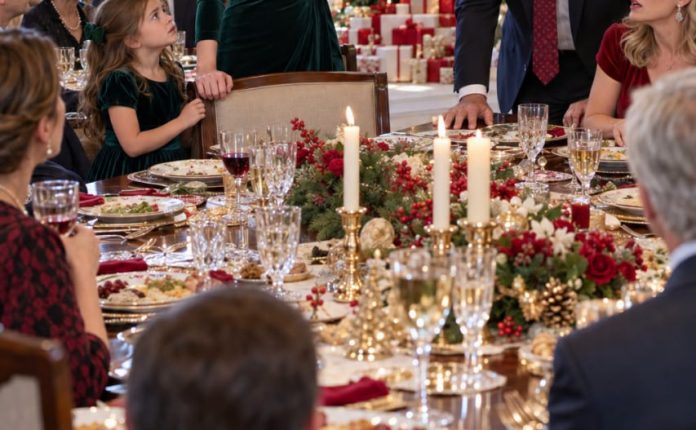
There were nine adults at lunch, including me.
I knew everyone well enough to recognize the strained cheerfulness moving around the table. My cousin Paul asked three questions about traffic. His wife talked at length about a school fundraiser.
Mom served extra potatoes to people who hadn't asked for them.
I kept my folder on the floor beside my chair.
We ate.
June told a story about losing her reading glasses while they were clipped to her blouse. People laughed more loudly than the story required.
For nearly twenty minutes, I thought perhaps we could finish the meal without it happening.
Then Dad put down his fork.
“I'd like us to clear the air.”
June's smile disappeared.
“Martin, it's my birthday.”
“And we're all here.”
He looked at me.
“Your mother and I have been put in a very difficult position this week.”
I folded my napkin.
Brooke stared at her plate.
Dad continued.
“We made plans based on an understanding. Claire chose to withdraw her support at the last minute, after other people had already committed money.”
“No,” I said.
He raised his hand.
“Let me finish.”
“No. You don't get to establish that as the starting point.”
The room fell quiet.
My pulse was beating in my throat, but my voice sounded ordinary.
“I never agreed to fund Brooke's purchase.”
Mom reached for the water jug.
“We don't need to go over every conversation.”
“Which conversation?”
She stopped.
“The one where I agreed. When was it?”
Brooke looked up.
“You said you wanted me to find something stable.”
“I do.”
“You said you believed I could do more than temporary office work.”
“Yes.”
“What did you think that meant?”
“That I believed you could do more than temporary office work.”
Paul lowered his fork.
Dad leaned toward me.
“This is exactly the problem. Everything has to be argued down to the last word.”
I reached for the folder.
Mom closed her eyes.
I set out three copies so people could look without passing one sheet around the whole table.
“This authorization was submitted with my name on it. I didn't sign it.”
Dad looked at the paper but didn't touch it.
“This isn't necessary.”
“You described me as someone who withdrew a promise. This shows what actually happened.”
June picked up the nearest copy.
She read slowly.
Nobody spoke until she reached the bottom.
“Martin,” she said, “did you witness Claire signing this?”
Dad pushed his chair back an inch.
“The situation wasn't as formal as that wording makes it sound.”
“Your name is on the witness line.”
Brooke began crying.
It happened abruptly, with no attempt to hide it.
“I was trying to do something,” she said. “For once, I was trying to get my life moving.”
I turned toward her.
“I know you wanted the café.”
“You don't know anything. You have your job, your savings, Grandpa's money—”
“And you could have asked me.”
“You would have said no.”
The answer came so quickly that she seemed surprised by it herself.
I let the silence hold.
Then I said, “You didn't know that.”
Brooke wiped her face with her napkin.
Dad began to speak.
June stopped him.
“Let her answer.”
My sister looked at the paper.
“I knew you'd want records. A business plan. Someone to go through every number.”
“Yes.”
“And then you'd tell me why I couldn't.”
“I might have told you why I couldn't invest.”
She shook her head.
“To you, it's all the same.”
There it was.
My refusal to promise money had become a judgment on whether she deserved a future.
Any question about costs or experience could be treated as proof I wanted her to fail.
“You were allowed to want that café,” I said. “You weren't allowed to make me responsible for buying it.”
Mom sat down heavily.
“We thought the trust would make it possible.”
“The trust doesn't belong to the household.”
“Your grandfather would never have wanted this.”
I took out the next page.
Dad's face tightened.
“This isn't a discussion about my father.”
“You've made his intentions part of it all week.”
I didn't read the old transfer amounts aloud. There was no need to convert Grandpa's help into a competition.
I explained that he had recorded substantial gifts to my parents and Brooke during his lifetime. His instructions showed that his later provision for me was intentional.
Dad knew the records existed.
I could see it in the way he stopped looking at me.
June read the short excerpt Aaron had provided.
Then she set it beside the authorization.
“Why have you been telling us Walter didn't know what he was doing?”
Dad rubbed the side of his face.
“I said he wasn't himself at the end.”
“This was written before he was ill.”
He looked toward Mom.
She didn't help him.
I had expected relief if the facts finally became undeniable.
Instead, I felt the awful intimacy of watching my parents run out of places to put something.
Dad had built so much of his authority on being the person who knew how matters should be handled.
Now his handwriting lay in the center of the lunch table.
Brooke whispered, “I copied it.”
Everyone looked at her.
She flattened her napkin against her knee.
“I had an old form. From when Claire helped me with the car insurance. Her name was on it.”
I remembered the form. Brooke had needed proof that I was lending her my car for a week while hers was being repaired.
“You kept that?”
She nodded.
“Dad said we only needed to get the application moving.”
Dad turned sharply.
“I told you Claire needed to agree.”
“Afterward.”
“Brooke.”
“You said she'd come around when she understood.”
Their voices rose together.
I put my hands under the table so nobody would see them shaking.
June spoke over both of them.
“You can discuss which part each of you did with your own advisers. Claire has answered the accusation you made about her.”
That stopped them.
No one congratulated me.
No one announced that I had won.
Paul asked, quietly, whether the lender had ever issued the loan.
“No,” I said. “The financing review stopped before funding.”
“So the house hasn't been taken?”
“No.”
Mom made a small sound.
“But we lost twelve thousand dollars.”
I looked at her.
“I understand.”
“That's years of saving.”
“I understand that too.”
She waited for the next sentence.
The one where I offered to make it whole.
I didn't give it to her.
Dad looked around the table, then back at me.
“Are you going to pursue this?”
The question stripped the room of everything incidental.
No one touched a plate.
“I have made a formal statement that the document wasn't mine. I'm preserving the messages and cooperating with the reviews. I won't withdraw the truth to protect the purchase.”
“You'd do that to your sister?”
Brooke stared at him.
For a moment, I thought she might say something.
Instead, she looked down.
“I didn't create the document,” I said.
Dad's face flushed.
“I won't be spoken to this way in my own house.”
I pushed back my chair.
“All right.”
Mom reached toward my wrist, then stopped before touching me.
“Where are you going?”
“Home.”
“We haven't resolved anything.”
“We've established what happened.”
I picked up the folder.
“I won't pay the deposit. I won't sign a new authorization. I won't discuss my trust as a family asset. If you need to communicate about the document, use Dana's office.”
The words sounded prepared because I had prepared them.
I needed them when my own voice threatened to disappear.
Brooke said my name.
I stopped beside her chair.
Her eyes were wet, but she wasn't crying now.
“Did you ever think about helping?”
“Yes.”
That seemed to hurt her more than no would have.
I didn't explain that I might have offered to pay for a proper business assessment or helped her compare options. Those possibilities no longer belonged in the room.
They were not a price list she could use to negotiate backward.
I kissed June's cheek.
“I'm sorry about lunch.”
She squeezed my hand.
“I would rather have an uncomfortable birthday than help this continue.”
Outside, the afternoon was pale and windy.
I sat in my car until my hands steadied.
Nobody followed me.
For years, I had imagined that setting a real boundary would feel like locking a heavy door.
It felt more like standing in cold air after leaving a crowded room, unable to decide whether I was relieved or simply alone.
Both, as it turned out.
The weeks afterward were less dramatic and much harder.
There were no more announcements about freezing my trust.
There were practical matters, legal correspondence, and long stretches when my phone stayed silent.
Dana helped me provide the original messages and a clear account of the events. The broker preserved the application and related emails. I gave a statement to an investigator concerning the disputed authorization.
I did not receive an immediate verdict wrapped in a satisfying bow.
There were interviews. Requests for clarification. Questions about who had sent which attachment and when.
Dad obtained his own legal advice.
Brooke did too.
I learned to answer the question actually asked, then stop.
I didn't speculate about motives in official statements. I didn't exaggerate the threat to my parents' house. I didn't claim money had been stolen from my trust when it hadn't.
What they had done was serious enough without improving it.
The café was eventually sold to another buyer.
Brooke deleted the photograph beneath the awning.
My parents tried to recover the deposit. Their own adviser reviewed the purchase terms and explained the difficulties.
They did not get it back.
There were additional professional fees and application costs.
To replenish their savings and cover what they owed, they sold a small lakeside cabin Dad had inherited from his uncle years earlier.
Mom sent me the listing.
No message accompanied it.
I watched the preview image load: gray siding, a narrow porch, two plastic chairs.
Then I archived the conversation.
Their home remained theirs.
So did the responsibility for deciding what to sell.
A month after the birthday lunch, Dad posted in the family group.
The message was short and stiff.
He said I had never agreed to finance Brooke's business, that the authorization should not have been submitted, and that it had been wrong to blame me for the failed purchase.
Dana had asked for a correction to the people who received the accusation.
Dad had resisted until June told him she would otherwise correct the story herself whenever it arose.
I read his message at work.
Then I put my phone away.
I had wanted a public correction because a public accusation had consequences.
Receiving it didn't restore anything private.
Mom wrote separately two days later.
She said she had known the signature wasn't mine.
She said she should have stopped the application.
There was no reference to my tone, no explanation about Brooke's difficulties, and no request for money.
I stared at that message for a long time.
Then I replied.
Thank you for saying that. I need some distance.
She answered that she understood.
For once, she didn't ask how long.
Spring came.
My scheduled distribution arrived through the trustee in the ordinary way, after the ordinary paperwork.
No one called to announce it.
There was no ceremony.
I sat at my kitchen table with the confirmation open and Grandpa's letter beside it.
The amount was substantial. I could finally make choices I had postponed for years.
That didn't mean I suddenly understood how to make them.
I met with an independent financial adviser. I paid off my car. I left the rest alone while we worked through taxes, reserves, and long-term plans.
I kept my job.
Not because I needed to prove I could.
Because I liked being good at something that had taken me years to learn.
Eventually, I rented a slightly larger apartment with a small room I could use as an office.
June helped me unpack books.
She found the framed photograph of Grandpa on a fishing pier, wearing a hat he hated and holding a fish too small to justify the expression on his face.
“Where does he go?” she asked.
“By the window.”
She set him there.
Brooke contacted me in early summer.
Her first message asked whether we could meet.
I said I wasn't ready.
She didn't send another for six weeks.
The second message contained an apology without an appointment attached.
She named the copied signature. She named the taunting call. She named the deposit she had tried to make me reimburse.
Then she wrote that she was working as a shift supervisor at a diner across town.
She hadn't included that as proof I owed her forgiveness.
At least, I hoped she hadn't.
I replied that I was glad she had found work.
That was all I could honestly offer.
The formal reviews concerning the application continued on their own timetable. I cooperated when asked and let Dana handle correspondence. My family no longer controlled the facts by insisting that everyone keep quiet.
I stopped checking for updates every morning.
There were other mornings to have.
In August, Mom asked whether I would meet her for coffee.
A public place, she suggested. Just the two of us.
I agreed to forty minutes.
She arrived early and stood when I entered.
For a while, we discussed her garden and my new apartment.
Then she put her cup down.
“I keep thinking about what I said at your door.”
I knew which sentence she meant.
You were always the easier child.
She looked at the table.
“I treated that as something you owed us.”
I waited.
“I don't know how to fix it.”
“I don't either.”
Her eyes filled, but she didn't ask me to comfort her.
We stayed for the forty minutes.
When we left, she asked before hugging me.
Dad sent birthday cards after that.
I read them.
I wasn't ready to have him back in my apartment, and I told him so.
For the first time, his disappointment didn't require me to revise my answer.
Some evenings were still difficult.
I missed the version of my family I had believed in. I missed being able to hear the phone ring without bracing myself.
Sometimes I wondered whether a check would have bought back the old ease.
Then I remembered the witness line.
There had been no ease on that page.
Only my name, used in my absence, and my father's certainty that I would eventually make it all right.
One evening, nearly a year after the call, I came home late from work with groceries cutting red grooves into my fingers.
I set the bags on the counter and opened the window.
The apartment smelled faintly of the basil plant June had brought me. Downstairs, someone was teaching a child to ride a bicycle, calling encouragement each time the wheels wobbled.
My phone lit up.
Mom had sent a photograph of her first tomatoes.
No question followed.
No estimate. No emergency. No careful silence waiting for me to fill it.
I sent back a photograph of my basil, which was surviving mostly through stubbornness.
Then I made dinner.
Grandpa's letter stayed in the drawer beside my table, close enough to find when I needed it.
I no longer read it every day.
THE END
This is a fictional story inspired by real-life family conflicts. Names, characters, dialogue, and events have been created or adapted for storytelling.
END PART 3
Disclaimer: This fictional story was created with AI assistance for entertainment. Names, characters, dialogue, and events are fictional. Any resemblance to actual people or events is coincidental.