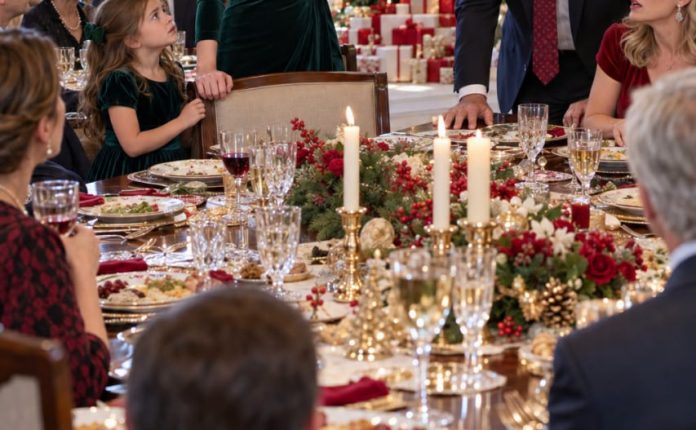
My sister was still smiling when my daughter began folding her drawing out of sight.
“Show me that again, Nora,” I said.
Across the table, Rachel rested her wineglass against the cloth napkin beside her plate.
“Oh, Hannah. She doesn't need applause for every piece of paper.”
Nora stopped folding.
The Christmas tree stood behind her chair, its lights reflected in the dark window. She had spent most of that afternoon at our kitchen table, drawing a cottage with a reading room beneath the staircase. There were shelves measured with a ruler, pillows shaded green, a little lamp positioned where someone could reach it.
She had asked me three times whether bringing it would seem silly.
I had told her Aunt Rachel designed rooms for a living.
Now I wished I had said we could leave it safely at home.
“I'm not asking for applause,” I said. “I'm asking to see her picture.”
Dad made a small impatient movement at the head of the table.
We hadn't reached the ham yet.
My name is Hannah Carter. I was thirty-three, and I had already sent my father sixty thousand dollars by the Christmas he decided to call me a parasite.
I wasn't thinking about that number when we arrived.
I was carrying a bakery pecan pie under one arm and checking whether Nora had zipped her coat. My phone vibrated against the kitchen counter while I lifted the pie from its box.
January transfer scheduled.
Twelve hundred and fifty dollars.
I swiped away the notification without opening it.
Dad's mortgage payment had become part of my month, like rent or electricity. I knew when it left. I knew how much remained afterward. I had become so practiced at arranging our lives around it that I no longer noticed myself doing it.
I managed three convenience stores around Columbus.
Some mornings began before five because someone couldn't open. Some evenings ended with me counting a safe twice while a tired cashier cried in the stockroom. The salary looked respectable until everything came out of it.
Rent. Insurance. Groceries. Nora's shoes.
Dad.
My Ford was twelve years old. I kept a blanket on the passenger seat because the heater sometimes produced nothing warmer than a determined breeze.
I had postponed a management certification twice.
The first time, Dad needed help catching up after retirement.
The second, he needed another year.
I called both decisions temporary.
That was the word he had used.
Ten years earlier, Nora's father had left us with an unpaid electricity bill and a message explaining that he wasn't ready for responsibility. I was ready for very little myself, but readiness didn't matter. Nora still needed formula. The landlord still needed rent.
Dad let us move into his spare bedroom.
I could remember that room with an accuracy that sometimes embarrassed me: the loose brass knob, the curtains with faded leaves, the secondhand crib he carried upstairs without asking whether I could help.
One night, after another apartment application failed, I cried in his kitchen.
He made scrambled eggs and put them in front of me.
“You belong here,” he said. “Eat before they get cold.”
For years, whenever I felt tired or resentful, I returned to that plate.
He helped me.
Therefore I should help him.
It seemed simple enough until helping became a permanent arrangement with only one person allowed to question it.
When Dad retired four years earlier, he called after Nora's bedtime.
He sounded embarrassed.
The mortgage was becoming difficult. His retirement income hadn't stretched as far as he expected. He needed breathing room.
“I can cover it for a while,” I said.
The payment was twelve hundred and fifty dollars. His lender already drafted from his household checking account, so he asked me to transfer the money there.
There was no contract.
There was my father saying thank you.
Every December after that, I asked whether his finances had settled.
“Almost,” he would say. “Could you give me another year, sweetheart?”
I always did.
At Christmas dinner, Rachel arrived twenty minutes late with a bottle of wine expensive enough that Dad read the label aloud.
She owned an interior design company and a small showroom in a converted warehouse. She dressed in quiet colors that somehow looked more costly than bright ones.
Dad stood to take her coat.
He hadn't stood when Nora and I arrived.
I noticed, then immediately felt petty for noticing.
That was another habit I had developed.
Rachel asked about a cousin's kitchen renovation, discussed a commercial client, and told Dad about a photograph of her work that might appear in a regional magazine.
He asked questions.
When I mentioned that one of my stores had passed a difficult inspection, he nodded while reaching for the mustard.
Nora waited for an opening.
She was good at waiting.
Finally, she unfolded her drawing.
“I made something you might like.”
Rachel leaned back.
“A house?”
“A cottage. But the stairs are wider so there's room underneath.”
“For storage?”
“For reading.”
Nora pointed to the shelves, explaining how the lamp would fit beside the window seat. Rachel looked down at the paper.
“Your mother used to come up with plans, too.”
I raised my eyes.
“Rachel.”
“What? She did.”
Nora glanced between us.
“Mom still has plans.”
“Of course,” Rachel said. “I'm only saying it's important to follow through.”
My daughter drew the paper closer.
Then Rachel added that people shouldn't grow up expecting someone else to carry them.
I put down my fork.
“Talk about the room she drew.”
“I am talking about her future.”
“Then leave my past out of it.”
Dad exhaled loudly.
“Hannah. We just sat down.”
Aunt Beth looked at me from the opposite side of the table.
She was Dad's younger sister, a woman who usually spoke softly enough that people leaned toward her. Now she set down her water without drinking.
Rachel reached across the table.
“Some people learn to build a home. Other people learn where the spare bedroom is.”
I took the drawing before her hand reached it.
“Don't speak to my daughter that way.”
Rachel's smile disappeared.
“I wasn't speaking to you.”
“You were speaking about me.”
Dad put both palms beside his plate.
“Apologize.”
I stared at him.
“For what?”
“For making an argument at my table.”
Nora's chair made a faint scraping sound as she moved closer to mine.
“No,” I said.
I didn't shout. I didn't swear.
I said one small word.
Dad pushed back his chair.
I stood because I thought we were leaving. My hand was already reaching for Nora's shoulder when he came around the table.
The first slap turned my face toward the tree.
The second caught me before I understood that he meant to do it again.
My hip struck the table. A glass overturned. Nora shouted, and I tried to move backward, but the chair was behind my knees.
Three more.
I counted them because counting gave me something to do.
Five.
Then Beth was between us, one hand against Dad's chest.
“Get away from her.”
He breathed through his mouth.
“You're nothing but trash,” he said. “Rachel made something of herself. You live off other people.”
I heard the radiator knocking beneath the window.
That detail stayed with me.
The room had become quiet enough to hear an old pipe.
Nora gripped my sleeve with both hands.
Rachel looked down at her plate.
For a moment, I waited for Dad to recognize what he had done. I wanted the man who carried the crib upstairs to look at his hand and understand it belonged to him.
Instead, he pointed toward my chair.
“Sit.”
Beth turned her head.
“Hannah, get your coat.”
Dad said I wasn't leaving while he was talking.
I took out my phone.
My cheek felt hot and strangely thick. I could hear my pulse inside one ear.
“What now?” Rachel asked.
I opened the banking app.
The January transfer waited beneath the words Dad house.
I had typed that description four years earlier while sitting on the edge of my bed.
My thumb wouldn't land where I wanted it.
I found the support number, entered the wrong menu, and started over.
Dad gave a short laugh.
“Always an audience.”
The line connected.
I answered the security questions. I spelled my surname. I confirmed my address.
Then I said, “Stop every automatic payment from my account to Thomas Carter's household account.”
Dad's expression changed.
The representative asked me to identify the recurring transfer.
I read the account digits.
“And cancel the January payment,” I added. “I won't be sending another mortgage payment. He has no authority over my account.”
Rachel sat forward.
“Hannah, just wait.”
I looked at her.
She had said my name all evening as though I were an inconvenience. Now she said it like a door was closing on her hand.
Dad lowered his voice.
“We can talk about the money after everyone leaves.”
“You can talk to Beth.”
The representative explained which instruction had been canceled and told me to review my other scheduled payments. I asked for a confirmation number.
Beth found a pen in her handbag.
I wrote the number across a grocery receipt.
Nora tugged my sleeve.
“Can we go?”
“Yes.”
I picked up her drawing.
Gravy had reached the corner with the window seat.
Rachel stood near the hall.
“You're doing this at the worst possible time.”
Beth looked at her.
“What time would have suited you?”
Dad answered before she could.
“My mortgage is due.”
But Rachel was looking at my phone.
At Thanksgiving, she had mentioned that January would be difficult for the showroom. Something about a payment falling before a client installment arrived.
I hadn't asked.
People who were praised for success rarely had to explain what success cost.
“What have I actually been paying?” I asked.
Dad reached for the phone.
Beth caught his wrist.
Rachel said, “Thomas. Don't.”
I had never heard her call him anything but Dad.
He pulled his arm back.
“You're embarrassing yourself,” he told me.
“No,” Beth said. “We're leaving.”
Rachel glanced toward Nora.
“Can't we discuss adult matters without involving her?”
My daughter was standing beside me with her mouth pressed shut so tightly the skin around it had gone pale.
“She was here for the adult part,” I said.
Outside, the cold air hurt my cheek.
Nora took my keys because I couldn't find the right one. She located the Ford and stood beside the passenger door, trying to be useful.
Beth told me she was driving us to urgent care.
I began to say I didn't need—
Then I stopped.
My daughter had seen enough of me making injuries smaller to help other people feel comfortable.
I sat in the back beside her.
At the first red light, Dad called.
Rachel called before his second attempt finished.
A cousin sent a message asking why I had made Christmas about money.
I put the phone facedown.
Nora watched Beth's hands on the steering wheel.
“Was it because I showed the drawing?”
“No.”
“Because I asked Aunt Rachel about the stairs?”
“Nora, look at me.”
She did, reluctantly.
“You did nothing wrong. I did nothing that made it right for him to hit me.”
Her eyes filled.
“Then why did he?”
I could have offered anger or stress or some careful explanation about people losing control.
Instead, I said, “I don't know why he chose that. We don't have to stay near him while we figure it out.”
At the clinic, Beth stayed with Nora while a nurse examined me.
Saying what happened aloud took longer than I expected.
“My father struck me.”
“How many times?”
“Five.”
The nurse waited while I swallowed.
She asked about dizziness, my hearing, whether my vision had changed. She asked whether I had somewhere safe to sleep.
I thought of our apartment.
My own door. My own key.
“Yes.”
I asked her to record the injuries.
When she photographed the swelling, I looked at a poster on the wall rather than the screen.
Afterward, Beth took us to her house.
She made toast and cut an apple. Nora ate half a slice while sitting against my side.
“Can we stay here tonight?”
“Of course,” Beth said.
She brought a blue blanket from the hall cupboard. Nora fell asleep on the sofa with her socks still on.
I sat at the kitchen table, holding an ice pack inside a dish towel.
Beth's phone lit up.
She read the message once, then pushed it across the table.
Dad had written that I had misunderstood an old family arrangement.
He said my payments were contributions toward what I owed him.
I read it twice.
“What I owed?”
Beth didn't answer for him.
I opened our old messages.
There were years of ordinary things: a leaking faucet, Nora's school photographs, reminders to bring rolls.
Then I reached the request.
Could use help with mortgage until retirement settles. Payment is 1250. Just temporary.
I turned the screen toward Beth.
“That's what he said.”
“Save it.”
“I have it right here.”
“Save another copy.”
Her tone was practical. It gave me a task I could finish.
I made a folder and began collecting the messages.
Last December, Dad had written: Still need another year on the mortgage, sweetheart.
This December: Nothing has changed with the house payment.
I stared at that one.
It was only three weeks old.
I had received it while standing in a store parking lot, waiting for my windshield to clear.
That night, I had told Nora we would take our weekend trip in spring instead.
My phone vibrated again.
Dad: We need to settle this without outsiders.
I set it down.
Beth put a cup of tea beside me.
“You don't have to answer tonight.”
“I want to know.”
“What?”
“Whether I was paying what he said.”
Beth sat.
I searched Rachel's messages next.
Eighteen months earlier, she had sent a photograph of her newly painted showroom. There were flowers beside the entrance and a narrow brass sign above the door.
Dad got me through a rough quarter. Couldn't have managed without him.
I remembered sending a heart.
I had been happy for her.
That was what made the photograph difficult to look at.
I had been happy while deciding whether we could afford summer camp.
Beth studied the date.
“Wasn't that around the time he sold the cabin?”
Dad had inherited a small lakeside cabin from his uncle. He sold it the summer before last, complaining about repairs and taxes.
I remembered asking whether the proceeds would make retirement easier.
“Most of it was already spoken for,” he had said.
I hadn't asked by whom.
Beth opened her laptop.
“We should check what we can check.”
I moved my chair beside hers.
The county property records took a while to navigate. There were documents with numbers that meant nothing to me, old filings, scanned pages tilted sideways.
Beth searched the address.
I held the cold pack against my cheek and watched.
She opened a document recorded eighteen months earlier.
A mortgage satisfaction.
The lender's name matched the one Dad had given me.
His name appeared beneath the property description.
I read the paragraph three times.
“Does this mean the mortgage is gone?”
“It means that mortgage was paid,” Beth said. “We don't know whether he borrowed again.”
I appreciated the distinction even as my stomach tightened.
The date was in June.
My transfers had continued in July.
And August.
And every month after that.
I had asked him twice whether he still needed mortgage help.
He had said yes.
Beth took her hand off the mouse.
“Don't call him yet.”
But my phone was already vibrating on the table.
Dad again.
I let it stop.
Then another message arrived.
If you stop that payment, you will be responsible for what happens to this family.
I looked from his message to the document on Beth's screen.
For four years, I had thought I understood what my money was protecting.
Now there was a date in front of me that divided those years in two.
And my father had kept asking me to pay after it.
END PART 1