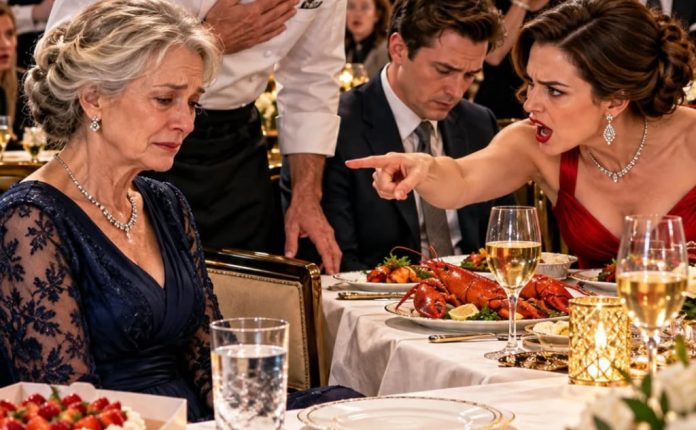
Claire ordered lobster for everyone except me, then pushed a glass of water across the linen.
“That will be enough for her.”
The waiter’s pencil stopped.
I waited for my son to correct her. Ethan had invited me. Ethan had said we ought to start again.
“Did you hear that?” I asked him.
He aligned his knife with the edge of his plate.
“Remember your place, Mom.”
I could hear someone laughing near the bar. A spoon touched a cup behind me. The restaurant went on being a restaurant, which felt almost impossible.
“All right,” I said.
I put my hands beneath the table.
The water had come from a heavy glass pitcher. Claire had poured it herself, a small domestic gesture performed in a room where people were paid to anticipate thirst. She had even turned the glass so the pale blue pattern faced me.
Nothing about it was careless.
I was sixty-five. My name was Eleanor Hayes, and I had worked with food for most of my adult life. I knew what it meant to leave one person unfed at a table.
So did my son.
Three days earlier, when he called, I had been scraping flour from the groove along my kitchen counter.
“Are you free Friday?”
“For you? Usually.”
“We thought dinner might help.”
“With what?”
He paused.
“With us, Mom.”
I rested the scraper on the counter.
For nearly a year, our conversations had been reduced to practical things. A parcel delivered to my apartment because someone needed a daytime address. A question about an old vaccination record. A request to watch Lily for an afternoon that became an evening.
I could not remember the last time Ethan had called simply to hear my voice.
“Just dinner?” I asked.
“Just a chance to clear the air.”
I wrote Rowan House on the calendar beside my refrigerator. I checked the bus route twice.
Then I took my navy dress out of its garment bag.
It wasn’t an expensive dress, but the seams sat properly, and I knew how to press it. I polished my shoes, repaired a loose thread at one cuff, and found the silver earrings Ethan had bought me when he was seventeen.
He had worked six weeks shelving groceries.
The earrings came in a cardboard box with a gold sticker. He left the receipt inside by mistake.
Twenty-eight dollars.
I had pretended not to see it.
On Friday afternoon, Lily called from Claire’s phone.
“Nana, are you making my cake?”
“Of course.”
“Strawberry?”
“Unless you’ve changed your mind.”
“No. Can strawberries be flowers?”
She was turning four on Sunday. The family celebration was planned for that afternoon, although I had not yet been given a time.
“We can arrange them like flowers,” I told her.
She considered this.
“Then I want flowers you can eat.”
I baked two sponge layers, filled them with cream, and put small strawberries around the top. The kitchen smelled sweet and warm even after I opened the window.
I wrote a card because Lily had started recognizing her own name.
To Lily. Love, Nana Eleanor Hayes.
It was more formal than I usually signed anything for her, but she liked tracing the letters in my name.
At the restaurant entrance, rain shone on the shoulders of people’s coats. Rowan House occupied an old bank, with high windows and brass fittings somebody polished often enough to keep fingerprints from settling.
I had passed it on buses.
I had never gone inside.
A young woman took my coat and offered to carry the cake.
“I’ll keep it with me,” I said.
I had carried cakes on crowded buses before. The box was safer in my hands.
Ethan stood when he saw me, which briefly restored something.
“Hi, Mom.”
He kissed the air beside my cheek.
Claire remained seated between her parents. Martin had one hand resting on a wine list; Judith was using her phone to check her hair.
“Eleanor,” Claire said. “You found it.”
“Yes.”
“The traffic can be confusing if you aren’t used to this part of town.”
“I came on the number twelve.”
Martin looked up at that.
My chair stood beyond the corner of the table, separated from Ethan’s by a gap broad enough for a server to move through.
I could have asked to close it.
Instead, I lowered the cake beside my handbag and sat.
That was an old habit: adjusting myself before anyone had to acknowledge an inconvenience.
Ethan said Lily was with a sitter.
“She called about the cake,” I told him.
Claire glanced down at the box.
“You can leave that with us afterward.”
I waited for a word that never came, then scolded myself for waiting.
Our waiter introduced himself as Daniel. He set down five menus and described the evening’s specials. There was a fish dish with white beans. I thought that sounded pleasant.
Before I could ask about it, Claire returned her menu.
“Four lobster dinners. The wine we discussed when I booked. Four of the small appetizers, and we’ll decide about dessert later.”
Daniel looked toward me.
Claire reached for the pitcher.
Everything that followed happened quietly.
That was part of what made it so difficult to bear. She had not lost her temper. My son had not been startled into saying something foolish.
They were comfortable enough to do it in normal voices.
After Ethan’s remark, Daniel addressed me directly.
“Would you like a moment with your menu?”
“For now, yes. Thank you.”
I could have ordered then.
I had money in my handbag. Not enough to live as they did, but enough for dinner.
Yet my throat had tightened in a way that made choosing fish or soup seem absurd. I needed a moment to understand what I had walked into.
Daniel left my menu beside my plate.
Ethan checked his phone.
My son’s father left when Ethan was six. One drawer emptied. One key missing from its hook. A number that rang until, eventually, it didn’t.
For several weeks, Ethan asked whether his father was coming home before bedtime.
Then he stopped asking.
I worked office-cleaning shifts before school, cafeteria shifts during the day, and evening jobs when I could arrange someone trustworthy to watch him.
There were good years and harder ones. I learned which shops marked down milk on Thursdays. I learned to repair a zipper without replacing it. I learned how to sleep sitting upright on the bus without missing our stop.
Ethan grew.
He was funny, observant, stubborn about homework and tender with injured things. Once, he carried a wet pigeon home in his sweatshirt and wanted to know whether soup would help.
That boy had existed.
Remembering him was not foolishness.
Believing the man would always behave like him had become something else.
The appetizers arrived. Four pale plates, each with a small, carefully arranged portion.
Martin tasted his and nodded.
“Excellent.”
Judith asked Ethan about work, and for several minutes they talked around me with the ease of people who had already decided who mattered to a conversation.
Then Martin mentioned a colleague whose mother needed help with rent.
“Sixty-nine years old,” he said. “Still expecting someone else to catch her.”
Judith shook her head.
“I couldn’t bear being a burden.”
I kept my eyes on the tablecloth.
I rented a small apartment above a pharmacy. It was clean, quiet after closing, and mine in every way that mattered except the deed.
I had never asked Ethan to pay for it.
He knew that.
He also knew why I had not accumulated a large retirement account. College bills had arrived during years when the cafeteria cut hours, and I had helped him because helping him felt like an investment in a life larger than my own.
I did not regret his education.
I regretted the silence across the table.
“Eleanor has always preferred simple things,” Claire said.
There was a warning folded into the apparent kindness.
I looked at her.
“Is there something you want to ask me?”
“Not ask, exactly.”
She brushed a crumb from the linen.
“We think some family arrangements need clearer expectations.”
“What arrangements?”
“Occasions. Appearances. You know how different people are comfortable in different settings.”
Judith studied her daughter’s face, then nodded.
Claire continued.
“We have a certain image now. Ethan’s work, mine. Some evenings are about that.”
Ethan took a drink of water.
“I wasn’t aware I’d caused a problem at one of your evenings,” I said.
“You haven’t,” he answered quickly.
Claire turned toward him.
“I’m trying to explain this properly.”
“Then explain it to me,” I said.
Her smile thinned.
“Not everything needs to include everyone.”
At least that was a sentence I understood.
For years, exclusion had arrived dressed as an oversight. This birthday was small. That holiday was last minute. Those photographs were from something connected to work.
I had offered each explanation a place to sit.
Now there was no room left.
Claire glanced at the cake.
“What do you think you can contribute to those situations?”
The question was so plainly meant that I almost thanked her for it.
“I can contribute a cake to my granddaughter’s birthday.”
“We’re talking about more than cake.”
“Apparently.”
“Love is lovely, Eleanor. But affection doesn’t provide status or opportunities. Connections matter.”
I looked at my son.
He was watching Claire’s hand.
I realized then that I had been waiting all evening for him to look back.
Daniel passed our table carrying an empty tray. He slowed beside my chair, perhaps because my menu was still open.
His gaze caught the card beneath the ribbon on the cake box.
“Excuse me,” he said. “Are you Eleanor Hayes?”
“Yes.”
He looked at me again, with a concentration that made me self-conscious.
“Thank you.”
Then he went toward the kitchen.
“Cake charge,” Claire said.
“I’ll pay it.”
“You don’t need to make that sound dramatic.”
I closed the menu.
There were things I could have said about drama. About making a woman take a bus across town to sit hungry beside the people who had invited her.
I did not trust myself to say only those things.
Beyond the dining room, a narrow door swung open. A cook in a white jacket stood with Daniel just inside it.
The cook stopped listening to someone behind him.
Then he turned.
Eight years will change a face, especially when the last time you saw it, the face belonged to a young man still growing into himself.
But some gestures remain.
Marcus Bell tilted his head when he wanted to be certain he had understood. At nineteen, he had done it over recipes, instructions, bus timetables, anything he could not afford to get wrong.
Now he did it while looking at me.
I knew who he was.
I had known he worked somewhere downtown. People sent me newspaper clippings occasionally, and he had written at Christmas until his second restaurant position took him out of state.
But restaurant names changed. My memory of him was tied to a basement kitchen with unreliable ovens, not a dining room with chandeliers.
He came across the room.
Claire sat straighter.
She had been dissatisfied with something about the bread. I could see her deciding how pleasantly to mention it.
Marcus stopped beside my chair.
“Mrs. Hayes.”
He said my name as though he had been hoping to find me.
“Hello, Marcus.”
For the first time that night, my voice nearly failed.
He glanced at my empty setting.
“Have you ordered?”
Claire answered.
“We’ve handled everything. Eleanor isn’t hungry.”
Marcus waited until I looked at him.
“Is that right?”
“No,” I said.
The word came out cleanly.
He nodded once.
“Then we’ll see to that.”
Martin put his fork down.
“Are you the manager?”
“Marcus Bell. Executive chef.”
Ethan’s expression altered.
“You know my mother?”
“She taught me to cook.”
Claire laughed lightly.
“Well, she certainly knows her way around a cafeteria.”
“Yes,” Marcus said. “And a teaching kitchen.”
There was no flourish to it. He did not offer my résumé to earn me a chair.
He looked at me.
“May I ask you something privately?”
Ethan shifted forward.
“Mom, let’s not turn this into a situation.”
I studied him for a moment.
“What would you call it already?”
His face reddened.
At the neighboring table, a woman lowered her eyes to her plate. Our conversation had not become a spectacle, but neither was it safely invisible.
Claire said, “This is a family matter.”
“Your family may discuss whatever it wishes,” Marcus answered. “My concern is that a guest has been told she won’t be eating.”
That left no convenient version of the facts.
Judith touched her daughter’s wrist.
“Perhaps we should order Eleanor something.”
I looked at her.
I had been sitting there hungry for nearly ten minutes.
Nobody had discovered a new principle. They had discovered a witness whose opinion mattered to them.
Marcus bent a little so I would not have to crane my neck.
“There’s a quieter table near the window. You’re welcome to join me for a few minutes, if you’d like.”
“I would.”
I lifted my handbag.
Claire reached toward the cake.
“You can leave Lily’s cake here.”
“I’ll make sure she gets it.”
“She’s expecting it.”
“I know.”
“Then why are you making this difficult?”
I picked up the box.
“Because I don’t want to remain at this table.”
Ethan put a hand inside his jacket.
“Wait. Before you go, we need to discuss Monday.”
Something in his voice stopped me.
He unfolded a sheet of paper beside my water.
Lily’s name stood at the top.
Below it was a weekly calendar.
Monday through Friday. Seven in the morning until half past six.
I stared at the boxes.
“What is this?”
“Our proposed arrangement,” he said.
Claire reached across him.
“We were going to go through it sensibly.”
I took the sheet before she could.
School drop-off. Collection. Lunches. Laundry. Dinner preparation on three evenings.
At the bottom, in Ethan’s handwriting, were the words: Mom can cover five days. No agency needed.
For a second, I could not make sense of the handwriting I recognized so well.
This was why he had called.
This was why my calendar had carried that small, hopeful line all week.
Claire had been offered a full-time position after several years of contract work. Ethan’s office expected him in earlier. Their previous childcare arrangement covered only part of the week.
They had found a solution.
They had brought the solution to dinner.
“You’ve put my name on this,” I said.
“It’s a starting point,” Ethan answered.
“You’ve written that I can cover five days.”
“We thought you’d like more time with Lily.”
“I like time with Lily.”
“Then—”
“This is fifty-seven and a half hours.”
Martin leaned back.
“Families help each other.”
I turned the page over. There were notes about food preferences, approved activities, and a reminder that I should use the side entrance when clients were visiting.
“Why the side entrance?”
Claire exhaled.
“The front room would sometimes be used for meetings. It’s a practical detail.”
There were always practical details surrounding the place assigned to me.
I looked at Ethan.
“Were you going to ask?”
“That’s what tonight was for.”
“No. Tonight was for telling me.”
He spread his hands.
“You’re retired.”
“From paid shifts. I didn’t retire from being a person.”
Claire said they had budgeted a contribution toward my bus fares and groceries.
One hundred and twenty dollars a week.
I had not asked about money. Hearing the number still made my face burn.
Not because I wanted a higher bid.
Because they had calculated the cost of having me and never considered the cost to me.
“Would I be welcome at your table after I made your dinner?” I asked.
Claire looked away first.
Marcus had remained a few steps back. He was giving us privacy as best he could in a room that offered none.
I folded the calendar along its existing creases.
Ethan reached for it.
I kept it.
“I’d like to read this when I’m not being watched.”
“It’s only a draft.”
“Then you should have no trouble drafting something without me.”
I moved my chair back.
Ethan stood halfway.
“Mom.”
For years, that word had been enough to stop me.
This time I kept walking.
Marcus led me to the window table. Daniel appeared with a fresh setting and asked whether I would like tea, wine, or something else.
“Tea,” I said. “And I’m sorry you were put in that position.”
He shook his head.
“Would you still like to see the menu?”
“Yes, please.”
The ordinary courtesy undid me more than the insult had.
I set the cake on the empty chair and pressed my napkin against my mouth.
Marcus waited.
He did not tell me I was strong. He did not tell me not to cry.
After a moment, he said, “The fish is good tonight. White beans, fennel, a little lemon. Unless you’d rather have something different.”
“That was what I wanted.”
“Good.”
He started to leave, then paused.
“I have about ten minutes before they need me back. Would you mind if I sat?”
I shook my head.
Up close, I could see the tiny pale marks on his knuckles. Every cook collects them.
“How did Daniel know my name?”
“We have an old photograph in the staff corridor. From the first training group at the community kitchen.”
I remembered the picture.
Six students, two volunteers, me in a blue apron that never tied evenly.
“You put that up here?”
“When we opened. I tell new staff where I learned.”
Daniel had seen my name on the birthday card, then asked Marcus whether I might be the woman in the photograph.
That was all.
No extraordinary coincidence beyond a cake, a name, and somebody paying attention.
“I nearly didn’t bring the card,” I said.
“Lily’s yours?”
“My granddaughter.”
He smiled.
“I thought so.”
When Marcus first came to the Saturday kitchen, he had two clean shirts and nowhere reliable to wash either one. He was staying with a cousin whose landlord did not permit another tenant.
He kept that from us for nearly a month.
I found out because he asked whether a person could proof bread in a parked car.
We found him somewhere safer to stay. Not me alone. The program director knew a housing worker; one volunteer had a spare room for a fortnight.
People did what they could.
I taught him to weigh flour, use a knife without fear, and start again when something burned.
He had done the rest.
“I’ve been meaning to find you,” he said.
“You could have called.”
“The old number didn’t work.”
“I changed it when I moved.”
He nodded toward the corridor.
“We’re restarting a small training partnership. Same community center. Properly funded this time. I was going to write.”
I almost laughed.
Across the room, my family had been discussing what I could contribute.
Here was someone asking whether I wanted to contribute at all.
“Don’t offer me work because you feel sorry for me.”
“I wouldn’t waste either of our time.”
He took a folded card from the pocket of his jacket and wrote a number on the back.
“Come see the kitchen next week. If it interests you, we’ll talk about the role. If it doesn’t, we’ll have lunch.”
Daniel brought tea.
Only after the cup was in front of me did I notice how cold my fingers had become.
At my family’s table, Claire spoke rapidly. Martin summoned Daniel and asked for the bill before the lobster arrived.
Daniel returned to the service station.
I looked down.
“I’ve spoiled their dinner.”
Marcus’s expression changed.
“Eleanor.”
It was the first time he had used my first name.
“They made choices before I came out here.”
He left me with that.
My fish arrived in a shallow white bowl. The beans had been cooked slowly enough to hold their shape without resistance. There was butter in the sauce, but not too much.
I took one bite.
Then another.
Ethan approached while I was eating.
He stood beside the cake.
“Can I sit?”
“I’m having dinner.”
“I can see that.”
“Then let me finish.”
His eyes flicked toward the other table.
He was still dividing himself between us, hoping there was a position from which nobody would ask him to choose.
“I didn’t mean what I said the way you heard it.”
“How did you mean it?”
He rubbed his forehead.
“I meant there are things Claire and I need to handle as a couple.”
“Then you could have said that.”
“I know.”
“Instead, you told me to remember my place after she decided I should have water while everyone else ate.”
He glanced toward a passing server.
“Could you keep your voice down?”
My voice was already low.
I put my fork down.
“Go back to your table, Ethan.”
“We need an answer about Monday.”
The words seemed to strike him a moment after he said them.
I looked at him until he lowered his eyes.
Then I took the calendar from my handbag and placed it beside my plate.
For the first time, I read it as a proposal I could refuse, rather than a duty I had failed to anticipate.
“No,” I said.
He looked up.
“You mean you need changes?”
“I mean you need to find childcare.”
“By Monday?”
“You chose when to tell me.”
He stood still.
Behind him, Claire rose from her chair.
I lifted my fork again, but my hand would not move.
This was the part nobody mentioned about finally refusing. The room did not become easier to breathe in. I did not stop loving the person I had disappointed.
Ethan looked frightened.
I had spent his childhood trying to prevent that expression.
Now I let him carry it.
END PART 1