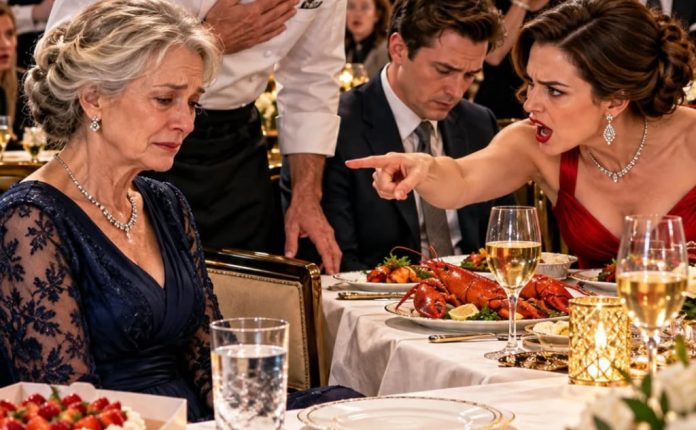
Claire reached our table before Ethan could reply.
“What did she say?”
He looked at me, then at her.
“She said no.”
“To which part?”
I set down my fork.
“To the arrangement.”
Claire’s mouth tightened.
“Eleanor, we have three days.”
“You’ve had longer than that.”
She said nothing.
“How long?” I asked.
Ethan answered.
“Since the offer came through. Nearly three weeks.”
The anger I felt then was less dramatic than I would have expected. It was clear and practical.
They had spent three weeks assuming I would say yes.
They had used the dinner to establish the terms on which I should be grateful for being asked.
“Why wait until tonight?”
“We wanted to explain in person,” Claire said.
“Then why begin by telling me I should attend fewer family occasions?”
“Because childcare and social events aren’t the same thing.”
There it was, stated without any awareness of what it revealed.
I would be suitable in their kitchen at seven in the morning.
I would be unsuitable in their dining room when anyone important came.
Ethan pulled the empty chair out.
Claire stopped him with a hand on its back.
“We should discuss this at home.”
“You can,” I said.
She looked at the cake.
“Lily will be very upset.”
“I’ll bring her cake tomorrow, if you agree on a time.”
“Sunday is her party.”
“Yes. I’m still waiting to be invited.”
Ethan closed his eyes.
Claire released the chair.
“It’s a small gathering.”
“I understand. Tell me when I can see her.”
For a moment, none of us spoke.
I had spent so long explaining what they meant that hearing their actual words felt unfamiliar.
Claire folded her arms.
“You’re doing this because Marcus recognized you.”
“No.”
“If he hadn’t come over, we would have worked it out.”
I thought about that.
Perhaps I would have tried harder to please them. Perhaps I would have accepted three days instead of five and called it compromise.
I could admit that without giving her the point.
“I was hungry before he came over,” I said. “You knew that too.”
Her face changed.
Not softened. She had simply run out of ways to make the conversation about my behavior.
Ethan moved the chair back into place.
“We’ll go.”
“Please do.”
He hesitated near the cake.
“Tomorrow morning? Ten?”
“That would be good.”
Claire turned first.
He followed her.
I watched them cross the dining room. Martin stood impatiently beside Judith, holding his coat. They did not look toward me.
Their bill had arrived. The lobster dinners they had ordered were being prepared for takeaway.
No one stopped them. No one applauded when they left.
They had wanted an evening that confirmed their importance.
What they got was a server who would remember how they treated someone who could not benefit them, and a chef who declined to make that treatment comfortable.
That was consequence enough for one night.
I finished my fish.
Marcus returned as Daniel cleared my bowl.
“Would you like dessert?”
“Not if it’s strawberry cake.”
He smiled.
For a few minutes, we talked about an old oven at the community center that ran hot on the left. He remembered the metal spoon I used to wedge beneath a crooked shelf.
Then his smile faded.
“Are you all right getting home?”
“Yes. There’s a bus at nine.”
“I can arrange a car.”
“I know you can.”
He nodded.
“Would you like me to?”
I considered the rain, my shoes, and the cake I would be carrying home again.
“Yes,” I said. “Thank you.”
It felt different when someone allowed me to answer.
When I asked for the bill, he told me he had invited me to be his guest.
“You don’t owe me a dinner because of something I did twenty years ago.”
“This one’s because I’m glad to see you.”
I let him have that.
Daniel returned my coat. I gave him a tip from the money I had brought for dinner.
“You didn’t need to know my name,” I told him.
He looked puzzled.
“To ask whether I wanted food.”
“No, madam.”
That mattered more to me than the photograph in the corridor.
At home, I put the cake in the refrigerator and hung my dress over a chair.
The earrings came off last.
I held them in my palm for a while.
Nothing about the evening had erased the boy who bought them. Nothing about that boy excused the man at dinner.
I put them back in their box.
My phone lit up while I was washing my face.
A message from Ethan.
Please don’t make permanent decisions while you’re upset.
I sat on the edge of my bed.
Then I wrote: I am not agreeing to provide weekday childcare. I will come tomorrow at ten with Lily’s cake. Please confirm.
He answered after twelve minutes.
Confirmed.
I slept badly.
At four, I woke convinced I had forgotten to pack Ethan’s lunch.
That had happened occasionally since I retired. My body remembered responsibilities long after they ended.
I lay still until the feeling passed.
At seven, Judith called.
I let the phone ring once more before answering.
“Eleanor, I think everyone was tired last night.”
“I wasn’t tired when we arrived.”
She inhaled.
“Claire is under enormous pressure.”
“I believe that.”
“It was an unfortunate misunderstanding.”
“Which part?”
“The dinner. The wording. All of it.”
I looked at the calendar on my kitchen table.
“Did you hear Claire order four meals?”
“Yes, but—”
“Did you hear Ethan tell me to remember my place?”
“That wasn’t well expressed.”
“Then please don’t call it a misunderstanding. I understood them.”
Judith was silent long enough for me to hear a television in the background.
Finally, she said, “Martin thinks this has become unnecessarily public.”
“It happened at a restaurant he attended.”
“I mean involving the staff.”
“I didn’t ask them to witness it.”
She did not answer that either.
I had once envied Judith’s confidence. She could walk into any room and behave as though a comfortable chair had been placed there for her.
Now she was calling a woman her daughter had humiliated to request that the humiliation be made less inconvenient.
“We all want what’s best for Lily,” she said.
“So do I. I’ll be there at ten.”
I ended the call before she could turn Lily into another argument.
There were messages waiting in the family group.
Most were photographs and reminders. That morning, Claire had written that the birthday weekend had become stressful because childcare plans had fallen through unexpectedly.
I read the sentence twice.
Then I put the phone down and made toast.
I did not need to answer instantly.
That was another unfamiliar permission.
After breakfast, I wrote a short response.
There was no agreed childcare arrangement to fall through. I was shown a weekday schedule for the first time last night and declined it. I will still bring Lily’s cake this morning as arranged.
I read it once for anything written to injure.
Then I sent it.
Ethan’s aunt Ruth replied privately.
Did they really expect all five days?
Yes.
Had they asked before?
No.
Her next message took longer.
I’m sorry, Eleanor. I should have called you more often.
I did not turn that into an invitation for her to condemn my son.
I thanked her.
In the group, Ethan eventually wrote: Mom is right. We hadn’t asked her. We made an assumption.
I stared at that message.
It was small. It did not restore the evening or answer for what he had said.
But it was the first time he had corrected a comfortable version of events without waiting for me to do it for him.
At ten, I stood outside their house with the cake.
Ethan opened the door before I rang twice.
He looked as though he had slept no better than I had.
“Come in.”
“Is this a good time?”
“Yes.”
Lily came running from the sitting room in socks that had twisted around her heels.
“Nana! You brought the flower cake!”
I knelt carefully.
She wrapped her arms around my neck, smelling of toothpaste and the strawberry shampoo I kept meaning to buy for my own bathroom.
“I did.”
“Can I see?”
Ethan carried the box to the kitchen.
Claire stood by the counter in a gray sweater, a laptop open beside her. She looked at me, then closed it.
“Thank you for making it.”
“You’re welcome.”
Lily wanted the lid opened immediately. She counted the strawberries twice and asked whether the little ones had grown beside the big ones.
“Probably on the same plants,” I said.
“Like cousins?”
“Close enough.”
Ethan laughed.
It startled me to hear it.
For a few minutes, we were only three adults looking at a cake with a child. I let those minutes be what they were.
Then Lily asked whether I was coming to her party.
Ethan looked at Claire.
I waited.
Claire crouched beside her daughter.
“We’re working out some grown-up things, sweetheart.”
Lily’s face changed.
“Is Nana in trouble?”
“No,” I said.
I spoke before anyone could make the answer complicated.
“Nana isn’t in trouble.”
“Then why can’t you come?”
Ethan pulled out a chair.
“She can. If she wants to.”
I looked at him.
He did not look away.
Claire remained crouched beside Lily, who was now busy touching the ribbon.
“The party starts at two tomorrow,” she said. “You’re invited.”
The invitation was overdue. It was also being offered in front of a child who needed the adults to stop making her guess.
“I’d like to come for a little while,” I said.
Lily clapped.
I would not make her birthday the place where I settled accounts.
When she went to fetch a drawing, Ethan asked whether we could talk.
“For a few minutes.”
He put the kettle on.
Claire remained by the counter.
“I didn’t mean to suggest you didn’t matter,” she said.
“At dinner?”
“Yes.”
“You asked what I could contribute.”
“I meant in certain settings.”
“I know what you meant.”
She folded her hands together.
“You don’t make it easy to explain.”
“I’m not asking for an explanation of why I was unsuitable. I’m asking whether you understand what you did.”
Her gaze shifted to Ethan.
He kept watching the kettle.
“I do,” she said finally.
“What?”
She looked offended by the question.
Then she looked toward the hall, where Lily was opening a drawer.
“I spoke about you as if you weren’t there.”
“And?”
“I shouldn’t have ordered without asking what you wanted.”
It was not everything.
It was more than she had said the night before.
I nodded.
“I won’t agree to the schedule.”
Her shoulders tightened again.
“I’ve already asked to delay my start date,” she said.
“That sounds sensible.”
“It may affect the position.”
“I hope it doesn’t.”
I meant that.
I had no wish to see her lose work. I knew too well what work could provide.
But concern was not consent.
Ethan brought me tea.
“I’ve contacted the agency again,” he said. “And I’m asking about an earlier departure two days a week.”
Claire looked at him.
He added, “We should have done that before.”
I had spent years anticipating their needs because it saved them discomfort.
Now I sat while they described the arrangements they would have to make themselves.
Nobody died of the inconvenience.
Lily returned with a drawing of our cake, larger than the house beside it.
She had put me inside the house.
I thanked her and took it home.
On Monday, I went to Rowan House through the service entrance.
There was no dining-room ceremony. A delivery driver was arguing about missing cartons, someone was cleaning the rubber mats, and Marcus had a pencil behind his ear.
He handed me an apron.
“Before we talk, tell me if this stock tastes flat.”
I tasted it.
“Needs time.”
“That’s what I said.”
“Then why ask me?”
“Because they think I’m being difficult.”
A cook at the stove grinned.
Within ten minutes, I was standing at a steel bench discussing onions.
It was a relief so physical I had to steady myself against the edge.
For years, I had been treated as an accumulation of things I could do for my family. Here, people wanted to know what I knew.
Marcus showed me the photograph in the corridor.
I looked younger than I remembered being.
Beside me stood six students, one holding a tray at an angle that made me nervous even after all those years.
Marcus pointed.
“Those rolls were terrible.”
“They were underproved.”
“They were terrible.”
“You came back the next week.”
He shrugged.
“You said I should.”
I remembered that afternoon.
He had scorched one batch and rushed another. A volunteer told him kitchens might not be his sort of work.
I had disliked that sentence.
He was nineteen. There were very few things anyone could know were not his sort of work.
I told him to clean the trays and return on Saturday.
That had been the whole speech.
Now he showed me a proposal for eight students, one afternoon a week, working toward entry-level kitchen placements.
There would be paid instructors. Travel assistance. Proper insurance. Ingredients that did not depend on whatever happened to be donated.
“I’d like you to mentor the instructors,” he said. “And teach if you want.”
I read the hours.
Twelve a week to begin with, including preparation.
The pay was printed clearly.
“So this is work.”
“Yes.”
“Not a favor disguised as work.”
“No.”
“I’ll need a stool for anything that involves standing longer than an hour.”
“Then we’ll get one.”
“And I won’t pretend everybody learns at the same pace.”
“That’s why I’m asking you.”
I took the proposal home.
I did not accept at the kitchen bench merely because someone had made me feel useful.
The next morning, I called with questions.
Marcus answered them.
Then I said yes.
Ethan came to my apartment that Thursday.
He asked first.
That detail was small enough to miss, and I noticed it anyway.
He brought no groceries, no flowers, nothing I would have to thank him for before we spoke.
I made tea.
He sat at my kitchen table and looked at Lily’s drawing on the refrigerator.
“I didn’t know about the classes,” he said.
“You knew I went to the community center.”
“I thought you helped serve lunch.”
“Sometimes I did.”
“Why didn’t you tell me?”
I took a moment before answering.
“I probably told you more than you remember. And after a while, you stopped asking about my week.”
He nodded slowly.
“I did.”
There was no use pretending I had never hidden parts of myself, either.
I had not told him how frightened I was after his father left. I had not shown him overdue bills. I had wanted him to go into the world without feeling chained to my sacrifices.
But I had not intended to teach him that I had no life beyond them.
“You weren’t responsible for making me interesting,” I said. “You were responsible for treating me decently.”
He looked down at his hands.
“I was embarrassed.”
The words hurt.
I let them.
“By what?”
“By how different everything looked. Your apartment. The jobs. The way Claire’s parents talked about their friends.”
He swallowed.
“I liked being included. I kept thinking if I didn’t contradict them, things would settle.”
“So you let them make me smaller.”
“Yes.”
I looked out at the pharmacy sign below my window.
Its light came on each afternoon before the sky was properly dark. I had grown fond of the ordinary reliability of it.
“At dinner,” I said, “I wasn’t asking you to explain my value to anyone. I asked whether you’d heard what your wife said.”
“I know.”
“You heard.”
“Yes.”
“And you chose.”
He began to cry then, quietly, wiping his face with the heel of his hand like the boy I remembered.
I did not move my chair closer.
There would have been comfort in comforting him. It would have given me something familiar to do.
Instead, I let him finish.
“I’m sorry,” he said. “For what I said. For leaving you there. For calling you only when we needed something.”
I nodded.
“I believe you’re sorry.”
“Can you forgive me?”
“I don’t know what that will look like yet.”
He accepted the answer badly for a moment. I could see the disappointment.
Then he accepted it better.
“All right.”
Before he left, he asked about my new work.
I told him about the first intake meeting, the training room, the problem with ordering enough aprons in different sizes.
He listened.
When I stopped, he asked another question.
That was where we began.
Claire’s apology came later.
She sent it in a message, then asked whether I would be willing to meet.
I chose a café near my apartment.
Without her parents, without Ethan, she seemed less certain where to put her hands.
“I liked having you available,” she said.
I stirred my coffee.
“That part was obvious.”
“I told myself you wanted it. You always seemed happy to take Lily.”
“I was happy to see Lily.”
“I know there’s a difference.”
“Do you?”
She looked at the table.
“I’m learning it.”
I could have said something sharp. There were several accurate things available.
Instead, I asked about the side entrance on the schedule.
She went red.
“We had clients coming occasionally. I worried about noise, appearances. I made it sound logistical.”
“It was written as though I were someone you needed to keep out of sight.”
“Yes.”
She did not add an excuse.
That made it possible for me to remain at the table.
I told her I would not provide regular childcare, that visits needed to be arranged, and that she could not speak about me to Lily as though my boundaries were punishment.
She agreed.
I did not promise closeness.
We finished our coffee.
Martin never apologized directly. Judith sent a card in which she wrote that the evening had made her reconsider some things.
I put the card in a drawer.
I did not have to decide whether it was enough.
By early summer, Ethan and Claire had established childcare they paid for and hours they had negotiated with their employers. It was expensive.
They managed.
I saw Lily twice a month at first. Sometimes we baked. Sometimes we rode the bus to the park and spent an hour deciding which ducks were related.
If Ethan needed a favor, he asked.
Occasionally I said yes.
Once, when I said I was teaching that afternoon, he answered, “Of course. Another time.”
I stood with the phone in my hand after the call ended.
There had been no sigh. No mention of family obligation.
Just another time.
At Rowan House, our first group learned to sharpen knives before they learned anything that looked impressive on a plate.
One student, a woman in her forties who had spent years caring for her parents, apologized whenever she asked a question.
I knew that habit.
I did not lecture her about it. I made sure she had time to finish speaking.
When the community center held its small fundraising supper, Marcus asked whether he could include my name among the instructors being thanked.
“Yes,” I said. “Just my name and what I do.”
He smiled.
Ethan bought two tickets.
He asked before assuming Lily could attend.
Claire came in a plain blue dress and spoke to Daniel, who was helping serve. I did not hear what she said, but he nodded, and she did not try to prolong the conversation.
After dinner, Marcus introduced the instructors.
I stood beside two other women and a man who had worked in institutional kitchens longer than I had.
There were no startling revelations.
No one discovered I owned the building. No fortune appeared to make my family’s conduct shameful in retrospect.
I had been worth feeding when they thought I was only a retired cafeteria worker.
When Marcus spoke about the program’s beginnings, Ethan listened with his hands still on the table.
Afterward, he introduced me to someone he knew.
“This is my mother, Eleanor Hayes. She helped build the training program.”
I touched his sleeve.
“I teach in it now.”
He smiled, a little embarrassed.
“She teaches in it.”
It was better that way. Present tense. Something he had taken the trouble to learn.
Later that month, I took Lily to a small café near the park.
Ethan had asked whether he could join us. I said yes.
We sat outside beneath an umbrella that trembled whenever a bus passed. Lily ordered soup because it came with bread she could tear herself.
Ethan waited until I had chosen before ordering.
Nobody commented on it.
Lily held up a strawberry from the little bowl beside her sandwich.
“Flower,” she announced.
I agreed.
My soup arrived first. Then hers. Then Ethan’s.
She looked at the three bowls and moved her chair closer to mine, scraping it across the paving stones.
“Now you can reach the bread, Nana.”
I took a piece.
Across the table, my son watched us for a moment before beginning to eat.
END PART 2
Disclaimer: This fictional story was created with AI assistance for entertainment. Names, characters, dialogue, and events are fictional. Any resemblance to actual people or events is coincidental.