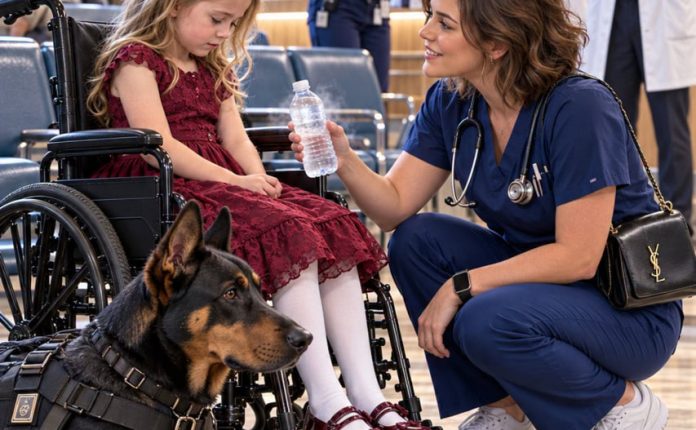
“Please don't make him leave,” the little girl said.
Dr. Everett Slade pointed toward the emergency entrance. “Then someone needs to control him.”
I was carrying a carton of replacement tubing when I heard them. The cardboard had softened against my damp sleeve, and a corner was beginning to tear.
The dog wasn't pulling toward anyone.
He stood close to a wheelchair, pressing his nose against a child's left hand. When she failed to respond, he touched a red pouch fastened beneath the armrest.
Across the waiting room, her mother stopped arguing with registration.
“He's a service dog. He's alerting.”
“To what?”
“She's diabetic.”
Slade had already turned away.
That was the first thing I should have stopped.
Later, I would return to that moment more often than to the collapse. A sentence spoken clearly. A physician close enough to hear. My own feet continuing two more steps because I assumed somebody responsible was already handling it.
I put the carton down.
Outside, Cleveland was disappearing under freezing rain. Water shone on the ambulance ramp, and every time the doors opened, cold air traveled across the waiting room at ankle height.
The child wore a burgundy sweater and small silver stars in her ears. One sock had slid beneath her ankle brace. Her mother had tucked a blanket around her knees, but her hands rested bare on the wheelchair's metal armrests.
They were shaking.
I knew her name only because her mother kept saying it.
“Maren, sweetheart, one minute.”
Bethany Haskins stood at the registration counter holding an insurance card that had split along one edge. The clerk was trying to correct an address, calling a supervisor who wasn't answering.
“I understand it's an old address,” Bethany said. “But that doesn't change her coverage.”
“We can fix the record.”
“She needs someone to look at her now.”
The clerk glanced toward the clinical desk.
“I've notified them.”
There was no malice in her voice. She sounded tired and trapped in a task that had somehow become more important than the reason the family had arrived.
I knew that sound.
Eleven months earlier, I had come to Northlake Regional Medical Center as a float nurse. I worked medical floors, emergency overflow, wherever staffing put me.
At thirty-four, I had mastered the useful art of being agreeable without becoming familiar.
I remembered people's coffee preferences. I volunteered to restock cupboards. When colleagues asked what I had done before moving to Cleveland, I said nursing, mostly.
That answer wasn't false.
It simply left out the desert dust, the evacuation aircraft, and the nights when I woke convinced somebody was calling from beneath a collapsed wall.
It left out Lieutenant Laurel Whitcomb.
It left out Lantern.
At Northlake, I was Laurel from the float pool. Reliable. Quiet. Sometimes difficult to find at staff celebrations.
A young resident passed the wheelchair carrying a tablet.
Maren lifted her hand.
“Something feels wrong.”
He stopped.
His badge read NOLAN PRICE.
“What feels wrong?”
“My fingers. And my head.”
He glanced at the tablet.
“Your mother mentioned you've had a hard day.”
She watched him.
“It's not like crying.”
“Try to relax while we're finding you a room.”
Her hand remained raised after he left.
The dog made a low sound in his throat.
Not a growl. A worried, insistent whine.
A security officer approached.
“Ma'am, can you settle him?”
Bethany looked back from the counter.
“He's trained to do that.”
The officer hesitated, then moved away.
I crossed the remaining space and crouched beside the chair.
The child smelled faintly of rainwater and the grape lip balm clipped to her backpack.
“Hello. I'm Laurel. I'm one of the nurses.”
Her gaze went to my badge.
“Am I in trouble?”
“No.”
“He's not bad.”
“I can see that.”
Atlas looked at me, then pushed his nose against the pouch again.
I noticed the wet shine along Maren's hairline.
The waiting room was cold. A man near the vending machines had pulled his coat over his head. Yet sweat had gathered above this child's upper lip.
“Tell me what's happening.”
“I can't make the words line up.”
“Are you dizzy?”
She nodded.
“Hungry?”
Another nod.
“Does your heart feel fast?”
Her lower lip trembled.
“Like when I have a nightmare.”
I turned the red pouch.
A medical identification patch was sewn onto its outer flap.
TYPE 1 DIABETES.
Bethany reached us as I opened it.
Inside were testing supplies, glucose, and prescribed emergency rescue medication.
“She didn't finish her lunch,” Bethany said. “The school called because she felt sick. I thought maybe a stomach bug, but she started shaking in the car.”
“Did she have her usual insulin?”
“At school. Yes. I told them that when we came in.”
I looked toward registration.
The clerk was watching us now.
“I asked the nurse to come,” she said.
“How long have you been here?”
Bethany checked the wall clock, then seemed unable to interpret it.
“Nearly forty minutes.”
The child's fingers slipped off the armrest.
I took her hand.
“Maren, when did you last eat something?”
“School.”
“Do you remember your insulin?”
She frowned, working hard.
“I don't know.”
Her mother knelt on the opposite side.
“Sweetheart, look at Mommy.”
Atlas pressed himself closer.
I raised my voice.
“Dr. Slade. I need you here.”
He stood near the nurses' station with a coffee cup in one hand.
“What is it, Whitcomb?”
“This child has diabetes and signs of hypoglycemia. She's becoming confused.”
“She was assessed at arrival.”
“She needs a glucose check now.”
He came toward us slowly.
There were things I would later understand about him. He had started his shift short two nurses. He was managing a crowded department. He had spent the afternoon making decisions with too little space and too much noise.
None of those facts changed the child in front of him.
“Her mother's already explained the anniversary,” he said.
Bethany stiffened.
I looked at her.
“My husband died two years ago today.”
Her voice had gone flat with the effort of keeping it steady.
“Maren was in the car with him. It's been a difficult morning.”
A photograph stuck out of the wheelchair pocket. Through the scratched plastic sleeve, I could see the dark shoulder of a Navy uniform.
I looked back at Maren.
Whatever grief had brought into this room, something else was happening to her body.
“She's sweating and having trouble speaking,” I said.
“She's upset.”
“I'm checking.”
Slade's eyes narrowed.
“You're a float nurse. Don't turn this into a performance.”
Maren looked between us.
“I didn't mean to.”
I wished I could have taken that sentence out of the room before anyone else heard it.
I squeezed her hand.
“You haven't done anything wrong.”
The meter beeped.
Thirty-four milligrams per deciliter.
For a moment, the number seemed too sharply printed, too definite for a room still pretending we had time.
“Thirty-four,” I called. “Activate the pediatric emergency response.”
Slade stepped toward me.
“Lower your voice.”
“She has severe hypoglycemia.”
“This attention-seeking needs to stop.”
I don't know whether he meant me or Maren.
She heard him.
I saw it in the way her mouth tightened just before her eyes lost focus.
“Mommy?”
Her body sagged.
I caught her head before it struck the metal armrest.
Bethany screamed.
The sound changed the room.
A man dropped his phone. The clerk came around the counter. Chairs scraped backward, clearing a space nobody had thought to clear while the child could still ask.
“Pediatric response,” I said again. “Now.”
Another nurse was already moving.
Leonora Ruiz had the compact, economical stride of somebody who had spent twenty years finding room where there wasn't any.
She brought a stretcher with an emergency technician.
“I'm here,” she said.
Those two words steadied me.
We transferred Maren carefully. I supported her head, checked her breathing, and watched the color around her mouth.
Bethany reached toward the red pouch.
“Her emergency medicine. Her endocrinologist said—”
“We have it.”
I checked the prescribed medication and followed the hospital's standing emergency protocol while help came.
Slade leaned over me.
“You don't have an order from me.”
“We have an emergency protocol.”
“Whitcomb.”
“Then assist us.”
He stared.
Atlas barked.
The sound cracked through the waiting room, sharp enough to make a security officer reach for his radio.
“Get that animal out,” Slade snapped.
Bethany made a helpless motion toward the dog.
“Atlas. Stay.”
I looked up.
“He alerted before she collapsed. Give us space.”
Leonora shifted equipment onto the stretcher.
“The response team is coming.”
Maren was breathing.
I kept returning to that fact.
Air moved. Her chest rose. We had a child to care for, a team arriving, work that needed doing.
Bethany gripped my shoulder hard enough to hurt.
“Please. I already lost my husband.”
The waiting room tilted.
Not visibly. Not to anyone who wasn't inside my skin.
The rain became another rain.
I was on my knees in freezing mud, leaning over a Navy officer whose fingers had locked around my wrist.
He was trying to speak through pain.
A message for his daughter.
A request I had never delivered.
“Laurel.”
Leonora's voice.
I looked at her.
“I'm here,” she said again.
I drew a breath and returned to the child's face.
The pediatric physician arrived with the response team. Dr. Imani Patel spoke quickly but without raising her voice, assigning tasks while she assessed Maren.
IV access. Further treatment. Monitoring.
I gave the number, the symptoms, the sequence, the rescue medication already administered.
Patel repeated the information back.
Nobody argued about rank.
Bethany stood beside me with a hand pressed over her mouth.
For several minutes there was only the work.
Then Maren's eyelids fluttered.
She took a deeper breath.
“Mom?”
Bethany bent across the rail.
“Oh, sweetheart. I'm right here.”
Maren looked frightened and terribly tired.
“Where's Atlas?”
Bethany called him forward.
The Doberman approached with his head low, as if he understood the room had finally caught up with what he had been trying to say.
He rested his chin beside her hand.
Her fingers moved against his ear.
My knees began shaking.
I stepped back once Patel had the handoff and the team had Maren settled.
Leonora caught my elbow.
“Sit for a second.”
“I'm all right.”
“That's never a useful answer.”
I almost smiled.
Then Slade came between us.
“You overstepped.”
I looked past him toward the stretcher.
“She lost consciousness with a glucose of thirty-four.”
“You undermined me in a public area.”
“I called for emergency help.”
“You made a scene.”
A woman who had been waiting with a bandaged wrist stood up.
“The little girl was asking you—”
“Please remain seated,” Slade told her.
His face was flushed.
I had seen that expression before, in different uniforms. The anger of someone who had been handed a chance to correct himself and instead decided correction was an attack.
“You made me look incompetent,” he said quietly.
I was tired enough to answer without cushioning it.
“I didn't make the decisions you made.”
He stepped back.
Celia Wexler appeared a moment later.
She wore a gray suit and hospital identification on a silver chain. I had seen her at orientation, discussing professional conduct beside a slide of smiling staff.
“Ms. Whitcomb,” she said. “You're suspended from patient duties pending investigation. Come with me.”
Leonora straightened.
“Based on what?”
“I'm not discussing personnel matters here.”
Bethany turned.
“She helped my daughter.”
“We need to review the sequence of events.”
“Then review it. Why are you taking her badge?”
Wexler held out her hand.
I looked down at my identification.
My photograph was eleven months old. I had worn a blue sweater to orientation because somebody told me it made me seem approachable.
I unclipped it.
The metal caught the scar across my thumb.
For one foolish second, I thought about simply going home.
I could pack the apartment. Find another hospital. Return to being a woman whose history fit into two boxes and a folder.
It was an old reflex.
When a room became dangerous, find the door.
The emergency entrance opened.
Three men stepped in out of the rain.
They wore dark jackets and boots wet to the ankle. The tallest held white roses in a paper sleeve. The man behind him was shaking water from his cuffs.
Atlas lifted his head.
He knew the men. I could tell by the sudden movement of his ears, the way his weight shifted.
Then he looked at me.
Bethany still held the leash, but loosely. He moved as far as it allowed, bringing his shoulder against my knees.
The tallest man stopped.
His flowers fell.
I saw his face before I allowed myself to know it.
Older around the eyes. A little gray at the temples. A pale line through one eyebrow that hadn't been there before.
Caleb Rourke.
He looked at my hands.
Then my face.
“No.”
I took a step backward.
“Lieutenant Whitcomb?”
The security officer moved closer.
Caleb didn't notice.
“Lantern,” he whispered. “We thought you were dead.”
My fingers closed around the badge.
“Caleb.”
Behind him, Micah Bell covered his mouth with his hand.
Owen Reyes stared so intently that I could see him trying to fit the person in front of him into a memory that had ended differently.
For three years, I had imagined meeting someone who remembered.
In every version, I found the right words.
In the waiting room, I couldn't find any.
Wexler looked annoyed by the interruption.
“Who are these men?”
“Friends,” Caleb said.
The word reached me more painfully than my old rank.
His gaze moved beyond me.
“What happened to Maren?”
I stared at him.
“You know her?”
“We served with her dad.”
The photograph in the wheelchair pocket had turned outward during the transfer.
Now there was no reflection across the face.
Daniel.
I knew the eyes.
I knew the crooked front tooth.
But in my memory his face was streaked with mud, and the hand gripping mine was slipping.
Bethany followed my gaze.
“My husband,” she said. “Daniel Haskins.”
Something cold moved through me.
I had never known his surname.
In the valley, the others had called him Doc's spare hands, or Lieutenant, or Dan.
There had been darkness, noise, blood. I had known enough to keep him alive for another minute.
Not enough to know whether he had survived the next hour.
Patel approached Bethany.
“We're moving Maren upstairs now.”
“Can Laurel come?”
Wexler answered immediately.
“She's no longer assigned to clinical duties.”
Bethany looked at her.
“I didn't ask her to give medication. I asked if she could walk.”
Leonora stepped beside the stretcher.
“I'll go with you. We'll keep you informed.”
Maren opened her eyes.
They found me between the adults.
“You believed me.”
I had worked in places where people were thanked for extraordinary things.
I had never wanted less to deserve a child's gratitude.
“Rest,” I told her. “They're taking good care of you.”
Bethany gathered the dog's leash.
Atlas returned to Maren at her call.
As the stretcher rolled away, the red pouch swung beneath the handle.
Caleb crouched to collect the roses.
A security officer's boot had crushed one bloom. Caleb separated the broken stem and laid it across the torn paper.
“We came because Bethany texted,” he explained. “We were meeting them for dinner. Every year, on the anniversary.”
I looked toward the elevator.
“Daniel survived?”
Caleb stopped moving.
“Yes.”
“The valley?”
“Yes, Laurel.”
For three years, I had carried a man's last request.
It had not been his last.
I pressed the heel of my hand against my mouth.
Micah took one step toward me, then stopped when I flinched.
Nobody touched me.
I was grateful for that.
“You were on the evacuation list,” Caleb said. “Then we heard your vehicle hadn't made it out. There were conflicting reports.”
“I was transferred.”
“We asked about you.”
“I didn't know.”
My own family had known I was alive. The military had known. I had been treated in Germany, then in the United States.
But knowing existed in separate rooms, behind different doors.
The men who remembered me from that valley had deployed again. I had gone into rehabilitation. By the time someone might have connected the pieces, I had stopped answering numbers I didn't recognize.
I had mistaken silence for safety.
Wexler cleared her throat.
“Ms. Whitcomb. My office.”
Leonora stood beside the open elevator.
“Preserve the original triage entries,” she called.
Slade folded his arms.
“The record will reflect what happened.”
“Then keep every version.”
The doors closed behind Maren.
Caleb waited until the sound faded.
“Daniel wrote you a letter.”
I looked at him.
“After he came home. He asked me to help find you.”
The waiting room continued around us. Somebody coughed. A cart rattled past. The clerk had returned to her computer, wiping her cheeks with the side of one hand.
“A letter?”
“Bethany still has it.”
I looked at the badge in my fist.
Then at Wexler's outstretched hand.
“I'll come to your office,” I said. “But I want Leonora present when she's available. And I want my emergency care documented before I leave.”
Wexler's expression tightened.
“This is not a negotiation.”
“No,” I said.
I set my badge in her palm.
“It isn't.”
Caleb moved aside, giving me a clear path.
As I passed, he said, very quietly, “You don't have to disappear again.”
I stopped.
For eleven months, being overlooked had felt like something I had earned.
Maren's voice returned to me.
You believed me.
I turned back toward the clinical desk.
“Please tell the nursing supervisor I need to complete an incident report.”
Slade looked up.
This time, I didn't lower my voice.
END PART 1