Wexler's office smelled of citrus cleaner and coffee that had been left too long on a warmer.
She closed the door.
Slade reached for the chair beside her desk.
“I asked for Leonora,” I said.
“Ms. Ruiz is attending to a patient,” Wexler replied.
“Then I'll wait.”
She watched me for several seconds.
I had spent years becoming easy to direct. It must have been irritating to discover the habit had limits.
Slade sat.
“This nurse openly challenged my assessment, administered medication without my instruction, and caused a disruption.”
I kept my hands flat on my thighs.
“Please distinguish between your instruction and the hospital's standing emergency protocol.”
Wexler opened a folder.
“We'll review the relevant policies.”
“Good.”
Slade leaned back.
“She's doing it again.”
For the first time, Wexler looked uncertain.
Not sympathetic. Simply aware that the easiest version of the meeting might not be available.
I asked whether the restriction on my duties was paid administrative leave, whether I would receive the reason in writing, and how I could submit my clinical account.
My voice sounded calm.
My left foot was shaking inside my shoe.
Wexler typed.
When Leonora arrived twelve minutes later, she carried a notebook and still had a strip of adhesive tape stuck to her sleeve.
“Maren?” I asked.
“Stable. Being monitored. Dr. Patel is with the family.”
Only then could I breathe properly.
Wexler began again.
This time Leonora interrupted at the first mention of unauthorized treatment.
“Which part?”
“We're establishing that.”
“Then don't state it as a finding.”
Slade stood.
“I won't have my medical judgment litigated by two nurses.”
Leonora didn't look up from her notebook.
“It isn't litigation. It's a description of what happened in our department.”
He left before the meeting ended.
Wexler watched the door close.
The room was quieter without him.
I gave my account in order, avoiding anything I hadn't personally seen. The sweating. The confusion. The pouch. The glucose result. The collapse. The response.
When Wexler asked why I had spoken so loudly, Leonora put her pen down.
“Because the first request wasn't acted on.”
I stared at a small chip in the desk varnish.
It was easier than looking at either of them.
By the time I left, I had a written notice of paid administrative leave and instructions for completing my account through the proper reporting system.
I also had the name of the nursing director.
Not my badge.
In the corridor, Leonora handed me a paper cup of water.
“You did the right thing.”
“I know.”
“Knowing doesn't always stop the shaking.”
I looked at her.
She glanced at my hands.
“You think you're subtle.”
I drank.
The water tasted of paper.
Across the hall, Caleb stood beside a vending machine with Micah and Owen. Someone had found a clean vase for the roses. Owen held it against his chest with the solemn concentration of a man transporting explosives.
Leonora followed my gaze.
“You want to tell me about them?”
“Not tonight.”
“All right.”
That easy acceptance nearly undid me.
She squeezed my shoulder once.
“Finish your report while you remember the details. Then go see that little girl, if her mother wants you there. As a visitor.”
I nodded.
“And Laurel?”
“Yes?”
“Whatever you were before this, you were a nurse tonight.”
I looked at her for a long moment.
She knew exactly what I needed to hear.
I completed my incident report at a workstation with the nursing supervisor present, using the access the hospital still permitted. I documented the emergency care in the appropriate place and confirmed the submission.
I didn't open anything unrelated.
I didn't photograph the screen.
The temptation to carry proof away in my pocket was strong. So was the knowledge that doing so would give them another problem to discuss instead of the child's care.
The supervisor gave me the confirmation number for my report.
I wrote it on the back of a receipt.
Outside Maren's room, Caleb sat with his elbows on his knees.
“You don't have to tell us anything tonight,” he said.
I sat two chairs away.
“Who told you I died?”
He rubbed his palms together.
“First we heard your transport was hit. Then somebody said no survivors from the rear vehicle. After that, everyone we asked seemed to be checking with somebody else.”
“My family was notified I was injured.”
“I know that now.”
“How could you not know then?”
He nodded once, accepting the anger.
“We should have kept asking.”
I looked at the floor.
“I stopped answering people.”
“That doesn't make it all your fault.”
The elevator opened at the end of the corridor. A delivery worker stepped out with stacked dinner trays.
The ordinary noise of the hospital seemed almost rude.
“We weren't given an official death notice,” Caleb continued. “I need you to understand that. We didn't bury you. But we heard enough, badly enough, that we believed it.”
Micah stood in the doorway.
“Some of us were back overseas before anybody untangled the transport lists.”
“And Daniel?”
“He knew you might have survived. He kept asking.”
I pressed my thumbnail against the cup's seam.
“I thought he died.”
Caleb's face changed.
“Oh, Laurel.”
There was nothing useful to do with the kindness in his voice.
I stood.
“Does Bethany know?”
“That you treated him? I told her what I knew. I said you might want to explain the rest yourself.”
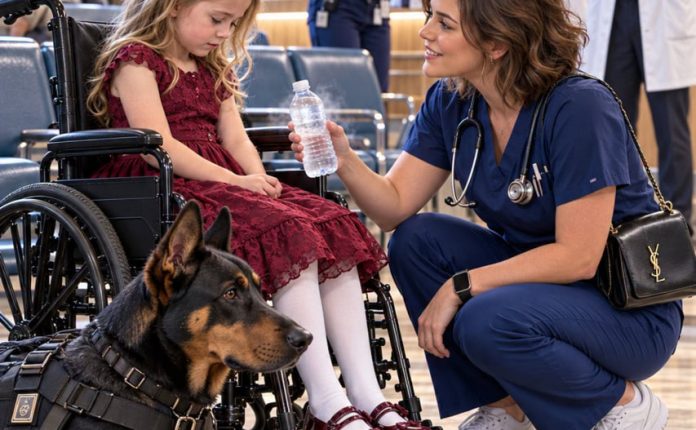
Through the partly open door, I could see Atlas on a mat beside the bed.
Maren was awake.
Her hair had been gathered into two uneven braids. One star earring had turned backward.
Bethany stood when she saw me.
“Are you allowed in?”
“If you want me.”
She pulled the door wider.
For a moment, neither of us spoke.
Then she hugged me.
I went rigid before I could stop myself.
She felt it and stepped back.
“I'm sorry.”
“No. You didn't do anything.”
“I keep feeling like I should be doing something.”
She looked at the monitor, the bed, the water pitcher.
There were too many objects in the room and none of them could give her what she wanted.
“Maren asked for you.”
I went to the bedside.
The child studied my plain sweater. I had changed out of my scrub top in the locker room.
“Did you get fired?”
“No.”
“Because of Atlas?”
“No, sweetheart.”
She looked toward the dog.
“They called him a problem.”
“He was doing his job.”
“Mom says the barking wasn't his regular alert.”
“Your mom knows him.”
“He uses his nose first. That's his quiet way.”
“I saw.”
Maren seemed relieved by that.
She moved a finger along the blanket's stitched edge.
“I tried being quiet too.”
Bethany closed her eyes.
I pulled a chair close enough that Maren didn't have to lift her voice.
“You shouldn't have needed to get louder to be heard.”
“Sometimes people think I mean my legs.”
I waited.
“When I say something hurts. Or something's wrong. They look at the chair.”
Bethany sat on the far side of the bed.
“I didn't know you felt that.”
Maren shrugged.
Not carelessly. With the small, practiced movement of a child who has learned some truths make adults sad.
Dr. Patel came in before any of us could answer.
She greeted me as Laurel, without the strange emphasis people sometimes put on a name when they have heard a rumor.
Then she spoke to Maren directly.
“We're going to keep checking how you're doing tonight. Your mom and I have talked about what probably led to your glucose falling. We'll work through it with your diabetes team.”
“Did I do it wrong?”
“No,” Patel said. “You're a child who got sick. Adults are going to help you work out what happened.”
Bethany's face crumpled.
She turned away to find a tissue.
Patel waited until she was ready before continuing.
Later, in the corridor, she told me the initial findings were reassuring, but observation mattered.
I thanked her.
She looked at me steadily.
“I reviewed your treatment entry.”
I braced.
“It matches the protocol.”
I nodded.
“Thank you for saying that.”
“I'll say it in the review too.”
It was the first time somebody with authority had offered something more useful than private sympathy.
When I returned to the room, Bethany had placed the Navy photograph on the bedside table.
Daniel Haskins stood on a lawn in summer light. He held a toddler wearing enormous yellow boots.
Maren.
I picked up the frame only after asking.
His face looked almost unfamiliar without pain.
“He came home,” I said.
Bethany watched me.
“Yes.”
I sat down because my legs had begun to tremble again.
“I treated him before an evacuation. I never knew what happened afterward.”
“He told me about a nurse.”
My fingers tightened around the frame.
“He didn't know whether you'd lived. He said every time he tried to give up, you gave him another task.”
I remembered.
Count the breaths.
Look at me.
Tell me your daughter's name.
Not because the tasks were important in themselves. Because a frightened man needed a place to put the next few seconds.
“What did he say about me?”
Bethany looked toward Maren.
The child had fallen asleep with one hand touching Atlas's vest.
“He said you were angry about his boots.”
I let out a sound that wasn't quite a laugh.
“One lace was tied around the equipment.”
“He told that story for a year.”
A year.
A whole year after the valley.
Time I had never imagined existed for him.
Bethany folded her hands.
“He took her to the aquarium. Repainted our kitchen. Made terrible pancakes because he wouldn't admit the pan was too hot.”
She smiled, then swallowed.
“I don't know if that helps or makes it worse.”
“It helps.”
The word broke in my mouth.
Caleb appeared in the doorway.
Bethany nodded toward her bag.
“It's in the blue folder.”
He brought it to her.
Inside were hospital discharge papers, school forms, a repair estimate for the wheelchair, and an envelope softened along one edge.
My name was written across it.
Laurel Whitcomb.
Beneath it, in parentheses:
Lantern, if that's still you.
I couldn't touch it.
Bethany placed it on the table between us.
“He wrote it after his second surgery. Caleb was trying to locate you.”
“What happened?”
“Returned mail. Messages passed through people who'd moved. Daniel was still looking when the accident happened.”
She smoothed a crease in the folder.
“Afterward, I put everything in a box. Things I could manage. Things I couldn't.”
“You don't owe me an explanation.”
“I know. But I want you to understand.”
Caleb stood with his hands in his jacket pockets.
“We found a possible address last year,” he said. “By then you'd moved again.”
“I was in rehabilitation housing. Then with my sister. Then here.”
A scattered trail.
Not a conspiracy. Not a heroic mystery.
Just injured people, paperwork, transfers, grief, and nobody standing in the middle with all the names.
Bethany pushed the envelope closer.
“He wanted you to have it.”
I picked it up.
The paper was warm from her hands.
At home that night, I put it on my kitchen table.
I made tea.
I didn't drink it.
The apartment was quiet except for a loose window latch tapping in the wind. I had rented it furnished because buying furniture felt like promising I would stay.
There was a table. Two chairs. A lamp with a yellow shade.
No photographs.
My sister had asked about that once.
I told her I didn't like clutter.
Now a dead man's handwriting lay beside an untouched mug.
I slid a finger under the flap.
My phone rang.
The hospital number.
For one moment I thought something had happened to Maren.
It was Wexler.
“We need to clarify your recollection of the mother's statements.”
I sat down.
“What specifically?”
“Dr. Slade recalls being told the child had no current diabetic concern.”
“That's not what I heard.”
“Memories during emergencies can be unreliable.”
I looked at the envelope.
“Then the review should compare the records and witnesses.”
A pause.
“We'd prefer to settle minor discrepancies before this becomes unnecessarily formal.”
“It was formal when you took my badge.”
Her voice cooled.
“I'm trying to help you avoid a prolonged process.”
“Please put any further questions in writing.”
After we hung up, I didn't open the letter.
I called Leonora.
She answered on the second ring.
“Tell me.”
I did.
When I finished, she was quiet.
Then she said, “Write down the time of the call and what you remember. Exact words where you can. Don't fill in gaps.”
“Have they asked you?”
“Yes.”
“What did you say?”
“The truth. It's less work.”
I laughed once, unexpectedly.
It hurt.
The next morning, I submitted a request to have the relevant electronic records, timestamps, and incident materials preserved through the hospital's compliance office.
I used their reporting channel.
I also contacted the nurse representative listed in our employee materials. Her name was Ruth Ames, and she sounded as though she had already heard three bad explanations before breakfast.
“Administrative leave is not a finding,” she told me. “Don't let anyone make you speak as though it is.”
She asked for the written notice and my account.
Then she asked whether I had eaten.
“I'm not hungry.”
“That wasn't the question.”
I ate toast standing over the sink.
At ten, Bethany called.
Maren had slept.
Her glucose readings were being managed. The team was discussing the next steps with her usual specialists.
Then Bethany said, “Someone asked me to confirm I hadn't told registration about diabetes.”
I sat on the edge of the bed.
“What did you say?”
“That I had told them.”
“Who asked?”
“A patient relations woman. She said it might have been lost in the noise.”
Bethany breathed in.
“Laurel, I was loud. I hate that I was loud, but I was.”
“You don't need to apologize for trying to get help.”
“I signed their form. The first one. I wrote diabetes on it.”
I closed my eyes.
“Tell the reviewer exactly that. And ask for a copy of what you submitted.”
“I have a picture.”
“Of the form?”
“My phone kept saying the insurance card photo was blurry, so I took the whole clipboard too. I was trying to show my sister what they were asking for.”
I stayed still.
“Don't send it around,” I said. “Keep the original. Let patient relations and the reviewer know you have it.”
Her voice sharpened.
“Are they trying to say I didn't tell them?”
“I don't know what the review will find.”
It was the only honest answer.
That afternoon, Nolan Price called me through the staff directory.
His opening sentence was so rehearsed I knew he had written it down.
“I would appreciate the opportunity to clarify a clinical interaction.”
I waited.
Then the rehearsed voice fell apart.
“I saw her.”
“I know.”
“She told me she felt different. I read the note about the anniversary and assumed—”
He stopped.
I could hear a door closing on his end.
“Slade asked me to sign an account saying the mother denied any active medical problem.”
“Did she?”
“No.”
“Then don't sign it.”
“I already wrote my note. Late. After she went upstairs.”
“Was it accurate?”
“I wrote that she was crying.”
“She was.”
“I didn't write that she asked for help.”
For a moment I could only hear the refrigerator motor.
Then I said, “You can correct an incomplete account without pretending the first one never existed.”
“He said corrections look like guilt.”
“Sometimes an accurate correction looks like an accurate correction.”
Price made a small, miserable sound.
“I should have checked.”
“Yes.”
I didn't soften it.
He hadn't called for comfort from the nurse whose intervention had exposed his mistake.
But before he hung up, I said, “Write what happened. Not what would make either of us feel better.”
Two days later, Ruth called with the date for a preliminary review.
The hospital had appointed an outside pediatric emergency physician to participate. Compliance was preserving the audit trail.
Slade had been removed from that waiting-room supervisory assignment while the review proceeded.
It wasn't the final consequence.
It was enough to tell me somebody was finally looking beyond my volume.
That evening, I opened Daniel's letter.
There were three pages.
The handwriting grew less even toward the bottom, as though his hand had tired.
He wrote about the daughter whose name he had repeated in the mud.
About learning to climb the stairs again.
About a nurse who had refused to let him turn his fear into an instruction to stop trying.
Then, halfway down the second page, I found the words that made me set the letter on the table.
He had remembered what I hadn't told anyone.
The rear vehicle.
The other casualties.
My choice to stay.
I covered my mouth.
For three years, I had remembered the blast more clearly than the minutes before it.
In my memory, there was always somebody I hadn't reached.
Daniel had written about the people who had reached the aircraft because I remained beside the road.
I called Caleb.
“I read it.”
He didn't ask which letter.
“Do you want company?”
I looked at the empty second chair.
“Yes.”
He arrived with Micah, Owen, and food in paper containers. They didn't bring uniforms or medals or a speech about bravery.
Owen found plates.
Micah repaired the tapping window latch with a screwdriver from his truck.
Caleb sat across from me while I read the last page again.
Daniel had ended with an address and a promise.
If you get this, come eat with us. Beth makes too much when she's worried. Maren will ask whether you know any pirates. Say no unless you want to be there all night.
I laughed.
Then I cried so hard I couldn't see the paper.
Nobody told me what it meant.
Nobody said it was time to move on.
Owen put a plate near my elbow.
Much later, when the food had gone cold, Caleb said, “We should tell Bethany you read it.”
“I'll tell her.”
He nodded.
“And Laurel?”
I looked up.
“That letter doesn't obligate you to rescue his family forever.”
I wiped my face with a paper napkin.
“I know.”
“You're allowed to know them.”
That was harder.
At the preliminary review, four days after Maren's collapse, I sat beside Ruth with my hands folded beneath the table.
Wexler sat opposite us.
Slade arrived late.
The reviewer introduced herself, explained the scope, and asked everyone to distinguish direct observations from assumptions.
For the first hour, we discussed the emergency care.
Protocol. Symptoms. Timing. Escalation.
The outside physician asked Slade why he had opposed the glucose check.
“I didn't oppose testing. I opposed a disruptive approach.”
She glanced at the documents.
“Then we'll need to reconcile that with the witness accounts.”
Slade's mouth tightened.
Wexler looked down.
The compliance officer opened a second folder.
“We also need to examine a discrepancy between the registration form and later descriptions of the presenting concern.”
A photocopy went onto the table.
Bethany's handwriting.
TYPE 1 DIABETES. SHAKING. FEELS UNWELL.
The time printed above it preceded the collapse by thirty-eight minutes.
The reviewer placed another page beside it.
A later account stating the mother had not disclosed diabetes.
Slade leaned forward.
“That requires context.”
“Yes,” the reviewer said. “That's why we're here.”
Then the door opened.
Nolan Price stood outside, holding a written statement with both hands.
“I need to correct something before you continue.”
END PART 2