The first thing Claire Morrison did was call an ambulance. The second was tell my father to step away from my front door.
I was sitting on the porch of the home I had shared with my late husband, Daniel, eight months pregnant and soaked from my water breaking. My father, Richard Hale, had dragged me out by my hair. His twenty-four-year-old wife, Kelsey, had laughed as I fell. Now both were staring at my phone as though the attorney on speaker had become the most dangerous person in the room.
“Richard,” Claire said, “Emily owns that house. You have no legal authority to sell it. And if you touch her again, there will be another witness to that fact.”
“I’m her father,” he snapped.
“That is not a property interest.”
Kelsey waved the folder she had retrieved from the kitchen. “We already have a buyer. The contract’s signed.”
There was a pause. Then Claire asked a question I didn’t understand until much later: “Who accepted the buyer’s money?”
Richard grabbed the folder from Kelsey. She stopped smiling.
Another contraction pulled tight across my belly. I curled around it, pressing my palm against the porch rail. Claire heard me struggling and told me help was coming. I tried to say that I was thirty-five weeks along, that my daughter wasn’t supposed to arrive yet, but the words came out broken.
A car stopped at the curb. My neighbor, Mrs. Alvarez, stepped out carrying groceries. She saw me on the porch, dropped her bags, and ran. Within seconds she was kneeling beside me, spreading her cardigan beneath my knees and asking whether I could breathe. When Richard told her it was a private family matter, she looked up at him with a fury I had never seen.
“Then why is your daughter out here in labor?”
Richard retreated inside. Mrs. Alvarez stayed with me until the paramedics arrived. One checked my blood pressure while another listened to the baby’s heartbeat. Their calm voices gave me something to hold on to. Before they lifted me onto the stretcher, I asked Mrs. Alvarez to take a picture of the folder visible through the open door. She took pictures of the papers Richard had scattered across the threshold, then handed my handbag to a paramedic.
I saw Kelsey watching from the front window as the ambulance pulled away. She wasn’t laughing anymore.
At the hospital, I was examined immediately. The baby’s heartbeat was reassuring, but my membranes had ruptured and the contractions were becoming regular. The doctor explained that the neonatal team would be present because my daughter was arriving early. She also asked about the bruises darkening on my arm and the tenderness in my scalp.
“My father did that,” I said.
It was the first time I had spoken the sentence without trying to soften it.
A nurse wrote down my account and asked if I wanted the injuries documented and the police contacted. I said yes. Daniel had died three weeks earlier; I could barely face another loss. But pretending my father had only been angry would not protect my child.
Claire called while the staff prepared another monitor. She had reached the title company named on the proposed sale documents. The company had put the transaction on hold after being told there was a dispute about the seller’s authority. More importantly, Claire had the recorded deed in front of her.
After our second wedding anniversary, Daniel had added me to the title. The deed expressly provided for survivorship. After his death, I was the surviving owner. The house did not pass into my father’s hands, and he wasn’t the executor of Daniel’s estate. He had never been appointed to represent anyone in the sale.
“Then how did he get a contract?” I asked.
“By telling someone a story that wasn’t true,” Claire said. “We need to find out how far he took it.”
She sent me a photograph of the last page Kelsey had left exposed in the folder. Beneath a statement authorizing Richard to market the property was a signature that looked like mine. It had the shape of my E and a long downward stroke on Mercer, but it wasn’t mine. I had spent the past three weeks signing hospital insurance forms and death certificates, not real estate papers.
There was something else. The address for notices was not my home. It was Richard and Kelsey’s rented apartment.
I remembered Kelsey visiting four days after the funeral. She had offered to “organize Daniel’s paperwork” while I tried to eat the first proper meal I’d managed in days. I had left her alone in the study for twenty minutes. Later, a folder from the desk seemed slightly out of place. I had assumed I was imagining things.
The next morning, Claire told me, Kelsey had emailed a cash buyer a copy of the forged authorization. Richard had described himself as the person handling the estate and promised an unusually fast closing. The buyer, a small investor named Martin Bell, had ignored the obvious warning signs. He had sent Richard a thirty-thousand-dollar advance directly to Richard’s account under a separate agreement before proper title checks were complete.
I stared at the ceiling after Claire told me the amount. Thirty thousand dollars. My father had pulled my hair, endangered my child, and thrown me onto the porch to protect a lie worth thirty thousand dollars already in his pocket.
“Where is the money?” I asked.
“We don’t know yet. But the buyer wants it returned.”
The nurse came in then to adjust my IV. When she saw my expression, she asked whether I needed to call someone. I almost said Daniel’s name. For six years, he had been my first call whenever something went wrong, even if the problem was as small as a flat tire. The empty space where that habit belonged hurt worse than I could explain.
Instead, I asked her to put my phone away. I needed to concentrate on the daughter he would never meet.
Labor moved quickly. At one point the contractions came so close together that I panicked, certain my body was failing both of us. The nurse gripped my hand and reminded me that the monitors showed what was actually happening, not what fear was telling me. I counted each breath the way Daniel and I had practiced in a childbirth class he had insisted we attend early.
He had been the only man there taking notes.
Just before midnight, our daughter was born. She gave one indignant cry, then another, and the room filled with movement as the neonatal team assessed her. She was small, with dark hair flattened against her head. They let me touch her cheek before taking her for observation. I whispered the name Daniel and I had chosen together.
“June. Your name is June.”
I had imagined Daniel holding her while I slept, laughing about how tiny her socks were. Instead, I watched a nurse carry her through a doorway and found that I was crying for two people at once: the child I had finally met and the father she never would.
June needed extra help with feeding and temperature control, but she was breathing on her own. The doctors were cautiously optimistic. After they settled me in a room, Mrs. Alvarez arrived with a small bag she had packed from my bedroom. Inside were clean clothes, a phone charger, and Daniel’s faded blue T-shirt.
“I remembered you sleeping with it,” she said. “I hope that’s okay.”
I pressed it to my face and nodded.
She also told me something I hadn’t known. Her front-door camera pointed partly toward our porch. It had recorded Richard pushing me through the doorway and Kelsey standing there laughing. Mrs. Alvarez had preserved the footage and offered it to the investigating officer. That meant I wouldn’t have to depend on my father’s version of what happened.
Two days later, Claire visited with a folder of her own. She showed me the recorded deed, the forged authorization, and emails the buyer had provided after discovering the sale couldn’t proceed. Richard had promised the house was unoccupied and that I had agreed to move out. In one message Kelsey had written, “She won’t be a problem by closing day.”
The words stayed on the page long after Claire turned it toward me. Kelsey had stood in my kitchen and laughed while I begged my father to stop hurting me. This wasn’t a spontaneous argument that had spiraled out of control. They had planned to get me out of the house.
Claire didn’t pretend that a lawyer could make everything vanish with one phone call. She explained that the title company would not proceed on their paperwork, that the buyer was pursuing the advance, and that the police were investigating the assault and the suspected fraud. She had also arranged for the locks to be changed with my authorization once officers confirmed the house was clear.
Then she hesitated. “Emily, Daniel asked me to keep something in your estate file.”
She took out a plain envelope with my name in his handwriting. Inside was a note dated five months earlier. Richard had asked Daniel to put the house up as security for a business loan. Daniel had refused. He had wanted a written record because my father had become increasingly insistent.
At the bottom Daniel had written, “If Richard ever claims he has a right to our home, please help Emily see the actual papers. I don’t want her bullied into believing him.”
I read it three times. Daniel hadn’t predicted his death. He hadn’t imagined what my father would do on that porch. But he had recognized something I had spent my whole life making excuses for.
A voicemail arrived from Richard that evening. His voice had lost its commanding edge. He said the buyer was threatening to sue, that Kelsey had used the advance to pay debts and reserve a new apartment, and that the bank account was almost empty. He asked me to tell the police he had only helped me outside because I was hysterical.
Then he said, “You can’t destroy your own father over one mistake.”
I sat beside June’s hospital bassinet and listened to the message twice. He didn’t ask whether she was alive. He didn’t ask her name. Even after everything, he wanted me to protect him from the consequences of what he’d done.
I saved the voicemail and sent it to the detective.
The investigation took weeks, not minutes. Detectives interviewed the buyer, collected the porch recording, and reviewed the electronic documents. When they questioned Kelsey separately, her account differed from Richard’s. Eventually she admitted she had copied my signature from papers in Daniel’s study and helped send the authorization, though she tried to blame Richard for the rest.
The buyer demanded repayment. Richard and Kelsey had counted on a sale they couldn’t legally complete, and money they’d already spent. Their plan for a new apartment collapsed. Richard’s own financial problems, which he had tried to conceal, came into the open. The case became a criminal matter, and I was also able to pursue protection from further contact.
Months later, Richard pleaded guilty to charges arising from the assault and attempted fraud. The court ordered restitution as part of the resolution. Kelsey’s role was addressed separately. Neither could sell my house, take its equity, or rewrite what the porch video showed. I did not celebrate when I heard the outcome. I felt tired and grateful that someone had finally made them answer for their choices.
By then, June and I were back home. She had spent several days being monitored before the doctors cleared her to leave the hospital. Claire had helped ensure the locks were changed and that I understood which documents needed my attention. Mrs. Alvarez had watered the plants and left a casserole in the refrigerator. The nursery Daniel and I painted pale yellow was exactly as we’d left it.
The first night was hard. I set June in her bassinet beside the bed, then stood in the doorway holding Daniel’s blue shirt. I had spent years believing that keeping peace with Richard was the price of having a father. The porch had finally shown me what that peace cost: my safety, my dignity, and almost my chance to bring June into the world without terror.
I was allowed to grieve a father who was still alive. I was also allowed to keep him away.
When June was old enough to track my face with her eyes, I began showing her photographs of Daniel. I told her how he danced terribly while cooking, how he always stole the corner piece of brownies, and how he painted stars above her crib even though he was afraid of heights on a ladder. I told her he had made sure our home belonged to us both, not because he expected a fight, but because we were a team.
One Sunday morning, I finally moved his coffee mug from beside the sink. Not into a box. I set it on the kitchen shelf beside a framed picture of him holding the tiny shoes we’d bought for June. Sunlight came through the window, and June made a sleepy sound against my shoulder.
My father had believed that losing Daniel meant losing my protection. What he never understood was that Daniel had left me something stronger than a house: proof that love could make room for my voice instead of silencing it.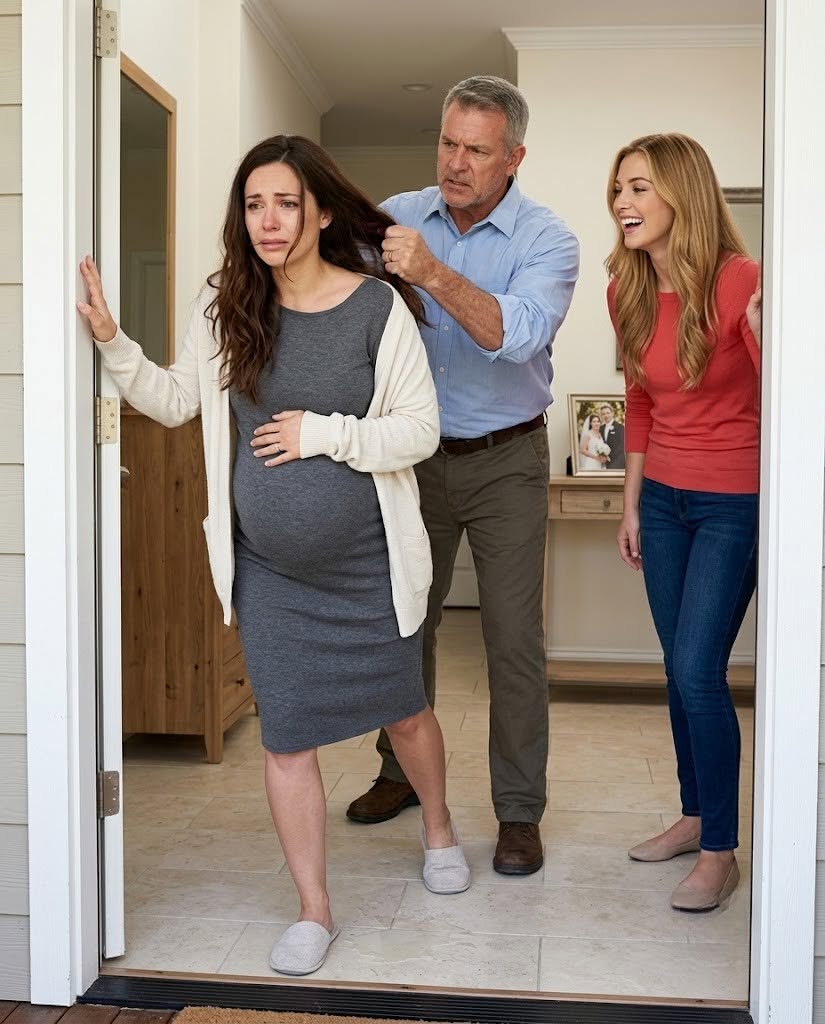 Richard and Kelsey had lost the money, the sale, and the future they tried to build on a lie. My father had also lost the right to know his granddaughter. That was the consequence he kept begging me to reverse.
I never did.
I looked down at June, safe in the home her father had loved, and whispered, “We’re staying.”