Part 3 — The Crutch That Fell
The crutch hit the hardwood floor with a sharp crack.
For one second, nobody moved. Coo the law high an vee tree me
My aunt Patricia stood in the hallway holding the remaining crutch against her chest, staring at me as though I had committed some terrible offense.
Behind me, my ten-year-old brother, Noah, made a small frightened sound.
“Please,” he whispered. “Don’t make her mad.”
Those five words changed everything.
I had come home expecting to find my little brother recovering from a broken leg. Instead, I had found him tied to a porch chair, his wrists red, his cast scraped, and his crutches deliberately hidden inside the house.
Now he was begging me not to upset the person who had done it.
I bent down and picked up the fallen crutch.
“Give me the other one, Aunt Patricia.”
She shook her head.
“You have absolutely no idea what I’ve been dealing with.”
“Then explain it to someone who can help. But you’re not keeping his crutches.”
Her expression hardened.
“You think because you’re twenty-three and have a job, you suddenly know how to raise a child?”
“I know you don’t tie injured children to chairs.”
She opened her mouth.
Then she closed it.
For a moment, something flashed across her face.
Not guilt.
Calculation.
She glanced toward the kitchen, where her purse sat beside a stack of unopened mail.
Then she said something that made my stomach tighten.
“If you take him out of this house, you’ll regret it.”
I stared at her.
“Are you threatening me?”
“I’m telling you that you don’t understand the situation.”
I looked back at Noah.
He was watching us with his hands pressed tightly together.
And suddenly I realized something that terrified me more than the ropes.
My brother hadn’t been surprised when I found him tied up.
He had been surprised that I was willing to untie him.
I took my phone from my pocket.
Patricia immediately stepped forward.
“What are you doing?”
“Calling for help.”
Her face went pale.
“Don’t you dare.”
But I was already dialing.
And when the dispatcher answered, I said the sentence I never imagined I would have to say.
“My ten-year-old brother has a broken leg. I found him restrained to a chair outside our house, and the adult responsible is refusing to return his medical equipment.”
Patricia lunged toward my phone.
I stepped back.
“Don’t touch me.”
She froze.
The dispatcher asked whether Noah was safe.
I looked at his shaking hands.
“No,” I answered. “Not yet.”
Part 4 — What the Paramedic Found
The police arrived first.
A patrol car pulled into the driveway, followed several minutes later by an ambulance.
Patricia transformed the moment she saw the uniforms.
Her angry expression disappeared.
Her shoulders slumped.
She pressed a hand against her chest and began speaking in a trembling voice.
“Thank goodness you’re here. My niece has completely misunderstood everything.”
Officer Daniel Reeves glanced at me, then at Noah.
“What happened?”
Patricia answered before I could.
“He’s been very difficult since his accident. Screaming, refusing instructions, deliberately falling over. I only restrained him briefly because I was afraid he’d injure himself again.”
The officer looked at the red marks around Noah’s wrists.
“With rope?”
Patricia hesitated.
“It was a temporary measure.”
The second officer, a woman named Collins, knelt beside Noah.
“Hey, buddy. I’m Officer Collins. Can you tell me your name?”
“Noah.”
“How old are you?”
“Ten.”
“Does your leg hurt right now?”
He nodded.
“How long have you been outside?”
Noah looked toward Patricia.
I saw the exact moment Officer Collins noticed.
She shifted slightly, placing herself between them.
“You can look at me, sweetheart. You’re not in trouble.”
Noah swallowed.
“Since after lunch.”
I checked my phone.
It was almost six in the evening.
Officer Collins gently asked whether anyone had helped him use the bathroom.
Noah shook his head.
“Did anyone bring you water?”
Another shake.
Patricia rushed forward.
“He had water earlier!”
Officer Reeves raised his hand.
“Ma’am, I need you to stay over here.”
That was when the paramedic, a woman named Sarah, began examining Noah’s cast.
She checked his toes, circulation, sensation, and the exposed skin around the edges.
Then she noticed the damage.
A long scrape ran diagonally across the white fiberglass near his ankle.
She examined it carefully.
“Did you fall?”
Noah nodded.
“When?”
“This morning.”
“How?”
He glanced at Patricia again.
Sarah waited.
Finally, he whispered, “She told me if my leg was really broken, I wouldn’t keep trying to walk.”
The porch went silent.
I felt a cold sensation spreading through my chest.
Sarah asked him to explain.
Noah stared at his hands.
“She said I was pretending. So she took my crutches and told me to walk to the kitchen without them.”
I turned toward Patricia.
She looked away.
Noah continued.
“I tried hopping. But I fell. My cast hit the stairs.”
Sarah stopped touching the cast.
“Has anyone checked your leg since then?”
Noah shook his head.
“And after that?”
His voice became almost inaudible.
“She said I was doing it for attention.”
Then he looked up at me.
“And she tied me outside.”
Sarah exchanged a glance with Officer Collins.
“We need to take him to the hospital.”
Patricia immediately protested.
“That’s completely unnecessary!”
But nobody was listening to her anymore.
When Sarah helped Noah onto the stretcher, he grabbed my sleeve.
“Can you come?”
I held his hand.
“I’m not leaving you.”
He stared at me.
Then he asked the question that nearly broke me.
“Even if Aunt Patricia says I’m bad?”
I swallowed hard.
“Especially then.”
Part 5 — The Secret Behind the Broken Leg
At the hospital, an X-ray revealed that Noah’s original fracture had shifted slightly from its previous position.
The orthopedic doctor explained that his leg needed to be stabilized again and monitored closely.
But the physical injury wasn’t what kept me awake that night.
It was what Noah told me afterward.
He lay in a hospital bed under a thin blue blanket, holding a stuffed dinosaur one of the nurses had given him.
I sat beside him.
The room was quiet except for the soft hum of the air conditioner.
“Noah,” I said gently, “I need to ask you something.”
He looked at me.
“When did Aunt Patricia start treating you like this?”
His fingers tightened around the dinosaur.
“A while ago.”
“How long?”
He didn’t answer.
I waited.
Then he whispered, “Since Dad went away.”
Our father had died eighteen months earlier.
A sudden heart attack.
No warning.
Our mother had died when Noah was three, leaving Dad to raise us alone.
After Dad’s funeral, Patricia offered to become Noah’s legal guardian while I finished my nursing program and secured a stable income.
At the time, it seemed like the responsible decision.
She had a house, a respectable job, and decades of experience raising her own children.
I had student loans and a tiny apartment.
I believed Noah would be safer with her.
I had been wrong.
“What happened after Dad died?” I asked.
Noah stared at the blanket.
“She got mad when I cried.”
My chest tightened.
“What do you mean?”
“She said big boys don’t cry about things they can’t change.”
I closed my eyes briefly.
“And when you hurt your leg?”
Noah looked toward the door before answering.
“She was mad because the hospital called you.”
I frowned.
“What?”
He nodded.
“She told them not to. But I remembered your number.”
Two weeks earlier, Noah had fallen from the back steps while Patricia was shopping.
I received a call from the hospital and rushed there immediately.
Patricia arrived nearly an hour later.
She claimed she’d been unable to answer her phone.
Now, remembering the way Noah had clung to my hand that day, I began wondering what else I had missed.
“Noah, how did you fall?”
He went quiet.
I didn’t push.
Then he whispered something I hadn’t expected.
“I wasn’t supposed to go outside.”
“Why not?”
“Because I was hungry.”
I stared at him.
He explained that Patricia had locked the kitchen pantry after accusing him of eating too many snacks.
He had asked for lunch.
She told him to wait until dinner.
When he became hungry enough, he tried to reach a bag of crackers she’d left in the garage.
He went down the back steps.
One board had been loose.
His foot slipped.
He fell.
I stared at him, trying to make sense of the story.
“Did she know you were hurt?”
Noah nodded.
“I yelled for her.”
“Did she help?”
He shook his head.
“She said I was being dramatic.”
“How long were you outside?”
“I don’t know.”
His voice cracked.
“Until the neighbor heard me.”
The hospital hadn’t called an ambulance that day.
Our elderly neighbor, Mrs. Bennett, had.
And suddenly I remembered Patricia’s angry expression when she arrived at the emergency room.
I had assumed she was upset about the accident.
Now I understood.
She was upset because somebody else had found him.
Part 6 — The Woman Across the Fence
The next morning, I spoke to the hospital social worker and gave her everything Noah had told me.
A child-protection investigation was already underway.
The police had documented the rope, photographed the porch, and collected Noah’s initial account.
But I knew there was one person who might understand what had been happening inside that house.
Mrs. Bennett.
She lived directly behind Patricia’s property.
For years, she’d been the kind of neighbor who left homemade cookies on doorsteps and remembered everyone’s birthdays.
When I knocked on her door, she opened it almost immediately.
The moment she saw me, her face changed.
“Is Noah all right?”
“He’s safe at the hospital.”
Her eyes filled with tears.
“Oh, thank God.”
I stepped inside.
Mrs. Bennett led me into her kitchen and poured two cups of tea, though neither of us touched them.
Then she said something that made my heart stop.
“I called children’s services three months ago.”
I stared at her.
“What?”
“I heard him crying outside one evening. Patricia told me he was having a tantrum. But the next day, I saw him carrying garbage bags almost as big as he was.”
“Why didn’t you tell me?”
“I tried.”
She reached for her phone.
My number was saved under my full name.
There were four outgoing calls.
All unanswered.
The dates stretched across two months.
I checked my own call history.
Nothing.
Then I remembered.
Patricia had insisted I change my phone number after someone supposedly tried to access my banking information.
She had been helping me transfer the account.
She was the only relative who knew the new number at first.
Mrs. Bennett had been calling the old one.
“I left messages,” she whispered. “I thought you weren’t interested.”
I covered my mouth.
She shook her head.
“I know now that wasn’t true.”
Then she opened a drawer.
Inside was a folder containing handwritten notes, dated photographs, and copies of two letters she’d sent to child-protection services.
“I started keeping records,” she explained. “Because whenever anyone asked Patricia questions, she had an answer.”
The photographs showed Noah doing yard work.
Carrying heavy bags.
Scrubbing patio furniture.
Standing alone outside in cold weather.
In one photograph, he was sitting on the back steps with his head buried in his arms.
I recognized his faded green sweatshirt.
It was the one I’d bought him for Christmas.
Mrs. Bennett pointed to another picture.
“This was taken the week before he broke his leg.”
Noah stood outside holding a broom.
There was snow along the fence.
He wasn’t wearing a coat.
I felt sick.
Then Mrs. Bennett showed me something else.
A recording from her security camera.
The camera faced her driveway, but part of Patricia’s back porch was visible in the corner.
The video was from the day Noah broke his leg.
At 11:42 a.m., Noah appeared near the porch steps.
He was limping.
Then he fell.
The audio captured him crying out.
A few minutes later, Patricia came outside.
She stood over him.
Even from a distance, I recognized her voice.
“Get up, Noah. I’m tired of this nonsense.”
He cried harder.
She walked back into the house.
He remained on the ground.
Mrs. Bennett looked at me.
“I heard him calling, so I went over.”
I couldn’t speak.
She touched my arm.
“I wish I had gone sooner.”
I looked at the frozen image of my brother.
And for the first time since finding him on that porch, my anger turned into something else.
Determination.
Because this wasn’t one terrible afternoon.
It was a pattern.
And I wasn’t going to let anyone explain it away.
Part 7 — The Money Nobody Mentioned
Three days later, I met with an attorney named Rebecca Hayes.
She specialized in family law and child-protection cases.
I brought copies of everything I had, including the hospital reports and Mrs. Bennett’s documentation.
Rebecca read silently for nearly twenty minutes.
Then she looked up.
“There’s something important I need to ask you.”
“What?”
“Did your father leave money for Noah?”
I nodded.
“Life insurance. And a trust.”
“How much?”
“Approximately four hundred thousand dollars altogether.”
She paused.
“Who manages it?”
“Aunt Patricia.”
Rebecca leaned back.
“Do you receive statements?”
“No.”
“Have you ever asked for them?”
I thought about it.
Once.
Six months after Dad died, I’d asked Patricia whether the trust was covering Noah’s school expenses.
She became irritated and told me that managing a grieving child was difficult enough without me questioning her finances.
I apologized.
I actually apologized.
Rebecca opened her notebook.
“We need to review the trust documents.”
Over the next week, my attorney obtained the paperwork through the appropriate legal process.
The results were devastating.
The trust had been established to pay for Noah’s education, medical care, housing, and everyday necessities.
Patricia was entitled to reimbursement for legitimate expenses.
But there were transactions nobody could explain.
Large withdrawals.
Payments to a private credit account.
Transfers to an investment business registered under Patricia’s adult son’s name.
There was also a payment toward a luxury vehicle.
All supposedly categorized as expenses related to Noah’s care.
Rebecca tapped one line on the statement.
“Do you recognize this company?”
I shook my head.
Then I saw the owner’s name.
My cousin, Brandon.
Patricia’s eldest son.
The same cousin who had recently opened a construction business.
Suddenly, I remembered Patricia boasting about helping Brandon buy expensive equipment.
I had congratulated them.
Now my hands were shaking.
“Are you saying she used Noah’s money?”
“I’m saying these transactions need a full accounting. Some may be legitimate, but several are deeply concerning.”
Then Rebecca showed me another document.
It was a handwritten summary Patricia had submitted to support a request for additional trust distributions.
Under Noah’s medical expenses, she had listed thousands of dollars in specialized recovery equipment.
Equipment Noah had never received.
Including orthopedic mobility aids.
I stared at the page.
“His crutches came from the hospital.”
Rebecca nodded.
“That distinction may matter.”
I thought about the porch.
The rope.
The scraped cast.
The way Patricia had raised the crutches above her head rather than hand them to me.
She had treated the equipment as something she owned because she’d been treating everything meant for Noah as hers.
Even his freedom to move.
Part 8 — The Recording That Ended Her Lies
Patricia’s attorney argued that the incident on the porch was an unfortunate disciplinary mistake.
He described her as an exhausted guardian overwhelmed by a difficult child.
He claimed Noah had exaggerated his pain because he resented living under strict rules.
Then investigators obtained additional security footage.
Mrs. Bennett’s camera had captured more of that afternoon than anyone initially realized.
At 1:16 p.m., Patricia walked onto the porch carrying a length of rope.
Noah was seated in the chair.
His injured leg stretched awkwardly in front of him.
Patricia bent down.
Seconds later, his arms stopped moving freely.
She walked into the house.
The recording continued.
At 2:03 p.m., Noah tried to stand.
He couldn’t.
He sat back down.
At 3:27 p.m., he leaned forward, apparently trying to reach the loose end of the rope with his fingers.
His cast scraped against the chair leg.
At 4:11 p.m., he began crying.
Nobody came.
At 5:38 p.m., my car pulled into the driveway.
The next image showed me rounding the side of the house.
Then stopping.
Even without hearing the conversation, I remembered every word.
Every trembling breath.
Every second.
And when the investigator played the recording for me, I realized something I’d forgotten.
Before I untied him, Noah had tried to smile.
A tiny, frightened smile.
As though he didn’t want me to think he was causing trouble.
I left the room and cried in the hallway.
Not because I thought I’d failed him forever.
But because I understood how hard he had worked to survive without upsetting anyone.
The evidence substantially undermined Patricia’s account of the afternoon.
With the hospital findings, witness statements, and financial records, investigators had far more than a family disagreement to examine.
Patricia was arrested in connection with the alleged abuse and unlawful restraint.
The financial investigation continued separately.
I didn’t celebrate when I heard.
I sat beside Noah’s hospital bed, watching him sleep.
For the first time in weeks, his face looked peaceful.
And that was enough.
Part 9 — What Noah Asked the Judge
The next several months were difficult.
There were interviews, medical appointments, therapy sessions, and hearings.
I applied for guardianship of Noah.
My attorney helped me document my income, housing, employment, and plans for his education and medical care.
Mrs. Bennett submitted her records.
Noah’s doctors provided reports.
The court reviewed the evidence.
Eventually, I was granted guardianship.
Patricia was no longer responsible for his care.
But the moment I’ll never forget happened during one of the proceedings.
The judge spoke gently to Noah in a private, child-sensitive setting, with appropriate support present.
She asked him what he wanted his new home to be like.
Noah thought for a long time.
Then he said, “Can I have my own crutches?”
The judge looked puzzled.
“Can you explain what you mean?”
Noah lowered his eyes.
“Ones nobody can take away when they’re mad.”
I pressed my lips together.
The judge was quiet for a moment.
Then she answered, “You deserve to have the equipment you need to move safely.”
Noah nodded.
But he wasn’t finished.
“Can I ask one more thing?”
“Of course.”
“If I say something hurts, will someone believe me?”
The judge’s expression softened.
“People responsible for your care should take your pain seriously and help you get medical attention when you need it.”
Noah glanced toward me.
I smiled through tears.
And for the first time since everything happened, he smiled back without immediately looking around to see whether someone disapproved.
Part 10 — The House Where He Could Finally Be a Child
Six months after that afternoon on the porch, Noah moved into a small two-bedroom apartment with me.
It wasn’t fancy.
The kitchen was narrow.
The bathroom faucet leaked whenever someone turned it too far.
The living room barely fit a couch and a coffee table.
But Noah loved it.
He chose blue curtains for his bedroom.
He taped drawings of dinosaurs to the walls.
He arranged his books by color because he said it made them look like a rainbow.
And every night, he placed his crutches beside his bed.
Even after the doctor told him he could gradually stop using them.
At first, I didn’t understand why.
Then one evening, while I was helping him straighten his blanket, I asked.
“Buddy, why do you still keep those so close?”
He shrugged.
“In case I need to leave.”
The words hit me like a fist.
I sat beside him.
“Noah, you don’t ever have to run away from this house.”
He looked uncertain.
“What if I do something wrong?”
“Then we’ll talk about it.”
“What if I break something?”
“We’ll figure it out.”
“What if I make you really, really mad?”
I took his hand.
“Then I’ll still love you.”
His eyes filled.
“Even if I cry?”
“Even if you cry.”
He stared at me for a long time.
Then he leaned against my shoulder.
And he cried.
Not quietly.
Not carefully.
He cried the way a child cries when he’s finally stopped trying to be brave.
I held him until he fell asleep.
For months afterward, recovery came in small steps.
He began asking for snacks without apologizing.
He stopped hiding food in his backpack.
He learned that making a mistake didn’t mean losing dinner.
His therapist helped him recognize that his pain, hunger, fear, and sadness were not misbehavior.
Some nights he still woke from nightmares.
Sometimes a raised voice on television made him flinch.
Healing wasn’t immediate.
And it wasn’t a straight line.
But gradually, the frightened boy on that porch began returning to the things he’d once loved.
Drawing.
Reading.
Building elaborate cardboard spaceships.
Laughing at ridiculous jokes.
And eventually, running.
The day his doctor cleared him for regular activity, Noah asked if we could visit the park.
We went on a bright Saturday morning.
He ran across the grass toward the swings.
Then stopped and looked back.
I waved.
“Go ahead!”
He hesitated.
Then shouted, “You’re not going to tell me to stop?”
“Not unless you need a break!”
He laughed.
A real laugh.
Loud and careless and completely free.
I watched him race toward the swings, his sneakers kicking up little clouds of dust.
And I thought about how close I had come to believing Patricia’s excuses.
How easily cruelty could disguise itself as discipline.
How often a frightened child might be dismissed as difficult.
Epilogue — The Empty Chair
Almost a year after I found Noah tied to the porch, I received a call from Rebecca.
The criminal proceedings had concluded with Patricia accepting responsibility for offenses related to Noah’s treatment and receiving a court-imposed sentence. The financial case had also resulted in orders addressing improperly used trust funds, although recovery of the money would take time.
Brandon’s role had been investigated separately, and I left those questions to the authorities.
No amount of money could undo what Noah had endured.
But the trust was placed under independent management, and his future educational and medical needs were protected as far as the legal process could provide.
That evening, I found Noah sitting at the kitchen table.
He was drawing a house.
A blue house with a red roof and yellow flowers.
Two stick figures stood outside.
One tall.
One small.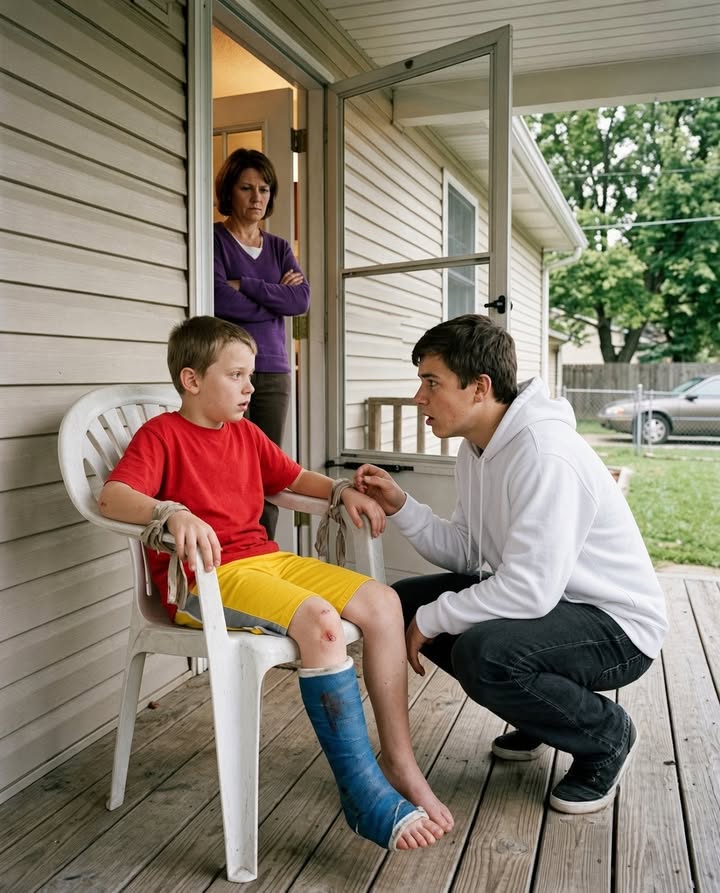 Both smiling.
“Who’s that?” I asked.
He pointed.
“That’s you.”
“And the little one?”
“Me.”
I noticed something beside the house.
A chair.
An ordinary wooden chair.
My stomach tightened.
“What’s the chair for?”
Noah looked up.
“It’s for when we sit outside and eat ice cream.”
I blinked.
“That’s a good idea.”
He smiled.
“Can we get one?”
“We can get two.”
He thought for a moment.
“Can we get three?”
“Who’s the third one for?”
He grinned.
“Mrs. Bennett. She makes good cookies.”
I laughed.
And for the first time, thinking about a chair on a porch didn’t make me feel sick.
The following weekend, we bought three folding chairs and set them on our tiny balcony.
Mrs. Bennett came over with chocolate-chip cookies.
Noah brought out lemonade.
We sat together watching the sunset turn the sky pink.
Noah leaned against me.
“Hey, sis?”
“Yeah?”
“Remember when you found me?”
I looked down.
“I remember.”
He was quiet.
Then he whispered, “I thought you were going to believe her.”
I felt tears gathering.
“I know.”
“But you didn’t.”
“No.”
He rested his head on my shoulder.
“Why?”
I brushed a strand of hair from his forehead.
“Because I believed you.”
He thought about that.
Then he smiled.
“Good.”
A few minutes later, he ran inside to get his dinosaur book.
The balcony door remained open.
The chairs stayed where they were.
Nobody was trapped.
Nobody had to earn the right to move.
And the boy who once begged permission to stand was now running freely through his own home.
I looked at the empty chair beside me.
For months, I’d remembered the scrape of fiberglass against wood, the rope around his wrists, and the way he’d apologized for needing help.
But that evening, I realized those memories no longer told the whole story.
There was another chair now.
Another porch.
Another ending.
And when Noah came racing back outside, laughing because he’d found the page with his favorite dinosaur, I knew exactly what I would remember most.
Not the day I found my brother tied to a chair.
The day he finally understood that he would never have to beg someone to untie him again.
THE END.