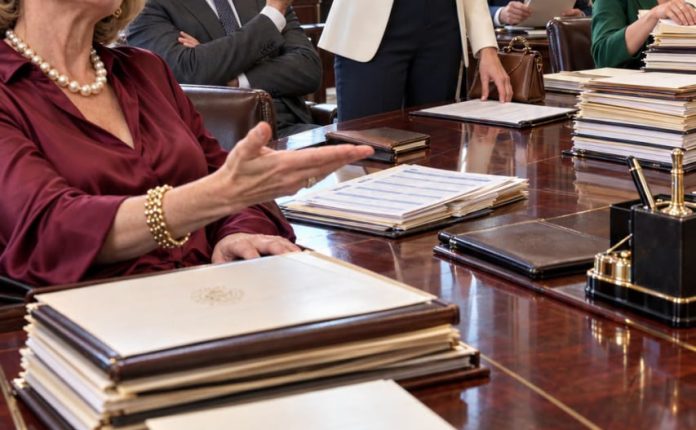
Nobody had saved me a proper chair.
There were six upholstered chairs in Meredith Bell's conference room, and five were occupied when I arrived.
The remaining one stood between a filing cabinet and a fern whose leaves had browned at the edges.
It was the kind of seat people took when they arrived late to a meeting that wasn't really meant for them.
I looked at my watch.
I wasn't late.
“Claire! There you are.”
My mother, Louise Morgan, smiled and waved.
She wore the pearl earrings I'd given her for her sixty-fifth birthday.
“Come sit down, sweetheart. We're almost ready.”
I was thirty-five, old enough to recognize when my mother was performing happiness for an audience.
That smile had appeared whenever she needed me to forgive an inconvenience before I knew what it was.
Usually, it involved moving furniture.
Or driving her somewhere.
Or paying for something.
This time, I had driven forty-three minutes through sleet to attend a meeting she described as important to my future.
My blue folder was tucked beneath my arm.
I had prepared it over two evenings after work.
Inside were six years of mortgage records, insurance information, repair receipts, medical expense summaries, and a carefully organized spreadsheet of my parents' monthly spending.
I thought we were finally going to have a serious conversation about their finances.
Instead, I found Aunt Vivian sitting beside my cousin Grant.
That was my first real surprise.
Vivian Ellis was my mother's older sister.
She had never liked me much.
When I was a child, she called me too serious.
When I became an accountant, she called me too concerned with money.
Whenever Grant needed help, however, she called me the sensible one.
Grant sat with one ankle resting on his opposite knee.
He wore a navy jacket that looked new and kept glancing at his smartwatch.
At thirty-seven, he had already accumulated an impressive collection of business explanations.
He had lost a partnership because his partner was unreasonable.
He had almost lost his company because the economy was unfair.
He had borrowed money from relatives because banks didn't appreciate entrepreneurship.
Nothing was ever quite his responsibility.
I had expected to see him at holiday dinners.
I hadn't expected him at a meeting concerning my parents' estate.
My father sat nearest the window.
Warren Morgan was sixty-eight.
He had worked as an automotive mechanic for most of his life, and even in retirement, the creases of his hands retained faint traces of dark grease.
His hands lay flat on the conference table.
He didn't turn when I entered.
“Dad?”
He looked up.
“Roads bad?”
“Pretty awful.”
He nodded.
Then he returned his attention to the parking lot.
I knew that expression.
It was the same one he wore when my mother began an argument he didn't want to have.
Attorney Meredith Bell greeted me with a professional smile.
She looked to be in her early fifties, with reading glasses suspended from a thin silver chain.
“Thank you for coming, Ms. Morgan.”
“Claire is fine.”
“Of course.”
I put my folder beside the empty chair.
“Mom said we're reviewing the estate plan.”
“We are,” Meredith replied.
“Wonderful. I've brought copies of the household financial summary in case they're useful.”
Grant gave a short laugh.
“Of course you did.”
I looked at him.
“Is something funny?”
“No. It's just very you.”
My mother made a small calming gesture.
“Let's not start anything.”
I hadn't started anything.
I hadn't even sat down.
Meredith waited until everyone was settled.
Then she opened a thick binder.
“Warren and Louise have executed a revocable living trust,” she began.
She explained that the trust was designed to manage their property during their lifetimes and direct its distribution after the surviving spouse died.
The principal assets included the home on Ash Street.
Their modest savings.
My father's pickup.
Personal belongings.
And any additional property properly transferred into the trust.
I listened carefully.
So far, there was nothing unusual.
My parents had talked about estate planning for years.
My father had survived two serious heart-related hospitalizations.
They were getting older.
It made sense to organize their affairs.
Meredith turned a page.
“Upon the death of the surviving trustmaker, the entire remaining trust estate is to be distributed to Grant Ellis.”
I heard the words.
I understood each one.
But together, they seemed impossible.
“Sorry,” I said.
Meredith looked up.
“Could you repeat that?”
She repeated it.
Grant would receive the entire remaining estate.
I looked from Meredith to my parents.
Then back again.
“Grant is the beneficiary?”
“Yes.”
“Not the trustee?”
“He is also named as a successor trustee under certain circumstances, but I'm discussing his beneficial interest.”
I swallowed.
“And my share?”
Meredith looked at the binder.
Then she looked at me.
“The document specifically states that your parents have intentionally made no distribution to you.”
The room became very quiet.
Outside, a maintenance truck moved through the parking lot.
Its tires crushed dirty snow against the curb.
I watched the driver reverse twice before finding a space.
I remember that absurd detail because I couldn't bear to look at my family.
“My parents' only child receives nothing?”
“That is what the current document provides,” Meredith said.
My mother reached across the table.
“Oh, honey.”
She enclosed my hand in both of hers.
“Please don't look so upset.”
I looked at her.
Her eyes were bright and expectant.
She seemed to believe I was supposed to reassure her.
“Mom, did you know about this?”
“Of course we did.”
“And you agreed?”
“We made the decision together.”
I looked at Dad.
His jaw moved slightly.
He said nothing.
“Why?”
My mother released my hand.
“Well, sweetheart, you have a wonderful career.”
I waited.
“You're independent. You've always been so responsible.”
She glanced affectionately at Grant.
“And Grant has three children to think about.”
Grant nodded as though the matter had been settled by a mathematical formula.
I felt something tighten beneath my ribs.
“So he gets the entire estate because he has children?”
“It's not as simple as that.”
“Then explain it.”
Vivian straightened the silk scarf around her neck.
“Claire, we discussed this thoroughly.”
I looked at her.
“We?”
“Your parents and I.”
“And Grant?”
“Obviously.”
“And nobody thought to include me?”
Vivian's mouth flattened.
“Everyone who needed to participate was involved.”
The sentence was delivered with such certainty that I almost admired it.
Almost.
I looked down at the blue folder.
The corners had softened from being carried to accountants, insurance offices, roofing companies, and hospitals.
Six years of paperwork sat beneath my fingertips.
Apparently, none of it had earned me a place in the discussion.
I turned to Grant.
“Do you know the house still has a mortgage?”
He looked offended.
“Obviously.”
“Do you know the balance?”
“I know there's a mortgage, Claire.”
“That wasn't my question.”
He shifted in his seat.
“Something over a hundred thousand.”
“Approximately one hundred thirty-two thousand when it was refinanced.”
“Fine.”
“And do you know who's been making the payments?”
My mother interrupted.
“Claire, don't embarrass everybody.”
I kept my eyes on Grant.
“Do you?”
He shrugged.
“You help out.”
“Help out?”
“Sure. That's what families do.”
I opened my mouth.
Then closed it again.
Because the last six years came back to me all at once.
Not as a list of numbers.
As ordinary days.
A cold kitchen.
A hospital parking lot.
My mother's wet eyes over a mortgage statement.
And the afternoon I'd made a promise I believed would last three months.
It had begun six years earlier.
Dad had just returned home from the hospital.
His cardiac medications had changed, and he was still moving carefully around the house.
Mom had burned toast that morning.
The kitchen smelled bitter.
A mortgage statement lay between her coffee cup and a half-eaten banana.
When I asked what was wrong, she started crying.
I knew something was serious.
My mother did not usually cry about money.
She preferred to pretend it wasn't a problem until someone else solved it.
“It's Grant,” she said.
I sat down.
“What about him?”
“His business is in terrible trouble.”
Grant owned a small equipment rental operation.
He supplied compact machinery to landscapers and contractors around Dayton.
He was always talking about expansion.
Another truck.
Another trailer.
Another market he was about to dominate.
Apparently, expansion had outrun cash.
“He's behind on everything,” Mom said.
“Payroll. Equipment financing. Insurance.”
I stared at her.
“Why are you telling me?”
“Because your father and I helped.”
I knew that word.
In our family, helped often meant paid.
“How much?”
She rubbed her thumb around the rim of her mug.
“Seventy-six thousand.”
I thought I'd heard incorrectly.
“Dollars?”
“Claire.”
“Where did you get seventy-six thousand dollars?”
She looked toward the hallway.
Dad was resting in the living room.
“We refinanced.”
I felt the blood leave my face.
Their house had been nearly paid off.
My father had talked for years about making his final mortgage payment.
He wanted to celebrate by taking my mother to dinner.
He used to joke about framing the cancelled loan statement.
Now they had borrowed against the property.
For Grant.
“Please tell me you didn't give him the money outright.”
Mom hesitated.
“He needed it immediately.”
“Was it a loan?”
“We didn't want to make him feel worse.”
“Was there paperwork?”
“Your aunt said he'd repay us.”
I sat back.
“Mom.”
“He employs people with families.”
“So do thousands of other businesses.”
“He could have lost everything.”
“And now you could.”
She started crying harder.
I remember feeling cruel for saying it.
Now I wish someone had said it before the refinancing documents were signed.
The new monthly mortgage payment was $1,480, including property taxes and homeowners insurance.
My parents' retirement income covered groceries, utilities, prescriptions, transportation, and basic living expenses.
Barely.
The mortgage was another matter.
Mom explained that they could manage temporarily if medical expenses didn't rise.
But they had already risen.
Dad's latest hospitalization had frightened them.
She asked whether I could help until things stabilized.
“How long?” I asked.
“Three months.”
“Three?”
“Just until we work something out.”
I looked at the statement again.
I knew how little room there was in their budget.
I knew Dad needed rest.
And I knew what might happen if they missed payments.
So I agreed.
Three months.
I set up access to the lender's online payment portal.
I linked my checking account.
I scheduled the payments.
And I told myself I was doing what any daughter would do.
Three months passed.
Nothing changed.
When I asked about their plan, Mom said Grant's company was still struggling.
Six months passed.
Dad needed another specialist appointment.
Nine months passed.
The water heater failed.
I paid for that, too.
By the end of the first year, I had covered twelve mortgage payments.
Seventeen thousand seven hundred sixty dollars.
I remember calculating the total while eating dinner at my apartment.
I had been saving for a down payment on a small house of my own.
Nothing fancy.
Two bedrooms.
A driveway.
A kitchen window overlooking something greener than the neighboring building's brick wall.
I closed the real estate website that evening.
I told myself there would be time later.
Then the second year began.
The mortgage was still mine to pay.
Not legally.
Not officially.
But every month, money left my account.
Every month, my parents thanked me.
Every month, there was another reason they couldn't manage without it.
The roof needed repair.
The furnace started failing.
My mother's insurance premium increased.
The phones needed replacing.
Grant, meanwhile, posted photographs of family trips.
He bought a newer truck.
He announced another business opportunity.
Whenever I asked whether he was repaying the seventy-six thousand dollars, Mom told me not to interfere.
“He's trying, Claire.”
“Has he actually made a payment?”
“He helps in other ways.”
“What ways?”
“He's your cousin.”
That was usually where the conversation ended.
By the third year, I began asking about legal arrangements.
I was a certified public accountant.
I understood the difference between sentimental assurances and documented financial interests.
I suggested we speak with an attorney.
Maybe my parents could record a loan.
Maybe we could agree on reimbursement.
Maybe they could add me to the deed if they truly intended the house to become mine.
Mom always reacted as though I had accused her of dishonesty.
“Why would you turn family love into a business transaction?”
“Because the payments are real money.”
“We know what you've done.”
“Then let's put something in writing.”
She would sigh.
“Claire, that house will be yours someday.”
The words were always gentle.
Sometimes she touched my cheek.
Sometimes she made tea.
Sometimes Dad nodded from the kitchen table.
I believed them.
I wanted to.
I grew up in that house.
I learned to ride a bicycle on Ash Street.
Dad taught me to change a tire in the driveway.
Mom marked my height on the pantry doorframe.
The house wasn't just an asset on a spreadsheet.
It was the place where my life began.
I thought I was keeping it safe for them.
And, eventually, for myself.
By the sixth year, I had made seventy-two mortgage payments.
The total was $106,560.
That figure did not include the water heater.
Or my contributions toward the roof.
Or the furnace.
Or phone charges.
Or insurance.
It also did not include the opportunities I had passed up.
A colleague bought a house and asked whether I wanted the number of her agent.
I told her I wasn't ready.
My best friend married in California.
I missed the wedding because the furnace at Ash Street broke that month.
I mailed a generous gift.
Then I sat alone in my apartment and watched photographs appear online.
I wasn't angry with my parents then.
I thought these sacrifices were temporary.
I was wrong about that.
Back in Meredith Bell's conference room, Grant was studying me with barely concealed impatience.
“Are we going to keep arguing about old expenses?”
I looked at him.
“Old expenses?”
“You made your choices. Nobody forced you.”
My father finally moved.
“Grant.”
“What?”
“Enough.”
It was the first firm word Dad had spoken since I arrived.
For one brief moment, I thought he might defend me.
Instead, Mom rested a hand on his arm.
“Let's not upset him,” she whispered.
Dad's shoulders dropped.
I looked at Meredith.
“Could I ask a few questions?”
“Certainly.”
“Did my parents tell you I've been paying the mortgage?”
Meredith hesitated.
“They discussed some assistance you've provided.”
“Did they tell you how much?”
“I don't believe I have a full accounting.”
I opened the folder.
I placed a summary sheet on the table.
“Seventy-two mortgage payments. One hundred six thousand five hundred sixty dollars.”
My mother made a faint sound.
Grant leaned backward.
Vivian stared at the paper without touching it.
“That's just the mortgage,” I continued.
“Other expenses are listed separately.”
Meredith studied the document.
“Were these payments intended as loans?”
I looked at my mother.
“I believed they were contributions toward a home I had repeatedly been told would eventually be mine.”
Mom shook her head.
“We never promised a particular legal arrangement.”
“You promised the house.”
“We said we expected you to be comfortable.”
“No, Mom. You told me it would be mine.”
She pressed her lips together.
Vivian spoke before either of us could continue.
“You're making a very unpleasant scene over money.”
I turned toward her.
“Money is what this meeting is about.”
“It's about family legacy.”
“Then why is the daughter who preserved that legacy being excluded?”
Grant leaned forward.
“Because you don't need the money.”
I stared at him.
He looked entirely serious.
“Grant, do you know what I earn?”
He shrugged.
“Enough.”
“Do you know how much I have in savings?”
“No.”
“Do you know what my rent is?”
“Why would I?”
“Then how do you know what I need?”
He looked at Vivian.
She looked at Mom.
Mom looked at Meredith.
Nobody answered.
I closed the folder again.
“Okay.”
My mother blinked.
“Okay?”
“Yes.”
She seemed relieved.
“I'm glad you're being reasonable.”
I could have told her there was nothing reasonable about what had happened.
Instead, I asked Meredith another question.
“Am I a borrower on the mortgage?”
“Not according to the documents I've reviewed.”
“Am I on the property deed?”
“No, based on the information supplied.”
“Am I obligated by this trust to maintain the property?”
“No.”
“Would I receive any ownership interest in exchange for continuing the mortgage payments?”
“Not under the trust provisions as presently written.”
I nodded.
“Thank you.”
Grant laughed under his breath.
“Here comes the accountant lecture.”
But I had no lecture prepared.
I had spent six years explaining.
Explaining why the mortgage mattered.
Explaining why repairs should be planned.
Explaining why Grant needed to repay what he'd borrowed.
Explaining why promises should be written down.
Nobody had wanted to listen.
And now I finally understood why.
They weren't confused.
They weren't waiting for better information.
They simply preferred an arrangement in which I carried the responsibility while Grant received the reward.
I stood.
Mom looked alarmed.
“Where are you going?”
“Home.”
“We haven't finished talking.”
“I think we have.”
“Claire, please.”
I picked up my coat.
Then I looked at my father.
“Dad, did you agree with this?”
His eyes moved toward Mom.
I waited.
He rubbed one thumb across the other.
Finally, he said, “Your mother thought it was best.”
“That's not what I asked.”
His expression tightened.
“I signed it.”
Those three words were worse than silence.
I nodded.
“Then I understand.”
Meredith stood politely.
“Claire, I would recommend independent legal advice before you make any decisions regarding the payments you've described.”
“Thank you. I'll do that.”
My mother reached for her handbag.
“Can we at least have dinner together?”
I looked at her.
She sounded genuinely confused.
As though I'd learned something mildly disappointing rather than discovering that the financial future I'd been promised had never existed.
“Not today, Mom.”
I walked toward the door.
Grant called after me.
“Don't make this dramatic.”
I stopped.
Turned.
And looked directly at him.
“Grant, what have you paid toward the house since my parents refinanced it?”
He opened his mouth.
Closed it.
Then said, “That's not the point.”
“It is to me.”
I left before he could answer.
Outside, the sleet had turned to freezing rain.
I sat in my car with the heater running.
I watched thin rivulets slide down the windshield.
For several minutes, I didn't move.
I didn't cry.
I didn't call a friend.
I didn't even turn on the radio.
I simply sat there trying to understand how a family could make such a decision and still expect everything else to remain the same.
Eventually, I drove home.
My apartment was quiet when I entered.
I hung my wet coat near the door.
Made coffee.
Then sat at the small desk by my bedroom window.
The blue folder lay beside my laptop.
I opened the spreadsheet.
The mortgage payments were recorded by date.
Seventy-two entries.
Most were identical.
$1,480.
I ran the total again.
$106,560.
I looked at my savings balance.
Then at the apartment lease renewal notice sitting beside my keyboard.
I had been considering buying a home for years.
But every plan began with the same obstacle.
The money leaving my account for Ash Street.
I opened an old message from Mom.
It was dated October 14, two years earlier.
At the time, I had suggested documenting my contributions.
Her response was still there.
“Sweetheart, please don't worry. You're protecting your future home. Dad and I know what you've done for us.”
I read it twice.
Then I saved a copy.
I found another message about the furnace.
Another about the roof.
There were several that referred to the house eventually being mine.
I saved those, too.
I wasn't sure whether they would matter legally.
But I wanted an accurate record of what had been said.
Next, I opened the lender's portal.
The March payment was scheduled to draw from my checking account.
My account.
My earnings.
For a mortgage that wasn't mine.
I stared at the scheduled transaction.
There was something strangely ordinary about it.
A date.
A payment amount.
A bank account number partly concealed by asterisks.
Six years of sacrifice reduced to a recurring instruction.
I checked the loan information.
I wasn't a borrower.
I wasn't an owner.
I wasn't even a beneficiary.
Then I called the mortgage servicer to verify how to remove my account safely.
The representative confirmed that I was authorized to make payments but wasn't personally obligated on the loan.
She explained how to remove my bank account from the payment arrangement.
I followed the instructions.
The screen refreshed.
The scheduled withdrawal disappeared.
A confirmation number appeared in its place.
I wrote it down.
Then I sat back.
I had expected to feel guilty.
Instead, I felt tired.
Not the ordinary exhaustion of a long workday.
Something deeper.
The weariness of finally acknowledging what had been obvious for years.
I went through the remaining accounts carefully.
My mother's car insurance.
The extra mobile lines on my phone plan.
The household services I had quietly subsidized.
I made notes about renewal dates and the proper steps for removing my voluntary contributions without abruptly cutting off essential services.
I wasn't going to create avoidable emergencies.
But I wasn't going to keep financing the arrangement indefinitely, either.
When I finished, I wrote an email.
I addressed it to both my parents.
I explained that I had removed my payment account from the mortgage arrangement.
I included the next due date.
I told them they would need to make future payments directly.
I also explained that I would transition the other expenses back to them with appropriate notice.
My wording was calm.
There were no accusations.
No demands that they change the trust.
No threats.
Just the financial boundaries I should have established years earlier.
Before sending it, I read the message aloud.
Then I clicked Send.
Nineteen minutes later, my phone rang.
Mom.
I answered.
“Hi.”
“What is this ridiculous email?”
Her voice was sharp.
I held the phone slightly away from my ear.
“It's a notice that I'm no longer paying your mortgage.”
“You cannot do that.”
“I already removed the scheduled payment.”
“Claire!”
“Mom, the next payment hasn't been made. You still have time to arrange it.”
She exhaled loudly.
“Your father cannot handle this kind of stress.”
“Then please don't turn it into an emergency.”
“How can you say that?”
“Because the mortgage is in your names. You know the payment amount. You know the due date.”
“Are you punishing us because of Grant?”
I looked at the spreadsheet.
“No.”
“Then what do you call this?”
“Stopping a voluntary payment.”
“Family doesn't behave like this.”
I closed my eyes briefly.
“Mom, you invited Grant into an inheritance discussion that excluded me completely.”
“That was about after we're gone.”
“And this is about what I'm doing while you're alive.”
“Those are different things.”
“They certainly are.”
She was quiet for a moment.
Then her voice softened.
“Sweetheart, you know we love you.”
I believed she did.
That was one of the hardest parts.
I didn't think my mother woke every morning wondering how to hurt me.
I thought she loved me in a way that had become tangled with what I could provide.
And she had stopped noticing the difference.
“I love you, too,” I said.
“But I can't keep paying for that house.”
She hung up.
That evening, Grant sent a message.
Apparently, my mother had called him.
His first sentence accused me of being selfish.
His second said I was putting my parents' home at risk.
His third was the most revealing.
“You should keep paying until things are settled. You're still their daughter, regardless of who gets the house.”
I read it slowly.
Then I replied.
“Are you offering to reimburse me?”
His answer came almost immediately.
“Unbelievable. Everything is always about money with you.”
I asked a simpler question.
“Will you pay the next mortgage installment?”
He didn't answer.
Instead, he warned that I was making a terrible mistake.
I saved the conversation.
Then I put my phone down.
For the first time in years, I went to bed without wondering whether my checking account could cover both my expenses and my parents'.
That didn't mean the situation was over.
Not remotely.
For the next several days, messages arrived from Mom.
At first, they were angry.
Then wounded.
Then carefully cheerful.
She sent a photograph of the living room.
She asked whether I remembered a school picture taken beside the fireplace.
She mentioned that Dad had been tired lately.
Every message circled the same issue without naming it.
Would I resume paying?
I answered questions about Dad.
I asked about his appointments.
I offered to help them review their budget.
But I did not restore the transfer.
Then Aunt Vivian called.
I hadn't spoken to her directly since the lawyer's office.
“Claire, your mother is beside herself.”
“I'm sorry she's upset.”
“She doesn't understand how you can behave so cruelly.”
“Did she tell you I'm refusing to visit?”
“No.”
“Did she tell you I'm refusing to speak to her?”
“No.”
“Then what exactly am I doing?”
“You know perfectly well.”
I leaned against the kitchen counter.
“I'm not paying a mortgage I don't owe.”
Vivian made a disgusted sound.
“You were willing to pay before.”
“Before I learned the arrangement.”
“Your parents are free to leave their property to whomever they wish.”
“I agree.”
“Then what's the problem?”
“They're also responsible for paying their own mortgage.”
For a moment, she said nothing.
Then she delivered the sentence I had been expecting.
“You're trying to blackmail them into changing the will.”
“No, Vivian. They can keep their estate plan.”
“Then why stop?”
“Because I can no longer afford to make their house my financial priority.”
“That's ridiculous. You earn good money.”
“So does Grant, according to him.”
She hung up.
I wrote down the date and what had been said.
Not because I intended to turn every family conversation into evidence.
Because I was finally learning how easily my words could be rewritten by someone else.
During the following week, I booked an appointment with an independent attorney.
Her name was Rebecca Shaw.
She practiced property and estate law in Dayton.
I brought the folder.
I brought the messages.
And I brought the question that had followed me home from Meredith Bell's office.
Had six years of financial sacrifice given me any claim to the house?
Rebecca listened without interrupting.
She reviewed the records.
Then she explained something I needed to hear.
Making mortgage payments did not automatically make me an owner.
A possible reimbursement claim would depend on the facts, the evidence, applicable law, and whether an enforceable agreement could be established.
My mother's texts might help explain my understanding.
But they were not a deed.
They were not a signed purchase agreement.
And there was no guarantee that I could recover what I'd spent.
I already suspected that.
Hearing it aloud still hurt.
“Did I make a terrible mistake?” I asked.
Rebecca considered the question.
“You helped people you trusted.”
“That isn't much of a financial strategy.”
“No,” she said.
“But trusting your parents isn't inherently unreasonable.”
I looked down.
“Apparently, it was in this case.”
She let the silence sit between us.
Then she asked whether I wanted to pursue a claim.
“I don't know.”
That was the truth.
I was angry.
I was embarrassed.
I felt foolish for allowing the arrangement to continue so long.
But I wasn't ready to turn my parents into legal opponents.
Not without understanding what that would mean.
Rebecca suggested preserving the evidence and avoiding informal promises while I considered my options.
She also encouraged me to keep the financial boundary separate from the inheritance dispute.
“You can stop voluntarily paying without making it a negotiation for the house.”
That sentence stayed with me.
I had no desire to buy my parents' affection by the month.
And I didn't want them to revise their trust merely because I threatened their immediate security.
If they ever changed their minds, I wanted it to come from an honest understanding of what had happened.
Not another bargain.
A month after the meeting, I was at work when my phone lit up.
It was Mom.
Five words.
“The mortgage is due.”
I stared at the screen.
The tax return on my monitor blurred.
Around me, printers hummed and someone laughed near the break room.
It was an entirely ordinary afternoon.
But I knew my answer would end a six-year pattern.
I typed three words.
“Not my problem.”
I looked at them.
They sounded harsher than I usually allowed myself to be.
Then I thought of the lawyer's table.
The empty chair.
My father's silence.
Grant's satisfied smile.
And my mother's assurance that I should not take her promises so literally.
I pressed Send.
For almost a full minute, nothing happened.
Then the phone began ringing.
Mom.
Grant.
Mom again.
I put it face down.
At five-thirty, I found a voicemail from Dad.
He wasn't shouting.
That made it harder.
“Claire, it's your father.”
A pause.
“Your mother says you're not making the payment.”
Another pause.
“I'd like to understand what happened.”
He cleared his throat.
“And there's something about Grant's money I should have told you years ago.”
I listened to the message twice.
Then I sat alone at my desk, staring at the folder I'd thought contained every important financial fact about our family.
Apparently, it didn't.
END PART 1