“Your husband left the house, the money, and the business to your son.”
I stared at Robert Sterling across the polished conference table.
“I'm sorry,” I said. “Would you please explain that again?”
He adjusted his glasses.
“The primary beneficiary of Randall Whitmore's estate is your son, Andre.”
The clock on the wall clicked steadily.
Beside Andre, my daughter-in-law Melissa shifted forward in her chair.
“It's perfectly straightforward, Henrietta.”
Nobody had asked her.
She answered anyway.
“Randall wanted Andre to have the responsibility of managing what he built.”
I looked at my son.
He was thirty-six years old.
He wore the navy suit I had bought him when he received his first promotion at the family company.
His hair was carefully combed, his jaw freshly shaved.
He had inherited Randall's dark eyes.
That morning, I hated how familiar they looked.
“Andre?”
He glanced toward Melissa before speaking.
“Dad wanted me to handle things.”
“What things?”
“The company. The investments. The properties.”
“And our home?”
His silence answered before Sterling did.
“The Maple Ridge residence is included in the property passing to Andre,” the attorney said.
I looked down at the document.
My vision blurred.
Three weeks earlier, I had watched six men carry Randall's coffin beneath a cold Connecticut sky.
Thirty-nine years of marriage had ended beside a grave surrounded by damp grass and flowers.
Now, sitting in a law office in Hartford, I was learning that the life we had built together apparently belonged to someone else.
I was sixty-two.
I had never imagined becoming a wealthy widow.
I had imagined remaining Randall's wife until we were both old enough to complain about our knees together.
We had planned to travel after he retired.
He wanted to see the Pacific coast.
I wanted to visit my sister in Oregon.
We had even begun arguing affectionately about whether to drive or fly.
Those plans disappeared when doctors discovered the illness that would take him.
The following months became a procession of hospital corridors, medication schedules, and sleepless nights.
I learned the names of nurses.
I learned which vending machine sold tolerable coffee.
I learned how to recognize pain in Randall's face even when he insisted he was comfortable.
What I had not learned was how to live without him.
Sterling cleared his throat.
“Mrs. Whitmore, the documents are legally significant, and we need to establish a practical timetable.”
I looked at the summary in front of me.
The estate was valued at approximately $2.5 million.
It included the Maple Ridge house, investments, vehicles, and interests in the business Randall had spent decades building.
His construction supply company had started with one rented warehouse and a used delivery truck.
I remembered sweeping that warehouse after closing.
I remembered preparing invoices on our kitchen table because we couldn't afford administrative help.
I remembered Randall arriving home with splinters in his fingers and dust in his hair.
We had built that company together.
My name had never appeared on the company letterhead.
That hadn't bothered me.
I had believed marriage meant we shared the life our work created.
Apparently, the legal documents told a different story.
“What am I supposed to live on?” I asked.
Sterling turned a page.
“You have been allocated the Beacon Falls property.”
“The cabin?”
“Yes.”
I laughed once.
It wasn't amusement.
It was disbelief escaping before I could stop it.
Randall had purchased the cabin decades earlier.
He sometimes went there when work became overwhelming.
It was a small wooden building surrounded by trees, with a sagging porch and a narrow gravel driveway.
I hadn't visited in years.
The last time I saw it, the kitchen window wouldn't close properly.
“The property is assessed at approximately fifteen thousand dollars,” Sterling continued.
Melissa smiled.
“See? You aren't being left with nothing.”
I turned toward her.
“You think that's something to celebrate?”
Her smile remained.
“I'm saying it's an opportunity. You always complained that the big house was difficult to maintain.”
“I complained about cleaning the gutters.”
“Well, now you won't have that problem.”
Andre rubbed his forehead.
“Melissa.”
She sat back.
“What? I'm trying to help.”
I studied my son.
“Andre, your father would never deliberately leave me unable to support myself.”
He looked at Sterling.
The attorney folded his hands.
“Mrs. Whitmore, your husband's stated intentions are documented.”
“Then I want to see when he signed everything.”
Sterling slid a packet toward me.
The pages were dense with legal language.
A signature appeared near the end.
It resembled Randall's.
But something about its shape troubled me.
Randall's right hand had become unsteady during his illness.
He sometimes struggled to hold a spoon.
This signature looked remarkably controlled.
I touched the page.
“When was this signed?”
Sterling gave me a date.
I remembered that week.
Randall had been exhausted, sleeping for much of each afternoon.
Andre had visited several times.
Melissa had brought flowers.
And Sterling had appeared one evening carrying a leather briefcase.
I remembered opening the door for him.
I remembered Randall asking everyone to leave his bedroom.
I had assumed they were discussing routine business matters.
“Randall wasn't well,” I said.
Andre's expression changed.
“Are you questioning Dad's mental capacity?”
“I'm questioning why nobody discussed this with me.”
“We have medical documentation,” Andre said.
The words landed carefully.
Not as an explanation.
As a warning.
Sterling looked between us.
“There are formal procedures for challenging estate documents, but litigation can be expensive and emotionally difficult.”
“How expensive?”
“That depends on the dispute.”
Melissa folded her hands.
“Andre and I have already spent quite a bit organizing everything. We really don't want to drag this out.”
I heard what she meant.
They had resources.
I did not.
They had lawyers.
I had barely slept.
A widow could spend years contesting an estate she could no longer afford to fight over.
Andre leaned closer.
“Mom, Dad made his choice.”
His voice was almost gentle.
That made it worse.
“Maybe he thought you needed something smaller.”
“Your father knew about my medical bills.”
“He also knew you could still work.”
I looked at him.
“Doing what?”
Andre shrugged.
“Something part-time.”
My right hand ached.
I pressed it against my knee.
It was hard to reconcile this conversation with memories of Andre at eight years old, crying because he had accidentally broken a neighbor's window.
I had sat beside him on the back steps.
We would tell the truth, I explained.
Then we would repair what he'd damaged.
He had asked whether I would still love him.
I told him nothing could change that.
I still loved him.
But I could no longer pretend I recognized the choices he was making.
Sterling indicated another page.
“This acknowledgment confirms that you've reviewed the distribution information.”
I read the line twice.
I was frightened that signing might surrender rights I didn't understand.
I said so.
Sterling explained that it acknowledged receipt rather than transferring the property itself.
He did not encourage me to seek independent advice.
Neither did Andre.
I signed the acknowledgment, feeling trapped between grief and the certainty that everyone else understood more than I did.
I would later learn how important it was that I had not signed a separate waiver of my rights.
At the time, I only wanted to leave.
Melissa stood.
“Excellent. Now we can discuss moving arrangements.”
I looked up.
“Moving arrangements?”
“The house, Henrietta.”
“Our house.”
She tilted her head.
“Legally, it's Andre's.”
“When?”
Andre spoke before she could.
“We were hoping you'd be out by Friday.”
It was Monday.
I stared at him.
“Four days?”
“We've already arranged for some work to begin.”
“What work?”
Melissa brightened.
“Nothing dramatic. Updating the kitchen, changing the carpets, repainting the upstairs rooms.”
“The upstairs rooms are fine.”
“They're very dated.”
I thought of the bedroom Randall and I had shared.
Our wedding photograph stood on his bedside table.
His slippers were still beneath the chair.
Melissa was discussing paint samples.
I gathered my handbag.
“I need to go home.”
No one tried to stop me.
Outside, Hartford traffic moved through the gray afternoon.
I sat in my car with both hands on the steering wheel.
For several minutes, I couldn't remember where I'd parked my house keys.
Then I realized I was holding them.
I drove to Maple Ridge slowly.
The house stood behind tall trees near the end of a quiet road.
Randall and I had moved there when Andre was ten.
Back then, the front lawn was mostly dirt.
We planted maples along the driveway.
Randall built a wooden swing beneath the largest tree.
Andre broke his wrist falling from it one summer.
I had wanted to remove the swing.
Randall insisted we should teach Andre to land properly instead.
For years, I considered that story evidence of my husband's wisdom.
After the funeral, I had begun questioning many things.
I walked into the kitchen.
The house smelled faintly of furniture polish and the lilies people had sent.
I stood at the counter where I had prepared thousands of meals.
Then I cried.
Not loudly.
I simply bent forward, pressed my forehead against my hands, and stayed there until the daylight shifted.
By Wednesday, I had packed most of my clothes.
Melissa arrived carrying a notebook.
She walked from room to room making observations.
“That cabinet should go.”
“This wallpaper definitely needs replacing.”
“Did Randall leave any original artwork?”
I watched her open a drawer.
“Please don't touch that.”
She looked offended.
“I'm just checking what needs to be inventoried.”
“You're standing in my bedroom.”
“Not for much longer.”
Andre entered behind her.
“Melissa, enough.”
She closed the drawer.
“Fine.”
But she smiled when she passed me.
Later, I found Andre alone in Randall's study.
He was sitting behind his father's desk.
For one brief moment, I saw the boy who used to climb onto Randall's lap and ask to help with paperwork.
“Andre,” I said quietly, “did you know about this before your father died?”
He kept looking at the computer screen.
“About what?”
“The will.”
“Dad discussed his plans.”
“When?”
“Over several months.”
“Why didn't you tell me?”
“He wanted to handle it himself.”
I approached the desk.
“Did he actually say he wanted me to have nothing?”
Andre's jaw tightened.
“Mom, I'm not doing this again.”
“I'm asking a simple question.”
“And I'm telling you the documents speak for themselves.”
He looked toward the hallway.
I followed his gaze.
Melissa was standing near the door.
She had heard everything.
Her face held no embarrassment.
Only impatience.
That evening, I sat in Randall's study after everyone left.
The shelves were nearly empty.
Andre had taken the business files.
Melissa had packed Randall's watches and most of his personal belongings.
I opened the bottom drawer.
Inside lay an old photograph of Randall standing beside a rough wooden cabin.
He looked about forty.
His sleeves were rolled up.
His smile was broad.
On the back, in his handwriting, were the words:
First summer at Beacon Falls.
I ran my thumb across the picture.
Randall had loved that place.
When we were younger, he sometimes disappeared there for an afternoon.
He said the quiet helped him think.
Once, I teased him about keeping a secret fortune beneath the floorboards.
He laughed.
“Nothing worth stealing.”
I had forgotten that conversation until the photograph brought it back.
The following morning, Melissa brought cardboard boxes downstairs.
“This is the last of Randall's personal things,” she said.
She pushed one toward me.
“Take whatever sentimental items you want.”
I opened it.
His reading glasses lay on top.
Beside them were his favorite fountain pen, a pocket notebook, and an old leather wallet.
At the bottom was a small brass key attached to a faded paper label.
Beacon Falls.
I stopped breathing for a moment.
During Randall's final hospital stay, he had repeatedly spoken those words.
Sometimes he whispered them while half asleep.
Sometimes he said them when Andre entered the room.
Once, near midnight, he caught my wrist.
“Henrietta. Beacon Falls.”
I leaned close.
“What about it, darling?”
He tried to speak again.
His mouth moved.
Nothing clear came out.
A nurse entered to check his medication.
By the following morning, he seemed too weak to remember our conversation.
I had blamed the medication.
Now I held a key that appeared deliberately labeled.
“What are you looking at?” Melissa asked.
I closed my fingers around it.
“Something your father kept.”
Andre glanced into the box.
“What?”
“Just an old key.”
He lost interest.
But Melissa watched my hand for another second.
I slipped the key into my handbag.
Friday came.
Two movers carried my remaining furniture to storage.
What I couldn't afford to store, I left behind.
I kept one suitcase, Randall's box, medication, a few photographs, and some kitchen supplies.
Melissa stood near the front door.
She had already chosen a different arrangement for the living room.
My favorite chair had been pushed against the wall.
As I carried my suitcase outside, Andre appeared.
“Mom.”
I turned.
For a second, I hoped he would apologize.
He placed an envelope in my hand.
“Directions to the cabin. I had the utilities transferred.”
“Thank you.”
He looked uncomfortable.
“If you need anything urgent, call.”
I studied him.
“Will you answer?”
His face tightened.
“That's unfair.”
“Is it?”
Melissa approached.
“We really need to get moving.”
She glanced at my aging Honda.
“Enjoy Beacon Falls, Henrietta. It's probably where you belong now.”
Her laughter followed me as I drove away.
I made it three miles before pulling into a grocery store parking lot.
There, beneath a fading sign advertising weekly specials, I cried until my chest hurt.
Then I took my medication with water from a plastic bottle.
I wiped my face.
And I drove toward Beacon Falls.
The cabin stood at the end of a gravel road bordered by bare trees.
March had left the ground muddy.
The siding had faded to a dull gray.
Several porch boards were soft beneath my shoes.
Inside, the air smelled of old wood and damp insulation.
I opened the curtains.
A cold draft slipped through the window.
The kitchen faucet dripped.
One burner on the stove worked only after several attempts.
The roof had leaked above the back bedroom, staining the ceiling.
I stood in the center of the room with my suitcase.
“This is it, Randall,” I whispered.
My voice sounded small.
That night, I slept beneath three blankets.
Every unfamiliar noise woke me.
Branches scraped the roof.
Something moved beneath the porch.
At two in the morning, the furnace stopped.
I sat in the dark wearing my coat.
The brass key rested on the table beside Randall's photograph.
I wondered whether it opened a storage shed.
There was an old padlock on a wooden cabinet outside, but the key didn't fit.
I tried the kitchen drawers.
Nothing.
I searched the small bedroom and the narrow utility closet.
Still nothing.
Eventually, I put the key back in my handbag.
I was too tired to search for mysteries.
I needed food.
Heat.
And a way to pay for my prescriptions.
Over the following weeks, I learned how quickly a comfortable life could shrink.
At Maple Ridge, I rarely checked grocery prices.
Now I compared every label.
I stopped buying meat except when it was discounted.
I stretched soup across several meals.
I called the pharmacy to ask whether my prescriptions could be filled in smaller quantities.
I sold a gold bracelet Randall had given me for our twenty-fifth anniversary.
The money covered basic expenses.
I hated selling it.
But I hated the thought of missing medication more.
Andre rarely answered my calls.
When he did, his conversations were brief.
“The business is busy, Mom.”
“Melissa and I have plans.”
“Have you looked into part-time work?”
He never asked whether the cabin was warm.
I stopped calling.
One Thursday morning, cold wind rattled the kitchen window.
I was preparing tea when I heard voices outside.
At first, I thought someone had gotten lost.
The cabin was far enough from the main road that visitors were unusual.
I looked through the curtain.
A man stood near the trees.
He wore a thin dark jacket and held one hand against his side.
Beside him was a woman carrying a worn shoulder bag.
Between them stood a little girl.
Her coat was zipped to her chin.
She was trembling.
I opened the door.
“Can I help you?”
The man stepped forward.
“I'm sorry to bother you, ma'am.”
His accent was gentle.
“We were looking for the road into town.”
“Are you walking?”
He nodded.
“Our car stopped about five miles back.”
The woman put an arm around the little girl.
“We thought there might be houses along here.”
“Where were you headed?”
“Anywhere we could find work,” the man admitted.
His wife looked away.
He introduced himself as Miguel Rodriguez.
The woman was Carmen.
Their daughter was Sophia.
She was eight.
Her cheeks were red from the cold.
“Have you eaten?” I asked.
Miguel immediately shook his head.
“We don't want to trouble you.”
I looked at Sophia.
“Sweetheart, have you had breakfast?”
She glanced toward Carmen.
“Mommy said we'd eat when we got somewhere.”
Her mother closed her eyes.
Sophia added quietly, “Her tummy made the hungry noise this morning.”
That settled it.
“Come inside.”
Miguel hesitated.
“Really, ma'am—”
“Please don't argue with an old woman standing in a cold doorway.”
Carmen gave a tired smile.
We entered the cabin.
Sophia held her hands toward the little heater.
I found a clean towel and helped her remove her damp gloves.
There wasn't much food.
I had vegetables, broth, bread, and a little cheese.
I made soup.
I toasted sandwiches in a skillet.
I prepared tea for the adults and warmed milk for Sophia.
Miguel sat near the window.
He kept looking at the damaged frame.
“You've got some water getting in there.”
“I've noticed.”
“Sorry. Habit.”
“What kind of work do you do?”
“Construction. Framing mostly. Roofing, repairs, some plumbing.”
Carmen spoke from across the table.
“I clean houses. I also took care of children for a family before we lost our apartment.”
They had lived near Waterbury.
Miguel's employer had reduced work during winter.
Then a delayed payment from another contractor left him without enough to cover rent.
Their landlord eventually filed for eviction.
They had spent their savings keeping their car running and paying for temporary rooms.
That morning, the car had finally failed.
“We weren't planning to come onto your property,” Miguel said.
“We just saw the roof through the trees.”
I looked at the dripping faucet.
“You seem handy.”
He nodded.
“Usually.”
“Could you take a look at that?”
He stood immediately.
“Of course.”
Within minutes, he had inspected the faucet.
He explained what needed replacing.
Then he noticed the loose window latch.
And the warped door.
And the floorboard near the stove that creaked whenever someone crossed it.
Sophia stepped on the board twice.
“It talks,” she said.
Her mother smiled.
“That's the house asking you to be gentle.”
I laughed.
It was the first time I had laughed in weeks.
After lunch, Carmen began washing dishes.
I tried to stop her.
She insisted.
Miguel offered to repair what he could.
“We don't have money right now,” he admitted, “but I can work.”
I watched him tighten the faucet.
Then I looked at Carmen standing beside the sink.
Sophia sat at the table, carefully tearing the last piece of sandwich into tiny bites.
She wrapped half in a napkin.
“For later,” she explained.
Something inside me shifted.
I had spent weeks thinking about everything taken from me.
Here was a family with even less.
Yet Miguel wanted to repair my home.
Carmen wanted to wash my dishes.
Sophia wanted to save food because she couldn't trust that another meal would come.
I looked around.
The cabin was shabby.
But it had walls.
A roof.
A kitchen.
A place where Sophia could leave her shoes by the door.
“Miguel,” I said, “can you sit down for a moment?”
He wiped his hands.
“Sure.”
Carmen turned from the sink.
I took a breath.
“I want to make you an offer.”
Miguel looked uncertain.
“What kind?”
“I want your family to have this cabin.”
Silence filled the room.
Carmen slowly put down the dish towel.
“Mrs. Henrietta?”
“I mean it.”
Miguel shook his head.
“We can't take your home.”
“You wouldn't be taking it.”
I looked toward Sophia.
“I'd be giving it.”
Carmen sat.
“But why?”
I considered the question.
There were practical reasons.
The cabin needed repairs I could neither afford nor perform.
My health made isolated living difficult.
The shelter system might help me find somewhere closer to medical care.
But those weren't the only reasons.
I remembered years of wanting Randall and Andre to come home safely.
I remembered what it meant to know a child was warm.
“I don't have much,” I said. “But this place could be something good for you.”
Miguel stared at the table.
“Where would you go?”
“Somewhere closer to town. I'll work it out.”
Carmen's eyes filled with tears.
“We don't even know you.”
“That's true.”
“Then why would you trust us?”
I looked at Miguel's hands.
He had already begun repairing a stranger's faucet.
I looked at Sophia's carefully saved sandwich.
And Carmen's worried face.
“Because I know what it feels like to lose a home.”
The words surprised me.
I hadn't said them aloud before.
We spent the afternoon talking.
I explained that I wanted the gift handled properly.
I would not simply hand over keys and leave them exposed to future legal problems.
Miguel agreed to help me contact a local legal assistance office.
Carmen insisted they couldn't accept unless I had a safe destination.
I promised to make arrangements.
I did not tell them how frightened I was.
That evening, after they left to seek help with their car, I sat beside the little heater.
The brass key lay in my palm.
Randall had whispered Beacon Falls.
He had left me this property.
He had hidden a key among his belongings.
But he had never explained why.
I looked toward the creaking floorboard.
For a moment, I wondered whether I should search again.
Then rain began tapping the window.
The ceiling leaked.
I moved a bucket beneath the stain.
There was always something more urgent.
Over the next several days, Miguel returned to repair the cabin.
Carmen helped clean.
Sophia swept the porch with a broom twice her height.
A local charity arranged temporary assistance while the family sought work.
Miguel found several days of construction labor.
Carmen interviewed for a cleaning position.
I contacted St. Mary's shelter in New Haven.
A counselor explained that I might qualify for transitional housing assistance.
It was not the life I wanted.
But it was a path.
With help from legal services, we began arranging a proper transfer of the cabin rather than relying on a verbal promise.
We documented my intent and made sure the Rodriquez family understood the property's condition.
The spelling error in the first draft made Miguel laugh nervously.
“Even my name is falling apart,” he said.
The office corrected it.
Rodriguez.
A small detail.
But important.
I had learned how much damage careless paperwork could cause.
Before the transfer was completed, I allowed the family to move in under a written agreement.
It gave them immediate shelter and established our intentions while the legal process continued.
On my final morning there, Sophia followed me onto the porch.
“Are you sad to leave?”
I looked at the woods.
“A little.”
“Then why are you going?”
“Because sometimes two people need different things from the same place.”
She considered that.
“Like I need a bedroom, and you need a doctor closer?”
I smiled.
“Exactly.”
She reached into her pocket.
Then she pressed a small stone into my hand.
It was smooth and gray, with a white line across it.
“For remembering us.”
I closed my fingers around it.
“Thank you, Sophia.”
She hugged me.
I held her longer than I intended.
Miguel carried my suitcase to the Honda.
Carmen stood beside the door, crying openly.
“I don't know how we'll ever repay you.”
“Don't try to repay me.”
I glanced at Sophia.
“Just give that girl a home where she can stop saving half her sandwiches.”
Carmen covered her mouth.
Miguel shook my hand.
Then he pulled me into a hug.
I drove away while Sophia waved from the porch.
At St. Mary's, my room contained a narrow bed, a dresser, and a small window overlooking a parking lot.
I shared a bathroom down the hallway.
Meals were served at fixed times.
I learned to keep my medication in a labeled container.
I learned the names of women who had lost jobs, husbands, homes, and sometimes all three.
One evening, a woman named Evelyn asked why I had given away my cabin.
I told her about Sophia.
Evelyn stared at me.
“You gave away your last property?”
“Yes.”
“That's either the bravest thing I've heard or the most foolish.”
“Possibly both.”
She laughed.
I smiled.
But some nights, after the lights went out, I wondered whether she was right.
I missed having a door that belonged only to me.
I missed Randall.
I even missed the sound of the cabin's unreliable furnace.
Two weeks after I moved into St. Mary's, my phone rang.
Carmen's name appeared on the screen.
I answered immediately.
“Is everything all right?”
Her breathing was quick.
“Mrs. Henrietta, please don't worry, but you need to come.”
“What happened?”
“We found something.”
“Is Sophia okay?”
“Yes. Everyone's okay.”
I heard Miguel speaking in the background.
Then Carmen continued.
“It's underneath the cabin.”
I sat upright.
“What do you mean?”
“There's a trapdoor.”
My hand tightened around the phone.
“Sophia kept telling us one part of the floor sounded hollow,” Carmen explained. “Miguel went underneath to investigate.”
I remembered the little girl stamping her foot near the kitchen.
The floor talks.
“He found a concealed section behind some boards,” Carmen continued.
“What was inside?”
She hesitated.
“A ladder. A space underneath. And a container.”
I looked toward my handbag.
The brass key was still there.
“Please come,” Carmen said. “There's an envelope with your name on it.”
I borrowed money for gasoline from my emergency fund.
Then I drove back toward Beacon Falls.
The cabin looked different when I arrived.
Miguel had repaired the porch.
The windows closed properly.
Carmen had planted small flowers near the steps.
A child's jacket hung beside the door.
For a moment, I couldn't move.
It was becoming exactly what I had hoped.
A home.
Sophia ran toward me.
“Mrs. Henrietta!”
She grabbed my hand.
“We found where the floor talks!”
Miguel approached.
“I didn't mean to damage anything.”
“What did you find?”
He led me around the cabin.
A section of boards near the foundation had been removed.
Behind them, a wooden trapdoor rested partly open.
A narrow ladder descended into darkness.
Miguel shone his flashlight inside.
“There was a false panel. Someone built this deliberately.”
My heartbeat quickened.
He helped me down three steps.
The air smelled of dry earth and old timber.
Beyond the ladder was a small reinforced storage space.
Shelves lined one wall.
There were sealed containers, folded papers, and a heavy metal box.
Randall had been a careful man.
Every item was arranged neatly.
Every container bore a date.
I recognized his handwriting on one label.
My knees weakened.
Carmen touched my arm.
“Let's go upstairs.”
We returned to the kitchen.
Miguel carried the largest container.
He placed it on the table.
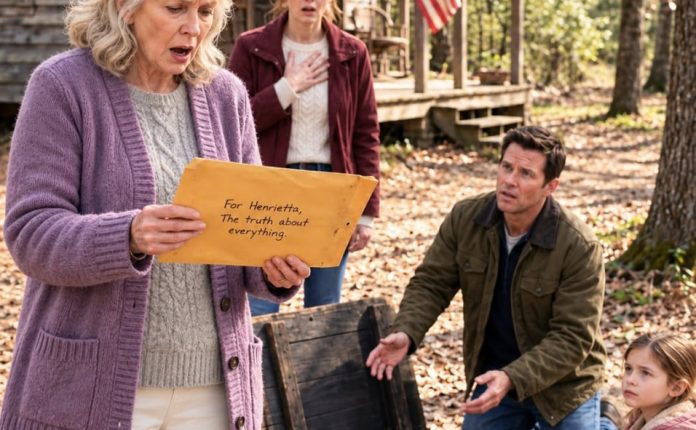
Inside were numbered folders, several recordings, and a thick envelope.
My name covered the front.
For Henrietta.
The truth about everything.
I sat down.
Randall had written those words.
Not Andre.
Not Sterling.
Randall.
I opened the envelope.
The letter was dated three months before his death.
“My dearest Henrietta,” it began.
“I am sorry that you may be reading this without me beside you.”
I pressed a hand against my mouth.
The next paragraphs described Randall's growing suspicion that Andre and Melissa were trying to gain control of his property before his death.
He had overheard conversations.
He had noticed changes to documents.
He had discovered that certain records no longer matched copies stored in his office.
I read slowly.
Then I reached a passage that made my chest tighten.
Randall believed the documents presented after his death might conceal something far more serious than an unfair inheritance.
He had hidden evidence at Beacon Falls because he no longer trusted the people managing his affairs.
Carmen sat beside me.
“Keep going.”
Miguel opened another container.
More folders.
More dates.
A locked metal box.
I reached into my handbag.
My fingers found the brass key.
It fit the lock perfectly.
I turned it.
Inside lay a sealed packet, a note bearing an unfamiliar woman's name, and a Hartford address.
At the bottom of Randall's letter, he had written one final instruction.
Find the woman named inside the box before you confront Andre.
I looked toward the kitchen window.
For weeks, I had believed Randall had abandoned me.
Now I understood that his final days had contained a struggle I had never seen.
And somewhere in Hartford, a stranger might know why.
END PART 1