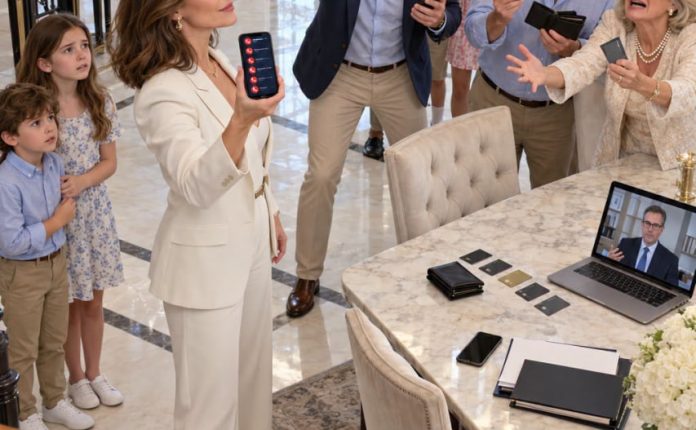
Rain was running down the collar of my jacket when my mother handed me a restaurant bill for a dinner I had never eaten.
“Since you missed dinner, Kais, you can cover it.”
I looked from the receipt to the fourteen relatives seated around the long table. My sister Lennox had a half-finished glass of wine in her hand. My father was studying his coffee. Nobody had saved me a plate, a chair, or even a piece of bread.
For a moment, I thought my mother was joking.
She wasn't.
The total was $2,047.36, including the service charge.
“Dinner was at six,” I said.
Mom glanced toward the decorative clock above the restaurant entrance. “We moved it to five. I thought you knew.”
She had sent me two reminders that morning. Both said six.
I took out my phone and showed her the messages.
She barely looked.
“Well, everybody was hungry. We couldn't just sit around.”
Across the table, Lennox laughed.
“Come on, Kais. You're our ATM, remember?”
She said it with the confidence of someone who had made the joke so often that nobody expected me to object.
My uncle Martin lowered his wineglass. Aunt Celia looked toward the window. One of my cousins began examining her phone.
My father did nothing.
And that, more than Lennox's laughter, made my face burn.
I had just finished four exhausting hours correcting a shipping mistake at Harbor Link Freight, the logistics company where I managed regional operations. A container bound for Tacoma had been assigned to a route ending in Anchorage. By the time we discovered the mistake, three departments were blaming one another, a customer was threatening penalties, and the driver was waiting for new instructions.
I'd stayed because somebody had to fix it.
Then I drove through forty minutes of Seattle traffic, worrying that my parents might be waiting.
They hadn't been waiting.
They had finished eating.
My mother tapped the receipt.
“Your father and I shouldn't have to worry about money on our anniversary.”
I looked at him.
“Dad?”
He finally lifted his eyes.
“Your mother just wants us to have a nice evening.”
“You've already had one.”
His expression tightened.
“Don't start.”
There was a time when those two words would have ended the conversation.
I was thirty-four years old, financially independent, and responsible for dozens of employees, yet my father's disappointment could still make me feel like the teenager who had forgotten to mow the lawn.
I picked up the receipt.
Mom's shoulders relaxed.
She thought I was reaching for my wallet.
Instead, I folded the paper once and tore it down the middle.
Lennox stopped smiling.
I tore the pieces again.
Four scraps fell onto the tablecloth beside a small silver dish filled with chocolate mints.
“What are you doing?” Mom whispered.
“I'm not paying.”
Her mouth opened.
I spoke before she could answer.
“You told me dinner started at six. You changed it without telling me. You ordered more than two thousand dollars of food, finished celebrating, and waited for me to arrive so you could hand me the bill.”
Aunt Celia shifted uncomfortably.
Lennox put down her glass.
“Oh, don't be so dramatic.”
I turned toward her.
“You have a job, Lennox. So does Dad. Why am I the only person expected to pay?”
Her expression hardened.
“Because you make more than the rest of us.”
“That isn't an answer.”
Mom pushed back her chair.
“After everything we've done for you, you're going to humiliate us over money?”
I looked at the empty place settings.
A waiter had just cleared the last dessert plate.
“You managed to celebrate without me,” I said. “You can manage to pay without me.”
I put the scraps down and walked away.
Behind me, Uncle Martin muttered something about young people having no gratitude.
Then my mother said, loud enough to reach the doorway, “Someone needs to remind him where he stands.”
I didn't turn around.
Outside, the rain was coming down hard enough to blur the restaurant sign.
I reached my car, sat behind the wheel, and stared through the windshield.
My hands were shaking.
Not because I feared I had made a mistake.
Because some part of me had known for years that this moment was coming.
My name is Kais Mercer.
I grew up in Belleview, in a blue two-story house with a narrow driveway and a maple tree that dropped leaves into the gutters every November.
My father, Robert, worked in building maintenance before becoming a facilities supervisor. My mother, Elaine, managed a small medical office for most of my childhood.
We were comfortable enough, although my parents frequently reminded us that comfort required sacrifice.
Lennox was three years younger than me.
She was clever, charming, and capable of persuading almost anyone to do something for her.
When we were children, she borrowed my bicycle and returned it with a bent wheel. Mom told me not to upset her.
When Lennox failed to finish a school project, I stayed awake helping her complete it.
When she wrecked her first car, my father asked me to lend her the money for repairs.
I became the responsible one.
Lennox became the one who needed understanding.
At first, that difference made me proud.
I liked being dependable.
After college, when I started earning a steady salary at Harbor Link Freight, I sent my parents money for a furnace repair.
Then came a plumbing emergency.
Then a mortgage payment during Dad's temporary layoff.
A little assistance became a regular expectation.
By the time I reached my thirties, I had stopped distinguishing requests from obligations.
Mom would call and say the mortgage was due.
I would transfer money.
Lennox would say her rent had increased.
I would help.
Dad would mention a car repair.
I would pay the garage directly.
They always thanked me initially.
Eventually, gratitude became unnecessary.
At the restaurant, my mother had not even bothered to ask whether I could afford the bill.
She had assumed.
I drove home through the rain with the radio off.
My apartment sat on a quiet street in Capitol Hill, above a small bookstore and a café that opened early enough for me to smell roasting coffee through the stairwell.
Inside, I dropped my keys into a ceramic bowl and stood in the kitchen.
The refrigerator hummed.
A delivery truck passed outside.
My stomach growled.
I had missed lunch because of the shipment emergency and now had nothing ready for dinner.
I made two pieces of toast and ate standing beside the counter.
Then I opened the filing cabinet beneath my desk.
I wasn't planning an investigation.
I wanted to know how much I had already given them.
The folder was labeled Mercer Support.
I had created it three years earlier when an accountant suggested keeping personal loans and family assistance separate from ordinary expenses.
I rarely opened it.
That evening, I carried it to the kitchen table.
The first documents were straightforward.
Mortgage transfers.
Dental bills.
A replacement water heater.
Vehicle registration payments.
Lennox's apartment deposit.
I remembered those expenses.
I had agreed to them.
But farther into the folder, the records became less familiar.
There were several charges on a secondary credit card I had allowed Lennox to use for genuine emergencies.
A clothing purchase.
An upscale Portland restaurant.
An electronics store.
Two nights at a hotel.
None appeared in our messages about emergencies.
I opened my banking app and downloaded additional statements.
Then I found a charge for a four-person vacation package in Palm Springs.
I stared at the date.
During that entire week, I had been working late in Seattle, preparing a quarterly operations report.
I remembered Lennox posting photographs from a resort.
Mom had commented on every picture.
I had liked one of them.
At the time, I assumed Lennox had saved for the vacation.
Now I was looking at a charge connected to my card.
I searched my messages.
There was no request for permission.
No explanation.
No promise to repay me.
I opened a spreadsheet and began entering figures.
Some transfers were direct gifts.
Others were expenses I had covered because someone told me the family was facing an emergency.
Several credit-card transactions remained unexplained.
The total filled the bottom cell.
$52,891.66.
I checked the calculations.
Then I checked them again.
Three years.
More than fifty-two thousand dollars.
And I could not confidently say how much of it had been taken with my informed permission.
I leaned back and closed my eyes.
For years, I had thought of myself as a man who helped his family.
The spreadsheet showed something less comforting.
My relatives had access to my income, my credit, and my willingness to accept their explanations without question.
I thought of my mother's expression at the restaurant.
Not embarrassment.
Not surprise.
Annoyance.
She had been annoyed that the person expected to pay had refused.
I went to the bathroom, splashed water onto my face, and looked at myself in the mirror.
I was tired.
My eyes were bloodshot from work.
But nothing about that reflection justified the way my family treated me.
Back at the table, I picked up my phone.
The first call was to the issuer of the secondary credit card.
I explained that I needed to remove an authorized user immediately and dispute several unfamiliar charges.
The representative verified my identity and walked me through the process.
I asked for a replacement account number and updated credentials.
Afterward, I canceled recurring transfers to my parents' mortgage account.
I removed saved payment arrangements that I had established for Lennox.
Then I reviewed the merchants associated with my cards.
Some charges were older and would require additional documentation.
I made notes.
I wasn't going to claim that every dollar I'd ever spent on my family was stolen.
That would have been dishonest.
I had willingly helped them many times.
But I wanted a clear distinction between money I had chosen to give and money someone had spent because they assumed they could.
By midnight, I had stopped the automatic payments and secured my primary accounts.
My phone had accumulated twenty-three missed calls.
Eleven were from Mom.
Seven were from Lennox.
Dad had called twice.
The others came from relatives who had attended the dinner.
I opened the messages.
Mom: You need to apologize for embarrassing us.
Lennox: Hope your little performance was worth it.
Dad: Call your mother.
Aunt Celia: Your parents are very upset.
There was not one message asking whether I had reached home safely.
Not one asking why I had looked exhausted.
Not one acknowledging that the family had finished dinner without me.
I put the phone facedown.
At six the following morning, I woke to fifteen Facebook notifications.
My cousin Natalie had posted about a troubling incident at the anniversary dinner.
She wrote that my parents were struggling to understand my recent behavior.
Another cousin commented that long work hours could affect a person's emotional stability.
Lennox had shared the post.
Her accompanying message read:
Sometimes loving someone means recognizing that they need help before they can admit it.
I read it twice.
Then I saw Mom's comment.
Please keep our family in your prayers. We are very worried about Kais.
The story they were telling was remarkably different from what had happened.
According to them, I had arrived late, behaved irrationally, frightened my parents, and stormed out after they tried to calm me.
There was no mention of the changed dinner time.
No mention of the two-thousand-dollar receipt.
No mention that I had been expected to finance a celebration I never attended.
I started typing a response.
Then I stopped.
If I replied angrily, they would use the anger as evidence.
If I stayed silent, they would treat my silence as confirmation.
I took screenshots instead.
I saved every post and message with its date.
Then I went to work.
Harbor Link Freight occupied a sprawling distribution facility south of downtown Seattle.
Most mornings began before seven, with supervisors reviewing shipments, delays, driver availability, and the occasional problem created by weather or equipment failures.
I had been with the company for eleven years.
I liked the work because freight either reached its destination or it didn't.
A delayed container could be traced.
A wrong destination code could be corrected.
An invoice could be reconciled.
There were complicated problems, but they usually left evidence.
Family problems were different.
People could insist they meant well while doing obvious harm.
That morning, my supervisor, Paula Mendoza, found me studying a shipping manifest I had already reviewed three times.
“You all right?”
“Didn't sleep much.”
“Family?”
I looked up.
She had worked beside me long enough to recognize when something was wrong.
“Something like that.”
She nodded toward my desk.
“Take ten minutes. The containers aren't going anywhere.”
I walked outside with a cup of coffee and called my friend Darien Wolf.
We had met in college and stayed close despite working in different industries.
Darien was an accountant who handled financial controls for a regional manufacturing company. He wasn't dramatic, and he rarely offered advice before asking questions.
He answered on the second ring.
“Kais?”
“Do you have time this week?”
“For what?”
“I need another pair of eyes on some statements.”
There was a pause.
“How bad?”
“I don't know yet.”
“Then let's find out.”
He arrived at my apartment three evenings later carrying takeout, two bottles of sparkling water, and a worn paperback about unhealthy family relationships.
He placed the book on the counter.
“Don't worry. I'm not assigning homework.”
I managed a smile.
We ate while I described the anniversary dinner.
When I repeated Lennox's joke about being the family ATM, Darien stopped chewing.
“She really said that?”
“In front of everyone.”
“And nobody objected?”
“No.”
He put down his fork.
“What did your father do?”
“Stirred his coffee.”
Darien was quiet for a moment.
Then he asked to see the spreadsheet.
We spread the statements across my kitchen table.
He didn't rush to conclusions.
He marked transfers I had knowingly authorized in one column and questionable charges in another.
He asked which expenses had written requests.
He asked whether I had ever given Lennox blanket permission to use the secondary card.
“No,” I said. “Emergencies. That was the agreement.”
“Did you define emergencies?”
“I thought we understood each other.”
He looked at me.
“That isn't the same as an agreement.”
I didn't argue.
He was right.
We examined the Palm Springs charges.
Darien asked whether I had been there.
I showed him my work calendar.
He checked the payment dates.
Then he moved to a Portland electronics purchase.
“Where were you on August fourteenth?”
“At work.”
“Can you confirm?”
I found the warehouse schedule.
I had attended a safety review that morning and signed several delivery reports.
Darien turned the statement toward me.
“This transaction happened in Portland while you were in Seattle.”
“Lennox lives in Portland.”
“Did she ask you to buy electronics?”
“No.”
“Then don't call it help until you know what happened.”
He marked the charge.
We worked for another hour.
Some expenses that initially looked suspicious turned out to have reasonable explanations.
I recognized a dental payment I had forgotten.
A hotel charge belonged to a work trip.
Darien removed them from the questionable column.
I appreciated that.
He wasn't trying to persuade me my family was guilty of every possible wrongdoing.
He was helping me identify what the records actually showed.
Near ten, he closed the folder.
“You know what worries me most?”
“The money?”
“The access.”
I looked at him.
“Lennox had permission to use one card for emergencies. Your parents know enough about your finances to request transfers. Your mother keeps your personal documents. You don't seem to know which accounts still have family members attached.”
I rubbed my forehead.
“Mom keeps the family paperwork. She always has.”
“Copies of your identification?”
“Probably.”
“Tax records?”
“Some old ones.”
He tapped the table.
“Then you need to secure more than a credit card.”
We reviewed my passwords and contact information.
I moved everyday banking away from accounts whose details my family knew.
I activated transaction alerts.
Darien encouraged me to check my credit reports and look for accounts I didn't recognize.
I told him I would do it over the weekend.
He hesitated.
“Do it sooner.”
At the door, he looked back.
“One more thing.”
“What?”
“Don't contact them yet.”
“Why?”
“Because you've stopped the money. Let's see what happens when they realize that.”
That night, after Darien left, an unknown number sent me a text.
Don't make this bigger than it is. Every family has things like this.
I read it several times.
The words sounded like my mother's usual explanations.
Don't be difficult.
Don't embarrass us.
Every family makes sacrifices.
I checked the number.
It wasn't saved in my contacts.
I considered calling it.
Instead, I took a screenshot and added it to the folder.
Then I checked the front-door lock.
I knew that was probably unnecessary.
Still, I checked.
Over the following days, Mom continued calling.
Lennox sent increasingly irritated messages.
First she accused me of overreacting.
Then she suggested that I owed her an apology.
Finally, she wrote that my refusal to help would create serious problems for people who had always supported me.
I wanted to ask which people she meant.
The relatives who watched me stand beside their empty plates?
The parents who moved their anniversary dinner without telling me?
The sister who treated my income as shared property?
But I remembered Darien's advice.
I didn't reply.
On Thursday afternoon, an automatic payment alert appeared.
A transfer to my parents' mortgage account had been stopped.
Within seventeen minutes, Mom called four times.
The fifth call came from Dad.
I let it go to voicemail.
His message was short.
“Kais, your mother says something's wrong with the bank. Call us.”
No greeting.
No question about my well-being.
Only concern about the missing payment.
I listened once and saved it.
That evening, I received another message from Lennox.
You can't just shut things off without warning.
I looked at those words for a long time.
She hadn't asked whether she was entitled to the money.
She was angry that the arrangement had ended.
I typed a reply.
My finances are no longer available for anyone else's spending. Any further financial requests must be made in writing.
I read it twice.
Then I sent it.
Her response arrived almost immediately.
Wow. You really have lost your mind.
I put the phone away.
The next few days were difficult in ways I hadn't expected.
I missed my mother.
Not the woman who had pushed the restaurant receipt toward me.
I missed the woman who used to make pancakes on snowy mornings and insist that I take an extra scarf to school.
I missed my father teaching me how to change a tire.
I missed Lennox at twelve years old, sitting beside me on the front steps, sharing the candy she'd hidden from our parents.
Those memories were real.
So were the financial records.
I was beginning to understand that loving people did not require pretending their behavior was harmless.
The following week, Harbor Link sent me to Portland to inspect a warehouse that was experiencing repeated inventory discrepancies.
I drove down before sunrise.
By midmorning, I was walking between rows of stacked freight with a clipboard in my hand, checking pallet numbers against shipping records.
My phone vibrated.
Unknown caller.
I almost ignored it.
Then I noticed the number's area code and answered.
“Hello, this is Kais Mercer.”
A woman spoke in a measured professional voice.
“Mr. Mercer, my name is Andrea. I'm calling from U.S. Bank's fraud department. Is now a convenient time to discuss a credit account?”
I stopped walking.
“What account?”
“I'll need to verify some information before we continue.”
She explained that I could call the bank's published number and be transferred to the fraud team if I preferred.
I did exactly that.
A few minutes later, I reached the department through the verified number and was connected to the case.
Andrea explained that an account had been flagged for suspicious activity.
It was a Black Reserve credit card.
Opened two months earlier.
Under my name.
I felt the blood drain from my face.
“I don't have that card.”
There was a short silence.
“That's why we're contacting you, Mr. Mercer.”
I moved away from the noise of the warehouse.
“What balance are we talking about?”
“A little over twenty-one thousand dollars.”
I gripped the nearest shelving unit.
Twenty-one thousand dollars.
Separate from the money I had already counted.
Separate from the family transfers.
Separate from the credit card Lennox had been authorized to use.
“Where was it mailed?” I asked.
Andrea confirmed that the mailing address on the application was my parents' house in Belleview.
I stared at the concrete floor.
That was the house where I grew up.
The house where Mom still kept old family records in the hallway cabinet.
The house whose mortgage I had helped pay.
“What's the email address on the account?”
“I can review the contact information with you.”
I heard her keyboard clicking.
Then she paused.
“Mr. Mercer, I need you to hear this carefully.”
She read the email address.
And I recognized it immediately.
END PART 1