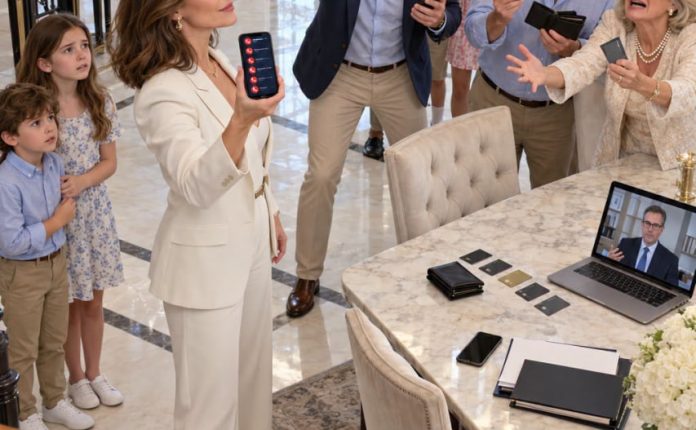
My father's hand rested proudly on the hood of my sister's Mercedes while thirty people applauded a story he knew wasn't true.
"Your grandmother insisted on doing this for Delaney," he announced. "She wanted her granddaughter to have every advantage."
I stood near the driveway with a sealed envelope in my coat pocket, watching my sister smile for photographs beside a car purchased with money that should never have belonged to her.
Three days earlier, Grandma Loretta had made a phone call from her hospice bed.
One phone call.
And although my father didn't know it yet, the man she called was sitting less than twenty feet behind him.
I hadn't always understood how far my parents would go to protect their preferred version of our family. I certainly hadn't imagined they would sell an antique piano belonging to a woman who was still alive, spend the proceeds on a luxury car, and then tell their friends she had enthusiastically approved the whole arrangement.
But by that Sunday afternoon, I'd learned how easily people could convince themselves that taking something was acceptable when they considered the rightful owner too weak to object.
My name is Everett Whitaker. I'm thirty-two years old, and I've spent most of my adult life teaching music to children in Minneapolis.
My parents never liked that decision.
My father, Calvin Whitaker, built a consulting company around commercial property management and business development. He wore tailored jackets, collected expensive watches, and liked introducing people according to their professions before mentioning their names.
My mother, Gwen, was equally interested in social standing. She organized charity dinners, maintained an impressive contact list, and believed a person's value could generally be determined by the neighborhood where they lived.
My younger sister, Delaney, suited them perfectly.
She had always been beautiful, sociable, and unusually skilled at making wealthy people feel interesting.
At twenty-eight, she worked in marketing, although she spent more time discussing opportunities than completing actual projects. She lived in a condominium my parents helped finance and dated Ryder Ashb, whose father, Hugh, controlled several investment businesses and had recently entered a major partnership with Dad.
To my parents, Delaney represented the family's promising future.
I represented an awkward subject to avoid at dinner parties.
"Everett teaches music," Mom would say whenever someone asked about me.
There was always a pause before the next sentence.
"Children's music, mostly."
As though teaching children was a regrettable condition that might eventually improve.
I had earned my degree, worked through graduate training in music education, and built a teaching practice that served thirty-seven regular students.
Some came from comfortable homes. Others attended through reduced-cost programs I helped arrange.
I taught children with learning difficulties, teenagers preparing auditions, and seven-year-olds who struggled to keep both hands moving at once.
I loved the work.
It didn't make me wealthy, but I could support myself, pay my bills, and come home knowing my day had mattered.
Grandma Loretta understood that better than anyone.
Her house stood near Lake Minnetonka, on a quiet street where old maples leaned over the sidewalks and the lake appeared between neighboring roofs.
It wasn't the largest house in the area.
The kitchen cupboards were old-fashioned, the upstairs bathroom had pale blue tiles, and she refused to replace the brass fixtures because she liked the way they'd aged.
But every room felt inhabited.
There were photographs from family vacations, postcards taped inside cupboard doors, and books stacked wherever a chair happened to be.
The living room smelled faintly of lavender and polished wood.
And beside the windows stood her antique grand piano.
It had a dark, richly figured case, ivory-colored keys that had mellowed with age, and a delicate carved music stand. The lower edge of one leg carried a small scratch from a Christmas when Dad had dragged a heavy wooden train beneath it.
Grandma never repaired that scratch.
"Your father was eight," she told me once. "He cried harder about scratching the piano than I did."
When I was seven, she placed me on the padded bench and showed me middle C.
I pressed the key too hard.
She laughed gently.
"That note didn't insult you, sweetheart. You don't need to punish it."
That became our routine.
Every Saturday morning, Grandma made cinnamon toast, poured orange juice into a little green glass, and taught me something new.
Sometimes we worked on scales.
Sometimes we played duets with her taking the lower part.
Sometimes I simply sat beside her while she played music I'd never heard before.
She wasn't a professional performer, although she'd once dreamed of becoming one. She'd taught piano privately for decades and played for weddings, church services, and community events.
By the time arthritis began troubling her fingers, she'd taught hundreds of students.
The piano carried those years in its wood.
There were faint marks where students had knocked the bench against the side. A small darkened patch near the treble keys came from the afternoon my grandfather accidentally spilled coffee while reaching for his newspaper.
Grandma could have refinished it.
She never wanted to.
"An old instrument is allowed to show that it has been loved," she said.
When I left for college, she gave me a handwritten book of her favorite teaching exercises.
When I graduated, she attended the ceremony even though traveling had become difficult.
When I started teaching, she helped me buy my first reliable keyboard.
And when my parents criticized my career, she never tried to persuade them that I was successful according to their standards.
She simply told me she was proud.
That made her home the one place where I never felt required to defend the life I'd chosen.
The trouble began when her heart condition worsened.
For several years, medication had helped her manage symptoms that gradually became more severe.
Then came two hospitalizations, followed by another frightening episode that left her exhausted after walking across a room.
Eventually, her doctors explained that further aggressive treatment was unlikely to give her the quality of life she wanted.
Grandma made her own decision.
She chose comfort-focused hospice care.
I remember sitting beside her when she told me.
She looked smaller beneath the hospital blankets, but her voice was steady.
"I'm not surrendering, Everett. I'm choosing how I spend the time I have."
I asked if she was frightened.
"Of course. But fear doesn't get to make every decision."
She looked toward the window.
"I've had a long life. I'd like the rest of it to be mine."
Dad arrived later that afternoon.
He listened while the hospice coordinator explained visiting arrangements, medication schedules, and the importance of keeping Grandma comfortable.
Then he began distributing responsibilities.
"Your mother and I have business obligations. Delaney has commitments with Ryder's family."
He looked at me.
"You'll handle the daily visits."
I explained that I taught most afternoons and evenings.
Dad waved one hand.
"Teachers have flexible schedules."
I told him mine wasn't particularly flexible.
"Well, you'll have to arrange something."
Mom leaned toward Delaney as I gathered my coat.
"At least he's useful for something."
She hadn't intended me to hear.
Or perhaps she had.
I turned toward the door without responding.
It wasn't the first time she'd said something like that, and arguing would only have given Dad an opportunity to lecture me about being oversensitive.
I rearranged my lessons.
I started preparing meals in advance, moved two students to Saturday mornings, and took over Grandma's evening visits.
The trip from my teaching studio to hospice wasn't short, especially when the roads were icy.
But Grandma never treated my presence as an obligation.
She always asked about my day.
She wanted to know which student had finally mastered a difficult passage, which parent had brought homemade cookies, and whether the little girl who hated practicing had learned to enjoy her lessons.
Sometimes we listened to recordings through a small speaker.
Other evenings, she was too tired to talk.
I would sit beside her, holding her hand while the monitor hummed and nurses moved quietly along the corridor.
Dad visited twice during one particularly difficult stretch.
Mom appeared on three occasions, usually accompanied by flowers arranged so elaborately that the nurses had trouble finding space for them.
Delaney visited once.
She took a smiling photograph outside Grandma's room, posted it with a message about cherishing family, and left before the evening medication round.
I noticed these things.
Grandma noticed them too.
But she rarely criticized anyone.
One Tuesday, after we'd spent half an hour listening to an old recording of Chopin, she turned toward me.
"Everett, I want to talk about the piano."
I smiled.
"Are you worried I'll forget how to play?"
"No. I'm worried someone will forget what I decided."
Her expression had grown serious.
"I've told your father, your mother, and Delaney that the piano is yours. I want you to have it."
"Grandma, you don't need to worry about that now."
"Yes, I do."
She squeezed my fingers.
"I've arranged it properly. Promise me you'll look after it."
I remembered the instrument standing beside her windows, sunlight falling across the keys.
"I promise."
"And play it," she said. "Don't turn it into furniture that nobody is allowed to touch."
I laughed.
"I wouldn't."
"Good."
She rested against the pillows.
"Some things are valuable because of what they're worth. Other things are valuable because of what they've held. Mine happens to be both."
At the time, I assumed she was simply reminding me of her wishes.
I didn't understand why she had emphasized that she'd made arrangements.
I would remember those words later.
Five days afterward, she asked me to visit her house and retrieve a box of concert photographs.
"They're in the downstairs study," she said. "Bottom shelf, beside the old programs."
I asked why she wanted them.
"I've been thinking about your grandfather. There are some pictures I haven't seen in years."
I promised to bring them the next afternoon.
The weather turned miserable overnight.
Freezing rain coated the sidewalks. The drive toward Lake Minnetonka was slow, with gray slush gathering along the road edges.
When I reached the house, the driveway was empty.
I unlocked the front door using the key Grandma had given me years earlier.
The first thing I noticed was the silence.
Not ordinary silence.
Something in the room sounded different.
I stepped into the living room.
Then I stopped.
The piano was gone.
For several seconds, I couldn't understand what I was seeing.
The framed photographs remained above the mantel. The upholstered chairs stood in their usual positions. Grandma's knitting basket was beside the sofa.
But the space near the windows was empty.
A pale rectangular impression marked the carpet where the piano had stood for thirty years.
I walked closer.
There were several small scratches on the floor where someone had apparently shifted the instrument before lifting it.
The old metronome Grandma kept on top had been moved to a side table.
I picked it up.
Its wooden case felt cold in my hand.
I looked toward the hallway, then the dining room, although I knew perfectly well that a grand piano couldn't have disappeared into either space unnoticed.
I called Mom.
She answered after several rings.
"Everett, I'm busy."
"Where is Grandma's piano?"
A pause.
"Your father handled it."
"What does that mean?"
"It means there were arrangements that needed to be made."
"What arrangements?"
She sighed.
"These are adult matters. Don't make everything difficult."
"Mom, Grandma told me that piano belongs to me."
"Your grandmother says a lot of things."
My stomach tightened.
"Did she agree to move it?"
"Talk to your father."
The call ended.
I stood in the empty living room, staring at my phone.
Then I went through the house.
I didn't search Grandma's private papers. I was looking for the photograph albums she'd requested and for some explanation of the missing instrument.
In the study, I found the box of photographs exactly where she said it would be.
Beside it sat several old concert programs.
I gathered them carefully.
On my way out, I noticed a torn piece of paper sticking from the kitchen trash.
A familiar description caught my eye.
It referred to a grand piano.
I pulled it free.
Most of the paper had been ripped away, but the remaining portion carried the name of an instrument dealer, part of a date, and a printed amount.
$95,000.
My hands went cold.
I turned the fragment over.
There was a transaction reference, although several digits were missing.
Outside, a small moving truck was disappearing around the corner.
I couldn't tell whether it had anything to do with the piano.
But the tire marks along Grandma's driveway were fresh, and there was packing material caught against the porch railing.
I folded the paper and put it in my pocket.
Then I drove to my parents' house.
Dad lived in a large home west of Minneapolis, in a neighborhood where even the mailboxes appeared expensive.
He opened the door holding a glass of scotch.
"Everett. This isn't a good time."
"Where's Grandma's piano?"
He looked at me for a moment.
Then he stepped aside.
"Come in."
Mom was sitting in the living room looking through an invitation list.
Delaney was upstairs.
Dad didn't offer me a seat.
"I sold it," he said.
I stared at him.
"You what?"
"Sold it. Ninety-five thousand dollars. Very good price, considering the market."
"You sold Grandma's piano?"
"That's what I just said."
"While she's in hospice?"
His expression tightened.
"Don't make this sentimental."
I almost laughed because I couldn't believe what I'd heard.
"Sentimental?"
"Everett, it's an object. An expensive object that was sitting unused in an empty house."
"She promised it to me."
"She won't need it," Dad replied. "And neither will you."
I looked toward Mom.
She lowered the invitation list.
"Your father made a sensible decision."
"Did Grandma agree?"
Mom exchanged a quick glance with Dad.
Neither answered.
I repeated the question.
"Did she know you were selling it?"
Dad took a drink.
"Your grandmother's health has been declining. We're the people responsible for making practical decisions."
"That's not an answer."
"Watch your tone."
Then Delaney came downstairs.
She was wearing cream-colored trousers and a fitted blue sweater, holding a black leather key case.
"Why's everyone being so serious?"
Dad's mood changed almost instantly.
"Perfect timing, sweetheart."
Delaney smiled, turning the case around one finger.
"We haven't told him?"
I looked from her to Dad.
"Told me what?"
Dad straightened.
"Your sister needed a proper vehicle. Something suitable for the circles she's moving in."
I waited.
He continued.
"She's meeting important people through Ryder and Hugh. First impressions matter."
Delaney opened the case.
Inside was a Mercedes key.
I looked at it, then at my father.
"You used Grandma's piano money to buy Delaney a car."
Dad shrugged.
"Money is meant to be useful."
For a moment, I couldn't find words.
I thought of Grandma teaching me to play while snow gathered outside the windows.
I remembered her smoothing the pages of old music books and correcting my posture with gentle patience.
Thirty years of lessons.
Decades of family gatherings.
Her grandfather's instrument, passed down through generations.
And Dad had turned it into a car because my sister wanted to impress her boyfriend's family.
"That piano wasn't yours to sell," I said.
Mom stood.
"Please don't start."
"It belonged to Grandma."
"Your sister is building a real future," she replied. "You're teaching little children to bang on keyboards. You don't require an antique grand piano."
Delaney laughed quietly.
"Honestly, Everett, where would you even put it?"
"In a place where someone actually plays it."
She rolled her eyes.
Dad raised one hand.
"Enough. The sale is finished."
I looked directly at him.
"Does Grandma know?"
Again, silence.
Then Mom approached.
Her perfume reached me before she did.
"Listen carefully," she said. "Your grandmother is very sick. Her heart cannot tolerate unnecessary stress."
"Then why did you sell something she loves?"
"Because someone has to make difficult decisions."
"Without asking her?"
Mom's expression hardened.
"If you go to that hospital and upset her, and something happens to her heart, that will be on your conscience."
I stared at her.
She moved closer.
"Are you prepared to live with that?"
Dad said nothing.
Delaney looked down at her keys, smiling faintly.
I wanted to shout.
I wanted to demand the dealer's name, take the car keys, and force my father to admit what he'd done.
But I understood something then.
My parents weren't merely dismissing my anger.
They were trying to make telling Grandma the truth feel dangerous.
They were making me responsible for the consequences of their actions.
I turned toward the door.
Dad spoke behind me.
"Don't make us regret allowing you to help with her care."
I stopped.
He had never allowed me anything.
Grandma had asked for me.
But I kept walking.
Outside, the cold air struck my face.
I sat in my car for several minutes without starting the engine.
Then I drove home.
That night, I spread old photographs across my kitchen table.
There was Grandma at her piano in a pale green dress, her hair pinned neatly above her shoulders.
There was Grandpa standing beside her with one hand on the instrument.
There was a picture of me at seven, sitting so far forward on the bench that my feet barely reached the floor.
On the back, Grandma had written:
Everett's first lesson. He insisted the difficult notes were hiding from him.
I sat there until after midnight.
I could hear my mother's warning repeating in my thoughts.
What if Grandma became distressed?
What if hearing about the piano genuinely made her condition worse?
For several hours, I considered saying nothing.
Then I remembered how Grandma had looked at me when she said she'd made arrangements.
She hadn't asked me to protect her from the truth.
She'd asked me to take care of something she valued.
The next morning, I arrived at hospice before breakfast.
Grandma was awake.
A small lamp glowed beside her bed, and a nurse was adjusting the water pitcher.
"You're early," Grandma said when she saw me.
I pulled up a chair.
"There's something I need to tell you."
She studied my face.
"About the piano?"
I froze.
Her expression changed.
"Everett?"
I took her hand.
"It's gone."
I explained everything.
The empty living room.
The torn transaction receipt.
Dad's admission that he'd received ninety-five thousand dollars.
The Mercedes.
Delaney's comments.
Mom's threat.
I spoke slowly, giving her room to interrupt.
She never did.
When I finished, she looked toward the window.
A long silence followed.
Then she breathed out.
"Calvin."
She said his name with a weary sadness that frightened me more than anger would have.
"I'm sorry, Grandma."
She turned back.
"What are you apologizing for?"
"I should have checked sooner. I should have known."
"No."
Her fingers closed around mine.
"You're not responsible for what another person chooses to do."
I swallowed.
"Mom said if I upset you—"
"I know what your mother said."
She waited until I looked at her.
"Everett, don't confuse protecting someone with keeping them ignorant."
I nodded, unable to speak.
Grandma reached toward the bedside table.
"Please give me my phone."
I handed it to her.
She opened her contacts, moved through several names, and pressed one.
A man answered almost immediately.
"Miles? It's Loretta."
She listened.
"No, I'm comfortable. The nurses are looking after me."
Then her tone changed.
"We need to proceed."
I watched her face.
"Calvin sold the piano. Ninety-five thousand dollars. He's already spent the money."
She paused.
"Yes. Exactly what we discussed."
My heart began beating faster.
She glanced toward me.
"Sunday. Gwen's birthday gathering at the house."
Another pause.
"Bring everything necessary. And Miles?"
She waited.
"It's time for them to meet my attorney."
She ended the call.
I stared at her.
"Grandma, what did you just do?"
She placed the phone on the blanket.
"Something I should have done much earlier."
"What does Miles know?"
"Quite a lot."
I waited for her to explain.
Instead, she asked me to move her water glass closer.
After taking a sip, she looked at me.
"Your grandfather used to say your father could persuade himself that a locked door belonged to him if he wanted badly enough to open it."
She smiled sadly.
"I always hoped Calvin would grow out of that."
"Did you know he might sell the piano?"
"I knew he was interested in its value."
She adjusted the blanket.
"When your grandfather died, your father asked whether the instrument was insured for its full value. A few years later, he suggested selling it to pay for improvements to his office."
"What did you say?"
"I said no."
"And he asked again?"
"More than once."
I thought of the way Dad had described the sale as sensible.
Grandma continued.
"Last spring, he asked whether I might consider giving Delaney some of the proceeds if the piano were sold. I told him the piano wasn't available."
She paused.
"He wasn't pleased."
"Then why didn't you tell me?"
"Because I wanted you to have your grandmother, not spend our remaining time worrying about her son."
She touched my wrist.
"But I took precautions."
"What precautions?"
"You'll understand on Sunday."
I leaned forward.
"Grandma, you don't need to protect me from this."
"I'm not protecting you from the truth."
She gave a faint smile.
"I'm making sure the truth arrives with the right paperwork."
Before I left, she asked me to attend the birthday celebration.
"Dress nicely."
"Grandma, I don't think Mom wants me there."
"She invited you, didn't she?"
"Only because it would look strange if I didn't attend."
"Then give her nothing to complain about."
I shook my head.
"I don't know if I can sit there and listen to Dad lie."
"You won't need to argue."
She looked at me carefully.
"Let him say what he wants to say. Let everyone hear it."
I promised.
As I stepped into the corridor, one of the nurses approached.
Her name was Rachel, and she'd looked after Grandma on several of my visits.
"Everett, could I speak with you?"
I stopped near the nurses' station.
Rachel lowered her voice.
"Your parents have been asking questions about your grandmother's ability to make decisions."
I felt a chill.
"What sort of questions?"
"Whether she's confused. Whether medication affects her judgment. Whether someone can take control of her paperwork."
"Did they ask for an evaluation?"
"They asked how that process works."
Rachel glanced toward Grandma's room.
"Your grandmother has been communicating clearly with us. But I thought you should know the questions were being raised."
"Thank you."
She nodded.
"Whatever happens, make sure she understands any documents someone asks her to sign."
I walked toward the elevator with my stomach tightening.
The piano hadn't been enough.
My parents were already asking how to control Grandma's decisions.
I called her attorney as soon as I reached my car.
Miles Wexler had a calm, deliberate voice.
He was in his early sixties, with silver hair and the restrained manner of someone accustomed to complicated family disputes.
We arranged to meet the next afternoon.
His office overlooked a small park in Minneapolis. The waiting room contained framed prints and an old grandfather clock that ticked so quietly I could barely hear it.
Miles invited me into a conference room.
"I've represented your grandmother for more than twenty years," he said. "She has authorized me to discuss certain matters with you."
I told him everything again.
He listened without interruption, occasionally writing something in a yellow legal pad.
When I described the receipt fragment, he asked to see it.
I took it from my wallet.
He examined the printed heading.
"Did you photograph the piano's empty location?"
"Yes."
"Keep those photographs. And don't alter this receipt."
He slipped it into a protective sleeve with my permission.
Then he asked about my father's exact words.
I repeated them as closely as I could.
"He said he sold it for ninety-five thousand dollars. That I didn't need it. That it was a good price."
Miles wrote something.
"Did he claim to have your grandmother's written authorization?"
"No."
"Did he show you any documentation?"
"No."
"Did anyone explain who received the proceeds?"
"Only that the money went toward Delaney's car."
Miles nodded.
"That is helpful."
I leaned forward.
"Can we get it back?"
"Possibly. The answer depends on the transaction, the purchaser's position, and certain documents already in existence."
"Does Grandma still own it?"
His expression remained careful.
"Your grandmother has authorized me to explain the relevant arrangement in the appropriate setting. I don't want to give you an incomplete answer today."
I felt frustrated.
He noticed.
"Everett, I'm not withholding information to make this dramatic. Your father has made statements about your grandmother's capacity, and there may be other transactions we need to examine. We must establish the record precisely."
I looked down at my hands.
"She's running out of time."
Miles softened.
"I know."
He opened a drawer and removed a sealed envelope.
"Your grandmother asked me to give this to you."
I took it.
On the front was my name in Grandma's familiar handwriting.
"Should I open it?"
"She asked you to keep it sealed until after Sunday's meeting."
I turned it over.
The flap was firmly closed.
"What is it?"
"Something personal."
I sat for a moment, holding the envelope.
Miles continued.
"Your grandmother began planning for the piano's future long before she entered hospice. That planning may be important now."
"Does Dad know?"
"He has been informed of certain arrangements."
"What about Mom?"
"That question is part of what we'll address."
He folded his hands.
"Your father is accustomed to dominating conversations. He may try to provoke you into reacting emotionally."
I nodded.
"He does that."
"Then let him speak. Stay calm. We need people to hear his position without it being filtered through a family argument."
The meeting lasted nearly two hours.
Before I left, Miles asked whether I'd received any written instructions from Mom about the birthday gathering.
I said no.
"Keep anything she sends."
He escorted me to the door.
"Your grandmother is a remarkable woman, Everett."
I smiled faintly.
"She always has been."
"Yes," he replied. "But I suspect even you don't know how much thought she's given to protecting the things that matter to her."
Saturday evening, Mom called.
I was cleaning the keys of a classroom keyboard when her name appeared on my phone.
"Everett, I want to make something clear before tomorrow."
I sat down.
"I'm listening."
"Your father will be making an announcement about Delaney's car."
"I assumed he would."
"And if anyone asks about the piano, the family position is that Loretta wanted it sold."
I closed my eyes.
"That's not true."
"Don't start."
"Grandma never agreed to it."
Mom's voice sharpened.
"Your grandmother wanted to help Delaney. We're simply explaining the decision in a way people will understand."
"You're inventing the decision."
"We're simplifying."
I let the word settle.
"Mom, a lie doesn't become true because you call it simpler."
She inhaled sharply.
"You've always resented your sister."
"That has nothing to do with Grandma's piano."
"You cannot stand seeing Delaney succeed."
I looked around my small apartment at the lesson books, the inexpensive furniture, and the framed photograph of Grandma beside one of my student ensembles.
"I don't resent Delaney for having a car. I resent the fact that you took something that wasn't yours to pay for it."
Mom went quiet.
Then she said, "Do not ruin my birthday."
She ended the call.
I took a screenshot of the call record and wrote down what she'd said while it was still fresh.
Then I hung my dark suit near the bedroom door.
The following morning, I went to hospice briefly before the gathering.
Grandma was resting, but she opened her eyes when I sat beside her.
"You look worried," she said.
"I'm going tonight."
"Good."
"Mom called. They're definitely going to tell everyone you wanted the piano sold."
Grandma closed her eyes for a moment.
"Then Miles will have something specific to correct."
I leaned closer.
"Are you sure you want this handled at her party?"
She looked at me.
"I didn't choose the occasion, Everett. They did."
She was right.
My parents had chosen to turn the sale into a public celebration.
They'd chosen to present it as Grandma's gift.
They'd invited people whose opinion mattered to them, including Hugh Ashb and several clients connected to Dad's business.
Grandma was simply refusing to let them use her name without giving her a voice.
I kissed her forehead.
"I love you."
"I know."
She smiled.
"And Everett?"
"Yes?"
"Remember what I taught you about playing difficult passages."
"Practice slowly?"
"That too."
She squeezed my fingers.
"Don't rush because someone else wants you to lose your place."
I laughed softly.
"I'll remember."
By late afternoon, I arrived at Grandma's house.
My parents had arranged the birthday gathering there because, according to Mom, the lakeside property made a more elegant setting than their own home.
Caterers moved through the kitchen.
White flowers stood on the dining table.
There were strings of small lights along the deck railing, and several guests had already gathered beneath outdoor heaters.
I noticed immediately that Mom had rearranged the living room.
The vacant space where the piano had stood now contained a large decorative plant and a pair of upholstered chairs.
It was almost as though she wanted to conceal the instrument's absence.
Aunt Joan, Grandma's younger sister, came toward me.
She was wearing a navy coat and carrying a small wrapped gift.
"Everett."
She hugged me tightly.
"How's Loretta?"
"Comfortable today. Tired, but clear."
Joan searched my face.
"Something's wrong."
I hesitated.
Then I told her quietly that the piano had been sold.
She drew back.
"What?"
"Dad sold it."
"When?"
"Earlier this week."
Joan looked toward the living room.
"I thought Loretta had already arranged for you to have that instrument."
My chest tightened.
"You knew?"
"She told me months ago."
Before I could ask anything else, Dad appeared.
"Joan! Glad you made it."
He clasped her shoulder, then glanced at me.
"Everett. You came."
"You invited me."
His smile didn't reach his eyes.
"Let's keep everything pleasant today."
Joan looked at him.
"Calvin, I heard something concerning—"
He interrupted.
"Later. We're about to make an announcement."
He guided her toward the terrace before she could finish.
I stood beside the doorway, watching the guests gather.
Mom wore a pale champagne-colored dress and an elaborate necklace.
Delaney arrived with Ryder shortly afterward.
She was carrying a small designer handbag and laughing as she described the new vehicle.
Ryder was pleasant enough. We'd never been close, but he generally treated me politely.
His father, Hugh, was less familiar.
He had the composed manner of someone who preferred listening before speaking.
He shook my hand.
"You're Loretta's grandson who teaches music."
I nodded.
"That's right."
"She speaks very highly of you."
The remark surprised me.
"You've talked to Grandma?"
"At a charity dinner a couple of years ago. She told me about your work with young students."
I smiled.
"That sounds like her."
Hugh glanced toward the empty piano corner.
"I remember an instrument standing there."
"It was there until recently."
Before he could ask more, Dad called everyone outside.
Near the driveway stood a brand-new Mercedes, bright beneath the late afternoon light.
A wide red ribbon crossed the hood.
Delaney clasped her hands dramatically.
"Oh, Dad!"
Several people laughed.
Someone began recording.
Dad raised his glass.
"My friends, I want to share something special."
I felt Miles arrive before I saw him.
A man in a dark suit walked through the gate and quietly took a seat near the refreshments table.
He carried a leather briefcase.
Dad hadn't noticed him.
"Our family has always believed in investing in the next generation," Dad continued.
Mom smiled proudly.
"And my mother, Loretta, has always shared that belief."
I felt my pulse quicken.
Dad placed his hand on Delaney's shoulder.
"When she learned that Delaney needed a vehicle appropriate for the opportunities ahead of her, she insisted on helping."
The guests murmured warmly.
"She decided to sell her antique piano," Dad said. "A difficult choice, naturally, but one she made happily for her granddaughter."
Delaney wiped an imaginary tear from beneath one eye.
"Grandma is so generous."
Dad smiled.
"And today we get to celebrate that generosity."
He lifted his glass.
"To Loretta!"
The guests applauded.
I stayed still.
Then Aunt Joan spoke.
"Calvin, did Loretta actually tell you she wanted the piano sold?"
The applause faltered.
Dad lowered his glass.
"Of course."
"When?"
He gave a tight smile.
"Joan, this isn't the time."
"You just told everyone it was her decision. I'm asking when she made it."
Mom stepped forward.
"Loretta has been unwell, Joan."
"I know exactly how unwell she is. I've spoken with her."
Dad's voice hardened.
"Her medication has made her confused."
Joan stared at him.
"She sounded perfectly clear yesterday."
The guests fell silent.
I saw Hugh turn toward my father.
Ryder lowered his hand from Delaney's waist.
Mom looked furious.
Then Miles Wexler stood.
He opened his briefcase and removed a dark blue folder.
"Calvin Whitaker?"
Dad looked at him.
"Who are you?"
"Miles Wexler. I represent Loretta Whitaker."
The color shifted in Dad's face.
Miles continued calmly.
"Your mother has asked me to address several matters arising from the sale of her piano."
Mom came down the steps.
"This is a private family celebration."
"I understand."
"Then whatever legal issue you're referring to can wait."
"Unfortunately," Miles replied, "your husband has just made several public statements about my client's wishes and mental condition."
Dad set down his glass.
"My mother is dying."
"Yes. And she retains the right to make her own decisions."
Aunt Joan moved closer.
"Let him speak, Calvin."
Dad looked around.
Every guest was watching.
Hugh's expression had grown serious.
Miles placed the folder on the table.
"Before we discuss whether Loretta approved the sale, we need to establish who owned the piano at the time it was removed."
Dad gave a short, dismissive laugh.
"My mother owned it."
Miles met his eyes.
"Are you certain?"
Dad's jaw tightened.
"Of course I'm certain."
Miles turned the first page toward him.
"Then I believe we should begin with this document."
I could see my father's name appearing on the page.
Beneath it was a date from the previous spring.
Dad leaned forward.
For the first time all afternoon, he had nothing to say.
END PART 1