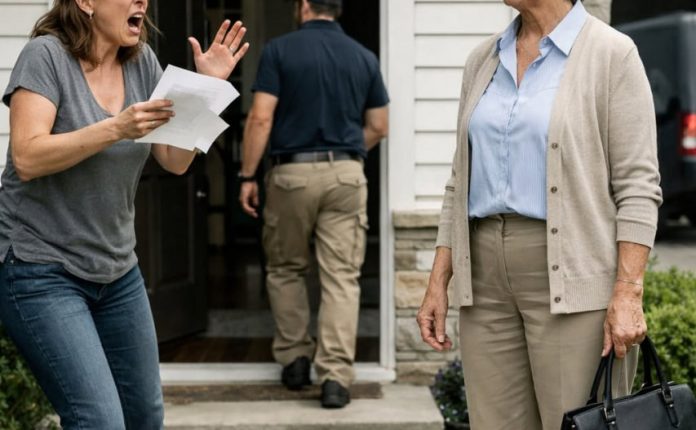
The first thing I noticed about Vanessa that Sunday afternoon was the sound of her shoes.
Their narrow heels struck the hardwood in sharp, impatient clicks. Five days earlier, I had stood beside my husband's grave in a pair of plain black pumps that pinched my toes. Vanessa had attended the same funeral wearing patent leather shoes with red soles, and apparently she had decided they were appropriate for the afternoon she intended to remove me from my own home.
"Margaret, we need to be practical," she announced. "You can grieve all you want, but you can't keep sitting here forever."
I stood beside the living room window with Daniel's cardigan folded over my arm.
"What are you talking about?"
She glanced at my son.
"Robert, explain it to her."
Robert looked down.
It was an expression I knew too well. At nine, he had worn it after breaking a lamp in the den. At sixteen, after denting our car and claiming someone had struck it in the school parking lot. At twenty-six, when he asked Daniel to cover a credit card balance that was larger than my annual grocery budget.
Now he was forty-two.
"Mom, with Dad gone, we need to streamline the living arrangements."
I waited.
Vanessa sighed.
"Honestly, Robert, why do you make everything so difficult?"
Then she turned toward me.
"Pack your things, Margaret. You can go live on the streets for all I care."
There was no anger in her voice. That was what made the words so difficult to absorb.
She said them the way someone might announce that the garbage collection had been moved to Thursday.
Through the window, I could see the dogwood tree Daniel had planted the summer Robert finished elementary school. Its branches were beginning to flower. A robin hopped across the grass, searching for worms after the morning rain.
Inside my house, nobody spoke.
My sister Linda occupied Daniel's favorite armchair. She had flown from Ohio for the funeral and stayed afterward, explaining that I shouldn't be alone.
Until that moment, I had believed her.
She crossed her ankles and examined the room.
"Don't take it personally, Maggie," she said. "Young people have different priorities."
I looked from my sister to my son.
"Robert, do you agree with what your wife just said?"
He rubbed his forehead.
"Mom, nobody wants you on the street."
"Then why hasn't anyone corrected her?"
Vanessa made a small impatient sound.
"We're talking about the house, not your feelings."
That house had been my home for thirty-seven years.
Daniel and I bought it in 1989, when Robert was eight. The front porch sagged, the upstairs bathroom leaked, and the kitchen cabinets had been painted a peculiar shade of yellow by the previous owner.
We could barely afford the down payment.
I worked twelve-hour night shifts at St. Vincent's Hospital, mostly in orthopedic recovery. Daniel worked for a regional logistics company, where his duties grew much faster than his salary.
We clipped coupons. We repaired appliances until the repairs cost more than replacements. Our vacations were afternoons at the lake with sandwiches packed in a cooler.
When Robert needed braces, Daniel postponed replacing our ancient Honda.
When college tuition rose unexpectedly, I sold jewelry my mother had left me.
Daniel never complained about the sacrifices.
He built the coffee table himself, sanding its edges until they were smooth enough for a child to tumble against without getting hurt.
Every December, he carried boxes of decorations down from the attic, even after his knees began troubling him.
He made my coffee when I came home exhausted from the hospital.
And although his career eventually became successful, he never stopped folding grocery bags for reuse.
Vanessa knew almost none of that.
She knew the house had a desirable address, mature trees, and a kitchen that could be renovated into something she called an entertainment space.
She also knew property values had climbed.
I suspected that was the only history that interested her.
"Robert and I think selling makes sense," she continued. "The proceeds can be managed properly."
"Managed by whom?"
"By us, obviously."
"Why?"
She looked startled.
"Because someone has to make sensible financial decisions."
I rested Daniel's cardigan on the back of the sofa.
"Who told you I was incapable of making them?"
Robert stepped forward.
"That's not what she means."
"Then I'd like to hear what she does mean."
Vanessa opened her handbag and took out her phone.
She held it near her hip, with the camera angled toward me.
At the hospital, I had spent years recognizing the small movements that revealed what patients were afraid to say. Vanessa's posture was just as easy to read.
She wanted a performance.
A sobbing widow. An angry mother. Something she could replay later with her own explanation attached.
I lowered my voice instead.
"Put your phone away, Vanessa."
She glanced at the screen.
"I'm not doing anything."
"Then you won't mind putting it in your bag."
For a second, her face stiffened.
Robert intervened.
"Can we please keep this civil?"
I looked at him.
"That depends on whether your wife is finished telling me where I should sleep."
Linda shifted in the armchair.
"Maggie, you're exhausted. Nobody makes good decisions during a time like this."
"Then why are we discussing selling my house five days after I buried my husband?"
Nobody answered.
Vanessa began walking around the living room.
She examined the china cabinet, then the dining table visible through the archway.
She took a pad of yellow sticky notes from her handbag.
"What are those for?" I asked.
"Organization."
She pressed a note onto the china cabinet.
Then another onto the sideboard.
She marked the dining table, a floor lamp, and the small antique secretary desk that had belonged to Daniel's mother.
My hands grew cold.
"Stop."
Vanessa barely looked up.
"These pieces will have to go into storage. Buyers prefer rooms without so much clutter."
I crossed the room and pulled the note from the cabinet.
"These are not your belongings."
"Margaret, nobody is stealing your plates."
"Then stop labeling them."
She turned toward Robert.
"See? This is exactly what I warned you about."
Robert took a long breath.
"Mom, Vanessa has been trying to help."
"Has she?"
I picked up the note from Daniel's chair.
He had spent his final months sitting there in the evenings, reading with a blanket across his knees.
When his hands became too weak to turn the pages, I read aloud.
Sometimes he fell asleep before the end of a chapter. Sometimes he listened with his eyes closed and corrected my pronunciation of a place name.
I had not yet found the courage to move his reading glasses from the table beside the chair.
Vanessa had already decided where the chair should go.
I folded the yellow note into quarters.
"Nobody touches his things."
Linda gave a sympathetic little sigh.
"Keeping everything exactly as it was won't bring him back."
I turned toward her.
"I know that."
My voice sounded unfamiliar.
Quiet. Almost distant.
"But moving everything out won't bring him back either."
Robert finally reached for one of the notes.
"Vanessa, maybe we should wait."
She caught his wrist.
"We've discussed this. Don't lose your nerve now."
That small gesture told me more than either of them intended.
They had planned this conversation in advance.
Perhaps during Daniel's final hospital stay.
Perhaps while I was choosing the flowers for his funeral.
I remembered the meeting with the funeral director.
Vanessa had insisted on hiring a professional eulogist because she wanted the service to sound polished.
The man had spoken about Daniel's executive judgment, his management experience, and his reputation in business.
He mispronounced our last name twice.
He never mentioned that Daniel used to carry our elderly neighbor's groceries up her front steps every Friday.
Or that he had spent six weekends repairing a bicycle for a boy whose father had died.
Or that he had never learned to cook anything more complicated than scrambled eggs, yet faithfully made breakfast whenever I was sick.
Those details had mattered to me.
They had apparently been too ordinary for Vanessa.
"There's paperwork," Robert said.
I looked at him.
"What paperwork?"
"Just something to simplify things."
Vanessa's mood improved immediately.
"Exactly. We can get that handled today."
She opened a large leather folder and placed it on the dining table.
Robert retrieved a pen from his coat.
"Mom, we're only trying to take some responsibility off your shoulders."
I stared at the pen.
I remembered Daniel in his hospital bed three weeks before his death.
His skin had taken on a grayish cast. He had lost so much weight that his wedding band slipped whenever he raised his hand.
One afternoon, while rain ran down the hospital window, he asked me to close the door.
Then he pressed a brass key into my palm.
"Keep this safe, Maggie."
I had smiled.
"Are you hiding chocolate from the nurses?"
He didn't smile back.
"Don't tell Robert about this. Not yet."
"Daniel, what's going on?"
"Promise me."
I had never heard him sound quite like that.
Not frightened exactly.
Determined, despite the effort it took to speak.
I promised.
He held my hand until a nurse came to check his medication.
Two days later, he died.
The little brass key now rested inside the lining of my coat pocket.
I had carried it through the funeral, through sleepless nights, and through every visit from relatives who suddenly seemed interested in Daniel's financial affairs.
I hadn't used it.
I wasn't even certain what it opened.
But when Robert placed the pen beside the leather folder, I felt the key pressing against my hand.
"Before I sign anything," I said, "I'd like to see what you've brought."
Vanessa pushed the folder toward me.
"It's routine."
"Then there shouldn't be a problem."
I pulled out a chair.
Our dining room smelled faintly of the lemon polish I had used the morning Daniel was admitted to the hospital for the final time.
His place at the head of the table was still empty.
I sat in my usual chair and opened the folder.
The first page contained several paragraphs of dense legal language.
I read slowly.
Vanessa tapped one heel against the floor.
"Margaret, if you insist on reading every word, we'll be here all night."
"Then you'll have to miss something."
Robert looked uncomfortable.
"Mom."
I continued reading.
The document authorized Robert and Vanessa to negotiate property transactions, communicate with financial institutions, handle proceeds, and execute agreements related to the house.
Near the bottom of the second page, I found a phrase that made me stop.
Irrevocable authority.
I looked up.
"Robert, why would I give you authority that I can't withdraw?"
He glanced at his wife.
"It doesn't mean that."
"That's what it says."
"It's temporary," he insisted.
"An irrevocable agreement isn't temporary."
Linda rose from the armchair and joined us.
"You're getting caught up in technical language."
I rested my finger against the sentence.
"Technical language is what determines who controls a property."
Vanessa folded her arms.
"You haven't dealt with legal paperwork in years."
That was true.
Daniel had usually handled our investments and insurance.
But I had spent decades reading medical orders, checking medication dosages, and correcting records that could have injured patients if mistakes went unnoticed.
I understood the importance of a word that changed someone's rights.
"Who prepared this?" I asked.
"Our adviser," Vanessa said.
"What's his name?"
"That isn't relevant."
"Is he an attorney?"
She hesitated.
"He works with property transactions."
"Then I'd like his business card."
Robert rubbed the back of his neck.
"Vanessa, maybe we should let Mom have someone review it."
She turned on him.
"We already paid to have it prepared."
I closed the folder.
"Then you should have asked me before spending the money."
I pushed it back across the table.
"I'm not signing."
For several seconds, there was only the ticking of the kitchen clock.
Vanessa's face changed.
The polished expression she wore in public disappeared.
"Do you understand what will happen if you refuse to cooperate?"
I kept my hands in my lap.
"Tell me."
"We won't be able to support you indefinitely."
I looked at Robert.
"Have I asked either of you for financial support?"
He didn't answer.
Vanessa continued.
"Your husband's income is gone. This house has taxes, insurance, maintenance. You can't pretend those expenses don't exist."
"No," I agreed. "I can't."
"Then be realistic."
I thought about the savings account Daniel and I had kept for emergencies. I thought about the pension payments I had earned at St. Vincent's. I thought about the final mortgage receipt Daniel had framed as a joke when we paid off the house.
Neither Robert nor Vanessa knew much about those things.
They had never asked.
"Are you finished?" I said.
Vanessa gathered the papers.
"Fine. But when you're desperate, don't expect us to solve everything for you."
I stood.
"Before you leave, remove the notes from my furniture."
Robert glanced around the room.
"Mom, please don't make this harder."
"Take them off."
He walked to the dining table and peeled away the first yellow square.
Vanessa watched with visible disbelief.
"You're allowing her to treat us like this?"
Robert didn't reply.
He continued collecting the notes.
For the first time that afternoon, he was doing something I had asked.
It should have comforted me.
Instead, I found myself wondering how much damage had to be done before my son would recognize it.
Vanessa snatched her handbag from the chair.
"You will regret embarrassing us."
"Perhaps," I said. "But I won't regret reading something before signing it."
She swept out of the room.
Robert stopped beside me.
"Mom, this really isn't what you think."
I studied his face.
He had Daniel's brown eyes and my father's stubborn chin.
For forty-two years, I had searched that face for the boy I loved.
"Then explain what it is."
He opened his mouth.
Closed it.
"I'll call you."
I knew he would.
Whether he would say anything worth hearing was another question.
After they left, Linda remained.
She walked through the hallway toward Daniel's office, where the door stood partly open.
"He always kept everything so organized," she remarked.
"Yes."
"Did he leave instructions about his business affairs?"
"I haven't finished sorting his papers."
She glanced toward the desk.
"Perhaps I could help."
"Not today."
Linda pressed her lips together.
"Maggie, don't shut people out. We're family."
I remembered her sitting silently while Vanessa suggested I sleep on the streets.
"Family can still knock before opening a drawer."
She gave me a wounded look.
Then she collected her suitcase and announced that she would stay at a nearby hotel until her return flight.
I offered no objection.
When the house was finally quiet, I sat on the edge of our bed and looked at Daniel's belongings.
His blue sweater hung behind the door.
His slippers remained beneath the chair.
His reading glasses sat beside a half-finished book.
I had been avoiding the small drawer in the nightstand.
Daniel had asked me to place an envelope there when he first became ill. He said it contained instructions I would need if something happened to him.
I had refused to discuss that possibility.
"You'll be home in a week," I had told him.
He smiled sadly.
"Then you can tease me for being overprepared."
Now I opened the drawer.
The envelope was cream colored, with my name written across the front.
I recognized his handwriting immediately.
The letters leaned slightly to the right, becoming smaller at the ends of lines.
Inside was a folded letter.
Maggie, there are things Robert must not control.
I stopped reading.
My husband had always been patient with our son.
He had paid Robert's college tuition, helped him start a business, and rescued him from more financial mistakes than I cared to remember.
They argued occasionally, but Daniel never stopped hoping Robert would become more responsible.
Why would he leave me such a warning?
I unfolded the rest.
The letter directed me to contact Eleanor Price, an attorney whose name I vaguely remembered from Daniel's business discussions.
There was an address downtown, a bank reference number, and a sentence underlined twice.
Do not surrender the brass key to anyone.
I took the key from my pocket.
It was small, worn at the edges, and attached to a plain metal ring.
I turned it over beneath the bedside lamp.
A number had been engraved near the handle.
217.
I remembered the last conversation Daniel and I had about Robert.
We were in the hospital, and he had asked whether our son had visited.
"Yesterday," I said.
"Was Vanessa with him?"
"Only for a few minutes."
Daniel looked toward the window.
"Robert has been asking questions about money."
"He's worried about you."
"Perhaps."
I sat beside him.
"What are you trying to tell me?"
He hesitated.
"Promise you'll give yourself time before agreeing to anything."
I thought he was worried about funeral arrangements or hospital bills.
"Of course."
He squeezed my fingers.
"Even if Robert says it's urgent."
Now, holding the key in our bedroom, I finally understood why he had been so specific.
Daniel had expected someone to pressure me.
He had known I would be grieving.
And he had taken precautions.
I called Eleanor Price's office the next morning.
A receptionist answered.
When I gave my name, there was a brief pause.
"Mrs. Margaret Bennett?"
"Yes."
"Mrs. Price has been expecting your call."
The words unsettled me.
"She has?"
"She asked that we arrange an appointment as soon as you contacted us."
I was given a time later that morning.
Before leaving, I locked the house, checked the back door twice, and placed Daniel's envelope inside my handbag.
The drive downtown took twenty minutes.
I had made that trip hundreds of times when I worked at the hospital, but the streets seemed different without Daniel beside me.
At a traffic light, I caught myself reaching toward the passenger seat to tell him about a man walking three small dogs.
The seat was empty.
I gripped the steering wheel until the light changed.
Eleanor's office occupied the third floor of an older brick building near the courthouse.
The receptionist brought me a glass of water.
Then a woman in her early sixties came to greet me.
She had short silver hair, dark glasses, and a steady manner that reminded me of the senior nurses I used to work with.
"Margaret," she said. "I'm sorry about Daniel."
She held my hand for a moment.
"He spoke about you often."
We entered her office.
On one wall hung a photograph of her standing beside Daniel at a charity event.
I looked at it.
"He never mentioned that picture."
Eleanor smiled faintly.
"He preferred to stay out of photographs whenever possible."
That sounded like my husband.
She invited me to sit.
"Before we discuss anything else, I need to ask whether Robert or Vanessa has contacted you about transferring property."
I stared at her.
"Yesterday."
"What did they want?"
"They brought documents authorizing them to manage the house."
"Did you sign?"
"No."
Eleanor slowly set down her pen.
"Good."
I described the folder, the language I remembered, and the request for irrevocable authority.
She took notes without interrupting.
When I finished, she removed her glasses.
"Daniel was worried this might happen."
"Why?"
"Because Robert had already approached him about the house."
I felt my stomach tighten.
"When?"
"Approximately six weeks before Daniel's final hospitalization."
"What did he ask?"
Eleanor folded her hands.
"He wanted his father to transfer the house into a family property arrangement that Robert and Vanessa would control."
"Daniel never told me."
"He intended to, but he was trying to gather more information first."
I looked at the photograph on the wall.
"What information?"
Eleanor glanced at the envelope in my hand.
"Did Daniel leave you a key?"
I placed it on her desk.
She examined the number engraved on the metal.
"That's the one."
She stood and went to a locked filing cabinet.
From the bottom drawer, she removed a sealed packet.
Before opening it, she returned to her chair.
"Margaret, there's something you should understand. Your husband spent many years building financial interests that were separate from his ordinary salary."
I frowned.
"He had retirement investments. I knew that."
"Yes. But his investments were considerably larger than you may have realized."
"How much larger?"
Eleanor didn't answer immediately.
Instead, she opened the packet and removed several documents.
One carried the name of a holding company I had never heard before.
Another listed a trust.
I leaned forward.
"What is all this?"
"Daniel established a revocable living trust years ago. He amended it before his death. You are now the person entitled to its assets, and the successor trustee responsible for administering them."
I shook my head.
"He never told me he had anything complicated."
"He wanted to explain it to you when he was well enough."
Eleanor passed me a summary sheet.
There were columns of figures, property descriptions, investment accounts, and ownership interests.
My eyes moved slowly down the page.
At the bottom was a total.
$28,000,000.
I stared at the number.
Then I counted the zeros.
Surely I was misunderstanding.
"Eleanor, what is this?"
"The current estimated value of the assets Daniel arranged to leave to you."
I sat perfectly still.
Outside, a truck sounded its horn.
Somewhere in the office, a printer started.
Ordinary sounds continued while the world I understood shifted beneath my feet.
"Twenty-eight million dollars?"
"Approximately, before final expenses, taxes, and any valuation adjustments."
I looked down again.
The amount remained.
"That can't be right."
"It is."
I thought about Daniel repairing our toaster with a screwdriver.
About him waiting for discounted garden plants at the end of the season.
About the way he complained when I bought expensive laundry detergent.
"How?"
Eleanor let me collect myself before answering.
"Daniel received substantial equity compensation as his company expanded. He retained investments through mergers and later invested in several businesses and properties. He also inherited a minority interest in a commercial enterprise from a former partner, then expanded that holding over time."
I listened without speaking.
"He kept his personal spending modest," she continued. "Much of the wealth remained invested. He also arranged for independent professional management."
I looked toward the window.
For years, Daniel had handled our finances with such quiet efficiency that I hadn't questioned every account.
We lived comfortably after he retired, but never extravagantly.
He had told me we were secure.
I had believed that meant we could pay our bills without worrying.
Now I was learning that his definition had been very different.
"Why didn't he tell me?"
Eleanor's expression softened.
"That is a question only Daniel could answer completely. But he left you a letter explaining some of his thinking."
She handed me another envelope.
I recognized his handwriting.
My dearest Maggie.
I couldn't bring myself to open it yet.
Instead, I asked, "Does Robert know?"
"He knows his father had investments. He does not know the full value of the trust, and Daniel specifically requested that we not disclose your private financial information to him."
I remembered Vanessa's shoes clicking across my living room.
Her sticky notes.
Her instructions to live on the streets.
A strange, uncomfortable feeling passed through me.
Not triumph.
Not satisfaction.
Disbelief.
They had been so certain I had nothing.
"Is the house mine?" I asked.
Eleanor nodded.
"Your home was held jointly with Daniel, with survivorship rights. His death did not transfer it to Robert. We have the title records here. We can also arrange to record the necessary documentation reflecting Daniel's death."
I covered my mouth.
All morning, I had been afraid that some unknown legal provision might support Vanessa's claims.
Now that fear began to loosen.
"Then why did Robert think he could sell it?"
"I can't tell you what he believed. But the agreement you described could have given him considerable control if you had signed it."
I looked again at the summary.
Twenty-eight million dollars.
I could hardly connect the number to anything in my life.
Eleanor pushed a tissue box toward me.
I had not realized I was crying.
"There's another matter," she said gently.
I wiped my cheeks.
"What?"
"The brass key opens a safe-deposit box containing original records and information Daniel did not want stored at home. I recommend that we visit the bank together."
"Today?"
"If you're comfortable."
I took a long breath.
"Yes."
She closed the packet.
"Margaret, before we go, I want to explain something important."
I waited.
"These assets belong to you. You do not need Robert's permission to manage them. You do not need to tell Vanessa what you've inherited. You can take time to understand everything."
My fingers tightened around Daniel's letter.
"Then that's what I'll do."
Eleanor nodded.
"We'll proceed carefully."
I stood and slipped the envelope into my handbag.
For the first time since the funeral, I felt that I had something other than grief to carry.
Responsibility.
And a warning from a man who had apparently spent his final weeks trying to make certain I would not be left defenseless.
As we prepared to leave, Eleanor paused at the doorway.
"There's one more reason Daniel wanted you to see the records in person."
I turned.
"What reason?"
"One of the properties held through his company is connected to Robert and Vanessa."
I frowned.
"Connected how?"
She looked at me steadily.
"They are living in it."
I thought of Vanessa's beautiful house, the one she photographed constantly and described to her friends as the reward for her husband's success.
Then I looked down at the small brass key.
Daniel had left me far more than money.
He had left me the means to discover just how much of our family's comfortable appearance rested on things nobody had told me.
END PART 1