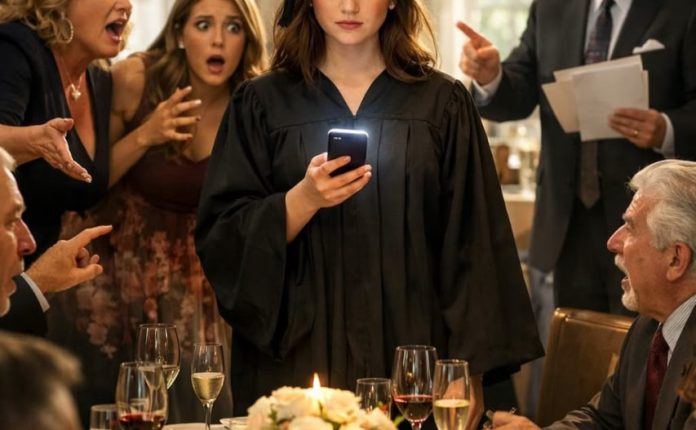
My name is Reyna Castillo, and the evening I graduated from high school, my stepmother stood in front of seventeen relatives at Pellegrino's restaurant and informed everyone that my college scholarship no longer belonged to me.
She didn't ask whether I had heard the news.
She didn't apologize for delivering it publicly.
She tapped a dessert spoon against her wine glass, waited for everyone to look at her, and announced that she had made arrangements with Weston University to give my scholarship to her daughter.
Then she sat down as though she had simply reminded us that dessert was on its way.
I was eighteen years old.
Six weeks earlier, I had received the Hargrove Merit Award, a four-year academic scholarship that covered tuition, university housing, and a modest living allowance.
It was the most important thing I had ever earned.
And apparently, according to Renata, it had become a family possession that she could distribute however she pleased.
“I called the university,” she said, smiling around the table. “Your scholarship is going to Mara now. She deserves it more.”
For several seconds, nobody spoke.
My grandmother Elena, sitting at the far end of the table, lowered her fork onto her plate.
Aunt Lidia stared at Renata.
My cousin Mateo looked from one adult to another.
Mara, my sixteen-year-old stepsister, stared at the white tablecloth.
I looked at my father.
Daniel Castillo had removed his jacket after dinner. His loosened tie hung slightly crooked beneath his collar, and his hands surrounded a water glass wet with condensation.
He watched a drop of water slide down the glass.
He did not look at me.
That small act of avoidance frightened me more than Renata's announcement.
For years, my father had responded to uncomfortable situations by waiting for someone else to make them disappear.
Usually, that person was me.
I was supposed to understand why Mara needed more attention.
I was supposed to accept that Renata had a different parenting style.
I was supposed to appreciate how difficult it was to blend two families.
But my scholarship was not a disagreement about chores, birthday presents, or who got to choose the family vacation.
It was my future.
“That's not how scholarships work,” I said.
Renata gave me the familiar smile she used whenever she believed I was about to embarrass myself.
“Reyna, sweetheart, there are arrangements adults can make that children don't necessarily understand.”
“I'm eighteen.”
“And we're still your parents.”
“My scholarship was awarded to me.”
Renata lifted her shoulders.
“Sometimes deserving something and needing something are two different matters.”
I felt heat rising into my face.
Outside the private dining room, I could hear someone laughing near the restaurant bar.
The smell of roasted garlic and melted butter seemed suddenly overpowering.
My graduation dress scratched against the back of my neck.
I had chosen that blue dress with Grandma Elena three weeks earlier.
We found it in a small shop where the owner gave us a discount after learning I had earned a university scholarship.
Grandma insisted on paying.
“Your mother would have wanted you to wear something you felt beautiful in,” she told me.
My mother, Sofia, had been dead for seven years.
She was forty-one when a sudden illness took her from us.
I was eleven.
For a long time afterward, my father and I had moved through our little house like people who were afraid to disturb the furniture.
He stopped playing music while he cooked.
I stopped asking whether he was happy.
We ate dinners in front of the television because conversations reminded us too much of the person who was missing.
Then Renata entered our lives.
She was organized, confident, and quick to make decisions.
She worked in property management, kept a color-coded calendar, and had an opinion about virtually everything.
At first, her certainty seemed helpful.
She remembered school deadlines when Dad forgot.
She arranged appointments.
She made the house feel occupied again.
When she and Dad married, she brought Mara with her.
Mara was nine.
She had thick dark hair, large brown eyes, and a habit of following her mother from room to room.
I wanted us to become sisters.
For a while, we tried.
We shared hair clips, watched movies on the living room floor, and complained about homework.
But Renata gradually established an order inside our home.
Mara's needs came first because she was younger.
Mara's mistakes required understanding because she was sensitive.
Mara's achievements required special celebrations because confidence didn't come naturally to her.
My achievements were treated as expected results.
“You've always been good at school,” Renata would say.
When I earned the highest grade in chemistry, she asked whether I could help Mara with algebra.
When I was chosen to represent our district at a science competition, she reminded me to finish the laundry before leaving.
When I won the Hargrove scholarship, she said, “Well, that's wonderful. Now perhaps we can concentrate on getting Mara where she needs to be.”
I thought she meant academically.
I had no idea she meant replacing me.
At Pellegrino's, Renata folded her napkin beside her plate.
“There's no reason for anyone to become upset,” she said. “This was done for the benefit of our family.”
Grandma Elena looked at my father.
“Daniel?”
He cleared his throat.
“Mom, let's not make a scene.”
She glanced around the table.
“Your wife just announced that she gave away your daughter's scholarship in front of seventeen people. What sort of scene were you expecting?”
Renata's smile disappeared.
“I'm not going to be insulted during a celebration I organized.”
“A celebration for whom?” Aunt Lidia asked.
Renata looked offended.
“For Reyna, obviously.”
I almost laughed.
Seventeen people had come to celebrate my graduation.
There were white roses along the center of the table and a cake decorated with a blue graduation cap.
Above the cake, a little gold sign said CONGRATULATIONS, REYNA.
I stared at those letters while Renata explained why the evening was apparently about Mara.
Then my phone vibrated.
The screen lit up beside my plate.
Hargrove Award Account Security Notice.
I recognized the university's official notification address.
My first thought was that Weston had sent another orientation reminder.
Instead, the message said an attempted change had been made to my scholarship account.
The university had detected a request involving contact authorization and financial arrangements.
The change had not been completed.
My account was temporarily restricted pending verification.
The message instructed me to contact the scholarship compliance office using the number published on the university website.
I read it twice.
Then a third time.
Renata noticed.
“Please put your phone away.”
I looked up.
“What did you do?”
She blinked.
“Excuse me?”
“Who did you speak with at Weston?”
“I already told you.”
“You said you called admissions.”
“Yes.”
“About an academic scholarship awarded to someone else?”
“About a family arrangement.”
I turned my phone toward her.
“Then why is the university telling me somebody tried to change my scholarship account?”
The blood seemed to leave her face.
Only for a moment.
Then her expression hardened.
“I don't know what you're talking about.”
My father moved his glass away.
“Reyna, perhaps we should discuss this at home.”
“Did you know?”
He looked at me then.
Really looked at me.
His expression was tired and anxious.
I knew that expression.
It was the one he wore whenever Renata wanted something he didn't know how to refuse.
“Your stepmother was trying to find a solution,” he said.
“To what problem?”
He rubbed his forehead.
“College is expensive.”
“The scholarship covers my tuition.”
“There are other expenses.”
“It covers my housing.”
“Not everything.”
I stared at him.
“Dad, the living allowance is included. You know that. We went over the award letter together.”
He said nothing.
Grandma Elena pushed back her chair.
She was seventy-three, small and straight-backed, with silver hair pinned neatly above her neck.
She had never been loud.
She didn't need to be.
“Reyna,” she said, “may I see the message?”
I handed her my phone.
Grandma read slowly, adjusting her glasses.
Aunt Lidia came around the table.
Lidia worked in student services administration at a community college. She was not a scholarship attorney, and she never pretended to be one, but she knew enough about university procedures to understand why the message mattered.
“Does it say the scholarship was transferred?” she asked.
“No.”
“Does it identify who submitted the request?”
“No.”
“Have you given anybody permission to access your account?”
I shook my head.
Then I remembered something.
Three nights earlier, Renata had placed several documents beside my dinner plate.
I had been finishing a presentation for my senior internship program.
She said the papers concerned medical coverage, emergency contacts, and college enrollment.
I signed one page without reading it carefully.
That was my mistake.
I remembered seeing my student identification number near the bottom.
I had asked about it.
Renata told me colleges needed identification numbers on everything.
At Pellegrino's, I looked directly at her.
“What was the form you asked me to sign on Wednesday?”
Her eyes narrowed.
“Household paperwork.”
“What kind?”
“I don't remember every document I handle.”
“Was it from Weston?”
“Reyna, stop this.”
Aunt Lidia spoke calmly.
“Renata, if this is a misunderstanding, we can clear it up. Just tell us what you submitted.”
Renata reached for her purse.
“I refuse to participate in an interrogation.”
She started to stand.
“Sit down,” Grandma Elena said.
Renata froze.
It was the first time I had ever heard Grandma speak to her that way.
Grandma's voice remained even.
“If you want to leave, nobody will stop you. But you made a public announcement about Reyna's education. You don't get to insist that everyone forget it the moment questions become inconvenient.”
My father looked miserable.
“Mom, please.”
“Daniel, you have a daughter sitting here who doesn't know whether her scholarship is safe. Perhaps you could concern yourself with her.”
The silence that followed was so uncomfortable that I heard the air conditioner click on above us.
Then Mara spoke.
“Mom told me Reyna didn't want to go.”
Everyone turned toward her.
Mara's cheeks were wet.
She held a tissue tightly between both hands.
“Go where?” I asked.
“To Weston.”
I stared at her.
“What?”
“She said you decided you'd rather stay here for a year. She said you were worried about leaving Dad.”
Renata spoke sharply.
“Mara, this is an adult conversation.”
“But you told me she agreed.”
“Mara.”
“You said she was happy to help me.”
My stepsister looked at me.
“Reyna, I thought you knew.”
I remembered the afternoon my acceptance letter arrived.
Mara had hugged me.
She asked whether the university had a big library and whether I would come home for Thanksgiving.
She helped me look at residence hall photographs online.
She had even offered me a little ceramic pencil holder from her bedroom because it matched the colors I wanted for my dorm.
I believed she was happy for me.
Now she looked at me as though she expected me to hate her.
“I never agreed to give you anything,” I said quietly.
“I know that now.”
Renata crossed her arms.
“You're both becoming hysterical over a misunderstanding.”
Mara stared at her mother.
“You told me the scholarship committee approved it.”
“The discussions were preliminary.”
“You said it was already arranged.”
“Mara, enough.”
Mara reached into her handbag.
She removed an envelope folded down the middle.
“Then what's this?”
Renata went perfectly still.
My father closed his eyes.
Mara unfolded a page and placed it on the table.
The paper carried a Weston University heading.
It included my full name, student identification number, and Hargrove Merit Award reference.
Below those details was a statement indicating that I had requested consideration of an alternative educational funding arrangement involving my stepsister.
At the bottom was a signature.
My signature.
Or something made to resemble it.
I leaned closer.
The first letter was almost perfect.
The final flourish was wrong.
I had stopped writing my last name that way two years earlier because my hand cramped when I did it.
Somebody had copied an older version.
I looked at Renata.
“Where did you get this?”
She swallowed.
“I explained that there were documents involved.”
“This isn't my signature.”
My father whispered, “Reyna.”
I turned toward him.
“Did you know about this?”
His expression told me the answer before he spoke.
“I thought you were considering a different arrangement.”
I felt a strange heaviness settle behind my ribs.
For years, I had defended him when Grandma said he needed to be more involved.
I told myself he was tired from work.
I told myself Renata made decisions because he preferred avoiding arguments.
I told myself he loved me, even when his silence made that difficult to believe.
Now he was sitting in front of me, watching a document bearing a copied version of my signature.
And he was not surprised.
“Did you see this before tonight?” I asked.
He didn't answer quickly enough.
“Yes,” he finally said.
The word was barely audible.
I leaned back.
Mara began crying again.
Renata looked toward the door.
Aunt Lidia took a photograph of the document after asking Mara's permission.
Grandma returned my phone.
“Reyna,” she said, “we're going to find out exactly what happened.”
Renata gave a short, bitter laugh.
“You're all behaving as though I've committed some terrible crime.”
Grandma looked at the copied signature.
“I haven't said what you've done. I intend to find out.”
I picked up the paper.
For a moment, I remembered my mother sitting beside me when I was six, teaching me to write my full name in careful letters across lined paper.
She used to say my name belonged to me.
I could write it however I wanted.
Now somebody had taken that name and attached it to a decision I had never made.
I folded the document carefully.
“I'm calling Weston,” I said.
Renata shook her head.
“Not until we've discussed this privately.”
“You already discussed it without me.”
She reached for the paper.
I moved it away.
Then my father stood.
“Reyna, I am asking you to come home first.”
I looked at him.
“No.”
He seemed startled.
It was a small word.
I had used it before, of course.
But not like that.
Not while looking directly at him.
Not without immediately explaining myself.
“No,” I repeated. “I'm not going home to let you decide what I'm allowed to know.”
Aunt Lidia put her hand on my shoulder.
“You can come with me.”
Grandma nodded.
“I'll come too.”
Renata turned toward my father.
“Daniel, are you really going to allow this?”
He looked between us.
Then he said the words that finished something inside me.
“She needs to calm down.”
I stared at him.
“My college account has been accessed without my permission, my signature is on a document I didn't sign, and your wife announced that my scholarship belongs to Mara.”
My voice shook.
“Which part would you like me to be calm about?”
He had no answer.
I gathered my phone, diploma tube, and small evening bag.
Grandma retrieved my graduation flowers from beside her chair.
As we approached the door, Mara called my name.
I stopped.
She stood beside the table, clutching her empty envelope.
“I'm sorry,” she whispered.
I couldn't answer her yet.
I didn't know what she had believed, what she had accepted, or what she had been told to keep secret.
I only knew that the girl I had tutored through difficult classes was standing in the wreckage of something her mother had created.
“Keep anything else she gave you,” I said.
Mara nodded.
Renata opened her mouth.
Grandma turned toward her.
“Don't.”
Then we left.
Outside Pellegrino's, the June air was humid.
Cars moved slowly along the street.
A couple stood beside the entrance, laughing as they waited for their ride.
I wanted to understand how strangers could still be happy when my life had just cracked open.
Aunt Lidia unlocked her car.
Grandma placed the flowers carefully on the back seat.
I called the number listed on Weston's official website.
An automated message explained that the scholarship compliance office was closed for the evening.
There was an emergency reporting option for suspected unauthorized account activity.
I selected it.
A recorded message instructed me to leave my name, student identification number, and a brief description.
I did.
I explained that someone had attempted to change my award account without authorization.
I said I had a document bearing a signature I did not recognize as mine.
My voice sounded unfamiliar.
Too formal.
Too steady.
I ended the message and sat with the phone in my lap.
Grandma settled beside me.
“Your mother would be proud of how you handled yourself,” she said.
I shook my head.
“I should have read that form.”
“Yes,” she said gently. “You should have.”
I looked at her.
She wasn't smiling.
She wasn't pretending I hadn't made a mistake.
“But trusting someone who lives in your home is not permission for that person to deceive you.”
I stared through the windshield.
“Did Dad know?”
Grandma took a long breath.
“I believe he knows more than he said.”
I thought about his silence at the restaurant.
His lack of surprise.
The way he asked me to come home instead of asking Renata for an explanation.
“I don't think I can go back there tonight.”
“You don't have to.”
Aunt Lidia started the car.
As we drove away, my phone received another university message.
It confirmed that my security report had been logged and that restrictions on account changes would remain in place until my identity could be verified.
My scholarship had not been canceled.
That should have been enough to let me breathe.
But I kept thinking about the document in my bag.
Somebody had imitated my signature.
Somebody had submitted information using my student records.
And my father had seen the paper before I did.
By the time we reached Grandma's house, I had made one decision.
I would protect my scholarship.
But I would not protect the people who had tried to take it.
END PART 1