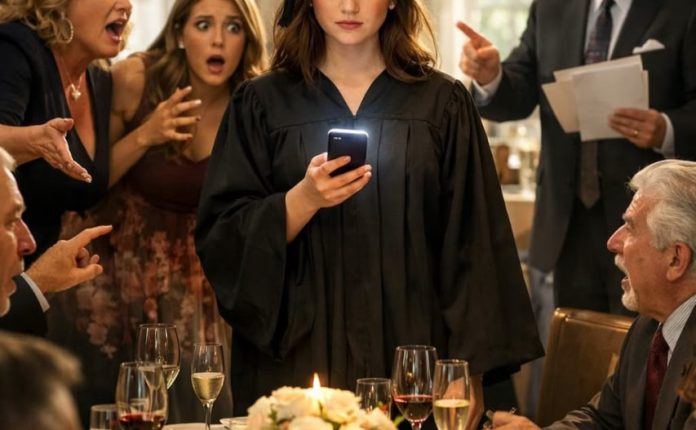
Grandma Elena lived in the same little brick house where my mother grew up.
There were geraniums in terracotta pots along the front steps, a brass clock above the kitchen doorway, and photographs arranged on the living room mantel.
My mother's school portrait stood near the center.
She was seventeen in the picture, with dark hair falling over one shoulder and the same uneven smile I saw whenever I looked in the mirror.
Grandma put my graduation flowers in a vase.
Aunt Lidia made tea.
I sat at the kitchen table with my laptop, phone, and the folded document Mara had given me.
Nobody told me to get some sleep.
Nobody insisted that things would look better in the morning.
Grandma sat across from me while I examined the paper.
The heading looked official.
The address matched Weston's admissions office.
But the document had no university seal, no authorized signature from a university representative, and no reference number indicating approval.
There was only my scholarship information and a statement about a requested funding arrangement.
At the bottom, above the copied signature, a sentence claimed I acknowledged consideration of an alternative award recipient.
I read it aloud.
Aunt Lidia frowned.
“That's unusually vague.”
“What does it mean?”
“I'm not sure it means anything legally. It certainly doesn't prove Weston agreed to transfer an award.”
She leaned closer.
“Look at the wording. It says consideration. Not approval.”
I examined the page again.
Renata had told everyone the scholarship was already Mara's.
But the document didn't say that.
It looked like an attempt to begin a process, not evidence that any process had succeeded.
“Could someone make this on a computer?” I asked.
“Certainly.”
“Could they put the university heading on it?”
“Yes.”
Grandma rested both hands around her cup.
“Then don't assume the paper is genuine simply because it looks familiar.”
I took photographs of both sides.
Then I saved them in a folder on my laptop.
Aunt Lidia suggested that I preserve the original without writing on it.
She helped me place it in a clean envelope.
We documented the date Mara handed it to me and what she had said about receiving it from Renata.
It felt strange to record a family dinner like an incident report.
But nothing about that evening felt like an ordinary family disagreement anymore.
At 10:14, my father called.
I watched his name appear on the screen.
For seven years, I had answered almost every call from him immediately.
That night, I let it ring.
He called again.
Then a message arrived.
Please come home. We need to work this out as a family.
I read it twice.
I wanted to ask which family he meant.
The one sitting at Pellegrino's while his wife humiliated me?
Or the one that expected me to return home and cooperate in concealing what she had done?
Instead, I wrote:
I am staying with Grandma. I have contacted Weston. Please don't access any of my school accounts or documents.
He replied several minutes later.
We weren't trying to hurt you.
I stared at those words until the screen dimmed.
Grandma noticed.
“What did he say?”
I showed her.
She read the message without comment.
Then she reached for the kettle.
“Would you like more tea?”
I nodded.
I was grateful she didn't ask me to forgive him.
The following morning, I woke before six.
Sunlight filtered through the curtains of my mother's old bedroom.
Grandma had kept the room mostly unchanged.
A narrow white dresser stood beneath the window. The quilt on the bed was faded around the edges, but I recognized the tiny blue flowers from childhood visits.
For a moment, I forgot where I was.
Then I remembered Renata standing beside the restaurant table.
I checked my phone.
There were five messages from Dad.
Two from Mara.
One from Aunt Lidia asking whether I wanted her to come to Grandma's before the university office opened.
Mara's first message was short.
I'm sorry. I didn't understand what Mom was doing.
The second was longer.
I have some messages she sent me. I can show you if you want.
I replied:
Please keep them. Don't delete anything. We can talk later.
Mara answered almost immediately.
Okay.
Then:
Reyna, I really thought you had agreed.
I closed my eyes.
I believed she had been told that.
Whether she had chosen to ignore things that didn't make sense was another question.
I wasn't ready to answer it.
At eight thirty, Aunt Lidia arrived with a notebook and a small bag of cinnamon rolls.
At nine, we called Weston together.
The scholarship compliance office transferred us to a representative named Ms. Kessler.
She introduced herself, confirmed my identity through the university's established verification process, and explained that a security flag had been placed on my account.
“I understand you reported an unauthorized request,” she said.
“Yes.”
“Are you somewhere private where you can speak freely?”
I looked around Grandma's kitchen.
“Yes.”
“Good. I can discuss your account with you. If you wish to have someone else participate, I'll need your verbal consent.”
I gave Aunt Lidia permission to remain on the call.
Then Ms. Kessler asked me to describe what happened.
I told her about the dinner.
The announcement.
The document bearing my name.
The signature that wasn't mine.
She listened without interrupting.
When I finished, there was a brief pause.
“Reyna, I want to clarify something important,” she said. “Your Hargrove Merit Award has not been transferred to another student.”
I pressed my fingertips against the table.
“Is it still mine?”
“Yes. Your award remains recorded in your name.”
I exhaled slowly.
Aunt Lidia wrote something in her notebook.
Ms. Kessler continued.
“The Hargrove Award is based on the recipient's individual academic record, application, recommendation materials, and selection by the scholarship committee. It cannot be reassigned by a parent, guardian, or another family member.”
“Even if the family asks?”
“Correct.”
“Even if someone signs something?”
“A student may decline an award, but that would not automatically assign it to another person. The committee would follow the award's established procedures.”
I looked at the document in its envelope.
“Then somebody lied.”
Ms. Kessler didn't respond to that statement directly.
Instead, she explained what the university had discovered.
A request had been submitted through a process intended for updating student contact information and asking questions about scholarship eligibility.
The request included my student identification number, personal details, and an attachment.
The sender represented herself as an authorized family contact.
There had also been an unsuccessful attempt to change the recovery email associated with my university account.
The attempted recovery address did not match mine.
I asked whether it was Renata's email.
Ms. Kessler explained that the university needed to complete its review before disclosing information about other individuals.
But she confirmed that the attempted change had been blocked.
“Did someone get into my account?”
“We haven't found evidence of a successful login through that attempt. We are reviewing related activity. The request itself contained enough personal information to require additional verification.”
I rubbed my forehead.
“Could my scholarship be taken away because of this?”
“Based on what we currently know, there is no indication that you authorized the request. Your award is active. We need your cooperation to secure the account and document what occurred.”
I felt Aunt Lidia's hand settle lightly on my shoulder.
Ms. Kessler gave us detailed instructions.
I needed to change my university password, review recovery options, and enable multifactor authentication.
I needed to submit a written statement about the document bearing my signature.
I needed to provide a copy of any suspicious paperwork.
And I needed to avoid sending sensitive information to anyone who contacted me outside official university channels.
“We'll communicate with you through verified contact information,” she said.
“Will you call my parents?”
“Not without an appropriate reason and authorization. You are an adult student, and your account belongs to you.”
I glanced at Grandma.
She smiled faintly.
For the first time since the dinner, I felt as though somebody had drawn a clear line around what belonged to me.
Before ending the call, I asked one final question.
“Did anyone at Weston tell my stepmother that Mara would receive my scholarship?”
Ms. Kessler answered carefully.
“No authorized scholarship decision has been made awarding your Hargrove scholarship to another person. I cannot speak to everything someone may have claimed in an outside conversation.”
“Thank you.”
After the call, Aunt Lidia closed her notebook.
I sat silently.
Grandma brought me a glass of water.
“Are you feeling better?” she asked.
“Yes.”
It was partly true.
My scholarship was safe for the moment.
But the university had confirmed someone tried to use my information.
And a new question had become impossible to ignore.
How had Renata obtained enough information to make the request?
I had kept my scholarship letter in a folder inside my bedroom desk.
My student account information was stored on my laptop.
But Renata had access to most of the paperwork that came into our house.
She collected the mail.
She kept copies of school forms.
She managed the household filing cabinet.
My father had my date of birth and Social Security information from earlier family records.
Between them, they knew nearly everything about me.
Except, apparently, what I actually wanted.
I spent the next hour securing my account.
Then I opened the folder containing the digital copy of the scholarship acceptance letter.
The original letter listed me as the recipient.
It described the award as renewable for four academic years as long as I met the academic requirements.
It included a sentence explaining that the award was nontransferable.
I had read that sentence before.
Now it seemed astonishingly important.
Renata either hadn't understood it or had decided it didn't matter.
At eleven thirty, Mara called.
I answered.
“Hi,” she said.
Her voice sounded small.
“Hi.”
“Are you mad at me?”
I looked at Grandma, who was washing cups at the sink.
“I don't know what I am.”
Mara sniffed.
“Mom says you're trying to ruin everything.”
I felt my shoulders stiffen.
“What does she say I'm ruining?”
“Our chances.”
“Of what?”
She hesitated.
Then she said, “Of me getting into Weston.”
I stared through the kitchen window.
“Mara, you're sixteen.”
“I know.”
“You haven't even applied to college.”
“I know.”
“The scholarship doesn't belong to our family. It belongs to the person who earned it.”
“I know that now.”
There was a long silence.
Then she whispered, “Mom said they were making an exception.”
“What kind of exception?”
“She said somebody from the scholarship office told her there was a way to change the recipient if the original student had family circumstances.”
“Did she show you anything?”
“Just the form.”
“The one you brought to dinner?”
“Yes.”
“Anything else?”
Mara hesitated again.
“Some emails.”
I straightened.
“What emails?”
“Mom printed them. She said they proved the university was reviewing things.”
“Do you still have them?”
“Some.”
“Can you send me pictures?”
“I think so.”
“Don't change or delete anything,” I said. “And don't do anything that puts you in danger or starts a fight.”
She was quiet.
Then she said, “I don't want to be the reason you can't go to college.”
My throat tightened.
“You aren't the reason I'm having this problem.”
“Mom says you're blaming me.”
“I'm asking what happened.”
Mara began crying.
I waited until she could speak again.
“Can I ask you something?” she said.
“Sure.”
“Did you really tell Mom you wanted to stay home because Dad needed you?”
“No.”
“She said you were afraid he'd be lonely.”
I closed my eyes.
My father had once told Renata that he worried about the house becoming too quiet after I left.
I remembered that conversation.
It happened at dinner in April.
I had been discussing housing options, and Dad mentioned how quickly the years had passed.
Renata had said, “Well, perhaps Reyna will decide not to go so far away.”
I laughed because I thought she was joking.
I didn't laugh now.
“Mara, I want to go to Weston. I've wanted to go there for years.”
“I know.”
“Then why did you believe her?”
She took a shaky breath.
“Because she said you were being kind.”
I stared at the wall.
Mara wasn't innocent of every choice she had made.
She had accepted a story that conveniently benefited her.
But she had also spent her entire life being told that her mother's decisions were thoughtful and correct.
I knew what that was like.
Before ending the call, she promised to send the photographs.
Twenty minutes later, four images appeared.
The first showed a printed email from Renata to an address resembling Weston's scholarship office.
The message asked whether an awarded scholarship could be reconsidered when the recipient intended to defer enrollment and another household member demonstrated financial need.
The second was a response from a general university information desk.
It referred Renata to published scholarship policies and advised that only the named student could make decisions concerning an awarded scholarship.
Renata had apparently interpreted that response creatively.
The third image showed another message Renata had drafted.
This one included my name and claimed I wished to reconsider enrollment.
The fourth photograph made my stomach tighten.
It showed part of a handwritten note from my father.
At the top were my student identification number and other personal details.
Underneath, he had written:
For Renata's university follow-up.
I enlarged the photograph.
The handwriting was unmistakable.
My father had written that information himself.
I sat back.
Aunt Lidia read the images.
Grandma joined us.
For several moments, none of us spoke.
Then Grandma said, “He helped her.”
I stared at the photograph.
“He told me he thought it was just an arrangement.”
Aunt Lidia shook her head.
“He may have believed something different from what Renata planned. But he knew she was contacting the university using your information.”
I wanted to argue.
I wanted to insist that Dad would never knowingly do something dishonest.
But I remembered the way he had looked at the copied signature.
He had known there was a document.
He had seen it before the dinner.
And he had still allowed Renata to stand in front of our family and announce that Mara deserved my scholarship more than I did.
At noon, Dad called again.
This time I answered.
“Reyna,” he said immediately, “where are you?”
“At Grandma's.”
“Are you coming home?”
“Not today.”
He sighed.
“Your stepmother is very upset.”
I looked at the handwritten note on my phone.
“Did you give Renata my student identification number?”
Silence.
“Dad?”
“She needed it for a question about the scholarship.”
“What question?”
“About whether there were options.”
“Options for whom?”
He took a breath.
“Renata thought there might be a way to help Mara eventually.”
“With my award?”
“I didn't understand everything she was doing.”
I closed my eyes.
“Did you give her my personal information?”
“Yes.”
“Did you know she was asking Weston to change my scholarship?”
“I knew she was asking about alternatives.”
“Did you see the form with my signature?”
Another silence.
“Yes.”
“Did you believe I signed it?”
“I thought she'd talked to you.”
“Did you ask me?”
He didn't answer.
“Dad, did you ask me?”
“No.”
I pressed the heel of my hand against my forehead.
“Then why did you let her use it?”
“I thought we were discussing possibilities. I didn't think she'd announce anything before speaking to you.”
I laughed once.
Not because it was funny.
Because his explanation was so painfully familiar.
He had misunderstood.
He had assumed.
He had expected Renata to handle things appropriately.
Somehow, every failure involved him doing nothing.
“I'm sending the university everything,” I said.
“Reyna, please don't make this worse.”
I stared at the wall.
“Worse for whom?”
He didn't answer.
“I need you to be careful,” he said finally. “Renata could lose her job if people start making accusations.”
“And I could have lost my scholarship.”
“That wasn't going to happen.”
“You didn't know that.”
Silence.
Then he said something I would remember for a long time.
“Your stepmother loves Mara very much.”
I looked at the photograph of his handwritten note.
“I know,” I said. “I just wish you loved me enough to tell her no.”
I ended the call.
Then I opened my laptop and began writing my statement to Weston.
I described the graduation dinner.
The Wednesday paperwork.
The document Mara had shown me.
My father's acknowledgment that he supplied information.
And the fact that I had never authorized anyone to request changes to my award.
I attached the photographs.
I included the original award letter.
Then I reviewed everything twice.
Aunt Lidia checked the dates.
Grandma sat beside me without speaking.
When I was certain the statement was accurate, I submitted it through Weston's secure reporting process.
A confirmation appeared.
My report had been received.
I closed the laptop.
That should have felt like an ending.
Instead, it was the first time I had placed the truth somewhere Renata couldn't control it.
END PART 2