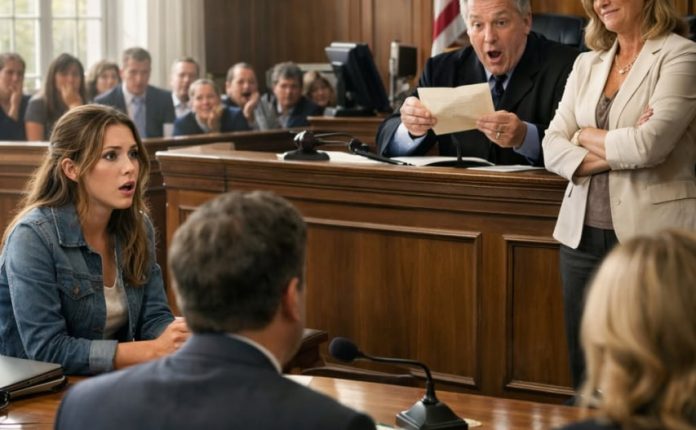
My father entered the courtroom wearing the navy suit he reserved for occasions when he wanted everyone to take him seriously.
He looked confident.
My mother walked beside him, wearing Grandma's pearl earrings and carrying a leather handbag that matched her shoes.
They sat together at the front.
Dad spoke quietly with his attorney.
Mom glanced toward me, then looked away.
I sat beside Evelyn.
Across the aisle, Rosa and Margaret had taken seats.
Rebecca Shaw was also present.
Daniel Whitcomb had provided the relevant records and was available to testify if necessary.
Evelyn leaned toward me.
"Remember what we discussed."
I nodded.
"Answer questions clearly. Don't argue. Let the documents speak."
I looked toward the judge's bench.
"Do you think he'll believe us?"
"He'll evaluate the evidence."
It wasn't comforting.
But it was the answer I trusted.
When the hearing began, my father's attorney described him as a devoted son who had taken responsibility for his elderly mother's affairs.
He said the seven cottages required experienced management.
He emphasized my long absences for work.
He suggested I had returned only after learning the value of Grandma's estate.
I sat very still.
Somewhere behind me, Rosa shifted in her chair.
Then my father's attorney discussed the trust documents.
He argued that Grandma's later decisions were inconsistent with her earlier wishes.
He questioned whether she understood the consequences.
I watched Dad nod.
He looked as though he expected the judge to agree.
My mother smiled faintly.
At one point, she whispered something to him.
He nodded again.
Then the attorney said that, as Grandma's son, my father should be permitted to administer the estate and address the disputed property interests.
The judge asked several questions.
Were all seven cottages titled in Grandma's individual name?
Were any held by a trust?
What recorded deeds supported the petition?
My father's attorney requested time to clarify the ownership history.
Evelyn stood.
"Your Honor, those questions go directly to the objections we've filed."
She explained that we had located an executed trust restatement and relevant property records.
She also described the financial accounting concerns.
Then she introduced the central issue.
My father's petition had represented that Grandma died without a valid estate plan affecting these properties.
But the available records suggested otherwise.
The judge reviewed the filings.
He asked whether opposing counsel had examined the trust documents.
Dad's attorney said they disputed their validity.
"On what grounds?" the judge asked.
Counsel cited concerns about Grandma's capacity and the circumstances of execution.
Evelyn then outlined the witnesses and documentation available regarding the signing.
Rebecca Shaw had supervised the process.
The trust restatement had been executed in accordance with the formalities Rebecca described.
There were contemporaneous records concerning Grandma's expressed wishes.
The judge listened carefully.
Then he turned toward my father's attorney.
"Do you have evidence supporting your allegation of undue influence?"
The attorney referred to family relationships and my status as a beneficiary.
The judge waited.
"Anything more specific?"
There was a pause.
I watched Dad's confidence begin to fade.
Evelyn requested permission to present the letter Grandma had left me, together with supporting testimony about its origin and date.
The judge reviewed the proposed exhibit.
It wasn't a substitute for the trust instrument.
Evelyn had explained that to me repeatedly.
The letter could not, by itself, transfer ownership of real estate.
But it could help explain Grandma's intentions and address the claim that I had manipulated her.
The judge read the opening page.
Then he reached the section describing Grandma's concerns about my father.
His eyebrows rose.
A brief, surprised laugh escaped him.
"Well," he said quietly, "this is interesting."
My mother turned toward Dad.
His face had lost its color.
The judge looked up.
"Counsel, your client's position appears to be that the granddaughter influenced these arrangements through repeated contact and pressure."
"Yes, Your Honor."
The judge glanced down again.
"Yet this letter specifically says she was away on an extended firefighting assignment when the relevant decisions were made."
Evelyn nodded.
"We have employment records confirming that."
The judge continued reading.
"Your grandmother also describes the very financial concerns now raised in the objections."
Dad leaned toward his lawyer.
For the first time that morning, he looked uncertain.
Evelyn introduced the supporting records.
There were statements showing transfers into Vale Coastal Management.
There were invoices Margaret had questioned.
There was correspondence concerning proposed property sales.
And there were records showing Grandma had requested an independent review.
The court did not immediately determine that every questioned transaction was improper.
That would require a fuller accounting and examination of the evidence.
But the documents created serious questions about my father's representations.
Then Margaret testified about her dismissal.
She described requesting supporting receipts.
She described Grandma's concern.
She explained why she had retained copies of relevant business records.
My father's attorney challenged her interpretation of the transactions.
Margaret remained calm.
"I didn't decide whether the expenses were appropriate," she said. "I asked for documentation so Mrs. Vale could decide."
The judge made a note.
Then Rebecca testified about the trust restatement.
She described her meetings with Grandma.
She explained the execution process and Grandma's instructions.
My father's attorney questioned whether Grandma had been physically weak.
Rebecca agreed that she had been.
"Did that affect her understanding?" he asked.
"Not in the meetings I conducted."
He asked whether I had been present.
"No."
"Had you spoken to Claire about the trust?"
"No."
"Who instructed you regarding the beneficiary designations?"
"Lenora Vale."
Rebecca's voice was steady.
"She was my client."
I looked toward Dad.
He was staring at the table.
The judge then asked about the property deeds.
Evelyn explained that recorded instruments had been obtained and would need to be considered alongside the trust documents.
The evidence indicated that the ownership interests could not simply be treated as assets passing automatically through the intestate estate my father had described.
The judge ordered additional submissions on the title history.
He also directed that the disputed property interests not be transferred pending further order.
Dad's attorney asked for clarification concerning ordinary business operations.
The judge allowed for necessary preservation and maintenance expenses subject to proper documentation and oversight.
I felt a wave of relief.
The cottages weren't being sold that day.
That was enough to make me breathe again.
Then the judge addressed the financial records.
He required a more complete accounting and set deadlines for producing documentation.
My father would have to explain the transactions.
He would also have to respond to the discrepancies between the probate petition and the estate planning records.
The hearing continued.
My mother was asked about communications concerning Grandma's illness.
She admitted that Grandma had asked for me.
She also acknowledged that my parents had known how to contact my employer.
The questions were uncomfortable.
Her answers were quiet.
When the attorney asked why I hadn't been informed sooner, she looked toward Dad.
He didn't look back.
Finally, she said, "We thought it would be easier to handle things ourselves."
The room went silent.
I looked down.
I had spent weeks imagining that moment.
I thought hearing the truth would make me feel victorious.
Instead, I felt terribly sad.
My grandmother had wanted me there.
My parents had decided her wish was inconvenient.
No court order could change that.
At the conclusion of the hearing, the judge made clear that the dispute involved several distinct questions.
The trust's validity had to be resolved.
The title to the cottages had to be established.
The financial transactions required examination.
And the administration of any probate assets had to comply with the law.
He declined to give my father the unrestricted control he had requested.
He also made clear that the hearing was not an opportunity for either side to claim victory beyond the orders actually entered.
We would return after the necessary records had been reviewed.
Outside the courtroom, my father approached me.
His attorney remained several steps behind him.
"You've embarrassed us," Dad said.
I looked at him.
"You told the court I didn't care about Grandma."
"You've turned private family business into a public spectacle."
"She was asking for me."
He looked away.
"Claire, don't start that again."
I felt the old instinct to apologize.
It rose automatically, the way it had since childhood.
I had always been the one expected to make things comfortable.
To smooth over arguments.
To accept explanations that didn't make sense.
To forgive before anyone admitted what they had done.
This time, I stayed still.
"Why didn't you call me?"
Dad's face tightened.
"Your grandmother was very ill."
"I know."
"Things were complicated."
"I know."
He looked directly at me.
"What do you want from me?"
I thought about the funeral I had missed.
The final conversation I never had.
The kitchen table where Grandma used to sort receipts.
The empty flowerpots outside her house.
"I wanted to say goodbye," I answered.
He opened his mouth.
Then closed it.
Mom stood behind him, crying silently.
For a moment, I wondered whether either of them understood.
Dad finally said, "You can't change what happened."
"No," I replied. "I can't."
I stepped around him.
"But I can stop you from changing what Grandma wanted."
Evelyn was waiting near the courthouse steps.
She handed me a copy of the order.
"Are you all right?"
I looked at the pages.
The dispute was not over.
There would be more records.
More testimony.
More difficult decisions.
But the cottages were protected from an immediate sale, and the court had required answers.
"I'm tired," I said.
Evelyn nodded.
"That's understandable."
I looked back toward the courthouse.
My parents were still standing near the doors.
They appeared smaller than I remembered.
Not harmless.
Not forgiven.
Just human.
And, for the first time, unable to control the entire story.
END PART 4