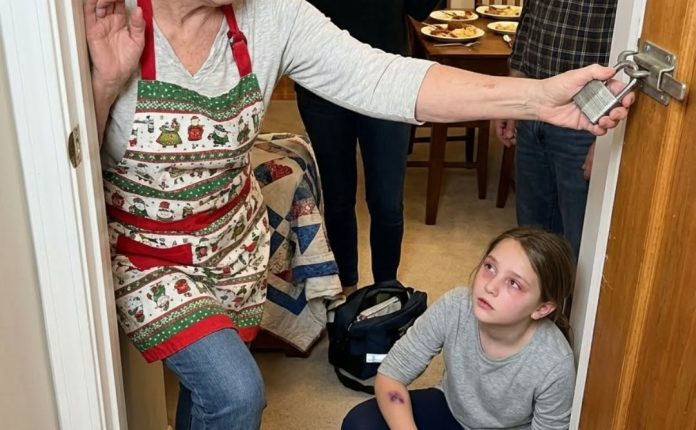
She knocked on the doorframe toward the hallway.
Margaret came back.
Lily pointed toward the cabinet.
Margaret shook her head.
Then she walked away again.
I couldn’t watch anymore.
Daniel could.
He watched every second.
When the recording ended, he sat silently.
Then he asked the officer, “Can I have a copy?”
The officer explained the next steps.
There would be an investigation.
Child protective authorities could become involved because the incident concerned intentional withholding of necessary medication from a minor.
Margaret would no longer be permitted unsupervised contact with Lily while matters were being reviewed.
That last part required no discussion.
She would never be alone with Lily again.
Not while I had any ability to prevent it.
Lily came home the following evening.
For two days, she barely mentioned what happened.
Then, while I was helping her get ready for bed, she asked something that shattered me.
“Was I bad?”
I turned around.
“What?”
“Grandma said I couldn’t have my pump because I was bad.”
I sat beside her.
“No.”
“But I yelled.”
“You can make a mistake and still deserve to be safe.”
She stared at her blanket.
“What if I yell again?”
I took her hand.
“Your medicine is never a punishment.”
She looked at me.
“Never?”
“Never.”
I explained that adults could take away television, toys, or privileges when necessary.
But food, safety, love, and medicine were different.
Those things were not bargaining chips.
Lily nodded slowly.
Then she hugged me.
Three days later, Margaret called Daniel.
He put the conversation on speaker.
She never apologized.
Instead, she blamed me.
According to Margaret, I had “weaponized” Lily’s asthma against her.
Calling 911 had supposedly been unnecessary.
Involving police had been humiliating.
Allowing officers to take her statement had been disrespectful.
Daniel listened quietly.
Then he asked one question.
“Mom, did Lily ask you for her inhaler?”
Margaret hesitated.
“Yes, but—”
“Did you refuse?”
“She needed to calm down.”
“Did you lock it in the cabinet?”
Another pause.
“Yes.”
Daniel closed his eyes.
“Then we’re done.”
Margaret immediately changed tactics.
“You’re cutting your own mother out of your life over one misunderstanding?”
“This wasn’t a misunderstanding.”
“I raised you.”
“And now I’m raising Lily.”
Margaret started crying.
Daniel remained calm.
“You taught me that parents protect their children. That’s exactly what I’m doing.”
Then he ended the call.
The investigation continued.
I won’t pretend it was simple.
There were interviews.
Medical records had to be provided.
We met with a social worker.
Lily spoke with a child specialist.
For weeks, our family lived beneath a cloud created by one terrible afternoon.
Margaret told relatives we had exaggerated everything.
Some believed her.
One uncle called Daniel and said families should resolve problems privately.
Daniel asked him one question.
“If someone intentionally took away your child’s ability to breathe safely, would you keep it private?”
The uncle didn’t answer.
Other relatives surprised us.
Daniel’s older sister, Rebecca, called immediately.
She apologized for not recognizing Margaret’s behavior sooner.
Then she told us something disturbing.
Margaret had always treated essential needs like privileges.
When Daniel was young, she withheld dinner as punishment.
Rebecca remembered having her bedroom door removed for months.
They had normalized it because they were children.
But Lily’s medical condition changed the stakes.
Eventually, authorities concluded that the incident warranted formal intervention.
I won’t pretend that outcome erased what happened.
Nothing could erase Lily’s voice from that phone call.
But something important changed inside our home afterward.
We built safeguards.
Lily now keeps an inhaler in a small medical pouch that remains accessible according to her doctor’s plan.
Her school has updated instructions.
Several trusted adults know exactly what to do during an attack.
Most importantly, Lily knows something she didn’t fully understand before.
She is allowed to ask for help.
Months later, I picked her up from school after art club.
She climbed into the car carrying a drawing.
“Look, Mommy.”
It showed three people holding hands.
Daniel.
Me.
Lily.
Above us, she had drawn an enormous blue sky.
“What’s this?” I asked.
“Our family.”
I smiled.
Then I noticed a small blue object drawn beside her.
“What’s that?”
“My inhaler.”
I laughed softly.
“Why did you draw that?”
She shrugged.
“Because it helps me breathe.”
To Lily, it was simple.
That was exactly what Margaret had failed to understand.
An inhaler wasn’t a privilege.
It wasn’t leverage.
It wasn’t something a frightened child should have to earn through obedience.
It was medicine.