My father curled his hand around Noah’s little plastic spoon, met Ryan’s eyes, and gave him a deadline: by the next day, everything Ryan believed he controlled would be gone.
Ryan actually laughed.
It was short and ugly, the kind of laugh he used when someone had said something he considered too ridiculous to deserve an answer.
“What exactly do you think you’re going to do?” he asked.
Dad didn’t respond to him.
He opened his hand and gave the spoon back to Noah.
Noah closed his fingers around it immediately, then leaned against my side as if he could make himself smaller just by standing close enough to me.
Ryan’s sister was still near the couch with her son, and the new iPad sat on the coffee table between them.
She looked from Dad to Noah.
Then she noticed what Dad had noticed.
The fading mark on Noah’s cheek.
“What happened to his face?” she asked.
Ryan answered before I could.
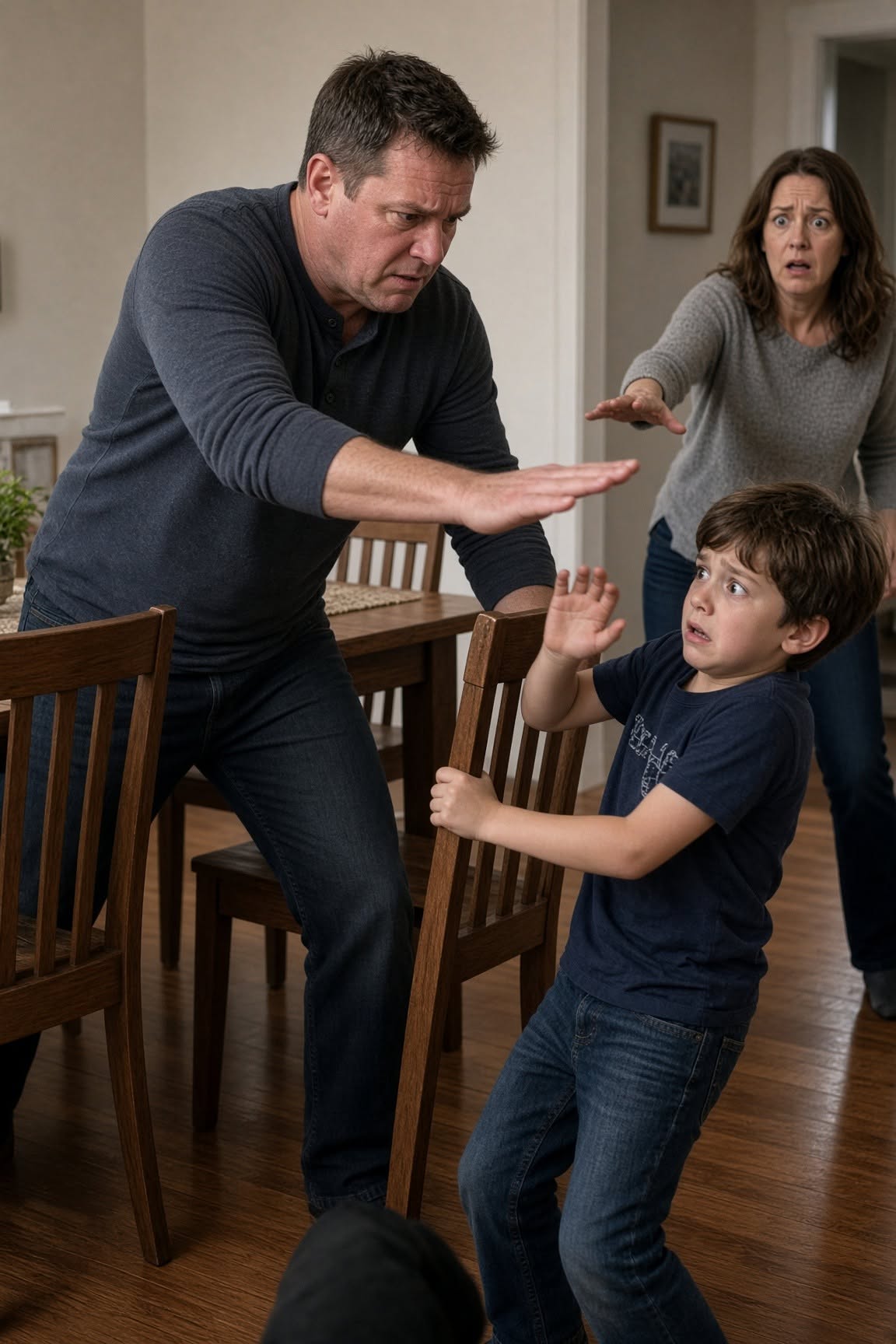
“He got disciplined. That’s all. Everyone needs to stop acting like I beat the kid half to death.”
Noah’s shoulders tightened.
Dad saw it.
So did I.
And for the first time, I understood how much of my marriage I had spent watching Ryan’s reactions instead of Noah’s.
I knew which cupboard door Ryan slammed when a bill irritated him.
I knew how his jaw moved when he thought I had embarrassed him.
I knew when to explain a receipt before he asked and when to keep quiet because an explanation would only make him angrier.
But I had become so practiced at managing Ryan that I had nearly forgotten the question that mattered.
What was Noah learning from watching me do it?
Dad finally looked at me.
“Do you want to stay here tonight?”
Ryan’s head turned sharply.
“She lives here.”
Dad kept his eyes on me.
“That wasn’t my question.”
I looked down at Noah.
He was rubbing the edge of the plastic spoon with his thumb.
He had carried it through the slap, through the night without his cake, and through the afternoon while another child opened a gift worth far more than anything he had asked for.
I thought about the money in my sewing basket.
My money.
Not grocery money Ryan had handed me.
Not household money I had to account for.
Money I had earned one hem, one curtain panel, one repaired school uniform at a time while everyone else slept.
Ryan had taken it because he could.
Then Noah had asked him not to.
And Ryan had hit him.
“No,” I said.
Ryan blinked.
I swallowed and said it again.
“No. I don’t want to stay here tonight.”
Noah looked up at me.
That tiny movement did more to steady me than anything Dad could have said.
Ryan stepped away from the table.
“You’re seriously doing this because I smacked him once?”
His sister stared at him.
“Once?”
Ryan threw up a hand.
“Oh, come on. Don’t start. You have no idea what he’s been like lately. Begging for things. Whining about his birthday. She’s been encouraging it.”
His sister’s eyes dropped to the iPad. Her son was still holding the box it had come in. “He was begging for a cake?” she asked. Ryan exhaled hard. “It wasn’t about the cake. It was the principle.” “And what principle was the iPad?” Ryan didn’t answer. His nephew looked confused now, the excitement from twenty minutes earlier gone. Ryan pointed at his sister. “Don’t drag your kid into my family problems.” She stared at him for a moment, then reached for the gift bag. Her son looked at her. “Mom?” She crouched beside him and spoke quietly enough that none of us missed the care in her voice. “You didn’t do anything wrong. But we’re not keeping a gift that was used to hurt somebody else.” The boy hesitated, then picked up the iPad. He walked over to Ryan. Ryan looked annoyed rather than embarrassed. That told me more than an apology ever could have. His nephew held the box out. “You can take it back, Uncle Ryan.” Ryan didn’t reach for it. The boy kept holding it there. Finally, Ryan snatched the box from his hands and dropped it onto the dining table. The sound made Noah flinch. Dad saw that too. He still didn’t threaten Ryan. He didn’t raise his voice. He simply turned to me and said, “Get what you and Noah need for tonight.” Ryan laughed again, but this time there was strain underneath it. “You think she’s just walking out?” I looked at him. For years, questions like that had worked because I heard the warning inside them. How will you pay for anything? Where will you go? Who will believe you? What happens when the grocery card stops working? What happens when I decide you’ve had enough? But Dad hadn’t told me to fight Ryan. He had asked me what I wanted. That difference mattered. “I’m taking Noah upstairs,” I said. Ryan moved as if he might follow. His sister stepped between the dining room and the hallway. Not dramatically. She simply stood there. “Let her pack.” Ryan stared at her. “You’re taking her side now?” “I’m taking the seven-year-old’s side.” Upstairs, my hands shook so badly that I dropped Noah’s toothbrush twice. He watched me put pajamas, underwear, school clothes, his medication, and his favorite hoodie into his backpack. I grabbed a change of clothes for myself and the folder where I kept our basic household papers. Then I stopped in front of the sewing basket. The lid was still crooked from where Ryan had searched it. For three weeks, that basket had represented something tiny and almost embarrassing to me: a secret attempt to afford a grocery-store birthday cake in a house where there was more than enough money. Now I picked it up too. Noah touched my arm. “Mom?” “Yeah, baby?” “Are we in trouble?” I nearly broke right there. Instead I knelt so we were eye level. “No.” He studied my face as if he needed to be certain. “Am I in trouble?” “Noah, you are not in trouble for wanting a birthday cake.” His mouth trembled once. Then he nodded. Downstairs, Ryan was pacing beside the dining table when we returned. The iPad was still sitting where he had dropped it. His sister had already put her son’s jacket on him. Ryan looked at my bag. “This is insane.” I said nothing. “You’re going to run to Daddy because you got your feelings hurt?” Nothing. “And when you need money tomorrow?” There it was. Not Noah. Not the bruise. Not even an apology. Money. The thing Ryan believed ended every argument because eventually every road led back to him. Dad opened the front door. Cold evening air moved into the entryway. “Come on,” he said to Noah. Noah took my hand instead. We walked out together. Ryan called my name from behind us. I kept moving. He called again. I kept moving. He said I would regret embarrassing him. I kept moving. But when we reached Dad’s car, Noah suddenly stopped. He pulled his hand from mine and reached into his pocket. For one horrible second, I thought he wanted to go back. Instead, he checked for the spoon. When he felt it, his shoulders loosened. Then he climbed into the back seat. That night at Dad’s house, Noah fell asleep on the couch before nine. Dad covered him with an old throw blanket and sat across from me at the kitchen table. He didn’t ask why I had stayed with Ryan so long. He didn’t tell me what I should have done years earlier. He asked me something much harder. “Does Ryan control all the money?” I told him about the Monday transfers. The grocery limits. The receipts. The questions over five dollars. The sewing. The cash Ryan took. Dad listened without interrupting. When I finished, he asked whether I could access my own earnings. “The sewing money, yes. If I make more.” “Then start there.” It wasn’t a rescue speech. It was a practical instruction. The next morning, I opened an account in my own name and arranged for future sewing payments to go somewhere Ryan could not monitor through the household balance. I photographed the records I already had access to: the fixed household deposits, the messages demanding explanations for ordinary spending, and the texts Ryan had sent after we left. Those texts changed by the hour. First came anger. Then promises. Then blame. Then another promise. At one point he wrote that he had only been trying to teach Noah gratitude. At another, he accused me of turning our son against him. I read each message once and saved it. I did not argue with him about what had happened. Noah’s cheek did that for me. By late morning, Ryan finally asked the question I knew was coming. “When are you coming home?” I looked through the kitchen doorway. Noah was sitting at Dad’s small table drawing seven candles on a piece of printer paper. Not six. Not eight. Seven. I typed my answer. “We aren’t coming home today.” Ryan called immediately. I let it ring. Dad glanced at the phone but didn’t touch it. That mattered too. He wasn’t replacing Ryan’s control with his own. The choice stayed mine. Around lunchtime, Ryan’s sister came by. She carried no iPad. She brought Noah a birthday card from his cousin and a plain envelope containing the sewing money Ryan had taken from me. I stared at it. “Where did you get this?” “Ryan gave it to me last night,” she said. “He told me to give it back so everyone would stop acting dramatic.” I almost laughed at the wording. Even returning stolen money had become, in Ryan’s version, proof of everyone else’s unreasonable behavior. His sister looked embarrassed. “I should have noticed more,” she said. I didn’t make her explain. She had seen enough the day before to make her own decision. Before leaving, she asked Noah what kind of cake he wanted. He looked at me first. Old habit already. Checking. Waiting to see whether wanting something was allowed. I smiled. “Tell her.” “Chocolate,” he said softly. Then, with a little more confidence, “With seven candles.” She nodded. “Sounds good.” After she left, Dad pushed the returned bills across the table toward me. “What are you going to do with those?” Three days earlier, I would have said save them. Two days earlier, I would have hidden them. The day before, I would have been terrified Ryan would find them. Now I folded the money and put it in my wallet. “I’m buying my son a cake.” Dad smiled for the first time since he had walked into our house. That afternoon, Noah came with me. We didn’t order anything elaborate. We chose a small chocolate cake from the grocery-store bakery, the exact kind he had wanted all along. He picked the candles himself. At the register, I paid from my own wallet. No explanation. No receipt inspection. No mental calculation about how I would justify a few dollars missing from the grocery account. It felt strange that such an ordinary thing could make my hands shake. Back at Dad’s kitchen, Noah set his plastic spoon beside his plate before anyone even cut the cake. His grandfather noticed but didn’t say anything. We put seven candles on top. No giant party. No expensive decorations. No tablet. Just cake, candles, his cousin’s birthday card, and people who understood that a child asking to be celebrated was not an act of greed. When I lit the candles, Noah stared at them with an expression I will never forget. He looked happy, but cautious. As if somebody might still walk in and tell him he had asked for too much. I sat beside him. “Go ahead.” “All of them?” “All seven.” He blew them out. Dad clapped once, then stopped himself when Noah laughed. It was the first real laugh I had heard from my son since the slap. Ryan spent that day calling what had happened an overreaction. He still had his company. He still had his expensive SUV. He still had the big house everyone else thought meant we were lucky. Dad’s warning had never been about making those things vanish overnight. Ryan had mistaken possessions for security for so long that he could not imagine another kind of loss. By the end of that next day, his wife was no longer afraid to leave his house. His son was no longer waiting for his permission to have a birthday cake. His sister had stopped helping him pretend the iPad was generosity. And the money he had used to control every ordinary choice had failed to bring any of us back. Dad had not taken Ryan’s power away. He had simply recognized before I did that Ryan’s power depended on me believing I had nowhere else to go. Once that belief was gone, the rest began to change. There were still difficult conversations ahead. There were still practical decisions about money, parenting, housing, and what contact with Ryan would look like. I did not pretend one night away had solved years of control. But I also stopped measuring progress by whether Ryan understood or approved of it. I started sewing again at Dad’s kitchen table. This time, I didn’t hide the payments in a basket. Noah sometimes sat near me doing homework while I worked. The plastic spoon stayed in the silverware drawer even though it didn’t match anything else. I could have thrown it away. I never did. For Noah, it eventually became just a spoon. For me, it marked the day I finally understood the difference between being provided for and being controlled. Weeks later, when I opened that drawer, I found Noah had used it to eat the last piece of leftover chocolate cake straight from the container. He looked up at me, frosting on the corner of his mouth. For a second, he seemed worried that I might be upset. Then I handed him a napkin. “Finish it before it gets dry.” His face relaxed. And he did.