By the time Andrew was headed toward the hospital, I had already stopped thinking of him as the man I needed beside me.
He was coming to Katie’s room as my husband, yes. As her stepfather. As the person who had spent years sitting at our kitchen table, carrying groceries through our front door, and acting like he belonged inside every ordinary part of our lives.
But now he was also the man my ten-year-old daughter said had been behind the wheel of the SUV that struck her and left her in the road.
And I knew something else before he ever reached the hospital.
I was done protecting him from the truth.
Katie slept beside me, her small hand resting on top of the blanket. The monitor kept its steady rhythm. The room smelled faintly of sanitizer and cold coffee, and the vinyl chair beneath me felt like it had molded itself permanently into my back.
I had been sitting there so long that time had stopped feeling normal.
Hours were measured by nurses entering the room, the monitor changing tones, paper cups being replaced, and Katie opening her eyes for a few seconds before exhaustion pulled them closed again.
The night before, I had thought the worst thing in my life was not knowing whether my daughter would wake up.
Then she did.
And the first truth she gave me changed everything.
“Mom… Andrew did it.”
At first, I thought I had misunderstood her.
Her voice was weak. Barely above a whisper.
I leaned closer to the bed until my face was only inches from hers.
“Did what, sweetheart?”
Katie’s eyes opened wider.
Not confused.
Not drifting.
Focused.
“He was driving.”
For a second, my mind refused to connect those words to anything real.
Andrew drove us everywhere.
The grocery store. School pickups when my schedule ran late. Weekend errands. Family visits.
Our SUV was so ordinary to me that I could picture every detail without trying: the cup holders, the worn spot near the driver’s door, the things we always seemed to leave in the back.
Katie knew it too.
She told me she recognized the SUV before she fully recognized Andrew.
She remembered seeing it coming toward her.
She remembered the impact.
Then she remembered Andrew stepping out.
That was the detail I could not push away.
He got out.
He saw her.
According to Katie, he said her name.
A stranger could have panicked.
A stranger might have driven away without understanding who was lying behind them.
But Katie said Andrew stood there looking directly at her.
Then he got back into the SUV and left.
I wanted there to be another explanation so badly that my first instinct was to question my own child.
“Are you sure it was him?” I asked.
Katie squeezed my hand.
“He looked right at me, Mom.”
That was enough.
I stopped asking her to prove what she remembered.
She was ten years old, lying in intensive care after being hit by a vehicle, and somehow I had nearly made her carry the additional burden of convincing me that she knew her own stepfather.
I sat there holding her hand while years of small moments rearranged themselves in my head.
Things I had dismissed.
Things I had excused.
Things I had called family tension because that phrase sounded easier than admitting how often I was expected to surrender my judgment just to keep everybody comfortable.
The house key in my purse suddenly felt heavier than metal should.
Only the night before, my mother-in-law had been angry that I would not leave Katie’s bedside to help with her birthday celebration.
My daughter was in the ICU.
And somehow I had still been treated like the unreasonable one.
Come home.
Cook.
Stop making everything dramatic.
Then came the threat.
If I refused, I should not expect my house key to work when I returned.
At the time, I had been too exhausted and too terrified for Katie to argue about it properly.
I remember staring at the key and thinking how ridiculous the whole fight was.
My child was fighting to recover, and my mother-in-law was turning access to my own home into leverage over a birthday dinner.
For years, I had labeled comments like that as difficult-family behavior.
I told myself she was controlling because she cared too much.
I told myself Andrew was caught between his wife and his mother.
I told myself every family had problems.
But after Katie spoke, those old explanations sounded thin.
Control was still control even when somebody called it concern.
A threat was still a threat even when it came from family.
And a man asking for silence after his stepdaughter woke up with a memory was not behaving like a worried father.
I picked up my phone and called Andrew.
He answered on the third ring.
“Where are you?” I asked.
“At Mom’s.”
His voice sounded normal.
That almost made it worse.
I looked at Katie while I asked the next question.
“Did you drive our SUV yesterday?”
There was a pause.
Not long.
But long enough that I noticed it.
Then Andrew laughed once.
“What kind of question is that?”
I did not answer him directly.
“Katie woke up.”
The laugh disappeared from his voice.
I told him she remembered the car.
That was all.
I did not say Katie had named him.
I did not tell him she had described him getting out.
I did not tell him she remembered him looking at her or saying her name.
I gave him almost nothing.
Andrew filled the silence himself.
He started telling me why Katie might be wrong.
Children got confused after accidents, he said.
Medication could affect memory.
People remembered things incorrectly after trauma.
He kept explaining possibilities I had not asked him to explain.
And as I listened, one thought became impossible to ignore.
Why was he defending himself before I had accused him?
I had only said she remembered the vehicle.
I had not said she remembered the driver.
Yet Andrew was already trying to weaken her credibility.
Then he asked me something that changed the entire call.
“Has Katie talked to anyone else?”
I looked toward the bed.
Her eyes had closed again.
Her fingers remained curled against the blanket.
I could hear the monitor behind me.
“No,” I said.
Andrew exhaled.
It was not the sound of a father asking whether his injured stepdaughter was frightened.
It was not the sound of a man desperate to know whether she was okay.
It sounded like relief.
Then he gave me an instruction.
“Keep Katie quiet. Don’t let her talk to anyone until I get there.”
I stared at the phone.
There are sentences that do not feel dangerous until you hear them from the wrong person at exactly the wrong moment.
That was one of them.
Keep Katie quiet.
Not comfort her.
Not tell her he loved her.
Not ask whether she needed anything.
Keep her quiet.
I looked at the house key again.
The night before, his mother had used that key as a threat to make me leave my daughter’s bedside.
Now Andrew was using his role as my husband to tell me what my daughter should and should not say.
Two different people.
The same expectation.
Obey first.
Question later.
I did not argue with him.
For once, I did not try to explain my feelings in a way he might accept.
I did not tell him his question sounded suspicious.
I did not tell him Katie had already said his name.
I simply listened until the call ended.
Then I walked back fully into Katie’s room and sat down beside her.
Something inside me had shifted.
For years, whenever Andrew or his mother became angry with me, I automatically examined myself first.
Had I overreacted?
Had I misunderstood?
Had I embarrassed them?
Could I have said it more gently?
Could I have waited?
Could I have kept the peace?
That habit had become so normal that I barely noticed I was doing it.
Even while Katie lay in the ICU, part of me had still been vulnerable to being called dramatic.
That realization made me feel sick.
My daughter had been hit by a vehicle.
She had opened her eyes and identified the man she believed was driving.
And I was still carrying years of training that told me everybody else’s comfort had to be considered before my own judgment.
Not anymore.
Katie moved slightly under the blanket.
I reached for her hand again.
She was weak, but when her eyes opened, she knew me.
She knew where she was.
And she knew what she had seen.
I did not need to turn her hospital room into an interrogation.
I did not need to make her repeat every detail until she was exhausted.
I needed to be her mother.
That meant listening.
That meant staying.
That meant refusing to let anybody pressure her into silence simply because the truth might destroy the version of our family we had been pretending was stable.
My phone buzzed again.
I expected Andrew.
It was his mother.
Her message was not about Katie.
She did not ask if Katie had improved.
She did not ask whether my daughter had opened her eyes.
She wanted to know when I was coming home.
I stared at the words for several seconds.
Then another message arrived.
The wording made it clear Andrew had already spoken to her about something.
I did not know exactly what he had told her.
But I knew enough to understand that while I was sitting beside an injured child, they were already discussing the situation between themselves.
That familiar old pressure returned for half a second.
Answer quickly.
Smooth it over.
Explain yourself.
Make sure nobody is angry.
Then I looked at Katie.
No.
For years, I had protected adults from uncomfortable feelings.
I had changed plans to avoid arguments.
I had swallowed comments because fighting back would ruin dinner, a weekend, a holiday, a family gathering.
I had treated their reactions like emergencies.
Now I was sitting beside an actual emergency.
The difference could not have been clearer.
Katie needed me more than they needed obedience.
That truth was painfully simple.
I left the messages unanswered and kept my attention on the bed.
The room continued around us.
Footsteps passed in the corridor.
A cart rolled somewhere outside.
The monitor kept counting out the seconds.
Katie slept.
I watched her breathe and thought about Andrew’s question.
Has Katie talked to anyone else?
I replayed it until every word felt sharp.
If he believed Katie was simply confused, why was that his concern?
If he believed her memory could not be trusted, why did he care who heard it?
If he was innocent, why had he responded to news that she remembered the SUV by immediately attacking her memory?
I did not need to answer those questions aloud yet.
His behavior had already changed what I believed.
And once that happened, other memories started surfacing.
Not evidence.
Not proof of what Katie said happened.
Just the emotional pattern of our marriage.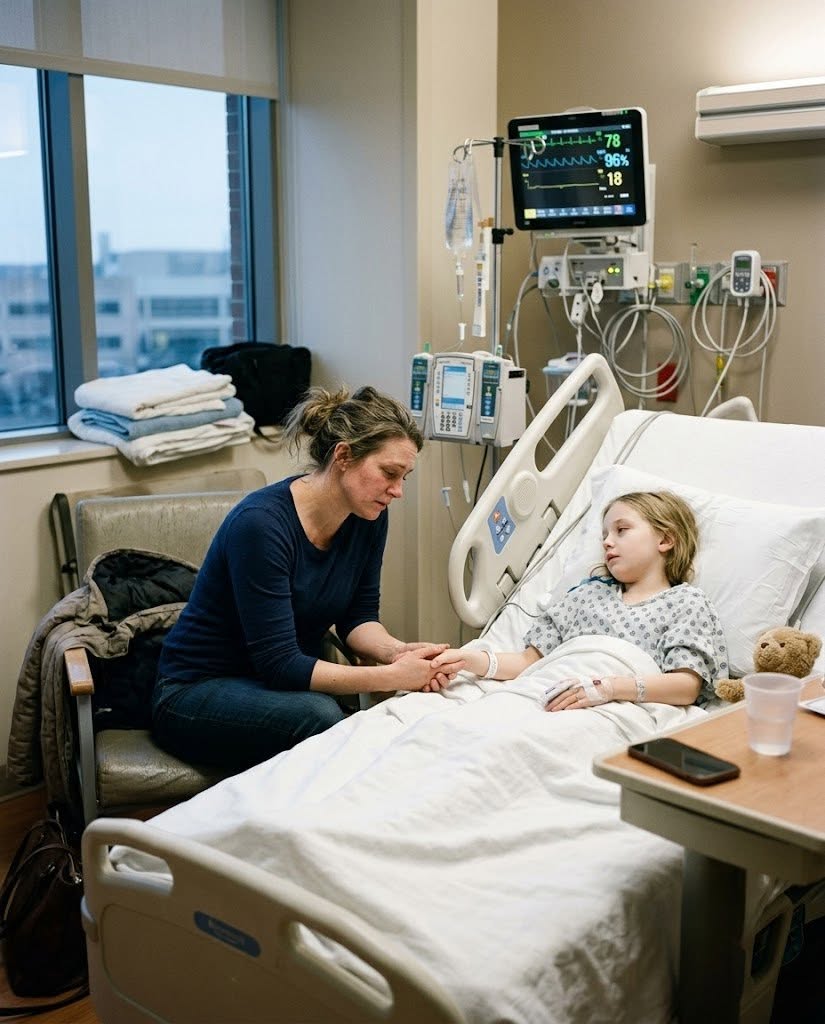 How often I had been told I was overthinking.
How often tension disappeared only after I gave in.
How easily Andrew could make a disagreement feel like a flaw in my personality instead of a conflict between two people.
For a long time, I had thought endurance was part of marriage.
Compromise.
Patience.
Picking your battles.
All of those things can be real.
But somewhere along the way, I had stopped noticing how often I was the only person expected to practice them.
I looked at my daughter and felt ashamed of how much space I had given that pattern inside our home.
Not because I had known something like this would happen.
I had not.
But because Katie had been watching what I tolerated.
Children notice which person apologizes first.
They notice who gets to raise their voice.
They notice who controls the mood of a room.
They notice when a mother changes her plans because somebody else threatens consequences.
Now Katie was lying in a hospital bed telling me something that could tear our family apart.
And I had one job.
Believe that she deserved to speak.
My phone remained in my hand.
I thought about calling Andrew back and confronting him immediately.
Part of me wanted to hear him explain the entire thing.
I wanted a sentence that would make everything impossible somehow become reasonable.
Maybe Katie had seen the SUV but mistaken the driver.
Maybe Andrew had some explanation for why he sounded relieved when I said she had not spoken to anyone.
Maybe there was some answer that would return us to yesterday morning, before the hospital, before the ICU, before those four words changed the shape of my marriage.
But wishing for an explanation was not the same as having one.
So I did not chase him for reassurance.
I stayed where I was.
That choice felt small from the outside.
It was only a mother sitting beside her child.
But for me, it was the first time in years that I refused to leave the place I knew I belonged simply because Andrew’s family wanted something else.
The birthday dinner could happen without me.
The house could stay locked if his mother followed through on her threat.
Andrew could be angry that I had not obeyed him.
None of those things mattered more than Katie.
The key in my purse was no longer a symbol of whether I was welcome in that house.
It was just a key.
Metal.
Replaceable.
My daughter was not.
Katie woke briefly again and looked toward me.
I leaned closer.
“You’re here,” she whispered.
“I’m here.”
That was all I said.
No speeches.
No promises I could not make.
I just tightened my hand around hers.
Her eyes closed again.
Mine stayed open.
Somewhere between that moment and the next buzz of my phone, I realized I no longer cared whether Andrew thought I was dramatic.
I cared whether Katie felt safe enough to tell the truth.
Those were not the same thing.
They had never been the same thing.
My screen lit up with another notification.
Then another.
I ignored both.
Andrew had said he was coming.
That knowledge sat in the room with me even though he was not there yet.
I pictured him walking through the hospital door expecting the same version of me he had spoken to on the phone.
The wife who explained too much.
The woman who softened hard questions so nobody felt accused.
The person who could be pressured with family disapproval, a ruined birthday, or a threat about a house key.
That woman had been sitting in the vinyl chair when Katie first opened her eyes.
But she was changing quickly.
Not because I had suddenly become fearless.
I was terrified.
If Katie’s memory was right, then the man I had married had left her after hitting her.
If Andrew understood what she remembered, then his first instinct had not been concern.
It had been control.
And if his mother already knew enough to begin applying pressure before he even reached the hospital, I could no longer treat their behavior as separate little family disputes.
I did not know exactly what Andrew would say when he arrived.
I did not know whether he would deny everything, blame Katie’s medication, or accuse me of turning against him.
I did not know what his mother had been told.
I did know one thing.
I was not leaving Katie’s bedside to make anybody comfortable.
I was not telling my daughter to stay quiet.
And I was not going to pretend Andrew’s reaction on the phone had sounded normal.
The hospital corridor outside the room grew busier.
Every set of footsteps made me glance toward the doorway.
A nurse passed.
Then someone pushing a cart.
Then another family moved quietly down the hall.
Not Andrew.
Not yet.
I looked at the key once more before putting it back into my purse.
The night before, my mother-in-law had tried to make that small piece of metal feel like power.
Come home or lose access.
Obey or be shut out.
But sitting beside Katie, I finally understood how little that threat mattered compared with what was happening in front of me.
A house could be entered through another door.
Locks could be changed.
Things could be packed.
Plans could be rewritten.
But a child who had trusted me enough to wake up and tell me the truth needed to know her mother would not trade that trust for peace at a birthday table.
I reached over and adjusted the edge of Katie’s blanket.
Then I put my phone face down.
Andrew was still on his way.
He thought he was coming to control what Katie said next.
What he did not know was that the silence he expected from me had already ended.
How often I had been told I was overthinking.
How often tension disappeared only after I gave in.
How easily Andrew could make a disagreement feel like a flaw in my personality instead of a conflict between two people.
For a long time, I had thought endurance was part of marriage.
Compromise.
Patience.
Picking your battles.
All of those things can be real.
But somewhere along the way, I had stopped noticing how often I was the only person expected to practice them.
I looked at my daughter and felt ashamed of how much space I had given that pattern inside our home.
Not because I had known something like this would happen.
I had not.
But because Katie had been watching what I tolerated.
Children notice which person apologizes first.
They notice who gets to raise their voice.
They notice who controls the mood of a room.
They notice when a mother changes her plans because somebody else threatens consequences.
Now Katie was lying in a hospital bed telling me something that could tear our family apart.
And I had one job.
Believe that she deserved to speak.
My phone remained in my hand.
I thought about calling Andrew back and confronting him immediately.
Part of me wanted to hear him explain the entire thing.
I wanted a sentence that would make everything impossible somehow become reasonable.
Maybe Katie had seen the SUV but mistaken the driver.
Maybe Andrew had some explanation for why he sounded relieved when I said she had not spoken to anyone.
Maybe there was some answer that would return us to yesterday morning, before the hospital, before the ICU, before those four words changed the shape of my marriage.
But wishing for an explanation was not the same as having one.
So I did not chase him for reassurance.
I stayed where I was.
That choice felt small from the outside.
It was only a mother sitting beside her child.
But for me, it was the first time in years that I refused to leave the place I knew I belonged simply because Andrew’s family wanted something else.
The birthday dinner could happen without me.
The house could stay locked if his mother followed through on her threat.
Andrew could be angry that I had not obeyed him.
None of those things mattered more than Katie.
The key in my purse was no longer a symbol of whether I was welcome in that house.
It was just a key.
Metal.
Replaceable.
My daughter was not.
Katie woke briefly again and looked toward me.
I leaned closer.
“You’re here,” she whispered.
“I’m here.”
That was all I said.
No speeches.
No promises I could not make.
I just tightened my hand around hers.
Her eyes closed again.
Mine stayed open.
Somewhere between that moment and the next buzz of my phone, I realized I no longer cared whether Andrew thought I was dramatic.
I cared whether Katie felt safe enough to tell the truth.
Those were not the same thing.
They had never been the same thing.
My screen lit up with another notification.
Then another.
I ignored both.
Andrew had said he was coming.
That knowledge sat in the room with me even though he was not there yet.
I pictured him walking through the hospital door expecting the same version of me he had spoken to on the phone.
The wife who explained too much.
The woman who softened hard questions so nobody felt accused.
The person who could be pressured with family disapproval, a ruined birthday, or a threat about a house key.
That woman had been sitting in the vinyl chair when Katie first opened her eyes.
But she was changing quickly.
Not because I had suddenly become fearless.
I was terrified.
If Katie’s memory was right, then the man I had married had left her after hitting her.
If Andrew understood what she remembered, then his first instinct had not been concern.
It had been control.
And if his mother already knew enough to begin applying pressure before he even reached the hospital, I could no longer treat their behavior as separate little family disputes.
I did not know exactly what Andrew would say when he arrived.
I did not know whether he would deny everything, blame Katie’s medication, or accuse me of turning against him.
I did not know what his mother had been told.
I did know one thing.
I was not leaving Katie’s bedside to make anybody comfortable.
I was not telling my daughter to stay quiet.
And I was not going to pretend Andrew’s reaction on the phone had sounded normal.
The hospital corridor outside the room grew busier.
Every set of footsteps made me glance toward the doorway.
A nurse passed.
Then someone pushing a cart.
Then another family moved quietly down the hall.
Not Andrew.
Not yet.
I looked at the key once more before putting it back into my purse.
The night before, my mother-in-law had tried to make that small piece of metal feel like power.
Come home or lose access.
Obey or be shut out.
But sitting beside Katie, I finally understood how little that threat mattered compared with what was happening in front of me.
A house could be entered through another door.
Locks could be changed.
Things could be packed.
Plans could be rewritten.
But a child who had trusted me enough to wake up and tell me the truth needed to know her mother would not trade that trust for peace at a birthday table.
I reached over and adjusted the edge of Katie’s blanket.
Then I put my phone face down.
Andrew was still on his way.
He thought he was coming to control what Katie said next.
What he did not know was that the silence he expected from me had already ended.