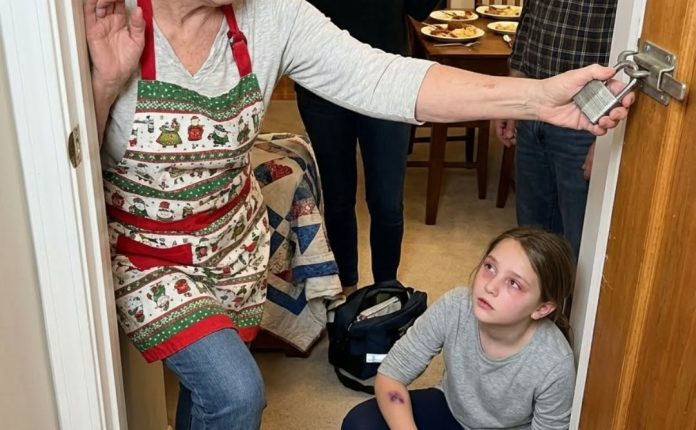
Joan skipped hello and went straight to telling me what I needed to fix.
She did not ask about Olivia.
She did not ask whether my daughter had slept, whether she was scared, or whether she had finally stopped blaming herself for being turned away from her grandparents’ home after a tornado.
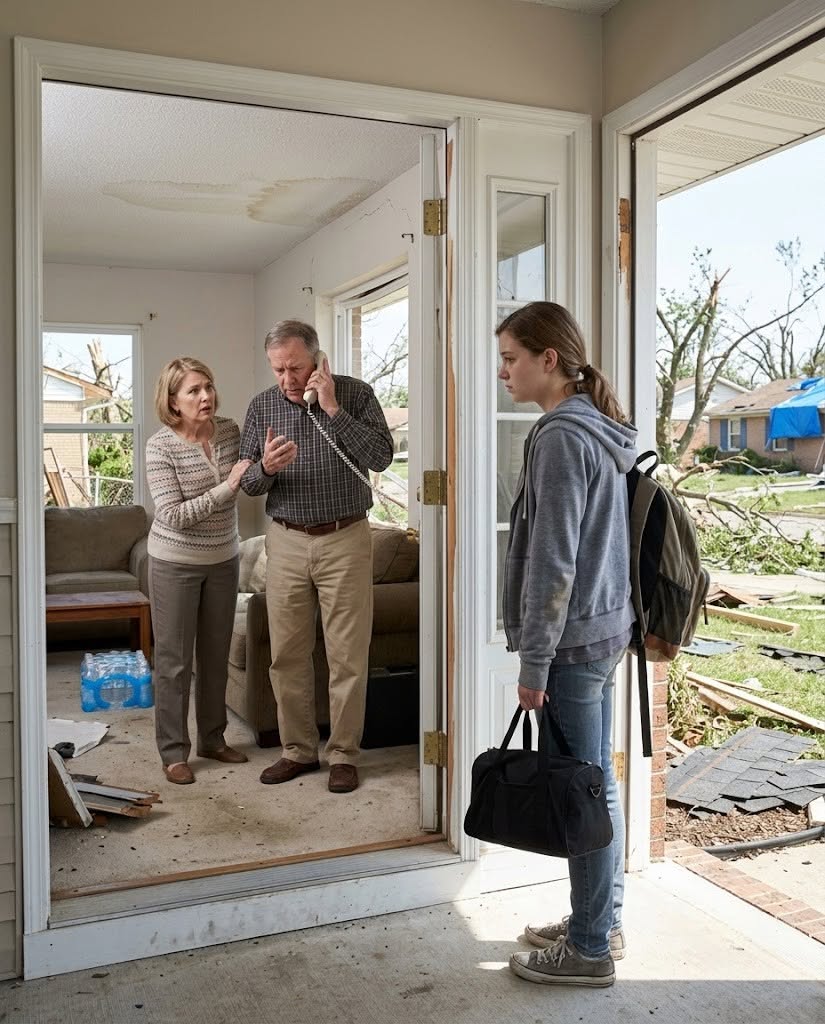
Joan wanted the money problem solved.
I sat at the kitchen table with my phone against my ear and my laptop open in front of me. Across from me, Olivia kept her eyes on her homework, but I knew she was listening.
Her pencil had stopped moving.
That tiny detail mattered more to me than anything Joan was saying.
For years, I had listened to my family explain why their emergencies deserved my attention.
Now my sixteen-year-old daughter was sitting three feet away, waiting to hear whether I would finally treat what happened to her like it mattered.
“Joan,” I said, “before we talk about anything else, I want to ask you one question.”
She exhaled sharply.
I could hear the impatience in it.
“What?”
“Did you know Olivia was coming to Mom and Dad’s house after the tornado?”
There was a pause.
Not a long one.
Just long enough.
“Yes,” she said. “But you know how crowded it is here.”
I looked at Olivia.
Her shoulders tightened.
That house had been crowded for years.
Joan and her three children had lived there rent-free for years.
There had always been room for one more grocery bag, one more school backpack, one more birthday gift, one more favor, one more expense that somehow landed in my lap.
But when my daughter arrived during a disaster with a suitcase in her hand, suddenly capacity had become a principle.
“I know exactly how crowded it is,” I said.
Joan started talking faster.
She said everyone had been stressed.
She said Mom had been overwhelmed.
She said Dad was worried about the house.
She said Olivia could have called someone else sooner.
That last part almost made me interrupt her.
Almost.
Instead, I let her finish.
Because that was something I had learned too late about my family: if I waited long enough, they often explained the truth while trying to escape it.
Olivia had called someone else.
Me.
Her mother.
From outside the house where I had specifically sent her for safety.
She had called while I was inside an emergency department filled with people injured by the same storm that had damaged our home.
I could still remember exactly how her voice sounded.
Small.
Careful.
Almost apologetic.
“Mom, I’m outside Grandma’s house.”
At first, I had thought she meant she had just arrived. Then she told me they would not let her in. She had knocked. She had rung the bell. She had waited near the front of the house with her suitcase while my mother stayed on the other side of the door. And then my mother had told her there was no room. I had spent that day moving through a hospital where strangers were making space for strangers. Chairs had been pushed together. Hallways had become waiting areas. Staff members who had barely slept were finding blankets, chargers, cups of water, and places for families to sit. Nobody pretended it was convenient. It was an emergency. You made room because someone needed it. That was why my mother’s words hit me the way they did when I finally called her. “We are not operating a charity.” She had said it about my daughter. Her granddaughter. A sixteen-year-old girl standing outside after a tornado. I had not yelled. I had not threatened anyone. I called my aunt Cindy. Before I could finish explaining, she told me she was leaving to get Olivia. “Tell her she can stay here as long as she needs,” Cindy said. That sentence did more than solve the immediate problem. It showed me something I had spent years avoiding. People who want to help do not always need a committee meeting first. Sometimes they just get in the car. Only after Olivia was safe did I confront my mother. Even then, my mother minimized it. She told me I made things sound more serious than they were. She acted as though Olivia had experienced an inconvenience instead of rejection during a disaster. I finished my shift carrying that conversation around in my head. When I finally got home, Eric was waiting at the kitchen table. I told him what my parents had done. He already knew. He had spoken with Olivia. Then he told me the part that changed the shape of my anger. Olivia had asked whether I was angry with her. Not with them. With her. She thought she might have done something wrong by arriving at the house I told her to go to. She thought the locked door might have been something she caused. That was the moment the situation stopped being a family argument in my mind. It became a parenting decision. I could not control whether my parents understood what they had done. I could not force Joan to care. I could not make anyone apologize sincerely. But I could control what I continued supporting. So I opened my laptop. I reviewed the commitments I had carried for years. The monthly allowance I sent my parents. The help with their mortgage. The tuition assistance I had promised for Joan’s oldest daughter. I did not cancel those payments because I wanted anyone to suffer. I stopped because I finally saw what my money had been doing to me. It had turned generosity into obligation. Every time I rescued someone, they adjusted their lives around the assumption that I would rescue them again. Then my help stopped looking like help. It started looking like something they owned. And somehow, while I was making sure everyone else had enough, my own daughter had become the person expected to understand why there was nothing available for her. So I ended the transfers. No dramatic announcement. No group message. No speech. I simply stopped financing relationships that had become one-directional. The next morning, Olivia came home. She set her bag down and looked at me with the expression I had been dreading. “Mom… are you angry with me?” I walked straight to her. “No,” I said. “Never with you.” Then I held her. I told her she had done exactly what I asked. I told her adults had failed her, not the other way around. And I promised her something I should have made clear much earlier. She would never again have to stand outside someone’s home and beg them to decide whether she was worth making space for. After that, I expected questions from my family. I expected at least one message asking how Olivia was doing. None came. Not that day. Not the next. For two weeks, nobody asked about her. Then the missing money began to register. My mother texted first. Did you forget the transfer? My father called because of the mortgage notice. Joan contacted me about her daughter’s tuition payment. It was almost impressive how quickly they noticed what had disappeared from their accounts compared with how slowly they noticed what had happened to Olivia. Soon the messages changed tone. My mother said family should forgive. Joan accused me of destroying everyone over one misunderstanding. My father insisted Olivia had never truly been in danger. That sentence stayed with me. Our home had been damaged by a tornado. I had sent my daughter somewhere I believed was safe. She had been refused entry. Whether she eventually found shelter did not erase the decision they made before that happened. Safety is not proven by the fact that someone else eventually steps in. Olivia sat across from me doing homework while the messages kept arriving. I tried not to react visibly. She tried not to watch me react. We were both pretending the phone was just a phone. Then another message appeared. “After everything we have done for you, you owe us.” I read it twice. That was when I turned back to my laptop. Over the years, I had kept records. Not because I expected a fight. Because I was the organized one. When my parents needed something paid, I kept the confirmation. When Joan needed help, I saved the messages. When money was described as a loan, a favor, temporary assistance, or something that would be handled later, I kept the related documents together. It was ordinary recordkeeping. Until suddenly it was not. I opened the password-protected folder. Inside were years of transfers, agreements, payment records, and messages tied to favors my family had gradually started treating like permanent rights. Joan called while I was looking through them. I let the phone ring once. Then twice. Instead of answering immediately, I selected the first document I knew they had stopped thinking about a long time ago. That was the moment everything narrowed. Not because I was planning revenge. Because I finally understood that memory had been doing too much work in our family. Everyone remembered what they had done for me. Nobody seemed able to remember what I had done for them. And whenever the two versions collided, I was expected to stay quiet so the family could remain comfortable. I had done that for years. I had smoothed things over. I had paid bills without embarrassing anyone. I had stepped in without announcing it. I had avoided keeping score because I thought keeping score made love smaller. But there is a difference between keeping score and keeping facts. Facts mattered now because my daughter was watching. She had watched adults tell her there was no room. She had watched those same adults become furious when financial support disappeared. And now she was watching me decide whether their anger would be enough to make me retreat. Joan’s call stopped. Then started again. This time I answered. And that brought me back to the kitchen table, with Olivia’s pencil motionless across from me and Joan telling me what needed to be fixed. I listened until she finally ran out of momentum. Then I asked, “Have you talked to Olivia?” Joan hesitated. “That’s not what this is about.” There it was. The whole problem in one sentence. To Joan, the tuition payment was separate from the way Olivia had been treated. To my parents, the mortgage help was separate. The allowance was separate. The years of favors were separate. They wanted every benefit of family to remain untouched while every responsibility of family became negotiable. I could not make that arrangement make sense anymore. “It is exactly what this is about,” I said. Joan told me I was punishing her daughter for something she had not done. That accusation hurt because there was truth inside it. Her daughter had not turned Olivia away. She had not told my child there was no room. And I did not want another young person dragged into an adult conflict. So I chose my words carefully. “I’m not asking your daughter to apologize for you,” I said. “But I am no longer able to carry financial commitments for everyone else as though nothing happened.” Joan said I had already promised. I looked at the document open on my screen. That was exactly why I had opened the folder. Promises had details. Arrangements had terms. Money had dates. And years of family storytelling could not change what had actually been said, paid, or agreed to. I did not start reading documents aloud. I did not threaten her with them. I simply stopped accepting the idea that I owed everyone indefinite support because I had once chosen to help. Joan called me selfish. A year earlier, that word would have worked. I would have spent the rest of the night wondering whether I had gone too far. I would have tried to find a compromise before anyone had even acknowledged hurting my daughter. But Olivia was still sitting across from me. That changed the math. I was not trying to prove that I was generous anymore. I was trying to prove to my daughter that boundaries did not disappear just because relatives became angry. “Is Grandma mad at me?” Olivia asked after I ended the call. I closed the laptop. “She’s upset with me,” I said. Olivia looked down. I knew that look now. She was trying to collect responsibility that did not belong to her. So I stopped it before it could settle. “This is between the adults,” I told her. “You are not responsible for anybody’s bills, anybody’s arguments, or anybody’s reaction to what happened.” She nodded, but sixteen-year-olds do not erase hurt because a parent gives them the correct sentence once. So we kept living. Eric made dinner. Olivia went back to schoolwork. I returned to the hospital. Our damaged home still needed attention. The town was still recovering. Real problems continued existing whether my family was angry with me or not. That helped more than I expected. For years, their crises had always felt like the biggest thing in the room. Now I could see them in proportion. My mother could send an angry text, and I could still finish my shift. My father could complain about money, and I could still sit beside Olivia while she worked through an assignment. Joan could call me cruel, and I could still remember who had opened a door for my daughter when it mattered. Aunt Cindy never asked for praise. She had simply gone to get Olivia. That remained the clearest contrast in the whole story. One part of my family had spent years receiving help and still measured compassion by convenience. Another relative heard that a sixteen-year-old was stranded outside after a tornado and reached for her keys. I did not need a speech to understand the difference. Over the next several days, I reviewed the folder carefully. Not to build a weapon. To make sure I understood my own obligations before anyone else told me what they were. That distinction gave me more peace than I expected. I realized how often I had agreed to help without creating an endpoint because asking for one felt rude. I had confused clarity with coldness. I had been afraid that boundaries would make me less loving. Instead, the absence of boundaries had made my help invisible. It had become part of the furniture. Useful. Expected. Rarely acknowledged unless it disappeared. My parents continued trying to frame the tornado night as a misunderstanding. I stopped debating the label. Calling it a misunderstanding did not change where Olivia had been standing. Calling her safe afterward did not unlock the door retroactively. Calling me unforgiving did not create an apology. I no longer needed them to use the same words I used. I only needed to decide what I would do with the information I had. That was the decision that changed everything for me. I stopped making my boundaries dependent on whether the people crossing them agreed they were reasonable. The financial support remained stopped. The arguments continued for a while. I did not answer every message. I answered the ones that required a practical response and ignored the ones designed only to make me feel guilty. Most importantly, I stopped discussing the conflict in front of Olivia whenever I could avoid it. She had already carried enough of it. One evening, I found her at the kitchen table again. Same chair. Same backpack nearby. A completely ordinary school night. She was working through homework while Eric rinsed dishes at the sink. My phone buzzed on the counter. I saw my mother’s name. Olivia saw it too. For a second, I watched the old worry cross her face. Then she looked at me. I left the phone where it was. “Do you need help with that?” I asked, nodding toward her homework. She studied me for a moment. Then she turned the notebook around. “Actually, yeah.” So I pulled my chair closer. The phone buzzed again. I did not reach for it. There would be time for adult problems later. My daughter was home. She was inside. She was safe. And this time, there was room.