My sister pried the torn envelope free from Mom’s fingers and laid it across my waiting palm. For a second, all I could feel was the rough paper against my fingertips and my daughter’s warm weight against my other arm.
My mother’s hand stayed suspended between us, as though she had expected to take the envelope back before I could look at it. My sister stepped closer to me instead, quietly putting her body between Mom and the hallway door.
I looked down at the front of the envelope and saw my full name. Under it was my mother’s address, the one I had used temporarily during the ugly weeks after my marriage ended and before I found the small apartment she never stopped criticizing.
Then I saw the return name. It belonged to my ex-husband.
I looked at Mom. “How long have you had this?”
She folded her arms and glanced toward the dining room, where every person at the table was now listening without pretending otherwise. “It came a few days ago. I didn’t think Christmas was the time for another one of your dramas.”
The word another landed almost as hard as what she had said about my baby. My sister’s face tightened, but she let me answer for myself.
“It was addressed to me.”
Mom exhaled sharply. “And I am still your mother. I knew what was in it before you did, and I knew it would upset you.”
I stared at the ripped flap. “Because you opened it.”
She did not deny it. Instead, she reached for the excuse she had used my entire life: concern.
“I was trying to protect you.”
My daughter made a small restless sound against my shoulder, and I shifted her higher without looking away from Mom. Eight months old, tired from noise and strange faces, she had no idea that the people in that hallway were arguing about decisions made before she could even hold up her own head.
I slid one finger beneath the folded pages. My mother moved toward me immediately.
“Don’t read that here,” she said. “Take it home if you’re determined to make yourself miserable.”
That was the first moment I understood that the letter was not something she wanted to spare me from. It was something she was afraid I would understand.
I unfolded the first page. My ex had written my name at the top in the same blocky handwriting I had seen on grocery lists, birthday cards, and eventually the paperwork that ended our marriage.
The first paragraph was an apology. Not for the divorce itself, and not a request to get back together, but for something he said I had never been told.
During my pregnancy, my mother had contacted him privately. More than once.
I stopped reading and looked up. “You were talking to him behind my back when I was pregnant?”
Mom’s jaw tightened. “He was my son-in-law. I was allowed to speak to him.”
My sister shook her head. “That’s not what she’s asking.”
I read the next few lines. According to my ex, Mom had repeatedly suggested that I was hiding concerns about the baby from him and that he needed to think carefully before tying his entire future to a situation he did not understand.
He wrote that she never claimed to have a diagnosis. She did something subtler: she used phrases like “something might be wrong,” “you need to protect yourself,” and “you don’t know what kind of life you’re signing up for.”
My throat tightened. Across the hallway, Mom’s eyes stayed fixed on the paper rather than my face.
My ex admitted he had already been scared. We had been fighting about money, sleep, work, and the thousand small pressures that turn louder when two people are expecting a child and neither one knows how to say they are terrified.
He wrote that instead of coming to me with what Mom had said, he let suspicion grow. He started reading normal disagreements as proof that I was hiding something, and I started feeling him pull away without understanding why.
The letter did not excuse him. In fact, he said exactly that.
He had chosen to believe somebody else instead of asking his own wife a direct question. He had chosen distance, then resentment, then the kind of cold silence that eventually became our divorce.
But he wanted me to know where one of the first cracks had come from. He had recently realized I might never have known about those conversations at all.
I lowered the page. “You told him our baby might have something wrong with her.”
Mom’s response came quickly. “I told him to be realistic.”
My aunt inhaled behind us. My cousin shifted in his chair, but nobody interrupted.
“Realistic about what?” I asked.
Mom pressed her lips together. “You were anxious constantly. You were reading everything, questioning everything, calling about every little thing. I could see how hard motherhood was going to be for you.”
I almost laughed, except nothing about it was funny. “So you told my husband the baby might be a problem?”
“I told him marriage is difficult when a child needs more than expected.”
There it was. Not an apology, not even a denial.
My sister stepped forward. “Mom, you had no reason to tell him that. None.”
Mom turned on her. “You don’t know what I knew.”
“Then say it,” my sister replied. “What did you know?”
Mom opened her mouth and stopped. There was no doctor’s statement, no secret information, no fact she could put on the table beside the turkey and polished glasses.
There had only been her fear, her judgment, and the certainty that her instinct gave her permission to interfere. The same instinct had apparently followed my daughter all the way to Christmas dinner.
I looked at the baby in my arms. Her eyelids were getting heavy, and one fist was still knotted into my sweater like she had decided I was the safest thing in the room.
Even if my mother had possessed a real concern, there had been a hundred decent ways to speak to me privately. She had chosen a crowded dinner table and the word normal as though my daughter were an item she was inspecting before deciding whether to keep it.
I folded the letter once. Mom reached toward it again.
I stepped back. “No.”
It was only one word, but everyone heard the difference. I was not defending myself anymore; I was preventing her from taking something that belonged to me.
Mom’s eyes flashed. “You’re going to believe a man who left you over your own mother?”
“He is responsible for what he did,” I said. “And you’re responsible for what you did. Those can both be true.”
She had no quick answer for that. She was used to arguments where one person had to become completely innocent before the other could be guilty.
My sister picked up the diaper bag from where I had dropped it beside the hallway table. She slid the book and the little bunny deeper inside, then took the crooked packages from under my arm so I could hold my daughter with both hands.
Mom watched her. “You’re leaving too?”
My sister looked at the torn envelope in my hand, then at our mother. “I’m walking her out.”
That small decision changed the room more than any speech could have. My sister had spent years doing exactly what I had done: lowering her voice, changing subjects, smoothing over the roughest parts of Mom so the rest of us could make it through a meal.
This time, she opened the front door. Cold air swept through the hallway and lifted the corner of the letter.
Mom called my name as I stepped outside. For one second I almost turned automatically, the way I had turned my whole life whenever her voice carried that particular mixture of command and disappointment.
My daughter moved against my chest. I kept walking.
My sister helped me buckle her into the car seat while I stood beside the car trying to get my hands to stop shaking. She did not tell me to calm down or ask whether I was sure I wanted to leave.
Instead, she tucked the bunny beside the diaper bag and said, “Call me when you get home.”
I drove back to my apartment with the heater humming and my daughter asleep behind me. The letter sat on the passenger seat the entire way, folded into quarters like something ordinary.
My apartment looked especially small when I opened the door that night. There were bottles drying beside the sink, laundry draped over the back of a chair, and a stack of unopened mail I had been meaning to sort for days.
For the first time, none of that embarrassed me. It was messy because a baby lived there and because I worked and because I was tired, not because I had failed some invisible inspection my mother had been conducting since I was old enough to choose my own clothes.
I put my daughter in her crib, waited until her breathing settled, and carried the letter to the kitchen table. Then I read every page from beginning to end.
My ex did not ask for forgiveness. He did not ask me to reconsider the divorce, and he did not blame my mother for choices that were his.
He wrote that he had been ashamed of how easily her warnings had matched his own fears. Once he began worrying that I was hiding something from him, every tense conversation between us became evidence in a case he had already decided was real.
Near the end, he wrote that after our daughter was born, he finally understood how much of that fear had been built from suggestion rather than fact. He had wanted to tell me several times, but each month that passed made the truth harder to admit.
Then came the line that hurt most because it was so plain. He said he should have asked his wife a question instead of letting her mother answer it for her.
I sat there for a long time after reading that. The refrigerator clicked on, my daughter’s monitor gave a soft burst of static, and somewhere upstairs somebody dragged a chair across the floor.
Ordinary noises. Ordinary life.
My phone rang shortly after ten. It was my sister.
She did not start by asking whether I had finished the letter. She said, “I owe you something too.”
A week earlier, she had stopped by Mom’s house to drop off food for Christmas dinner. She had seen the envelope on the kitchen counter with my name on it and recognized my ex’s handwriting.
When she came back from carrying bags to the pantry, the envelope was open. Mom had already removed the pages.
My sister asked why she had opened my mail. Mom told her the letter contained things that would “set me off” and that she planned to decide whether I needed to see it.
My sister argued with her, but not hard enough. That was how she put it.
She had told herself Mom would eventually give it to me. She had told herself Christmas Day was close and that confronting her immediately would create another family disaster.
Then, at dinner, Mom looked at my baby and used almost the same kind of language my sister had seen referenced in the letter. That was the moment she realized the letter was not old history to our mother.
It was still how she thought.
My sister’s voice broke when she apologized. I told her I was angry she had waited, but I was grateful she finally stopped waiting.
Both things were true. I was beginning to realize that adulthood had far more room for two truths at once than my mother’s house ever had.
The next morning, Mom sent me six messages before breakfast. None included the words I am sorry.
She said I had misunderstood her intention, that my ex was rewriting history, that my sister had betrayed her, and that everyone had been exhausted because holidays make people say things badly. Then she wrote that she hoped I would not “punish a grandmother” over one difficult evening.
I read the messages twice. After that, I wrote one reply.
I told her the issue was not one sentence at Christmas. She had insulted my daughter publicly, interfered in my marriage privately, opened mail addressed to me, and then tried to keep it because she believed she was entitled to decide what I could handle.
I told her she would not see my daughter until she could acknowledge those actions without explaining why they were supposedly for my own good. I also told her to stop accepting anything addressed to me and to stop using my sister as a messenger.
Her answer arrived almost immediately. “You’re being cruel.”
I did not respond.
The family version of Christmas began changing before noon. Mom told one relative that I had stormed out because she had expressed concern about the baby, leaving out the letter entirely.
My sister did something she had never done before. In the family group conversation, she corrected Mom in one short message and included only what she had personally witnessed: Mom insulted the baby, Mom had opened a letter addressed to me, and Mom tried to hide it.
No insults. No dramatic language.
Mom called her within minutes. My sister let the call ring.
A few relatives stayed out of it. My aunt sent me a private message saying she was sorry she had looked down at her plate instead of speaking when Mom first made the comment.
I appreciated the apology, but I did not tell her it was fine. It had not been fine.
Three days after Christmas, I answered my ex’s letter. I thanked him for finally telling me, and I told him I would not pretend his confession erased the way he had treated me during our marriage.
I also told him something else. If we were going to raise our daughter from separate homes, neither of us could let my mother become a third parent in decisions that belonged to us.
His response was shorter than I expected. He said I was right.
There was no speech about winning me back. He did not ask me to reassure him or forgive him for being scared.
Over the following months, the only thing that mattered was whether behavior matched words. He kept his scheduled time with our daughter, communicated directly with me, and stopped discussing our parenting choices with my mother.
We did not become a romantic reunion story. We became two adults trying to do one job better than we had done the marriage.
My sister changed too. Instead of sending me updates about whether Mom was sad, angry, offended, or “ready to talk,” she started asking what I actually needed.
Sometimes the answer was diapers from the store. Sometimes it was twenty minutes holding the baby while I folded laundry, and sometimes it was simply coffee at my kitchen table without mentioning Mom at all.
Mom tested the boundary for several weeks. She sent gifts through relatives, tried to have my aunt ask when she could visit, and once left a bag outside my apartment door without telling me she was coming.
I returned the unopened bag through my sister. Not because the contents mattered, but because access to my daughter was not something Mom could purchase with presents after refusing responsibility.
The first real apology came near the end of winter. It was a voicemail, and for once there was no sentence beginning with but.
Mom said she had humiliated my daughter. She said she had interfered between me and my husband when I was pregnant, and she admitted opening a letter that did not belong to her.
Then she said, “I kept calling it concern because that sounded better than control.”
I listened to that line twice. I still did not call her back that day.
An apology was new information, not instant access. I needed to see whether she could tolerate the consequences of what she had done without turning them into another accusation against me.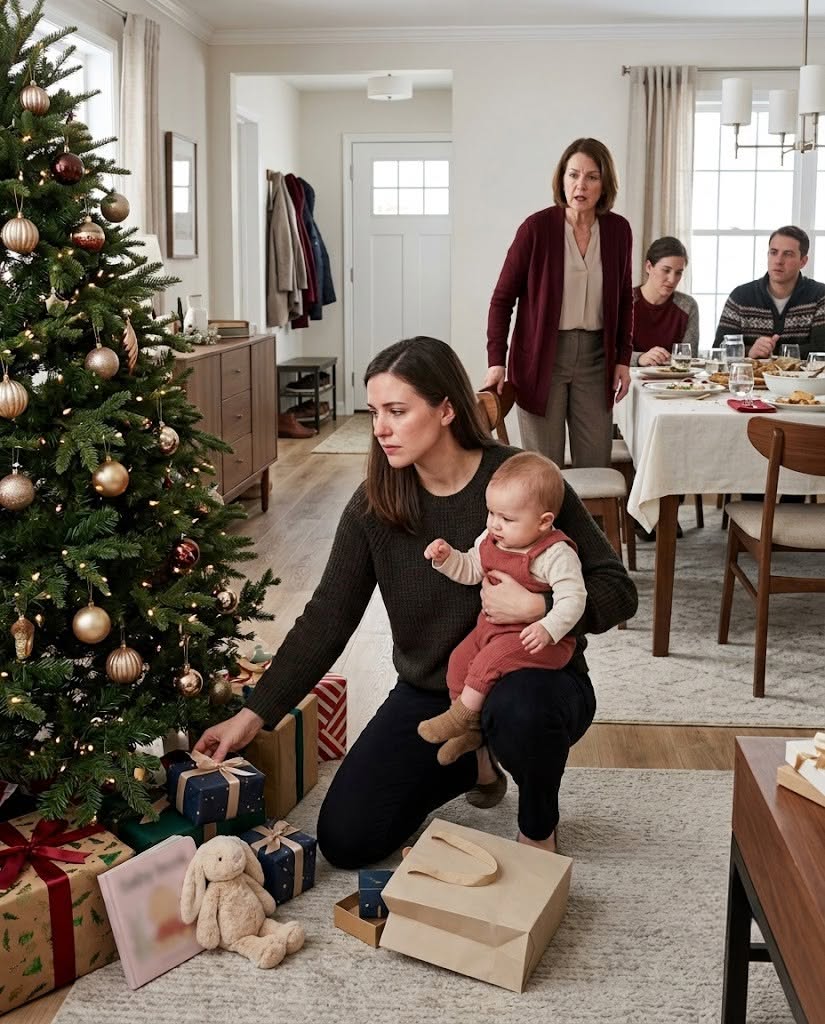 Weeks passed before I agreed to speak with her by phone. Months passed before I agreed to see her without my daughter.
When we finally met, she started to explain what she had been afraid of during my pregnancy. I stopped her and told her I was willing to hear about her fear only after she understood that fear had never given her ownership of my marriage or my child.
She nodded. More importantly, she did not argue.
I did not promise that holidays would return to normal. Normal had been the problem.
By my daughter’s first birthday, we had built something different. My sister came early with groceries, my aunt brought the same kind of soft books she had been buying since the baby was born, and my ex arrived for his part of the day without lingering or turning the room into a performance.
Mom was not there. She had begun respecting the boundaries, but trust was moving more slowly than regret.
I felt guilty about that sometimes. Then I would remember my daughter curling her hand into my sweater at Christmas and how clear the choice had felt when I finally understood who I was supposed to protect.
By the following December, Mom and I had managed two short visits in neutral, ordinary settings. She had been careful with her words, had followed my rules, and had not once asked when she would be “forgiven.”
That mattered. It did not erase anything.
Christmas morning happened in my apartment. The tree was smaller than my mother’s, the dining table did not match the chairs, and there was no polished display waiting for anybody’s approval.
My sister sat cross-legged on the rug while my daughter, now steady enough to hurry from one piece of furniture to another, attacked wrapping paper with both hands. The little bunny from the Christmas before had survived a year of naps, car rides, spilled milk, and being dragged by one ear through every room I owned.
The old letter was no longer hidden in anybody’s cardigan. I kept it in a folder in my desk with the divorce papers and other things I did not need to look at every day but refused to pretend had never happened.
My mother had once treated information like power and concern like permission. In my home, nobody needed permission to love my daughter exactly as she was.
She toddled across the rug, picked up that same worn bunny, and placed it in my lap before reaching for the next gift.
Weeks passed before I agreed to speak with her by phone. Months passed before I agreed to see her without my daughter.
When we finally met, she started to explain what she had been afraid of during my pregnancy. I stopped her and told her I was willing to hear about her fear only after she understood that fear had never given her ownership of my marriage or my child.
She nodded. More importantly, she did not argue.
I did not promise that holidays would return to normal. Normal had been the problem.
By my daughter’s first birthday, we had built something different. My sister came early with groceries, my aunt brought the same kind of soft books she had been buying since the baby was born, and my ex arrived for his part of the day without lingering or turning the room into a performance.
Mom was not there. She had begun respecting the boundaries, but trust was moving more slowly than regret.
I felt guilty about that sometimes. Then I would remember my daughter curling her hand into my sweater at Christmas and how clear the choice had felt when I finally understood who I was supposed to protect.
By the following December, Mom and I had managed two short visits in neutral, ordinary settings. She had been careful with her words, had followed my rules, and had not once asked when she would be “forgiven.”
That mattered. It did not erase anything.
Christmas morning happened in my apartment. The tree was smaller than my mother’s, the dining table did not match the chairs, and there was no polished display waiting for anybody’s approval.
My sister sat cross-legged on the rug while my daughter, now steady enough to hurry from one piece of furniture to another, attacked wrapping paper with both hands. The little bunny from the Christmas before had survived a year of naps, car rides, spilled milk, and being dragged by one ear through every room I owned.
The old letter was no longer hidden in anybody’s cardigan. I kept it in a folder in my desk with the divorce papers and other things I did not need to look at every day but refused to pretend had never happened.
My mother had once treated information like power and concern like permission. In my home, nobody needed permission to love my daughter exactly as she was.
She toddled across the rug, picked up that same worn bunny, and placed it in my lap before reaching for the next gift.