They kept turning the pages until they reached the last section, and then the assumption that had carried them through that birthday dinner finally collapsed.
For years, Caleb, Marissa, and Douglas had treated my future as though it were already written for them.
That final page reminded them of something they should never have forgotten.
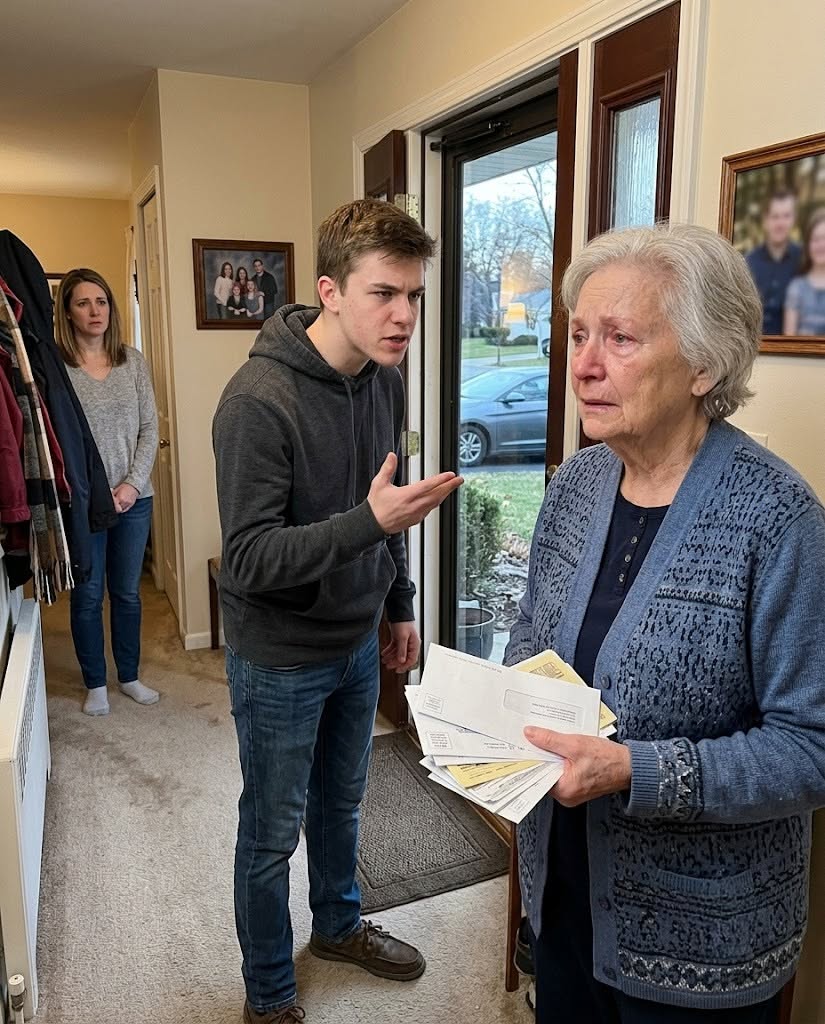
My life was still mine.
So was my money.
So was my choice.
Douglas had been the first one reaching for the paperwork when I placed the three documents beside Caleb’s birthday cake, but by the time he got to the end, the confidence he had brought into my dining room was gone.
He had expected an elderly woman who could be pressured, managed, questioned, and eventually pushed aside.
Instead, he was sitting across from a woman who had heard exactly what her family thought of her and had prepared accordingly.
The cake was still in the middle of the table.
The candles were untouched.
Caleb’s phone remained near his hand, though he had stopped reaching for it the moment his own recorded voice began filling the room.
Only minutes earlier, he had been waiting for his eighteenth birthday gift.
Now he was listening to himself explain what he believed my death was worth.
One week before that dinner, he had been sitting at my kitchen table eating blueberry pancakes.
He sat in Walter’s chair, the same chair my husband had used for years, and spoke to me with the casual certainty of someone who believed there would be no consequence for saying the cruel thing out loud.
“The greatest present would be for you to die so we can finally divide everything.”
At first, my mind resisted the sentence.
I thought perhaps I had heard him wrong.
I wanted to have heard him wrong.
So I asked him to repeat himself.
He did.
“You don’t mean anything to us except the inheritance, Grandma. You should just die already so we can split the money.”
There are moments when pain arrives loudly.
This one didn’t.
The pancake in the skillet burned while I stood there with the spatula in my hand.
That smell stayed with me because everything else in the kitchen looked so ordinary.
A plate on the table.
Blueberries scattered near Caleb’s fork.
Morning light.
Walter’s chair.
And my grandson telling me that the people I had spent years helping were waiting for me to die.
I paid part of their mortgage when things were tight.
I paid car expenses when another bill threatened to push them under.
I paid nearly all of Caleb’s school costs because I wanted him to have opportunities without hearing adults argue about money every night.
I paid because they were family.
I bought his braces.
I bought his sports uniforms.
I helped him get his first car.
None of those things had felt like investments.
I never kept a private scoreboard.
When my daughter called and said they were short, I helped when I could.
When Caleb needed something important, I told myself that grandparents were supposed to make life a little easier for the next generation.
I thought I was helping them survive hard years.
Caleb’s words showed me that somewhere along the way, my help had stopped feeling like generosity to them.
It had become expectation.
Then entitlement.
Then calculation.
He told me his parents had already discussed what would happen after I died.
He said life would be easier for them.
He talked about assisted living as if moving me out of my own home would simply be a practical financial decision.
According to him, the money I was spending on myself would eventually become his anyway.
Eventually.
That word told me more than he realized.
He wasn’t speaking like a teenager making one ugly joke.
He was repeating a way of thinking he had heard often enough to believe it was normal.
That was why I reached for the digital recorder I had begun carrying after Walter died.
I had not bought it because I expected a betrayal like this.
I carried it because I had learned something uncomfortable after becoming a widow: people sometimes question an older person’s memory faster than they question the behavior of everyone around her.
If a conversation mattered, I wanted a reliable record of what had actually been said.
So I pressed the button without making a scene. Caleb kept talking. The recorder kept running. And for the first time that morning, I stopped trying to explain his words away. Three days later, I discovered that the conversation in my kitchen was not the worst part. I went to Marissa’s house carrying financial papers connected to another plan they expected me to help support. Nobody answered when I arrived. But I could hear voices inside. Then I heard Douglas. His tone was practical. That almost made it worse. He was talking about how long they might have to wait if I lived another fifteen or twenty years. He was talking about my money. He was talking about my home. He was talking about my accounts. He was talking about my life as though it were an obstacle in a financial plan. They had gone further than waiting for an inheritance. Douglas had begun building a story about me. According to that story, I was becoming forgetful. Unreliable. Unable to manage my own affairs. He wanted examples that could be described as proof. He believed that if enough people accepted the idea that I was no longer capable, control of my finances and property could be taken out of my hands. They called that protecting the family estate. I had another name for it. They were preparing for a future in which my voice would matter less than theirs. I stood outside my own daughter’s house listening to the people I had helped discuss how to weaken my authority over the life I had built. I did not knock. I did not walk inside and start screaming. I did not give Douglas the opportunity to turn a confrontation into another example of how emotional or confused I supposedly was. I recorded what I heard. Then I went home. By the end of that day, I had two recordings. One contained my grandson describing my death as a financial benefit. The other captured my son-in-law discussing how my independence could be questioned before nature gave them the inheritance they wanted. But recordings alone were not enough for me. If Douglas intended to create a false picture of my mental condition, I needed more than anger. I needed clarity. My financial adviser reviewed what was happening. My attorney prepared new documents. An independent evaluation confirmed that I was fully capable of managing my own affairs. Every old permission that could have given someone else unnecessary access or authority was revoked. And I signed a new will. I did not do it in a burst of revenge. I did it because their plan had depended on one dangerous assumption: that my kindness meant I would never protect myself from them. Kindness is not surrender. They had confused the two for years. Caleb’s birthday gave me the first moment when all of them would be sitting together in my home. They arrived expecting a celebration. Caleb expected a gift. Marissa behaved as though the week before had not changed anything. Douglas carried himself like a man who still believed the future was moving in his direction. The cake sat in the center of the table. I looked around at people I had loved through late payments, school expenses, unexpected bills, and years when their problems repeatedly became my problems. Then I placed the recorder beside the candles. I pressed play. Caleb heard his own voice first. “You don’t mean anything to us except the inheritance, Grandma.” No retelling could soften it because there was nothing to debate. It was his voice. His words. His certainty. He had spoken them at my table while eating the breakfast I made for him. Marissa looked toward him and then toward me. Douglas stayed still long enough for me to understand that he was already calculating what the recording meant. Caleb’s hand moved toward his phone. Then it stopped. There was nowhere for any of them to hide inside the usual family excuses. He couldn’t say I had misunderstood. Marissa couldn’t say I was remembering the conversation incorrectly. Douglas couldn’t explain it away as a confused interpretation from an older woman. Then the second recording began. That one changed the room differently. Caleb’s cruelty had been personal. Douglas’s plan was deliberate. His own voice explained why waiting for me to die naturally was inconvenient. His own voice discussed the possibility of portraying me as incapable. His own voice connected that idea to control over my finances and property. The story he had intended to tell about me suddenly had competition from a record he could not rewrite. They had wanted proof about my memory. I had proof about their intentions. When the recording ended, I placed three documents beside the cake. The first was the independent competency evaluation. It answered the story Douglas had been trying to build before he had the chance to build it any further. The second showed that previous financial permissions had been revoked. Whatever informal access or expectation they had relied on was no longer something they could treat as permanent. The third was my newly signed will. Douglas reached toward it first. I covered the last page with my hand before he could turn it. Not because I was afraid of what it said. Because after years of letting other people behave as though my resources belonged to the family before they belonged to me, I wanted one thing to be unmistakable. He would read it when I allowed him to read it. That small movement changed more than any speech could have. They had expected control. They got a boundary. They had expected confusion. They got documentation. They had expected gratitude to keep me compliant. They got a decision. Douglas eventually read the pages. Marissa read them after him. Caleb followed what they were doing, his birthday forgotten for the moment as the meaning of the paperwork became clearer. Whatever future they had discussed among themselves was no longer something they could treat as settled. The will reflected my choices, not their expectations. That difference mattered more than the number attached to any account. For five years, they had grown accustomed to my help arriving before consequences did. A mortgage payment would be short, and I would help. A car expense would come up, and I would help. Caleb needed school money, and I would help. Something went wrong, and Grandma found a way to make it easier. They had built their comfort around that pattern. They had also made a mistake. They began to believe the pattern could never end. Caleb’s comment revealed the ugliest version of that belief, but Douglas’s recording showed how far it had spread. This was no longer only about a teenager saying something cruel. It was about a family that had started speaking as though a living woman’s estate already belonged to them. It was about people discussing control over her life while continuing to accept her help. It was about the distance between being loved and being useful. Marissa had to sit with that distinction too. She was my daughter. That fact did not disappear because I was hurt. Neither did the years between us. But being my daughter did not give her the right to participate in conversations that reduced my future to a financial timetable. Loving someone does not mean pretending their choices cannot wound you. And helping family does not require financing your own erasure. Caleb had turned eighteen believing adulthood might begin with a gift from me. Instead, his birthday marked the first time he had to look directly at the consequences of what he had said. He had spoken about inheritance as though it were guaranteed. He had spoken about my home and money as though time was the only thing standing between him and ownership. He had assumed that because I had paid for so much already, I would eventually leave everything according to the expectations his family had built. The paperwork on the table told him otherwise without needing to humiliate him back. That mattered to me. I did not want revenge to become the thing guiding my decisions. I wanted control of my own life returned to the person it had always belonged to. Me. Douglas had tried to make my age the weakness in the story. The competency evaluation removed that weapon. He had counted on old permissions. Those were revoked. He had counted on a will he thought he understood. That had changed too. Each document answered a different part of the plan I had overheard. Together, they made one fact impossible to ignore. I had listened. I had understood. I had acted. And I was still capable of deciding what happened next. There was no dramatic victory lap at the table. The people sitting across from me were still my family, which made every part of the night more painful, not less. I could look at Caleb and remember the child whose braces I paid for. I could remember buying uniforms because I wanted him to walk onto a field without feeling different from everyone else. I could remember helping with his first car and worrying whether he would drive too fast. Those memories did not vanish because of one recording. But neither did the recording vanish because of those memories. Both were true. That was the hardest part. The grandson I had loved was also the young man who had told me my best gift would be dying soon enough for him to receive money. The daughter I had supported was also part of a household where my future had been discussed as a financial problem. The son-in-law I had repeatedly helped was also the man whose voice I had recorded describing how my independence might be undermined. Family history could explain why walking away emotionally was difficult. It could not excuse what they had done. By the time the final section of the will was read, the birthday dinner no longer belonged to the plan they had brought into my house. Nobody was deciding whether I had become too old to manage myself. Nobody was discussing my property as though I were already absent. Nobody was treating my generosity as an advance payment on an inheritance. The question had changed. The question was no longer what they would get when I died. It was what kind of relationship, if any, they were willing to have with me while I was alive and fully able to choose for myself. That answer could not be written into a will. It had to be earned afterward. I looked at the documents beside the cake and realized how strange the table must have appeared. Birthday candles. Financial paperwork. A recorder. A family forced to hear itself clearly. I had spent years believing that keeping people afloat was one of the ways I showed love. Maybe it was. But love without boundaries had allowed them to forget that the person writing the checks was still a person with plans, memories, dignity, and a future of her own. My husband Walter was gone, but the years we had built together were not simply a prize waiting for whoever outlived me. The home, the accounts, and everything connected to them represented work, choices, sacrifices, and a life that had existed long before Caleb began calculating what he might inherit. That night, for the first time in years, I stopped measuring my decisions by how much easier they would make life for everyone else. I measured them by something simpler. Was this my choice? Was I making it freely? Was I protecting the life I still had? The answers finally mattered. The cake remained on the table while the papers passed from one pair of hands to another. But the real change had happened before anyone finished reading. It happened when I stopped allowing their expectations to stand in for my consent. Caleb thought his eighteenth birthday would bring him one more thing from Grandma. Instead, it became the day he learned that generosity is not ownership, help is not entitlement, and a living person is not an inheritance waiting to happen. I had spent five years protecting them one emergency at a time. That night, I protected myself.