Daniel’s eyes dropped to the folder resting on my suitcase. I had pulled it from the home office before Noah and I headed for the door, and the instant he recognized it, his body went still.
It was Noah’s document folder.
Nothing dramatic was written across the front. No warning. No threat. Just the ordinary folder where we kept the important papers connected to our son—the things Daniel had seen me organize year after year and never thought twice about.
But sitting on top of two packed suitcases, it meant something different.
It meant I wasn’t bluffing.
Daniel looked from the folder to me, then toward Noah, who had moved behind my hip when his father reached for him.
“What are you doing with that?” he asked.
His voice had changed.
A minute earlier he had been angry. Loud. Certain that the force of his voice would put everything back where he wanted it.
Now he sounded careful.
“I’m taking Noah with me,” I said.
Daniel’s jaw tightened. “You don’t get to decide that by yourself.”
I glanced past him toward the hallway.
From where we stood, I could still see part of Noah’s bedroom doorway.
Except it didn’t look like Noah’s room anymore.
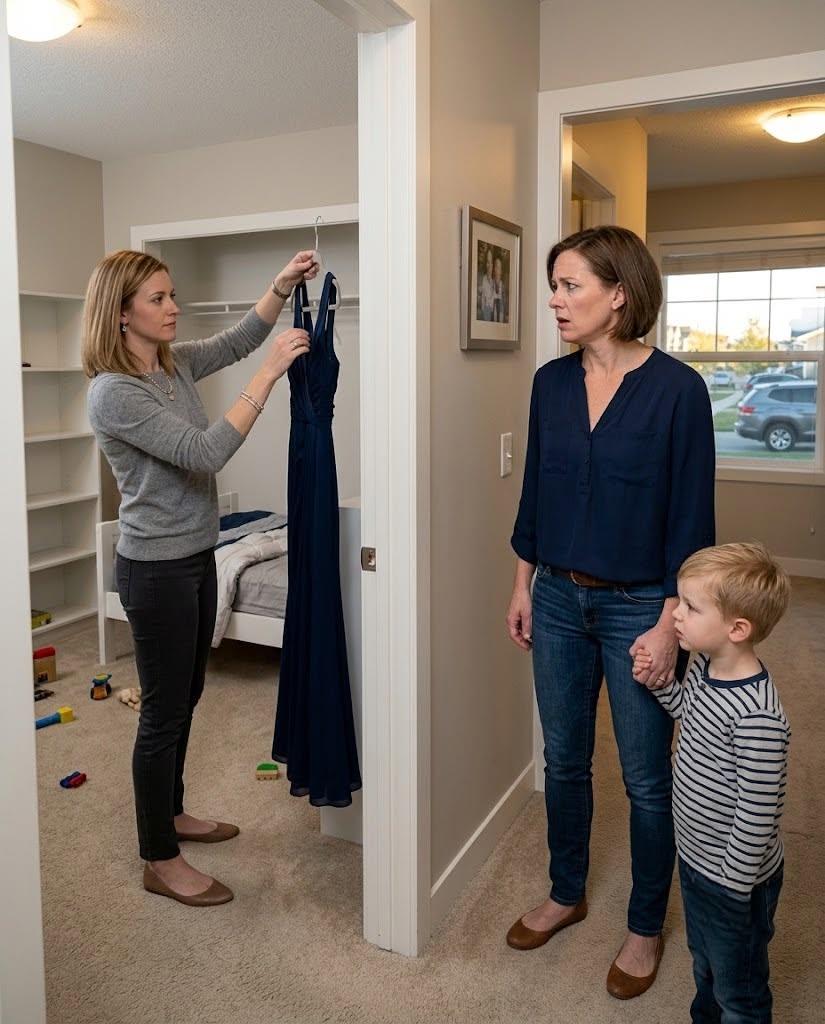
The blue curtains were gone. His bed was gone. His baseball trophies had been shoved into a cardboard box like clutter someone meant to deal with later.
And Madison’s clothes were hanging where my seven-year-old son’s shirts used to be.
“You already made a decision by yourself,” I said.
Daniel followed my eyes.
For the first time since he had walked through the front door, he seemed to understand that this argument wasn’t about whether I suspected an affair.
That question was over.
Madison was standing in my house wearing his shirt.
Her dresses were in my son’s closet.
Her chair was sitting where Noah’s bed had been.
There was nothing left to explain away.
Daniel rubbed a hand over his mouth and looked at Madison.
“What exactly happened here?”
I almost laughed, but there was nothing funny left in me.
Madison stared at him. “What do you mean?”
“You moved all his stuff?”
Her eyebrows lifted. “You told me I could use the room.”
Daniel looked at me quickly.
That tiny movement told me everything.
He wasn’t shocked that she had moved in.
He was shocked that she was saying it in front of me.
Madison continued before he could stop her. “You said Noah could sleep in the guest room.” “The guest room doesn’t even have a bed,” I said. Daniel snapped, “Caroline, can we talk privately?” “No.” One word. He stared at me. For years, Daniel had been able to move every difficult conversation somewhere private, somewhere he could lower his voice and change the subject and make me wonder whether I had misunderstood what I had seen with my own eyes. Not this time. Noah was standing there. He had already seen his room. He had already asked where his things were. I wasn’t going to teach him that adults could erase something important to him and then make the truth disappear behind a closed door. Daniel stepped closer. “Caroline, you’re emotional right now.” Madison looked down. I almost admired the predictability of it. For six months, that had been Daniel’s favorite defense. When I asked why he was coming home so late, I was insecure. When I noticed perfume on a jacket that didn’t smell like mine, I was imagining things. When I asked about hotel charges on our credit card, he told me executive travel was complicated and accused me of looking for problems. Every question somehow became evidence against me. So eventually I had stopped asking questions out loud. I started paying attention instead. I remembered dates. I noticed which conferences seemed to require late-night calls and which ones somehow required Daniel to turn his phone facedown the second he walked into the kitchen. And months earlier, when I finally admitted to myself that wanting my marriage to survive was not the same thing as having a marriage worth saving, I called an attorney. I had not filed anything then. I had simply wanted to know what my choices were. Daniel never knew. The petition beside my wedding ring upstairs had been prepared because some part of me already understood that I might eventually need it. I just hadn’t known what would finally make me sign. Then I opened my son’s bedroom. That did it. Not the perfume. Not the hotel charges. Not even Madison. It was the cardboard box. Noah’s trophies were inside it, stacked sideways beneath books and little things he had collected over the years. One trophy still had dust around the base because Noah refused to let me wipe it too aggressively after his team picture had been taped underneath. Daniel knew that. He had been there when Noah brought it home. He had taken pictures. And still, somewhere between his affair and whatever future he had been imagining with Madison, our son had become movable. A bed could be removed. A room could be reassigned. A child could be told to adjust. That was the part I could not negotiate with. Daniel lowered his voice. “I didn’t tell her to throw anything away.” Behind me, Noah spoke. “My bear was by the trash.” Daniel’s face tightened. He looked toward Madison. She immediately said, “I didn’t throw it away. It was beside the trash.” Noah’s hand slipped into mine. He wasn’t crying. That made it worse. He was watching the adults carefully, trying to figure out whose version of reality he was supposed to believe. I squeezed his fingers. Daniel noticed. “Noah,” he said, softening his voice, “buddy, nobody was getting rid of your things.” Noah stayed behind me. Daniel tried again. “We were just moving things around.” “Why?” Noah asked. Daniel opened his mouth. Nothing came out. Madison shifted her weight and crossed her arms. “I’m not going to be treated like I caused all of this,” she said. I looked at her. She was right about one thing. She hadn’t caused all of it. Daniel had. Madison had walked into a space he told her she could occupy. She had been cruel to me. She had looked at my child’s empty room and called the lack of a bed in the guest room “not my problem.” I would never forget that. But she hadn’t made vows to me. She hadn’t tucked Noah into that bed when he was sick or sat beside him while he practiced reading or promised him that this house was his home. Daniel had. That realization changed where I aimed my anger. I stopped looking at Madison. I looked only at my husband. “You told her I wouldn’t stop you.” He flinched. I had photographed the message before packing my bags. Move in whatever you want. Caroline won’t stop us. Those words had bothered me more than the affair itself. He hadn’t simply betrayed me. He had counted on my silence. He had built his plan around it. Daniel glanced toward the dresser in Noah’s former room, probably realizing exactly which message I had seen. “You went through her phone?” “She left it open on the dresser.” “That doesn’t give you the right—” I stared at him. He stopped. Even Madison looked at him then. Of all the things Daniel could have said, defending the privacy of the phone sitting in our son’s erased bedroom might have been the worst choice available. He knew it too. He dragged both hands through his hair. “Okay. Fine. This got out of control.” This. The word floated between us as though the problem were a scheduling mistake. I nodded toward the hallway. “Go look at his room.” “I saw it.” “No. Look at it.” Daniel didn’t move. I continued. “Look at his trophies in a box. Look at the place where his bed used to be. Look at his bear on the floor. Then come back and tell your seven-year-old son this just got out of control.” Noah pressed closer to me. Daniel’s expression hardened again, but now the anger had nowhere clean to go. He could blame me for being insecure. He could blame Madison for going too far. He could blame timing, stress, misunderstandings, anything he wanted. But the room was still there. That was the problem with physical evidence. It did not care how persuasive you were. Daniel finally walked to the doorway. He stood there without entering. I watched his shoulders shift as he took in the mirror, the velvet chair, the clothes, and the box of Noah’s things. Noah watched him too. For a second, I remembered another version of Daniel—the father who used to sit cross-legged on that bedroom floor helping Noah build impossible towers out of plastic blocks. I had loved that man. Maybe some part of him still existed. But love cannot keep doing the work of accountability forever. Daniel turned back. “I can fix the room.” There it was. The solution he understood. Furniture. Curtains. Objects. Things that could be purchased, replaced, moved back. I shook my head. “This isn’t about the room anymore.” His eyes flicked toward the suitcases. “Then what do you want?” I had spent so many years answering that question with a list. Come home when you say you will. Stop treating every concern like an accusation. Be present with Noah. Tell me the truth. Respect me enough not to make me prove what I already know. That afternoon, I didn’t give him another list. “I want to leave.” Daniel stepped into my path. Not aggressively enough to touch me, but deliberately enough that I noticed. Noah noticed too. I moved the suitcase handle into my other hand and kept my voice level. “Move.” Daniel looked down at Noah. “This is your home.” Noah’s eyes went toward his bedroom. Then back to his father. “My room is gone.” The sentence landed harder than anything I could have said. Daniel’s posture changed. He moved aside. I walked past him. Noah came with me. Madison stayed near the hallway, suddenly quiet, surrounded by the expensive clothes she had been so comfortable arranging a short time earlier. At the front door, I stopped only once. Not for Daniel. For Noah. “Your bear,” I said. His eyes widened. I set down my suitcase and went back to the bedroom. The bear was exactly where I had seen it, facedown beside the trash. I picked it up, brushed a bit of lint from one ear, and carried it back to my son. Noah took it with both arms. Daniel watched the entire thing. He did not say a word. That small stuffed bear had never been worth much money. But Daniel’s silence told me he finally understood what the afternoon had cost him. A home is not the rooms you own; it is the people who trust that they are safe inside them. My sister was waiting for us. I had called her before Daniel came home, and she had not asked me to justify leaving or explain whether I was completely sure. She had simply asked what Noah and I needed. That mattered more than I expected. By the time we reached her place, Noah was exhausted. He still had his backpack because he had never put it down after school. The sight of it made my chest hurt. A seven-year-old should have been thinking about homework, snacks, or whatever game he wanted to play after dinner. Instead he had watched his mother photograph his dismantled bedroom, pack two suitcases, sign divorce papers, and walk past his father without knowing whether we were coming back. I helped him settle in and placed his bear beside him. He touched one worn ear and looked at me. “Are my trophies okay?” “Yes.” “Are we getting them?” “Yes.” He thought about that. “Is Dad mad at me?” That question nearly broke the control I had held all afternoon. I sat beside him. “No, sweetheart.” “Because I came with you?” “No.” He stared down at the bear. I chose my next words carefully because I refused to make Noah responsible for adult betrayal. “This is something between grown-ups. You didn’t cause it, and you don’t have to fix it.” He nodded, but children do not stop worrying simply because adults give them a sentence meant to make worry disappear. So I stayed beside him until his shoulders finally relaxed. Later, when the house was quiet, I checked my phone. Daniel had called repeatedly. There were messages too. Some were angry. Some were defensive. Some tried to sound reasonable. He wanted me to come back so we could discuss things like adults. He said I was making a permanent decision during an emotional moment. He said Madison could leave. He said Noah’s bedroom could be restored exactly as it had been. He said we had too much history to throw away. That last message held my attention. Too much history. For years, history had been the reason I stayed. Our wedding. The house. Noah being born. Birthday mornings. School pictures on the refrigerator. Ordinary nights when Daniel and I sat on opposite ends of the couch and still believed ordinary meant secure. But history could not be used as a deposit toward future trust. At some point, the present had to count too. And the present was brutally clear. Daniel had not made one bad choice. He had made a series of choices that required me to doubt myself so he could keep making them comfortably. Then he had made one choice involving our son that I could not rationalize. He had given away Noah’s room while Noah was at school. That detail stayed with me. No warning. No conversation. No attempt to make the change gentle. A child had left home in the morning believing his room would be waiting for him after school, then returned to find that another adult had claimed it. Daniel could replace the furniture. He could not erase that moment from Noah’s memory. The next morning, I looked at the photographs again. The empty walls. The box of trophies. The designer dresses. Madison’s phone on the dresser. Daniel’s message. And finally the picture I had taken almost without thinking: Noah standing in the hallway with his backpack still on, staring into the room where his bed should have been. I stopped there. That was the photograph that mattered most to me. Not because it proved an affair. Because it reminded me what my decision was actually protecting. Daniel had spent six months convincing me that I was afraid of losing my husband. By the end, I realized I was much more afraid of teaching my son that love required accepting humiliation quietly. So I did what Daniel had never expected me to do. I stopped arguing for my place in a life where he had already begun replacing me. I let the signed papers say what I no longer needed to shout. I let the packed suitcases say the rest. And I let Daniel stand in the house he had chosen to rearrange, surrounded by everything he thought he wanted. He still had the walls. He still had the bedroom. He still had the gold-framed mirror, the velvet chair, and the expensive clothes hanging neatly in the closet. What he no longer had was the assumption that Noah and I would remain there no matter what he did. That was the thing he had actually lost. Not furniture. Not appearances. Not the argument. Us. A few days earlier, I would have believed leaving required some huge final confrontation, the kind where every betrayal was named and every lie was answered. It didn’t. The most important moment had been much quieter. It happened when Noah stepped behind me instead of toward his father. Daniel saw it. I saw him see it. There was no clever sentence capable of undoing that. Trust had shifted in a child-sized movement across a hallway floor. And although I had spent years wondering what evidence would finally be enough for me, the answer turned out not to be the hotel charges or the perfume or even the message on Madison’s phone. It was Noah asking where his things had gone. That night at my sister’s house, his stuffed bear sat beside him again. No gold mirror. No velvet chair. No designer dresses. Just one tired little boy sleeping with something familiar tucked under his arm while I sat nearby with two suitcases, a signed divorce petition, and the first clear sense I had felt in months that I had stopped waiting for Daniel to decide what happened to us next.