Patrick still believed the woman returning that night was the same dependent wife he had cornered with paperwork. By the time Emma and I walked through those doors again, he would learn how badly he had misjudged Rebecca Alden.
His message stayed open on my phone while Emma sat beside me in the back seat, both hands wrapped around the sleeve of my coat.
COME BACK TONIGHT. WE HAVE AN EVENT. BRING EMMA. YOU WILL APOLOGIZE TO VANESSA BEFORE THIS GETS WORSE.
A second message arrived less than a minute later.
AND DON’T EMBARRASS ME.
I read both twice.
Not because I was confused.
Because for seven years I had trained myself to look for the hidden price inside every sentence Patrick sent me.
If he said we needed to talk, it meant I needed to agree. If he said something was best for Emma, it usually meant it was easiest for him. If he said money was tight, it meant my grocery allowance would shrink while another expensive charge appeared on a card I was never allowed to question.
This time, though, the threat sounded almost small.
I had already made the call he never imagined I would make.
My father’s chief of staff was sitting across from me in the quiet rear lounge of a private building Patrick had never known I could enter without asking permission. He had arrived with no entourage and no dramatic questions, only a plain dark folder, two paper coffee cups, and the same careful expression I remembered from seven years earlier.
He glanced at Patrick’s message.
“The event he’s talking about is tonight’s gala,” he said.
I knew the one.
Patrick had been talking about it for weeks because the guest list included people he desperately wanted to impress. He had ordered a new tuxedo, changed his cuff links twice, and complained that my dresses looked too inexpensive for the room.
Vanessa had apparently found something suitable.
Pale blue.
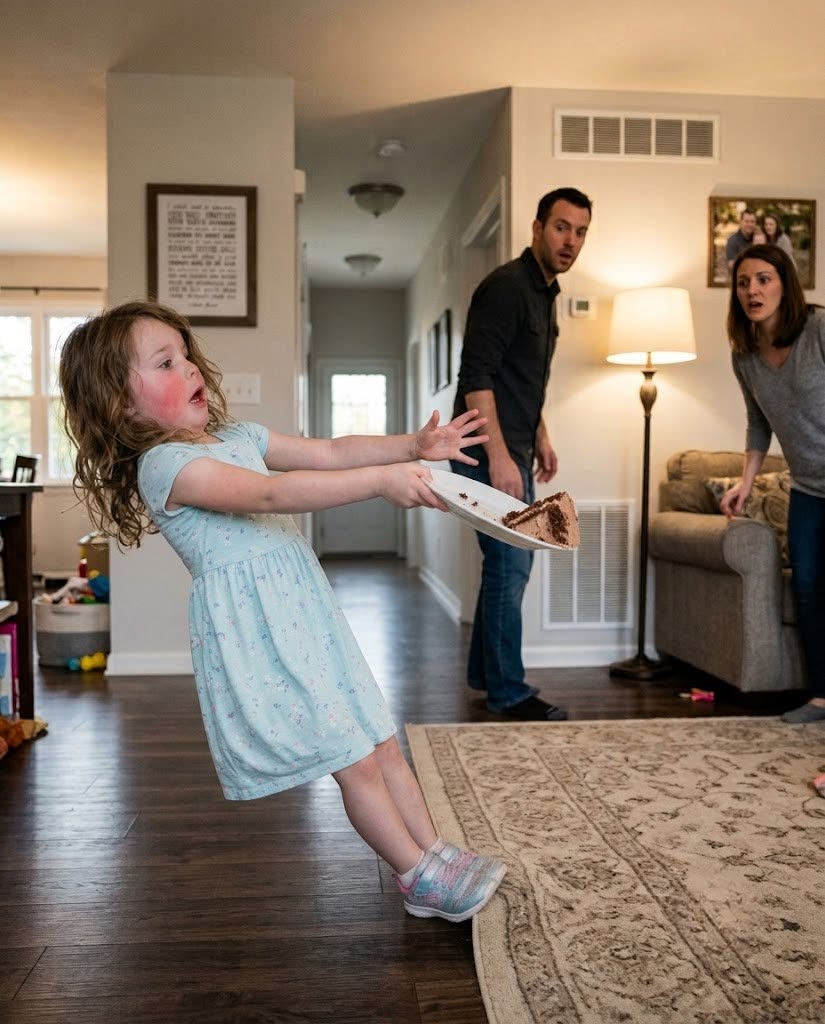
Now decorated with chocolate frosting.
The chief of staff looked at Emma, then back at me.
“Your father is already there.”
My throat tightened.
Emma shifted closer against my side.
“Grandpa?” she whispered.
The word sounded strange because I had spent years keeping my old life out of our house.
I had not filled Emma’s childhood with stories about wealth, old family photographs, or the powerful people who knew my father by name. I had been afraid Patrick would discover just how much of myself I had hidden when I married him.
But during the drive, I had finally shown Emma one photograph on the chief of staff’s phone.
It was old.
I was younger, standing beside my father with one arm around his waist, both of us laughing at something outside the frame.
Emma had studied his face carefully.
“That’s your daddy?”
“Yes.”
“So he’s my grandpa.”
I could barely answer.
“Yes.”
The chief of staff closed the folder.
“You do not have to go to the gala.”
I looked again at Patrick’s message.
For years, Patrick had controlled me by making every choice feel expensive.
Leave, and lose the house.
Argue, and lose the allowance.
Finish school, and be called selfish.
Push back against his mother, and be accused of breaking the family apart.
Tonight was different.
He had ordered me to appear because he still believed obedience was the only language I knew.
“I want to go,” I said.
The chief of staff’s expression changed slightly.
“For your father?”
“For Emma.”
Emma looked up.
I squeezed her hand.
“I want her to see me say no.”
We arrived through a quieter entrance nearly an hour later.
I had not changed into anything extravagant. I wore a simple dark dress the chief of staff had arranged for me after I realized my coat and blouse still carried a faint smear of frosting from holding Emma after Vanessa hit her.
Emma wore the same little shoes I had skipped lunches to buy three months earlier.
That detail mattered to me more than the chandeliers.
Inside, the ballroom was bright with polished glass, formal tables, servers moving between clusters of guests, and conversations full of people measuring one another’s importance without admitting that was what they were doing.
Patrick loved rooms like that.
He spotted me almost immediately.
His shoulders loosened.
For one brief moment, satisfaction crossed his face.
He thought I had obeyed.
Vanessa stood beside him in another dress, this one dark and fitted, her hair freshly redone. Patrick’s mother was nearby, talking to a couple I did not recognize.
Patrick crossed the room quickly.
“Where have you been?”
I looked at him.
“Taking care of Emma.”
“You turned your phone off.”
“I turned you off.”
His jaw tightened.
Behind me, Emma gripped my hand harder.
Patrick lowered his voice.
“Do not start something here.”
“I didn’t.”
I looked past him at Vanessa.
“She did.”
Vanessa gave a small laugh.
“Oh, please. Your daughter ruined a gown and threw a tantrum.”
Emma pressed against my hip.
I felt her body go rigid.
Patrick noticed.
He did not comfort her.
Instead, he leaned toward me.
“This is exactly why I told you to come. You’re going to fix this before people start hearing some ridiculous version of what happened.”
“The true version?”
“Rebecca.”
The warning in my name was familiar.
It simply no longer worked.
Vanessa folded her arms.
“I would settle for an apology.”
I stared at her.
“From the five-year-old you slapped?”
Two people standing nearby turned their heads.
Patrick saw them.
That was what finally frightened him—not Emma’s tears, not Vanessa’s hand striking our child, but witnesses.
He stepped closer.
“Keep your voice down.”
“Why?”
“Because you’re making a scene.”
“No, Patrick. I’m describing one.”
His mother hurried over.
“Rebecca, enough. Not here.”
Emma looked between the adults surrounding us.
Her fingers were trembling.
I crouched beside her.
“You haven’t done anything wrong,” I told her.
Patrick exhaled sharply.
“Stop filling her head with this nonsense.”
Then Vanessa said the sentence that pushed the evening past any chance of pretending.
“If she had been raised properly, none of this would have happened.”
Emma’s face crumpled.
Patrick turned toward Vanessa, and for half a second I thought something human might finally break through.
It didn’t.
He turned back to us.
“Both of you apologize.”
I stood.
“No.”
He blinked.
Patrick was used to resistance that eventually became surrender. He was not used to a complete sentence with nowhere to push. “I said apologize.” “And I said no.” Vanessa glanced toward the nearby guests. “Patrick, forget it. They’re embarrassing you.” That was the lever she chose. His pride. He stepped in front of me and pointed toward the floor beside Vanessa. “Fine. If you’re determined to behave like this, then you and Emma can kneel down and apologize properly. Maybe that will teach both of you some humility.” I thought I had misunderstood him. I hadn’t. Emma did too. “Kneel?” she whispered. Patrick looked at his own daughter. “You heard me.” A nearby conversation stopped. Then another. The ballroom did not become completely silent, but the space around us changed. People shifted. A server slowed. Someone at the next table lowered a glass without drinking from it. Patrick realized he had an audience and somehow decided that made backing down impossible. “Go on,” he said. I moved Emma behind me. “My daughter will never kneel to someone who hit her.” Patrick’s face hardened. “Your daughter needs discipline.” “She needed her father.” That landed harder than shouting would have. His eyes flicked toward the people watching. “You are proving exactly why those separation terms are necessary.” There it was. The papers. The house. The money. Emma’s schedule. Patrick reached inside his jacket and pulled out a folded copy of the documents as if a stack of paper could restore the balance he had always counted on. “You signed them,” he said. “I acknowledged receiving them.” “Don’t play games with me.” “I’m done playing yours.” Vanessa shifted impatiently. “Patrick, handle this.” Emma suddenly tugged my hand. “Mom.” I looked down. She was staring across the ballroom. Her eyes had locked on an older man who had just entered through the opposite side of the room with several people around him. I knew the shape of his shoulders before I could clearly see his face. Seven years disappeared in a single heartbeat. My father had more gray in his hair. His posture was slower. But he was still the man from the photograph Emma had studied in the car. The man Patrick had spent weeks talking about without ever understanding why I went quiet whenever his name came up. The man many people in that ballroom watched carefully because, among a room already crowded with extraordinary wealth, he was still the person everyone seemed to make space for. Patrick followed Emma’s stare but misread it. “Emma, I am talking to you.” She released my hand. “Emma?” She ran. Patrick reached after her too late. Her little shoes struck the polished floor in quick uneven steps as she crossed the open space between tables. My father saw her coming. He stopped walking. Emma did not hesitate. She ran directly into his arms. He bent just in time to catch her. And with tears still wet on her face, my five-year-old wrapped both arms around his neck and cried one word loud enough for Patrick to hear. “Grandpa!” My father froze. So did Patrick. Emma buried her face against my father’s shoulder. He looked over her head at me. I had imagined that reunion countless times during the first year I was gone. In some versions I apologized. In others he did. Sometimes I walked away before either of us spoke. None of those imagined scenes included my daughter shaking in his arms because another woman had hit her while her father watched. My father’s eyes moved from me to Patrick. Then to Vanessa. Then back to Emma. He did not make a grand announcement. He simply asked, “Sweetheart, are you Rebecca’s little girl?” Emma nodded against his shoulder. His hand came up carefully to the back of her head. “Then I’m your grandpa.” Patrick finally moved. “Mr. Alden, there’s obviously been some confusion.” My father looked at him. “Who are you?” I watched Patrick absorb the question. For a man obsessed with status, being unknown was almost physically painful. “Patrick,” he said quickly. “Rebecca’s husband.” My father looked at me. I shook my head once. “Not for much longer.” Patrick’s voice sharpened. “Rebecca, don’t do this here.” My father did not interrupt me or answer for me. That mattered. He kept one arm around Emma and waited. For seven years Patrick had spoken over me until I sometimes stopped trying to finish sentences. My father gave me the room to finish one. “Vanessa slapped Emma across the face this afternoon,” I said. “Patrick watched it happen. Then he blamed Emma. He handed me separation papers designed to leave me dependent on whatever access to my daughter he decided to allow. Tonight he ordered us to kneel to Vanessa and apologize.” Several people close enough to hear looked toward Patrick. He laughed once, too quickly. “That’s not what happened.” Emma lifted her head from my father’s shoulder. “She hit me.” Patrick’s mouth closed. Emma pointed at Vanessa. “Daddy saw.” Vanessa stepped forward. “She spilled cake all over me. I barely touched her. Rebecca is making this sound insane.” My father looked at Emma. “Did you spill the cake on purpose?” “No. I tripped.” “And then what happened?” “She grabbed me and slapped me.” Patrick cut in. “She’s five. She doesn’t understand—” “Stop.” The word came from me. Not my father. Me. Patrick stared. I took out my phone. I did not have a secret recording or some miraculous piece of evidence that solved everything in thirty seconds. I had what was real. Patrick’s messages ordering me back. The separation papers he had prepared before that afternoon’s confrontation. The timeline on my call log showing when I left. And Emma, who deserved to tell what happened without being corrected by the man who had failed to protect her. I held the phone where Patrick could see his own words. “You told me to bring her here so we could apologize.” Patrick glanced at the screen. “That doesn’t prove anything.” “It proves you weren’t concerned about whether she was okay.” He turned toward my father. “Sir, whatever Rebecca has told you about our marriage—” My father finally answered him. “Rebecca hasn’t told me anything about your marriage.” Patrick stopped. “She called me tonight,” my father continued. “After seven years.” The pain in that sentence was not theatrical. It was worse because he kept his voice steady. “Do you understand what it takes for my daughter to disappear from my life for seven years and then call me only after someone hurts her child?” Patrick looked at me as if the answer must somehow be my betrayal of him. “You never said he was your father.” I almost laughed. Years earlier, when Patrick had once noticed my maiden name on an old document, he had joked about whether I was related to the Alden family he read about in business pages. I had answered, “Not anymore.” He had shrugged and gone back to his phone. He had never asked why. He had never wanted the parts of me that could not be useful to him. “You never asked who I was,” I said. “You only cared how much I needed you.” Vanessa looked from Patrick to me and then toward my father. For the first time that night, she seemed unsure where to stand. Patrick tried another direction. “This is a private family issue.” “It was,” I said, “until you ordered your wife and five-year-old daughter to kneel in a ballroom.” He looked around and realized other people had heard enough to form their own opinions. No one applauded. No one needed to. The same room Patrick had entered hoping to look powerful had become the first room where I refused to help him perform that version of himself. My father handed Emma carefully back to me. Then he asked one question. “What do you want to do now?” Not what should happen to Patrick. Not what punishment he could arrange. What did I want? It had been so long since anyone asked me that without already deciding the acceptable answer. I looked at Emma. “I want somewhere safe for us to sleep tonight. Tomorrow I want help understanding those papers. After that, I want to finish what I abandoned.” My father’s eyes softened. “Graduate school?” I nodded. Patrick actually scoffed. “Rebecca, you’re being ridiculous. You think you’re going to walk out, play student again, and raise Emma by yourself because your father showed up with money?” I turned toward him. “No.” He waited. “I’m going to raise her without teaching her that money gives someone permission to humiliate her.” Patrick stepped closer. My father did not move between us. I was grateful for that too. I did not need another man to stand in front of me while I spoke. I needed people who would stand beside me after I had spoken. “Rebecca,” Patrick said, lowering his voice again, “think very carefully. Once you leave tonight, don’t expect to come back when this fantasy falls apart.” I reached into my bag. The house key rested against my fingers. For seven years, that key had represented the place I kept trying to preserve no matter what happened inside it. I placed it in Patrick’s hand. “I’m not coming back for the house.” His fingers closed around the key automatically. “I’ll come back for Emma’s things when it’s appropriate.” Then I took my daughter’s hand. My father walked on her other side. Patrick did not follow us. The next morning was quieter than the gala. There were no chandeliers, no formal clothes, and nobody measuring anybody’s importance. There was a kitchen table, three cups of coffee, Emma eating toast, and a professional reviewing the separation papers while I answered questions one at a time. I learned quickly that Patrick’s folder was not the magical command he had made it sound like. It was paperwork he wanted me frightened enough to accept without challenge. I preserved his messages. I kept the documents. I wrote down the sequence of what had happened from the moment Emma dropped the cake until we left the gala. Most importantly, I stopped coaching myself to minimize anything just because describing it accurately made someone else look bad. Patrick called repeatedly. Then his tone changed. First came anger. Then explanations. Then messages claiming Vanessa had overreacted but that I was destroying a family over one mistake. I did not debate him by text. The people helping me had given me one useful instruction: keep communication narrow, preserve what matters, and do not get pulled back into the argument he knows how to control. So I answered only what concerned Emma. Vanessa never received the apology she demanded. Patrick never received the kneeling wife he expected. And my father never handed me some blank check that magically repaired seven years. He offered something harder and more valuable. Time. He drove Emma and me to ordinary appointments when I could have had someone else do it. He listened when I explained why I had disappeared instead of interrupting to defend himself. I admitted that I had been afraid he would use his resources to take over my life if I came home. He admitted there had been years when he confused protecting me with deciding for me. We did not repair everything in one conversation. We started with breakfast. Then another breakfast. Then an afternoon when Emma convinced him to sit on the floor and build a crooked tower from wooden blocks while he kept pretending not to understand the instructions so she could correct him. I watched them from the kitchen doorway. For the first time, the wealthiest man Patrick knew was not important because of what he owned. He was important because when Emma said, “No, Grandpa, this piece goes here,” he moved the piece. Months later, I reopened the application information for the graduate program I had once abandoned. I expected the old shame to return. Instead, I thought about Emma’s question after Vanessa hit her. Why didn’t Daddy stop her? I could not rewrite Patrick’s answer to that question. I could change mine. I could show her that leaving late was still leaving. That rebuilding slowly was still rebuilding. That a home was not made safe by the person who paid the mortgage but by what happened when somebody inside it was scared. One afternoon Emma helped me make cupcakes. She insisted on doing the frosting herself. The first one leaned sideways beneath a mountain of chocolate icing. The second was worse. On the third, she turned too quickly and brushed a streak of frosting across the sleeve of my sweater. Her whole body stopped. Her eyes jumped to my face. For a second, I saw the ballroom, the pale blue gown, Vanessa’s hand, and my daughter on the floor. Emma whispered, “I’m sorry.” I picked up a napkin. “It’s frosting, sweetheart.” I wiped my sleeve. Then I handed her the piping bag again. Emma stared at it before slowly taking it from me. “Can I keep going?” “Of course.” She squeezed too hard. Chocolate frosting curled across the next cupcake and spilled onto the plate. Emma looked at me. I smiled. This time, she did too.