Just as Mark and I thought the appointment was winding down, the pediatrician stopped us with a question neither of us had prepared to hear.
Until then, my son had been holding himself together by concentrating on the papers in his hands.
He kept looking at the same circled line, then at Lily, then back at the doctor, as if staring long enough might make the three things fit into an explanation he could live with.
Lily was still sitting on the exam table with her purple crayon.
She had drawn a house with a roof almost as tall as the walls and two windows that were different sizes.
She was eight years old.
That mattered more than anything printed on those pages.
The doctor had already made one thing clear: the test results raised serious concerns, but concern was not the same as permission to start making accusations.
He wanted Mark and me to understand what the testing could establish, what it could not establish by itself, and why Lily’s timeline mattered.
Mark listened with the stiff concentration of someone trying not to fall apart in front of his child.
I knew that look.
I had seen versions of it on job sites after an engineer pointed toward a crack nobody wanted to admit was moving.
People often think the dangerous moment is the collapse.
It isn’t always.
Sometimes the dangerous moment comes earlier, when something small stops making sense and everyone has to decide whether they are going to look closer or look away.
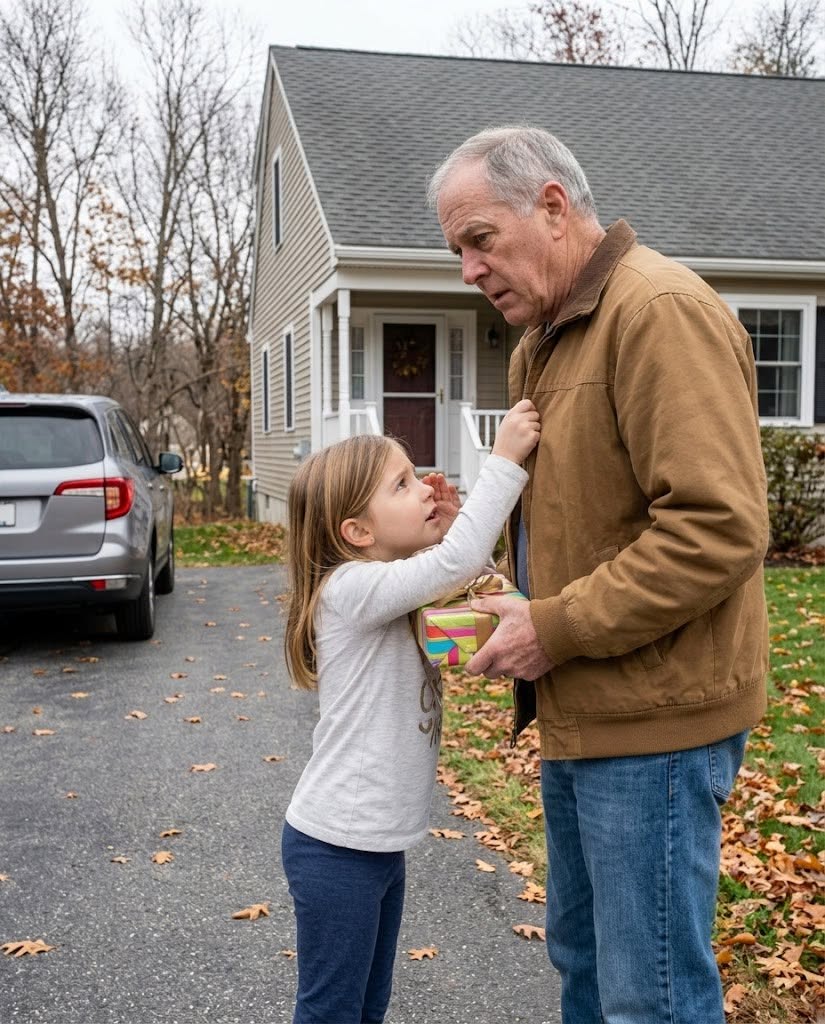
That Tuesday had started with nothing more alarming than a badly wrapped birthday present on the passenger seat of my car.
Late October had turned cold enough that I drove with the heater on low, one hand on the wheel and the other occasionally reaching over to make sure the box had not slid onto the floor.
The ribbon kept curling up on one side.
I had tried twice to flatten it before leaving home.
Lily would not care.
She had never cared whether I could wrap a gift properly.
She cared about getting to tear it open.
At least, that was what I expected.
I pulled into my son’s driveway thinking about an eight-year-old’s birthday and whether Mark would tease me about the crooked paper.
Natalie opened the front door before I finished knocking.
“Mark’s at work,” she said.
That was all.
No hello.
No smile.
Nothing openly hostile, either.
Just a flat statement delivered from the doorway.
I remember thinking the house was unusually quiet.
Not peaceful.
Quiet. There is a difference. A home with a child in it usually has some kind of movement leaking from one room into another—a television, shoes on a floor, a drawer closing, a voice calling from somewhere down the hall. That afternoon, I heard almost nothing. Then I spotted Lily through the back of the house. She was outside on the tire swing in her pink hood, dragging the toes of her sneakers through the mulch. The moment she saw me, her whole face changed. For one second, she looked like the Lily I expected to find on her birthday. Then her eyes moved toward the kitchen window. It was quick. But I noticed. I had spent too many years around structures to dismiss small changes simply because they were small. On bridges and retaining walls, the first warning was rarely dramatic. A seam widened. A surface shifted. Water appeared where water had never appeared before. One detail by itself might mean nothing. Several details, placed in the right order, could mean everything. I went outside and sat beside Lily on the back steps. I handed her the present. Normally, she would have attacked the wrapping paper before I finished telling her to be careful with the ribbon. This time, she did not tear anything. She ran one finger along the tape. Then she leaned toward me. “Grandpa, can you ask Mom to stop putting things in my juice?” I kept my hands exactly where they were. I did not want my face to frighten her. “What things?” She looked down at the package. “I don’t know. Mom says vitamins.” That was the moment my birthday visit became something else. I still did not know what Lily meant. I did not know whether she had misunderstood something ordinary, whether the taste of a supplement bothered her, or whether there was another explanation none of us had considered. So I asked about what she actually experienced. Not what she thought it was. Not what she thought her mother intended. What happened to her afterward? Her answer made the cold air feel sharper. Her legs felt “floaty.” She slept for a long time. Sometimes she could not remember the morning. I did not tell her what those symptoms might mean. I did not know. I also did not march into the kitchen and confront Natalie. That choice mattered. Anger would have been easy. Certainty would have been easy too. But neither one would have helped Lily if I was wrong about what I was hearing. What she needed was an adult who would take her seriously without teaching her what answer to give next. So I made the next decision practical. We were going to the pediatrician. I called Mark from the car. “I’m taking Lily out for lunch. Meet me at the pediatrician’s office.” His voice changed immediately. “Dad, what happened?” I watched Lily through the mirror. “Don’t call Natalie yet.” I gave him no dramatic explanation over the phone. I wanted him there. I wanted a doctor asking the questions. And I wanted Lily to tell the same story in her own words, without three frightened adults talking over her. Twelve minutes later, my phone buzzed. Natalie had sent a message. “She already ate.” I read it once. Then again. She had not asked where we were going. She had not asked what Lily wanted for lunch. She had simply told me that Lily had already eaten. By itself, that message proved nothing. I knew that. I kept reminding myself of it all the way to the doctor’s office. One strange sentence could not become a verdict simply because I was scared. Mark arrived looking like he had left work as fast as he could without thinking about anything except his daughter. He asked me what Lily had said. I told him as carefully as I could. His first reaction was not anger. It was disbelief. Then he looked at Lily. That was harder for him. She was sitting in the exam room as though this were any other appointment. A nurse came in and began asking questions. Lily answered in the same plain way she had answered me. “The bedtime juice makes me floaty,” she said. The nurse’s pen stopped. Only for a moment. Then she continued. I watched Mark notice it too. The pediatrician came in, listened, and did not rush to a conclusion. That steadiness helped more than panic would have. He ordered blood work, urine testing, and a toxicology screen. The word toxicology landed heavily in the room. Mark shifted in his chair. Lily asked if she could keep coloring. The doctor told her she could. So while adults quietly confronted possibilities none of us wanted, Lily worked on her purple house. Waiting became its own kind of pressure. Mark wanted to call Natalie. I could see it every time he touched his phone. He wanted her to tell him there was an innocent explanation. He wanted to hear something that would put the world back where it had been that morning. But he also understood why the doctor had asked us not to turn the appointment into a confrontation before the testing was reviewed. Fear has a way of making people race ahead of facts. The doctor seemed determined not to let us do that. At 3:52 p.m., he came back carrying several printed pages. That exact time stayed with me because I had looked at the clock just before the door opened. He stepped inside and closed the door behind him. His manner had changed. Not dramatically. That almost made it worse. “Mr. Whitaker, before anyone calls Natalie, I need you to look at this.” Mark took the pages. His eyes moved downward. Then stopped. One line had been circled. I watched my son’s face change before I ever saw the page clearly myself. His grip tightened. The paper bent slightly beneath his thumb. For several seconds, he said nothing. The doctor moved the results so both of us could see them. He explained that what he was looking at could not responsibly be separated from Lily’s symptoms and the timeline she had described. At the same time, he refused to turn a laboratory result into a story the evidence had not yet told. That distinction mattered. Mark wanted certainty. What he received was something more difficult: a serious concern that now had to be handled carefully. He looked toward Lily. She was filling in the roof of the purple house. Her feet did not reach the floor. That image nearly broke him. “She told you this happens after the juice?” he asked me quietly. “That’s what she told me.” He turned to the doctor. The doctor went through the sequence again. Lily drank something she called her bedtime juice. She said her mother described what was added as vitamins. Afterward, Lily reported feeling “floaty,” sleeping for unusually long stretches, and sometimes being unable to remember the morning. Those were the facts available to us. Nothing more needed to be added to make them frightening. The doctor asked when Mark had first noticed Lily sleeping longer than usual. Mark struggled with the question because, until that afternoon, he had never organized ordinary mornings into a timeline. A child being sleepy could be a child being sleepy. A rushed breakfast could be a rushed breakfast. A forgotten conversation could be dismissed as an eight-year-old being distracted. That was what frightened him now. Not one giant memory. Dozens of ordinary moments suddenly asking to be reconsidered. He rubbed both hands over his face. “How long?” he said. It was not clear whether he was asking the doctor, me, or himself. The doctor did not guess. Instead, he kept bringing us back to what could actually be established. When had Lily experienced the symptoms? Were they associated with a particular routine? Who was present? What had Lily herself said before adults began interpreting it? The questions were becoming more important than our assumptions. Mark picked up his phone. His thumb hovered over the screen. For most of his marriage, calling his wife would have been the automatic response to anything involving Lily. Now the same action felt different. He wanted to ask Natalie what she had been putting in the juice. He wanted to demand an explanation. He wanted to hear her voice and decide within the first three seconds whether she sounded surprised. But none of those things would change the papers on the exam-room counter. None would change what Lily had already told two adults in separate moments. And none would make an impulsive accusation safer for his daughter. Mark lowered the phone. He set it beside him. The doctor continued talking about the importance of documenting exactly what Lily had reported rather than feeding her details or repeatedly asking the same leading questions. I looked at my granddaughter and understood why restraint mattered. Adults can turn fear into noise very quickly. Children should not have to carry that noise for us. Lily held up her picture and asked whether the chimney should be purple too. Mark swallowed before answering. “Whatever color you want, sweetheart.” She chose purple. Of course she did. For a few seconds, the room looked almost normal. A father sat beside his daughter. A grandfather held a crookedly wrapped birthday present. A child colored a house. Then Mark’s eyes drifted back to the circled line. Normal was no longer something any of us could assume. The doctor asked us to think carefully about Lily’s routine without turning every memory into proof. That was harder than it sounded. Once fear enters a family, it tries to rewrite everything that came before it. A quiet breakfast becomes suspicious. A long nap becomes suspicious. A text message becomes suspicious. Even kindness can be dragged into the new story and examined from every angle. I did not want that for Lily. I wanted facts. I wanted her safe. And, as painful as it was, I wanted Mark to have enough clarity that whatever he did next would be about protecting his daughter rather than punishing someone before he understood what had happened. That was when I remembered Natalie’s message again. “She already ate.” I showed it to the doctor. He read it without changing expression. Mark stared at the screen. “Why would she send that?” I shook my head. “I don’t know.” That was the only truthful answer. We did not know. The message could not carry more meaning than it actually contained simply because the afternoon had become frightening. But it now belonged to the timeline. So did Lily’s whisper. So did the symptoms she described. So did the test results in Mark’s hand. The doctor arranged the pages on the counter and went over them again, slowly enough that neither of us could pretend we had misunderstood his concern. Mark asked the same question in several different forms. Could there be another explanation? Could the result mean something else? Could Lily have gotten into something accidentally? The doctor answered cautiously, never offering the certainty Mark was desperate to hear in either direction. Medicine could tell us some things. It could not manufacture a complete history out of one afternoon. That history had to be built from reliable information. Mark’s shoulders dropped. For the first time since he arrived, he looked less angry than exhausted. “I should have noticed,” he said. I did not tell him he should have. I did not tell him he should not have. Neither statement would have helped. Instead, I slid Lily’s birthday present farther from the edge of the chair before it could fall. The ribbon was still sticking up. That ridiculous detail gave me something ordinary to do with my hands. Lily finally reached for the package. “Can I open it here?” “Sure,” I said. She began picking carefully at the tape instead of ripping through the paper. Mark watched her for a moment. Then he looked at me. There are conversations between fathers and sons that happen without words. That was one of them. He knew I had brought Lily to the doctor because I was afraid. I knew he was fighting the instinct to make one phone call and demand that his world explain itself immediately. Neither of us knew what would happen when Natalie learned where we were. Neither of us knew what explanation she might give. And neither of us could responsibly fill those blanks ourselves. The doctor gathered the papers into a neater stack. Mark picked up his phone again, not to dial, but simply to hold it. It had become the object separating two versions of his life. On one side was the morning he had gone to work believing his daughter was home and safe. On the other was an exam room, a toxicology screen, and an eight-year-old describing a drink that made her legs feel “floaty.” He put the phone back down. Then the doctor looked from Mark to me. His expression was serious, but controlled. He was not interested in giving us a dramatic line. He wanted one missing piece of the timeline clarified before anyone contacted Natalie. He pulled his chair closer. Mark stopped moving. I rested one hand on the edge of Lily’s birthday box while she peeled another strip of tape away. And then the pediatrician asked the question that made both of us realize the next decision could not be made the way ordinary family arguments were made.