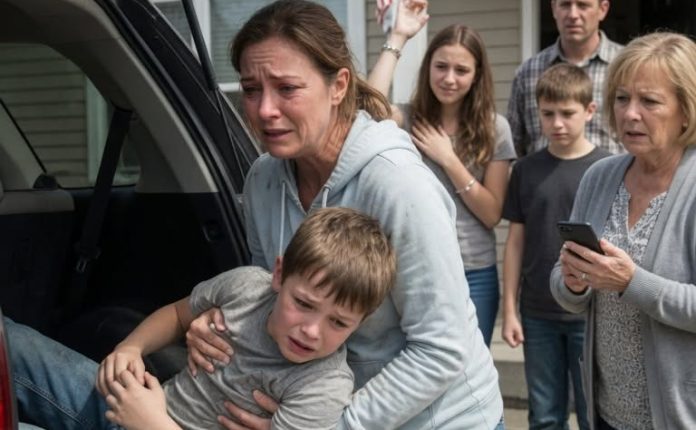
Three weeks after my divorce papers were signed, I rented a small pale-blue house in Cedar Falls, Iowa, and tried to believe it was the place where my ten-year-old daughter, Emma, and I could finally start over.
I wanted the house to mean something simple.
A clean break.
A front door that belonged to us. Rooms where nobody raised their voice. A kitchen where I could put a glass on the counter without wondering whether the smallest ordinary mistake was about to become an argument.
The hardwood floors creaked under our socks while we carried boxes from room to room, and the kitchen smelled faintly of lemon cleaner mixed with cardboard dust.
At sunset, the maple trees behind the backyard fence scattered patches of gold across the grass, and for a few minutes the whole place looked almost unreal in its calm.
After the last year of my marriage, calm felt precious.
There were no slammed doors.
There was no standing in a hallway rehearsing a sentence before I said it because I was trying to predict how it might be twisted.
There was no measured, reasonable voice telling me I was unstable whenever I finally pushed back.
I kept reminding myself that the divorce was over.
The papers were signed.
We had moved.
This was supposed to be the part where Emma and I learned what normal felt like again.
Emma had always noticed things adults missed.
Even before the divorce, she could tell when people were pretending everything was fine. She noticed changes in tone, doors left open, cars parked where they usually were not, and the way grown-ups stopped talking when a child entered the room.
Since the move, that alertness seemed sharper.
The first time she mentioned the neighbor’s truck circling the block twice, I told her the driver probably forgot something.
When she found the back gate standing open after I was certain I had latched it, I blamed the old hardware.
When she pointed out fresh scratches around the trim of the hallway closet, I ran my fingers over the marks and told her the previous tenants had probably moved something bulky through there.
Every explanation sounded reasonable when I said it aloud.
Maybe I needed them to sound reasonable.
I told myself we were both still jumpy from everything that had happened.
We unpacked dishes slowly because neither of us had much energy left by the end of the day.
One evening, we ate Chinese takeout on the living room floor because I had somehow misplaced the screws for the kitchen chairs during the move.
Emma sat cross-legged beside an open box, arranging her books on the window seat one by one.
Ten minutes later, she took every book back down again.
I watched her without asking why.
That night, she asked if she could sleep with the hall light on.
I said yes immediately.
Every yes felt like another brick in the safe home I was trying to build around her.
Yes, you can leave the light on.
Yes, you can keep your door cracked.
Yes, you can sit beside me while I unpack.
Yes, we can take our time.
What I wanted most was for her to understand that this house was different from the life we had left.
But Emma never once said she liked it there.
On the fourth afternoon, I was standing at the kitchen sink rinsing strawberries when she came beside me.
Her hoodie sleeves were pulled down over her hands, and she was staring past me toward the sliding glass door.
“Mom, I don’t think we should stay here.”
I turned off the faucet.
The sudden quiet made the refrigerator hum seem louder.
“Why?”
She did not answer right away.
Her eyes stayed on the backyard.
“I don’t know,” she said. “I just think we have to leave. Soon.”
The word soon landed differently than the rest.
Not someday.
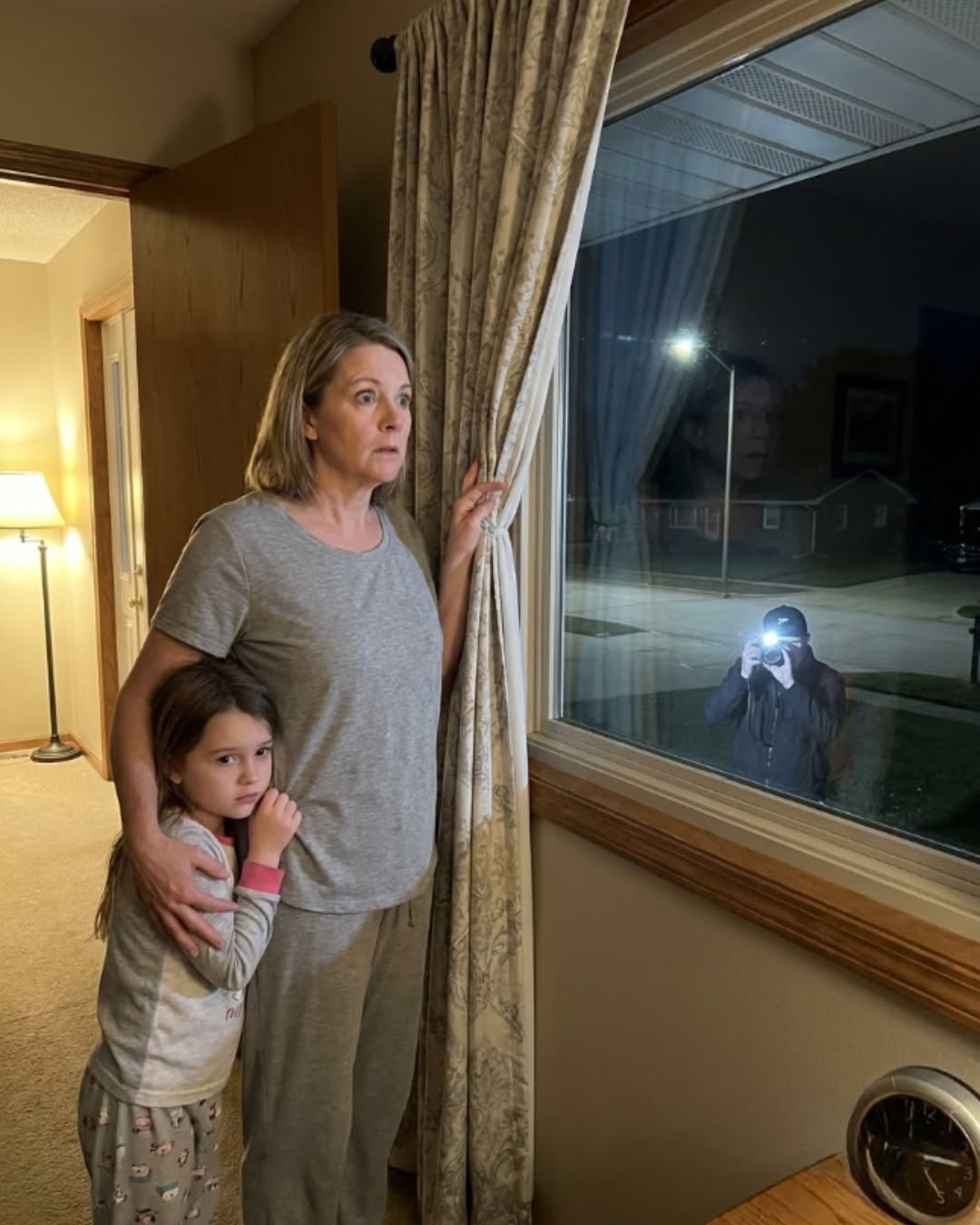
Not because she hated the room or missed our old neighborhood. Soon. I dried my hands and crouched enough to look at her face. That was when she told me about the man. She said she had seen him near the back corner of the fence. Dark jacket. Baseball cap. Standing completely still. He had not been walking a dog or checking a phone or doing anything that gave him an ordinary reason to be there. He was simply standing near the fence. Watching. Emma said that when she looked directly at him, he walked away. That should have been enough for me to stop explaining things. Instead, I reached for another ordinary answer because my life already felt too broken to hold another frightening possibility. Maybe he lived nearby. Maybe he had been cutting through the area. Maybe Emma had frightened herself because everything was unfamiliar. I checked the locks anyway. I pulled the blinds closed before dark. I walked through the house testing windows and doors, then went back and checked the back gate twice. Afterward, I told Emma that new houses could make our brains look for danger because we had not learned all their sounds and shadows yet. She listened quietly. Then she shook her head. “It’s not the house,” she said. I carried those words to bed with me. Sometime after midnight, I finally fell asleep. At 2:17 in the morning, Emma grabbed my shoulder hard enough to hurt. I opened my eyes and saw her beside the bed, pale in the darkness. “Mom,” she whispered. “Look out the window.” My first thought was that she had heard an animal. My second was that maybe someone had driven into the wrong driveway. Then I saw her face. I got up. We moved carefully toward the window, and I pulled the curtain back only far enough to look through the glass. Across the street, beneath a dead streetlamp, a man was standing perfectly still. He was facing our house. The distance should have made him seem less threatening. It did not. There was something in the way he stood there, without hesitation or embarrassment, as though he believed he had every right to watch us. Emma pressed against my side. Something round caught what little light there was when the man lifted one hand. For one second I could not understand what I was seeing. Then I recognized the shape. A camera. He raised it toward our window. My stomach dropped. I could feel Emma clutching the back of my shirt. The lens pointed directly at us. Then a white flash ripped through the darkness. He had taken our picture. I slammed the curtain shut so quickly the rod rattled against the wall. My hands were shaking when I grabbed my phone and called 911. I gave the dispatcher our address. I described the man’s dark jacket and baseball cap. I described his approximate height and the exact place where he had been standing. I kept my voice as steady as I could because Emma was watching me, and I did not want my fear to become hers. When I looked outside again, he was gone. The empty spot beneath the streetlamp scared me almost more than seeing him there. A patrol officer searched the block, the alley, and the fence line. I stayed close to Emma while he checked around the house. When he came back, his questions became more specific. Was I involved in a custody dispute? Was my ex-husband angry about the divorce? Had anyone learned our new address unusually quickly? I answered no too fast. I heard it myself. The officer heard it too. The truth was more complicated than the answer I had given him. My ex had made custody threats. He had spent months describing me as impulsive and unstable whenever it suited him. He had a way of turning ordinary disagreement into evidence that I was supposedly incapable of making good decisions. But I still resisted connecting that history to the man outside. Maybe I was afraid that saying the possibility aloud would make it real. Maybe part of me was still trained to question my own instincts before I questioned his intentions. The officer eventually left after telling me to keep the doors secured and call again if I saw anything else. Emma did not go back to sleep. Neither did I. We stayed together until the darkness outside the windows began turning gray. At sunrise, I opened the front door. A large brown envelope was lying on the doormat. I stopped with one hand still on the knob. It had not been there when the officer arrived. I knew that because I had stood in that doorway while talking to him. For several seconds, I simply stared at it. Then I brought it inside. There were six printed photographs in the envelope. The first showed me unloading a lamp on moving day. I remembered that moment because the lamp had nearly slipped out of my hands while I was trying to balance it against my shoulder. At the time, the street had seemed quiet. Now I looked at the photograph and realized someone had been watching. The second picture showed Emma alone on the front porch holding her stuffed rabbit. My breathing changed when I saw that one. It was no longer possible to pretend the person with the camera had simply been interested in me. He had been watching my daughter too. Another photograph had been taken through the backyard fence. Another showed our kitchen window from such a close angle that I could see my own hand resting on the counter. I thought about the open gate. The scratches around the closet. The man Emma had seen near the fence. All those explanations I had offered began collapsing at once. The final photograph was the one that made everything inside me go cold. On the back, written in hard block letters, were two words. STABILITY MATTERS. I knew that phrase. My ex-husband had repeated it throughout the divorce. He had used it in mediation. He had written it in emails. He had used the same words in the calm courtroom voice he adopted whenever he wanted to sound reasonable while presenting me as reckless. Stability matters. He had said it so many times that the phrase had almost stopped sounding like language. Now it was written on the back of a photograph taken outside the home where my daughter and I were supposed to be safe. When the police returned, I did not give the quick, easy answer anymore. I told them about the custody threats. I told them about the accusations. I explained how often my ex had used that exact phrase. Then I remembered something else I had worked hard not to examine too closely. The rental listing. My ex-husband’s sister had sent it to me through what she described as a “friend of a friend.” At the time, I had been grateful. The house was affordable. It was available immediately. There had been almost no hassle. I had needed somewhere to go, and I had interpreted the easy rental as luck arriving at the exact moment I needed it. Standing there with those photographs in front of us, the memory no longer felt lucky. The officer’s expression changed as I explained it. He asked me more questions about how I had found the property and who might have known we were moving there. I answered everything I could. Then Emma spoke. Her voice was so quiet at first that I almost missed it. “There’s something else.” I turned toward her. She looked embarrassed, as though she expected me to tell her she had imagined this too. She said that on some nights she heard someone moving above her ceiling. Not loud footsteps. Careful movement. A faint shift overhead. The kind of sound that stopped the moment she sat up in bed. My first reaction was disbelief, but this time I did not say it. I did not give her an explanation. I asked her where she heard it most clearly. She pointed toward her bedroom ceiling. The attic hatch was inside the hallway closet. The same closet with the scratches around the trim. We walked toward it together, but the officer stopped Emma and me before we got too close. Now the marks looked different. They were not random scratches from moving furniture. They clustered around the attic opening. Dust lay along the edges, except for one thin curved arc where the panel had recently shifted. I remembered touching those marks days earlier and telling Emma they were nothing. I could barely stand looking at them now. The officer ordered us to stay back. He reached up and hooked the pull cord with two fingers. The hatch opened. A wave of stale, warm air rolled down into the hallway. Nobody spoke. I stood behind Emma with both hands on her shoulders. The opening above us looked impossibly dark compared with the bright hallway below. Then we heard it. Directly above Emma’s bedroom came the slow scrape of someone moving across the ceiling joists.