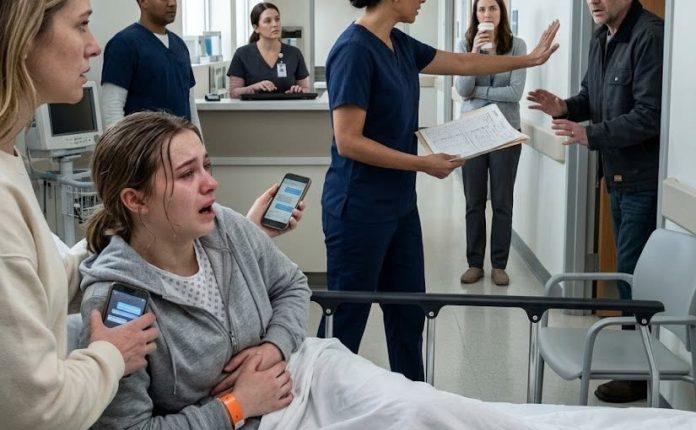
My eight-year-old son was lying in a hospital bed after three grown men pinned him down while his own grandfather attacked him.
When I finally reached him, he squeezed my hand and whispered, “Daddy… Grandpa said you weren’t coming.”
They thought I was just another suburban father who couldn’t protect his family, but they had no idea what life I had left behind—or the promise I was about to break.
The first thing I noticed inside the hospital wasn’t the noise.
It was the light.
Fluorescent bulbs buzzed above me while doctors moved quickly through the hall and nurses pushed equipment past the waiting room.
My phone kept vibrating in my pocket.
Christine had called eight times.
My wife wasn’t at the hospital.
She hadn’t followed the ambulance, called the doctors, or asked anyone whether our son was still conscious.
She was still at her father’s house—the same house Jake had just escaped from.
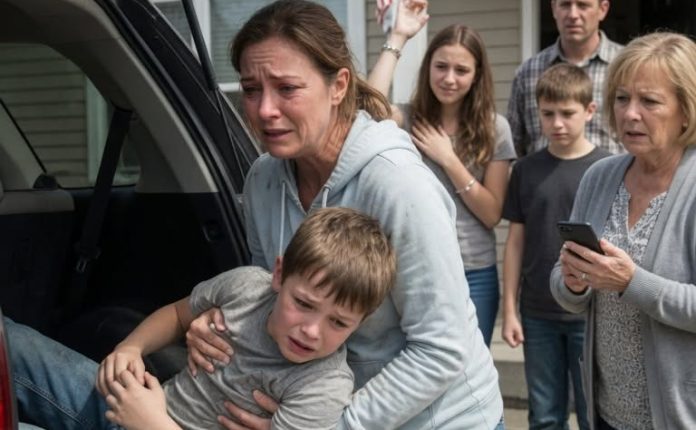
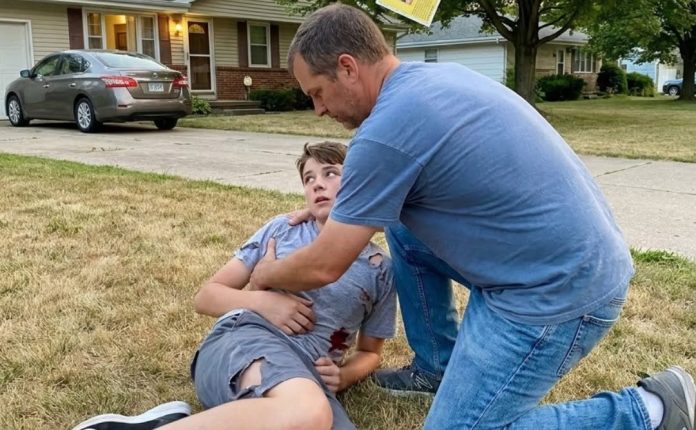
An elderly neighbor had found him stumbling along the sidewalk alone with blood running from his ear and one sneaker missing.
She called for help while Christine stayed behind with her father, Brian, and Scott.
The doctor told me Jake had suffered a serious concussion and needed additional scans because they were watching for swelling.
I heard every word, but my mind kept returning to that morning.
My biggest concern had been getting Jake to soccer practice on time.
Our weekends were usually cartoons, burnt pancakes, and Lego bricks scattered across the living room floor.
Now my eight-year-old was behind a hospital curtain with half his face swollen.
When the doctor said Jake was awake and asking for me, I followed her down the hallway and forced my anger somewhere deep inside my chest.
Jake didn’t need my rage.
He needed his dad.
He looked impossibly small beneath the white blanket, with purple bruising along one side of his face, small cuts on his cheek, and dried blood near his hairline.
His eyes opened slowly when I entered.
“Dad…”
I sat beside him and took his hand as carefully as I could.
“I’m here, buddy. I’ve got you.”
His fingers tightened around mine.
“I tried to run,” he whispered.
Then he told me what happened.
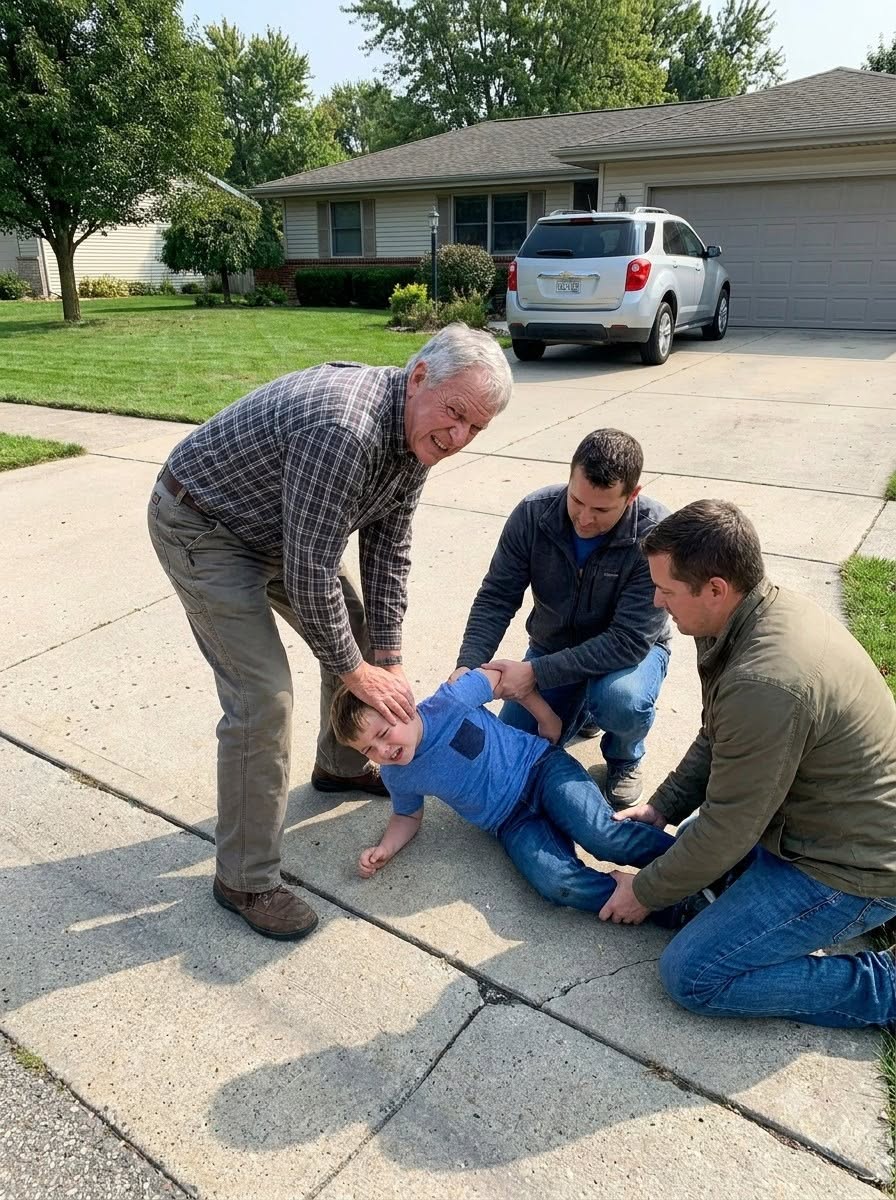
His grandfather had become angry because Jake defended me during an argument.
Brian grabbed Jake’s arms.
Scott held his legs.
Then his grandfather slammed his head against the driveway.
The monitor beside the bed continued beeping with the same calm rhythm while my son described three grown men surrounding him.
“Grandpa said, ‘Your daddy isn’t here to protect you,’” Jake whispered.
I kissed the uninjured side of his forehead.
“I’ll always come for you.”
His grip tightened again.
Then he said the words that cut even deeper.
“Mom didn’t stop them.”
Christine had called eight times, but she had never come to the hospital. She had stayed inside that house while our son stumbled into the street wearing one shoe. I stepped into the hallway and looked back through the glass. Jake was watching the doorway, making sure I hadn’t disappeared. My hand moved toward my phone. I didn’t call Christine. I didn’t call her father. I opened an encrypted app I hadn’t touched in years and scrolled to a contact saved without a name. It belonged to a life I had walked away from and promised myself I would never return to. I pressed the call button. The connection opened almost immediately. “I was wondering if I’d ever hear from you again,” a familiar voice said. Through the glass, I watched Jake pull the blanket closer to his chest. “I need your help.” There was a brief pause. “Who are we dealing with?” I gave him Christine’s father’s name, the names Brian and Scott, and the address of the suburban house where Jake had been hurt. He didn’t ask me what I wanted done to them. He knew me well enough to ask a different question. “What are the rules?” That was the question people used to ask me when the next decision could ruin several lives. I looked at Jake through the glass again. “Nobody touches them,” I said. “Nobody threatens them. I need the truth preserved before they rewrite it.” “And the boy?” “He stays safe.” “Then start with the calls.” I had spent years training myself not to react to the first version of a crisis. Panic made people loud, but facts were usually quiet. Dates, times, doors, vehicles, phone records, and the order in which people moved could tell a story long after everyone involved started lying. I had left that life because I was tired of measuring rooms by exits and judging strangers by their hands. I wanted burnt pancakes and soccer practice. I wanted to be ordinary. Christine had once made me promise that the people from my old world would never become part of our family’s life. I had kept that promise for years. Now I stood outside our son’s hospital room with the encrypted app glowing in my palm. “Save every voicemail,” the voice instructed. “Do not delete anything. Do not go to that house. Do not give them the reaction they expect.” “How do you know they expect one?” “Because your wife called eight times and never went to the hospital.” I ended the call and opened my voicemail. Christine’s first message lasted six seconds. “Please don’t come to Dad’s house. Just call me.” The second was almost identical. In the third, she sounded breathless. “You need to calm down before you do anything.” She still hadn’t told me what had happened to Jake. She hadn’t asked whether I knew he was in the hospital. In the fourth message, a man’s voice spoke in the background. It was her father. “Tell him to come here.” Christine whispered something I couldn’t understand. Her father spoke again, louder this time. “Get him here before he starts hiding behind doctors and lawyers.” My thumb stopped over the screen. I listened to the message again. Then I played the fifth voicemail. Christine was crying, but the words weren’t about Jake. “Dad says everyone needs to settle this face-to-face. Please don’t make it worse.” The eighth message was the longest. “Please answer. Dad says if you come over angry, everyone will finally understand what I’ve been dealing with.” I stood beneath the fluorescent lights and felt something colder than anger move through me. They weren’t only afraid I would come to the house. They wanted me there. They wanted the version of me Christine had described to them—the man I had worked hard to bury. If I arrived furious, broke down a door, or put my hands on any of them, the story would stop being about what they had done to Jake. It would become a story about me. My phone rang again through the encrypted app. “Did you hear it?” the voice asked. “They’re trying to bait me.” “Yes.” “They hurt my son, and now they want me to prove they were right about me.” “Then disappoint them.” I returned to Jake’s room. He watched me sit down and immediately reached for my hand. “Are you leaving?” “No.” “Mom kept saying it wasn’t supposed to happen,” he whispered. “Grandpa told her to call you.” I didn’t ask him anything else. He had already carried enough of the truth for one day. A nurse entered to check his pupils and adjust the monitor while I sat beside him, letting him hold two of my fingers. The old contact called again twenty minutes later. He had spoken to the neighbor who found Jake, but only after confirming that she was willing to help. Her doorbell camera faced part of the sidewalk and the edge of Christine’s father’s driveway. It hadn’t recorded the assault itself. It had recorded what happened afterward. The neighbor sent the original clip directly to me. Jake appeared first, staggering past a mailbox with one shoe on and one bare foot striking the pavement. Several seconds later, Christine came to the end of the driveway. She could see him. She could see the neighbor running toward him. She could see the ambulance turning onto the street. Christine took one step forward. Then her father appeared behind her and grabbed her arm. The camera’s microphone caught only pieces of the argument, but one sentence came through clearly. “Call your husband and get him here.” Christine pulled her arm free. “Jake needs me.” “The ambulance has him,” her father replied. “This is your chance to show everyone what your husband really is.” Brian stepped into view and said something too quiet for the microphone. Scott kept looking toward the street. Christine stood between the ambulance and the house for several seconds. Then she turned away from Jake and went inside. That was when she made the first call. I watched the clip three times. The first time, I saw a mother abandoning her injured child. The second time, I saw a daughter who had spent years obeying a controlling father. The third time, I understood the part that mattered most. Whatever pressure Christine felt, she had still made a choice. She chose the house. She chose her father. She left Jake alone in the street. My old contact told me to preserve the original clip, record when I received it, and provide it through the proper process once hospital staff completed their report. “They’re expecting you at the house,” he reminded me. “I’m staying here.” “Good.” “That isn’t what the old me would have done.” “The old you was useful because he could enter a bad situation. You survived because you eventually learned when not to.” An hour later, Christine arrived at the hospital. Her hair was uncombed, and she wore the same sweater she had been wearing in the doorbell footage. She looked toward Jake’s room, but a nurse stopped her before she reached the door. Jake had already told the medical staff he didn’t want to see anyone except me. Christine looked at me across the hallway. “Please,” she said. “I need to explain.” I asked the nurse for a private consultation room, but I kept the door open. I didn’t want another conversation that could be changed later. Christine sat across from me and twisted her wedding ring around her finger. “My dad lost control,” she said. “Brian and Scott were trying to stop everything from getting worse.” “They held Jake down.” “That’s not how they described it.” “Jake described it.” Her eyes moved toward the hallway. “He was scared. He could have misunderstood.” I placed my phone on the table and played the doorbell clip. Christine watched herself standing at the end of the driveway while the ambulance arrived. She watched herself turn away. When the recording ended, she covered her mouth with one hand. “Why did you call me eight times?” I asked. “I wanted you to know.” “Not one message mentioned that Jake was hurt.” She looked down. “Dad said you would come after him.” “He wanted me to.” Christine didn’t answer. “He wanted me angry, at his house, in front of Brian and Scott,” I continued. “He wanted me to give him a new story before anyone finished documenting the first one.” “I thought if you came, he would finally listen to you.” “You thought the man who had just hurt our son would become reasonable when I arrived furious?” Her voice cracked. “I didn’t know what else to do.” “You follow the ambulance.” She closed her eyes. “I was afraid you would take Jake away from me.” The honesty of that answer made the room feel smaller. She had not stayed because she believed Jake was safe. She stayed because she was afraid that helping him would cost her access to him later. She had protected her position as his mother instead of protecting the child who made her one. “I froze,” she whispered. “You made eight calls. You went back inside. You repeated what your father told you to say. That wasn’t one frozen moment.” Christine began to cry, but I didn’t feel victorious. I had loved this woman for eleven years. I knew the way her father could turn disobedience into betrayal and disagreement into shame. I also knew an eight-year-old boy was lying behind a hospital door because every adult in that driveway had expected someone else to stop what was happening. “You don’t get to see Jake tonight,” I said. “You can’t decide that alone.” “The medical team asked him who he feels safe with. He answered.” She stared at me. “Are you using your old connections against me?” “No. I’m using what Jake said.” The distinction mattered. My old life had given me tools, but it did not give me ownership of the truth. Jake had already spoken for himself. Hospital staff had documented his injuries before I arrived. The neighbor had called for help before anyone could coordinate a different story. Christine’s father had tried to turn me into the most dangerous person in the room, but every record showed that I was the one who stayed beside the bed. Two investigators arrived later that evening because of the hospital report. I gave them the original voicemails and the neighbor’s unedited video, then stepped back and let the facts belong to the process instead of to my anger. Christine initially repeated that Brian and Scott had been trying to restrain Jake for his own safety. Then one investigator asked why an eight-year-old would need both arms and both legs restrained on a driveway. Christine had no answer. They asked why she had not followed the ambulance. She said her father stopped her. They asked whether the door was locked. She said no. They asked whether anyone physically prevented her from leaving. She looked through the glass at Jake’s hospital room. Then she shook her head. Finally, she confirmed what Jake had told me. Brian held his arms. Scott held his legs. Her father slammed Jake’s head against the driveway after Jake yelled that I would come for him. Christine’s statement did not erase her failure, but it ended the family’s ability to pretend the assault had been a misunderstanding. Her father and brothers arrived in the hospital parking lot before midnight. They called Christine repeatedly and sent me messages demanding that I come outside. One message called me a coward. Another said a real father would face the men who had insulted his family. I remained in Jake’s room. My old contact, parked somewhere beyond the entrance, called once. “They’re here,” he said. “I know.” “Do you want me to move you?” I looked at Jake sleeping beneath the white blanket, his fingers still curled around the edge as though he expected someone to take it away. “No. They can stand outside all night. I’m exactly where I need to be.” Hospital security restricted their access, and the investigators spoke to them separately. I never went downstairs. I never gave them the confrontation they had prepared for. By morning, Jake’s scans showed no new swelling. The doctor said he would need rest, follow-up care, and close observation, but his condition had stabilized. Jake opened his eyes when sunlight began slipping through the blinds. “Did Mom come?” “She did.” “Is she mad at me?” “No one has the right to be mad at you.” He studied my face. “Did Grandpa leave?” “He can’t come in here.” For the first time since I arrived, Jake released the blanket. The man from my old life came to the hospital later carrying two paper coffee cups. He looked older than I remembered, but his eyes still moved automatically toward doors, hallways, and reflective surfaces. He handed me one cup without trying to enter Jake’s room. “You broke your promise,” he said. “I know.” “You called me. You opened the old channel.” “I had to protect my son.” He nodded toward the room. “You protected him by staying. That part didn’t come from us.” For years, I had believed my old life was defined by the things I knew how to do to dangerous people. That night reminded me that its most valuable lesson had always been restraint. Anyone could mistake rage for action. The harder choice was to remain beside the person who needed you while someone else tried to pull you into a fight. Jake was released into my care two days later. Christine agreed that she would not take him to her father’s home or arrange contact with her father, Brian, or Scott while the investigation and family proceedings continued. She moved out of our house voluntarily and stayed somewhere else. I changed the locks, not as punishment, but because Jake needed to know that no one could enter simply by claiming to be family. Christine wrote a statement describing what happened on the driveway and acknowledging that she had chosen not to follow the ambulance. She did not ask me to forgive her in the statement. That was the first honest thing she did after the attack. She wrote that she had spent most of her life managing her father’s anger by giving him what he wanted and telling herself that compliance prevented worse outcomes. When Jake challenged him, she fell into the same pattern. She tried to calm her father instead of protecting her son. Then, after Jake escaped, she allowed fear of losing her marriage and child to matter more than the child bleeding in the street. Understanding why she failed did not require me to pretend she hadn’t failed. Jake began speaking with a counselor and returned to school gradually. For several weeks, he refused to walk near the end of our driveway alone. He slept with the hallway light on and checked the front window whenever a vehicle slowed outside. I stopped telling him there was nothing to fear. Instead, I showed him what had changed. The doors were locked. The visitor list was controlled. His mother could not arrive without warning. His grandfather and uncles had no access to him. When Christine was eventually allowed a carefully arranged visit, she entered the room without reaching for Jake. She sat several feet away and waited until he looked at her. “I should have gone with you,” she said. “I should have followed the ambulance, and I didn’t.” Jake stared at the floor. Christine did not ask him to hug her, forgive her, or make her feel like his mother again. She stayed in the chair and accepted the silence she had earned. Their relationship did not repair itself in one afternoon. Some weeks Jake wanted to see her. Other weeks he refused. I let his sense of safety matter more than either adult’s discomfort. The investigation continued, and the adults responsible faced consequences through a process that moved far more slowly than my anger wanted it to. I stopped measuring justice by how quickly someone was punished. The first real consequence had already happened inside the hospital. Jake was believed. He was no longer required to enter that house, defend what happened, or sit beside the people who hurt him while they explained themselves. Three months later, his doctor cleared him to return to soccer practice. On the first Saturday morning back, I burned the pancakes because I kept checking the clock. Jake came downstairs wearing a clean jersey and carrying a new pair of sneakers. He sat on the bottom step and tied both shoes slowly. When we reached the field, he ran toward his team, then stopped halfway and looked back. I was standing beside the fence with his water bottle in one hand and my paper coffee cup in the other. He watched me for a moment, as if confirming that I had not disappeared. Then he lifted his hand. I lifted mine back. After practice, he climbed into the family SUV and dropped his cleats on the floor mat. “You came early,” he said. “I told you I would.” That evening, Jake left both sneakers beside the front door, where he could see them from the stairs. I turned on the hallway light before he asked and sat at the kitchen table while he built a crooked Lego tower beside me. Every few minutes, he glanced up to make sure I was still there. Every time he looked, I was.