
The packet was not a warning.
My parents planned to take Lily to Monday’s appointment and use the recording, their pickup history, and my emergency contact card to ask for temporary custody before I could respond.
A handwritten note beneath the appointment page said, ‘Bring Lily, school file, overnight calendar.’
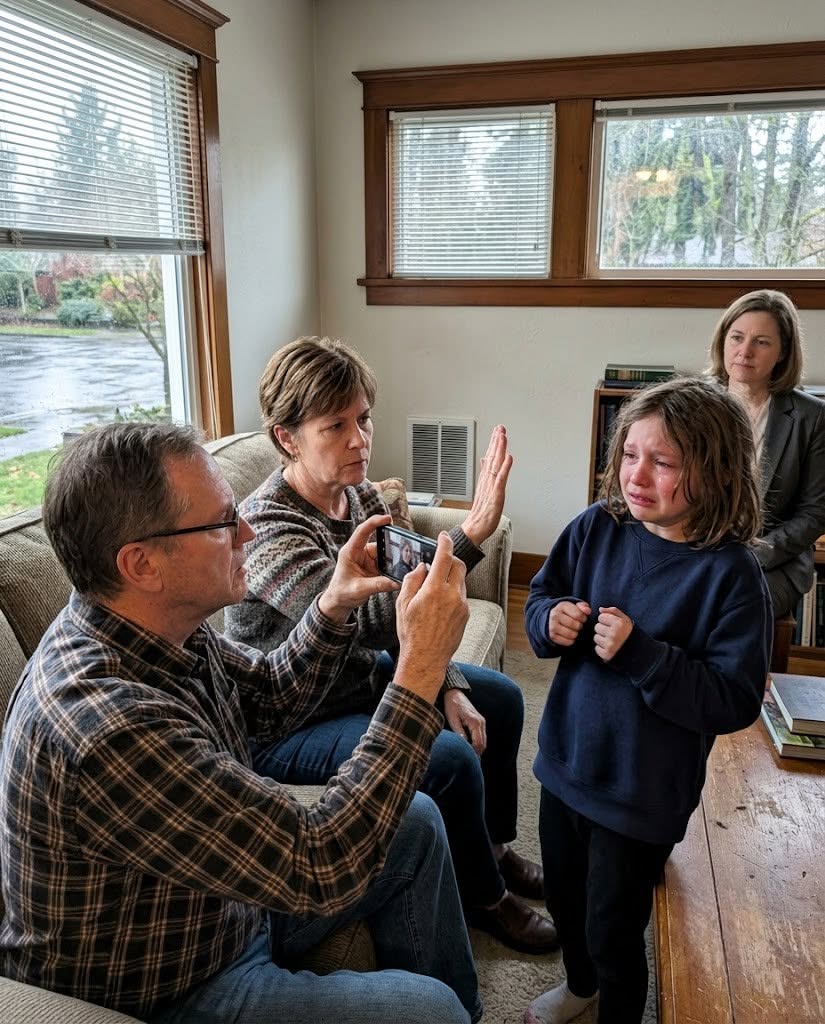
There was no overnight calendar in the sleeve.
They intended to make one.
I photographed every page on the kitchen floor while Lily sat on the couch watching the same cartoon episode twice.
The eggs were still on the table, and a strawberry heart had dried against the edge of her plate.
When I reached the final page, I found a blank statement titled ‘Immediate Safety Concerns.’
My mother had already written my name at the top.
Nothing had been filed yet, but they had prepared the shape of the accusation and left spaces for details they could add later.
I stayed quiet.
After returning the originals to the plastic sleeve, I opened Lily’s school portal and removed my parents from the emergency contact section.
A red banner appeared across the screen.
Changes submitted outside office hours required staff approval.
Until someone approved them, the old CARD remained active.
I emailed the principal, the attendance office, and the address printed on the law firm’s appointment sheet.
I wrote that Lily had been questioned without my permission, coached to make false statements, and recorded while distressed.
I asked the school to preserve every pickup record connected to my parents and instructed the law office not to communicate with Lily.
Before sending anything, I read each sentence aloud to make sure it contained facts rather than anger.
Lily came into the kitchen carrying one sock and asked whether she could have cereal instead of eggs.
I poured it for her.
At 11:26 that morning, I pressed send on all three messages and revoked the access my parents had spent years calling help.
The law office replied first.
Its automatic message said the building would reopen Monday at eight.
The school portal sent a confirmation number, but the contact names did not disappear.
My mother texted sometime that afternoon.
She asked whether Lily had slept well and reminded me that the blue coat in their hallway belonged to her.
The message sounded ordinary enough to make me feel sick.
I placed the phone facedown beside the sink and asked Lily what she wanted for lunch.
She wanted noodles without sauce.
While the water heated, she stood on a chair and watched the bubbles form, pressing both palms against her knees whenever the pipes knocked.
I asked whether Grandma had explained Monday’s appointment.
Lily nodded.
She said Grandma had promised they were going to meet another nice woman who would help make sure Lily never had to be alone again.
‘But I’m not alone,’ she said.
I told her I knew.
Then she said my parents had shown her the guest room and called it her new bedroom.
They had moved the exercise bike into the garage and placed several of her old drawings above the bed.
One drawing showed a purple horse with six legs.
My father had written ‘Lily’s Room’ on a strip of masking tape across the door.
The preparation had started before my trip.
That was the first reversal I could not explain away as panic, overprotectiveness, or one of my mother’s dramatic threats.
They had created a destination for the story they were forcing Lily to tell.
I took the noodles off the stove before they softened and sat beside her with my own bowl untouched.
Instead of asking what else happened, I asked what she needed from me that day.
‘Don’t make me talk to them,’ she said.
I promised they would not speak to her unless she wanted them to.
She ate seven noodles.
Later, I called Mara again.
She answered from a grocery store, with cart wheels rattling behind her and someone announcing a discount on peaches.
I told her about the packet, the recording, and the room labeled for Lily.
Mara went silent long enough for the store announcement to repeat.
Then she said, ‘Mom asked me something last month, but I thought she was venting.’
My mother had wanted Mara to confirm that Lily stayed with our parents whenever I traveled and that they handled most school emergencies.
Mara had replied that she did not know enough about my schedule to say that.
She had never told me.
‘She talks like every disagreement is a court case,’ Mara said.
Even with the packet in front of me, she still treated my mother’s behavior as noise that had accidentally become dangerous.
I asked her to forward the messages without adding explanations.
She sent six screenshots.
In the first, my mother called herself Lily’s consistent maternal figure.
In another, she claimed my work travel had increased, although this Europe trip was my first overnight business trip in nearly eight months.
The last message asked Mara to remember how often Lily had ‘needed rescuing.’
Mara had answered with a thumbs-up because she was boarding a flight and wanted the conversation to end.
My mother had replied, ‘Thank you, that helps.’
It did help.
Just not in the way she expected.
The screenshots showed her gathering supporting language before Lily ever entered that house.
I saved them with the packet photographs, then wrote a timeline beginning with the date my parents first offered regular school pickups.
For almost two years, their access had looked harmless in isolation.
A pickup when my meeting ran late.
A dentist appointment when I had the flu.
One overnight stay during a winter storm.
On paper, those favors could be arranged into a different story.
By Sunday morning, my timeline contained thirty-one dates.
Some were exact.
Others were marked only as sometime after school or during the week before Thanksgiving.
I did not fill gaps with guesses.
Lily slept until almost ten, then wandered into the hallway wrapped in her blanket and asked whether Monday was still a school day.
The house felt cold because I had forgotten to reset the thermostat after my trip.
I said she would go to school only after I spoke with the office in person. She considered that while rubbing the corner of her blanket across her lips. ‘Can I still bring my whale book?’ she asked. I said yes. At 3:14 Sunday afternoon, the school principal called from her personal phone. She had read my email and pulled Lily’s electronic sign-out history from the previous academic year. My parents had collected Lily twenty-three times. I had requested twelve of those pickups. The remaining eleven had been approved at the front desk because my parents were listed on the CARD and told staff I was unavailable. No one had called me afterward because Lily left calmly with familiar grandparents. My stomach tightened so sharply that I leaned against the refrigerator. The motor hummed against my shoulder, and a coupon magnet slid to the floor. I asked for copies of every sign-out entry and any notes attached to them. The principal hesitated. She said several records described my mother as providing ‘routine family care.’ One entry said I was traveling when I had actually been working twelve minutes from the school. Another said my father would keep Lily overnight because I could not be reached. That night, Lily had been home with me before dinner. My parents had not only used the access. They had been building the language around it. The principal approved my contact change, but she could not erase the records or rewrite what staff had been told. The CARD vanished from the current portal at 3:39. The history remained. For three minutes, I believed removing their names had taken control back. Then the principal told me my mother had called the school Friday morning and asked what documents a grandparent needed during a family emergency. She had also said I might return from Europe emotionally unstable. I lost the ground I had just gained. Even after the CARD disappeared, my mother’s version of Monday was already waiting inside the school office. I asked the principal to add one instruction in plain language: Lily could leave only with me. The principal entered it while we were still speaking and agreed to meet me at 7:35 Monday morning. After the call, I opened the refrigerator three times without taking anything out. Lily sat under the dining table arranging paper clips by color. I crawled beneath it and told her Grandma and Grandpa would no longer be allowed to pick her up from school. She looked at me carefully. ‘Even if they say you said yes?’ ‘Even then.’ Her shoulders lowered. That small movement gave me more useful information than another hour of questioning could have. Rather than spend Sunday trying to prove my parents were cruel, I documented the ordinary systems they had learned to manipulate. The pickup desk. The emergency form. The friendly explanations offered when no one expected a lie. Before dinner, Mara came over with the blue coat my mother had left on her porch. She carried it by two fingers as though it smelled bad, although it only smelled like my parents’ cedar closet. Inside one pocket, I found three folded index cards. Each contained a question in my mother’s handwriting and a sentence beneath it for Lily to memorize. One read, ‘What happens when Mommy travels?’ The answer beneath it said, ‘I stay with Grandma because Mommy is gone a lot.’ Another asked who helped with homework. The prepared answer named my father. The third card had been torn down the middle. Only the words ‘feel safer’ remained. Mara stared at the cards and said my mother might claim they were part of a game. She was wrong again. I did not correct her. I photographed the cards, sealed them with the packet, and asked Mara to leave because Lily had begun listening from the stairs. Mara put the coat over a chair, missed one sleeve, and let it drag across the floor before walking out. I left it there. That evening, Lily and I made pancakes for dinner because neither of us wanted anything that required a knife. She poured too much batter into the first one, and it spread into the shape of Florida. For several minutes, we discussed whether Florida looked more like a boot or a melted animal. Nothing dangerous happened. At 8:47, my mother finally revealed that she knew I had found the packet. Her text said, ‘I hope you understand that everything we did came from concern.’ She did not ask how Lily felt. She asked whether I had contacted the law office. I replied with one sentence. ‘All contact and pickup permission have been revoked.’ My father called immediately. I let it ring. He left a voicemail saying adults should settle family matters privately and warning me not to turn Lily against people who loved her. My mother sent another message a few minutes later. She said they would cancel Monday’s appointment if I agreed to meet them without recording the conversation. The condition told me they were afraid of records when they did not control them. I did not answer. At 9:18, Mara forwarded a message from my mother claiming the appointment had been canceled. For the first time all weekend, the threat appeared to shrink. The packet was still unfiled. The CARD was inactive. The school had written instructions. Lily fell asleep with the whale book open against her chest, and I sat beside her until my right foot went numb. I almost believed we had reached the end. Monday morning smelled like wet pavement and burned coffee from the travel mug I forgot on top of my car. Lily wore the blue coat after asking me to check both pockets. At school, the principal met us beside the locked front doors and handed me printed copies of the sign-out records. She had highlighted every entry that mentioned travel, overnight care, or an inability to reach me. Eight entries had been created by the same office employee, who had accepted my mother’s explanations without calling. The employee had followed the CARD. That distinction mattered. My parents had not needed forged documents or secret passwords. They needed one legitimate form and enough confidence to make each lie sound routine. I signed a new release restriction in the principal’s office while Lily drew circles on a sticky note. The new instruction required direct verbal confirmation from me before any change, even during an emergency. I showed Lily the page before signing it. She read the line with her name twice. Then she handed me the pen. At 8:06, the law office emailed an acknowledgment of my weekend notice. The message did not discuss my parents’ case, but it confirmed that no one from the office would interview or contact Lily. The appointment had not been canceled. It had been moved to the afternoon. My mother had lied to Mara so I would stop watching the morning. That was the third reversal. They were not retreating. They were changing the hour. I left Lily at school only after the principal showed me the internal alert attached to her file. Then I drove home, placed the sealed packet on the dining table, and waited for whatever my parents tried next. Nothing happened before lunch. At 1:52, Mara texted that Mom had stopped responding to her. At 2:11, I folded laundry that had been sitting in the dryer since Friday. One of Lily’s socks clung to the back of my sweater for nearly an hour. At 2:38, my phone displayed a school security notification. An unauthorized adult had attempted to collect Lily. My father had entered the office holding a copy of the old yellow CARD. He told the receptionist I had been taken to the hospital and that he needed to remove Lily immediately. When staff called my number, I answered on the first ring. The principal locked the interior door and kept Lily in her classroom. I drove to the school without calling my parents, Mara, or anyone who might soften the facts before I arrived. My hands shook against the steering wheel, but the road was clear and the heater blew against my face. My mother’s car was parked across two spaces near the entrance. Inside the office, my father stood at the counter while my mother spoke quietly to the principal about protecting children during unstable family situations. She used the voice she once used when bringing soup to sick neighbors. My father still held the copied CARD. He raised it when he saw me. ‘You gave us permission,’ he said. ‘That permission was revoked yesterday.’ My mother stepped toward me and asked whether I had slept since returning from Europe. The question was meant for the principal. I placed the plastic sleeve on the counter. The appointment sheet, prepared claims, copied CARD, rehearsal notes, and Lily’s index cards were visible through the clear cover. My mother stopped moving. I told the principal that my parents had questioned Lily, coached false statements, and attempted to use school records to establish a caregiving arrangement that did not exist. Then I told my father the school had recorded his hospital claim in the incident log. His face changed before his voice did. ‘We were worried,’ he said. I pointed to the copied form in his hand. ‘You used that after being told it was revoked.’ My mother said Lily needed stability. I answered, ‘You recorded her until she repeated your sentence.’ No one spoke. The office clock clicked once above the filing cabinets, and the principal moved a plastic cup away from the edge of her desk. My mother reached for the packet. I covered it with my palm. The principal told both of my parents to leave the building and warned them that any further pickup attempt would be documented as unauthorized access. My father looked toward the hallway leading to Lily’s classroom. I stepped between him and the door. He left first. My mother remained long enough to tell me I would regret humiliating people who had sacrificed for me. I opened the office door. She walked out without the CARD. The principal placed it in the incident envelope with the sign-in sheet and my written revocation. The document my parents had treated as proof of ownership became evidence of the moment they ignored a clear boundary. Lily did not see them. When the final bell rang, I waited beside the classroom door instead of making her walk through the office. She came out carrying the whale book and asked why I was early. I said Grandpa had tried to pick her up, but the school had followed our new rule. ‘Did they call you?’ she asked. ‘Yes.’ ‘And you answered?’ ‘Yes.’ She took my hand. Over the next several days, the family-law appointment produced no filing because my parents could not present Lily, could not claim current access, and could not explain the coached statements without exposing how they were created. I kept checking the county case system anyway. Nothing appeared. My parents sent three messages about concern, two about forgiveness, and one accusing Mara of betraying the family. Neither of them apologized to Lily. I blocked their numbers after saving every message. Mara continued saying she had never believed they would go that far, as though disbelief erased the weeks she had watched them prepare. I stopped asking her to understand. She was no longer allowed to pass messages between us. Lily began eating breakfast again, though she refused scrambled eggs for a while. Some mornings she asked whether the school rule was still there. I showed her the portal whenever she needed to see it. Her name remained at the top. Mine was the only pickup authorization beneath it. A week later, the principal gave me the original revoked CARD after copying it for the incident file. I did not throw it away. I placed it inside the clear sleeve with the rehearsal cards and the statement my mother had planned to complete. The yellow CARD no longer granted anyone access to my daughter. It documented exactly why that access had ended.