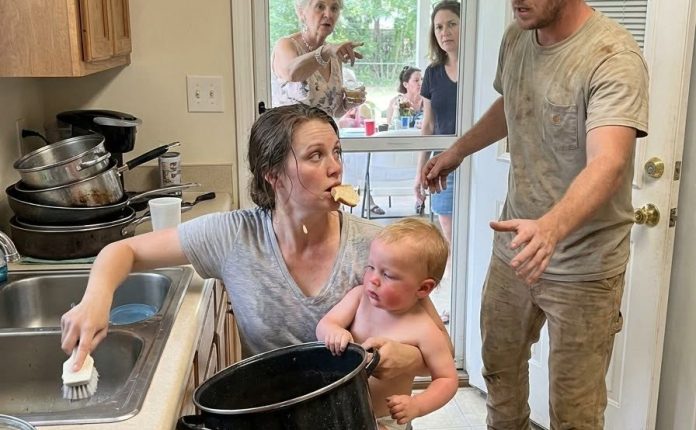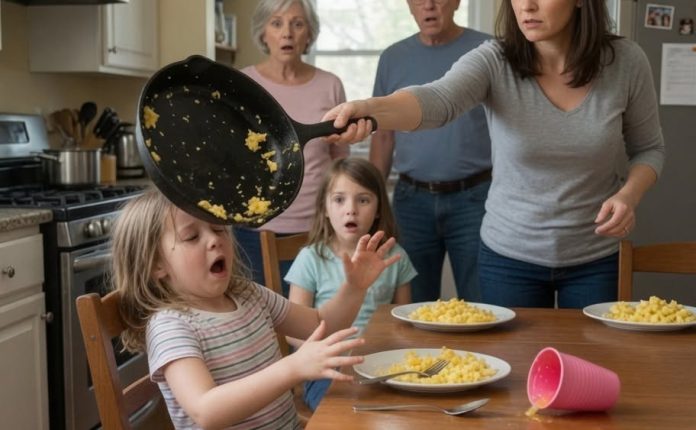
The first thing I remember clearly is the cold edge of the kitchen counter digging into my palm.
I had wrapped my fingers around it so tightly that my knuckles had gone white, but even that pain felt far away compared with what was happening inside my chest.
Every breath stopped halfway in.
I would pull air through my mouth, feel the beginning of it scrape down my throat, and then hit something that seemed solid and immovable.
It felt as though a belt had been cinched around my ribs and someone kept tightening it one notch at a time.
Dirty dinner plates were stacked beside the sink, streaked with gravy and mashed potatoes that had already begun to dry around the edges.
Warm water ran over the glass in my hand, spilling across my fingers and disappearing beneath the dishes.
The overhead light looked strangely distant.
Its yellow glow narrowed until the entire kitchen seemed to exist at the end of a blurry tunnel.
Behind me, chairs scraped against the floor as my family carried on with the ordinary end-of-dinner routine.
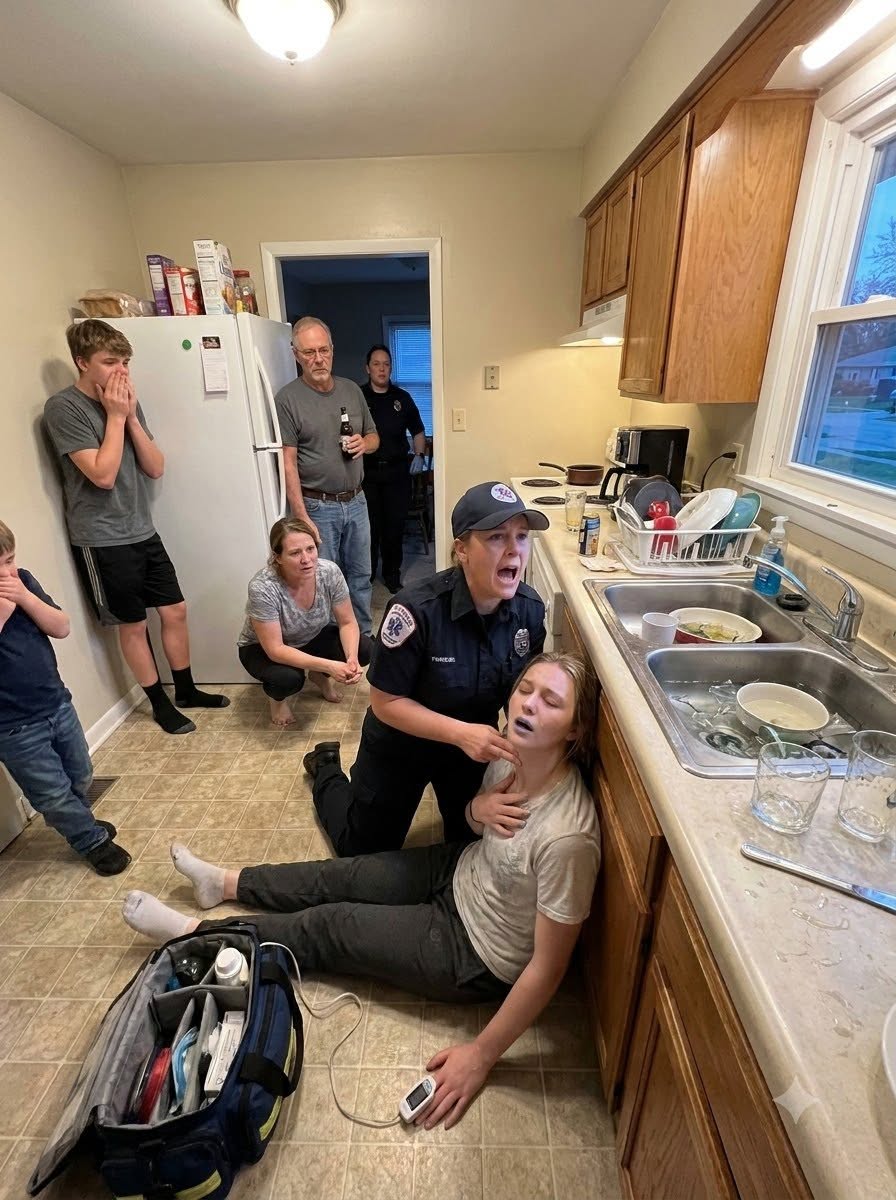
Someone closed a cabinet. A television laughed from the living room. Uncle Ray twisted the cap from another beer near the refrigerator. Nobody seemed to notice that I had stopped washing the dishes. I tried to turn toward my mother, but the movement made the pressure in my chest worse. “Mom,” I wheezed. “I can’t… breathe.” She was gathering napkins from the table when she looked over. Her face tightened—not with fear, but irritation. “Stop pretending,” she snapped. The words hit me with a strange clarity, even while everything else blurred. I had expected concern. I had expected her to come closer, place a hand on my back, or at least ask what hurt. Instead, she sounded as though I had interrupted her. Uncle Ray leaned one shoulder against the refrigerator and rolled his eyes. “She’s doing it again,” he said, raising his beer. “Every time there’s work to do, she suddenly gets dramatic.” I tried to answer him. I wanted to say that I had been standing at the sink without complaining. I wanted to tell him that I had already cleared the table, scraped the plates, and filled the basin. Most of all, I wanted to explain that this was not an excuse and did not feel anything like ordinary tiredness. Only a thin rasp came out. My chest rose, but the breath did not seem to reach my lungs. I pressed one hand against my sternum as though I could physically force the tightness to release. The counter shook beneath my other hand. My younger brother, Caleb, was still standing beside the kitchen table. He was supposed to be carrying the last few cups over to me, but he had stopped moving. He stared at my face with a frightened concentration none of the adults seemed willing to give me. “Mom,” he said. “Her lips look blue.” “They do not,” Mom replied. She did not step closer to check. She did not bend down to look at me under the kitchen light. She simply dismissed him in the same sharp tone she had used on me. Then she pointed toward the sink. “Emma, stand up straight. You’re eighteen years old, not eight.” For one desperate second, I believed that perhaps she was right. Maybe I was panicking. Maybe standing upright would open my chest. Maybe everyone would stop looking annoyed if I could just force myself to behave normally. I pushed down against the counter and tried to straighten my back. The room tilted immediately. My knees folded before I understood that they were giving way. The glass slipped from my wet fingers and struck the bottom of the sink. It shattered with a sharp crack that cut through the television, the running water, and Uncle Ray’s voice. My shoulder hit the cabinet first. Then my hip struck the tile. I ended up curled beside the sink with one arm trapped beneath me and my cheek near the cold floor. Water spilled over the rim of the counter and spread toward my hair. For a moment, all I could see were the lower cabinet doors and the broken reflections of the overhead light in the puddle. The crash finally brought my stepfather, Daniel, in from the living room. He appeared in the doorway, took one look at me, and stopped. Unlike my mother, he did not begin by asking whether I was exaggerating. His expression changed the second he saw my body curled against the cabinets. “Call 911,” he said. Mom spun toward him as though he had insulted her. “Daniel, don’t encourage this.” He looked from her to me, and something in his face hardened. “Call them,” he repeated, louder. Nobody moved quickly enough. Daniel was stepping toward the phone when Caleb reached it first. He grabbed it with both hands and nearly dropped it while trying to unlock the screen. His fingers shook so badly that he missed the numbers once. When the dispatcher answered, Caleb gave our address in Cedar Rapids, Iowa. His voice cracked in the middle of the street number, and he had to repeat it. He kept looking at me while he spoke. “My sister can’t breathe,” he said. “She fell down. She’s still awake, but she can’t talk.” The dispatcher must have asked him questions because Caleb began answering in short, frightened bursts. “Yes, she’s breathing.” “No, not normally.” “She’s eighteen.” “Yes, someone is with her.” That last answer was technically true, though I had never felt more alone. I lay on the kitchen tile while sweat slid into my hairline and cold water soaked the sleeve of my shirt. Every breath came out smaller than the one before it. I could hear my family talking above me, but their voices seemed to move farther away. Daniel told Uncle Ray to move the broken glass. Uncle Ray muttered that nobody should touch anything until the ambulance arrived. Mom kept saying my name as though repeating it more sternly would make me get up. Finally, she crouched beside me. Even then, she did not touch me. “Emma, this is enough,” she said. “You’re scaring your brother.” I stared at the tile between us. A thin line of water crept through the grout. I wanted to tell her that Caleb was not the only one who was scared. I wanted to say that I had never chosen this, that I was not trying to punish her, and that I would have given anything to stand up and finish those dishes if it meant I could breathe again. My mouth would not form the words. I tried once, but my lips barely moved. Daniel came down near my feet, careful not to crowd me. He looked pale and furious. His anger was not directed at me. That realization gave me a small, fragile sense of safety, even as the rest of the room began to fade at the edges. “Stay with us, Emma,” he said. His voice was lower now. He asked me to squeeze his hand, but when he reached toward me, he stopped just short, apparently afraid of moving me the wrong way. I managed a weak twitch of my fingers against the floor. Across the room, Uncle Ray remained beside the refrigerator. His beer was still raised halfway to his mouth, but he was no longer drinking. The dismissive expression had left his face. He kept looking at me, then at Daniel, then toward the front of the house. Nobody mentioned the dishes anymore. Nobody told me to stand up. The wait for the ambulance could not have been long, but time changed shape on that floor. Seconds stretched until each one felt separate. I heard Caleb asking the dispatcher whether he should open the front door. I heard Daniel tell him yes. Footsteps pounded down the hallway. A lock turned. The front door swung open, letting in a strip of cooler evening air. Somewhere outside, a siren grew louder. I focused on that sound because it was the first thing in the room that seemed to be moving toward me instead of away. Mom was still crouched nearby. Her irritation had begun to crack, but disbelief remained in her voice. “She was fine at dinner,” she told Daniel. “She was talking. She ate. She got up on her own.” Daniel stared at her. “She isn’t fine now.” Mom glanced down at me again. For the first time, she seemed to study my face rather than my behavior. Her eyes lingered on my mouth. She looked at my chest, which was moving in quick, shallow jerks. Then she looked toward Caleb, perhaps remembering what he had said about my lips. The siren cut off outside the house. Vehicle doors slammed. Heavy footsteps approached the porch and entered through the open front door. Caleb hurried back into the kitchen, flattening himself against the wall to clear the hallway. “They’re here,” he said, though everyone already knew. A woman in a navy cap rushed into the room carrying a medical bag. Her partner followed with additional equipment, moving fast but carefully as he took in the cramped space, the wet floor, and the shattered glass inside the sink. The woman dropped to her knees beside me. Her movements were controlled and direct. She did not ask whether I had been avoiding chores. She did not tell me to stand up. She leaned close enough that I could see the concentration in her eyes. “Emma?” she said. “Can you hear me?” I forced my eyelids open. Her face moved in and out of focus above me. I could not lift my head, so I blinked once. “That’s good,” she said. “Stay with me.” She asked what I was feeling. I tried to answer, but my lungs could not spare enough air for a sentence. “Chest,” I managed. Then even that single word dissolved into a rasp. The paramedic placed two fingers against the side of my neck. Her expression remained professional as she searched for my pulse. For one second, she was completely still. The room around us seemed to hold its breath with her. Then her face changed. It was not a dramatic reaction. She did not gasp or freeze. What changed was the speed and urgency in her eyes. She pressed again, shifted her fingers slightly, and looked toward her partner. “Get the stretcher now!” she shouted. Her partner turned immediately and ran toward the front door. Daniel moved backward to clear a path through the kitchen. He pulled one of the chairs against the wall and kicked a dish towel over the water so no one would slip. Caleb pressed himself against the opposite wall with both hands covering his mouth. Uncle Ray lowered his beer at last. My mother stared at the paramedic as though the woman had begun speaking another language. “What?” Mom whispered. “What’s wrong with her?” The paramedic did not look away from me. She opened her medical bag, removed a small monitor, and clipped it onto my finger. A number appeared on the screen. She watched it for less than a second before reaching for more equipment. “Her pulse is thready,” she said. “Her oxygen is dropping. We need to move her now.” The words traveled through the kitchen with more force than the breaking glass had. Daniel’s jaw tightened. Caleb made a small sound behind his hands. Uncle Ray stared down at the floor. Mom remained crouched beside me, but every trace of impatience had vanished from her face. She looked at the monitor, then at the paramedic, and finally at me. Only then did my mother look terrified.