
I left work early on my son’s first birthday and came home to find my mother serving seafood and expensive liquor to nearly twenty relatives while my wife washed dishes with our sick baby in her arms.
Then my mother looked across my backyard and declared, “I’m the one in charge in this house.”
I set the birthday cake on the ground, pulled out my phone, and opened a hidden folder that turned her celebration into a full-blown police investigation.
My name is Connor Bradley, and I work as a construction engineer.
Most days, I leave home before the neighborhood is fully awake and return after the evening traffic has thinned out.
My work requires long hours, constant calls, and the kind of attention that cannot drift when people are depending on measurements, schedules, and safety decisions being right.
That Friday was different.
It was my son Frederick’s first birthday, and I had been planning for weeks to surprise my wife, Amy, by coming home early.
I told no one in my family because I wanted the afternoon to belong to the three of us.
A small birthday cake sat in the passenger seat beside a pendant engraved with the letter “F.”
The pendant was for Amy.
In the back seat, folded carefully inside a shopping bag, was the blue dress she had been admiring online for weeks.
She had shown it to me once, then immediately closed the page and said it was too expensive for something she did not really need.
That was Amy.
She could talk herself out of almost anything she wanted if she thought the money should go toward the baby, groceries, or the house instead.
I bought the dress because I wanted her to have something that was only for her.
I had imagined walking through the front door, seeing her surprised face, and spending the rest of the afternoon eating cake while Frederick smashed frosting across his high-chair tray.
Instead, I turned onto our street and saw a line of pickup trucks and cars blocking my driveway.
At first, I wondered whether there had been an emergency.
Then I heard music carrying halfway down the block.
People I had not invited were moving through my side gate with bottles, covered serving trays, and plastic bags full of ice.
A man I recognized as one of my mother’s distant cousins laughed as he carried a case of liquor toward the backyard.
He waved at me like I was arriving late to my own event.
I parked along the curb because there was no way to get near the garage.
The cake box shifted when I stopped, and I reached over to steady it.
That small motion stayed with me because everything still felt ordinary enough to fix.
Maybe my mother had decided to organize a surprise party.
Maybe Amy knew about it.
Maybe the crowd was larger than I would have chosen, but the intention was good.
For months, I had been transferring $3,000 to my mother, Teresa.
She moved in shortly after Frederick was born and told me she would take care of groceries, household bills, and childcare while I worked long hours.
She said Amy needed support and that family should help family.
I wanted to believe her.
Every month, I sent the money without questioning individual purchases.
Whenever I called from a construction site, I asked Amy whether everything was all right.
She always said it was fine.
Sometimes her answers were quick, but we had a newborn, and exhaustion seemed like the obvious explanation.
I believed her because I wanted to believe my family was making her life easier while I was away.
Standing beside my car that Friday, I still had not understood how wrong I had been.
I carried the cake toward the backyard and passed tables covered with pulled pork, seafood, desserts, and bottles of liquor that cost more than anything Amy and I normally bought for ourselves.
Nearly twenty relatives were gathered around the yard.
Some were eating.
Some were drinking.
Others were talking loudly over the music as though the house belonged to all of them.
There were no balloons for Frederick near the tables.
There was no high chair waiting for him.
No one was asking where the birthday boy was.
Teresa stood in the middle of the gathering wearing a brand-new dress and sparkling jewelry.
She held a bottle of tequila in one hand and filled small glasses with the other.
“My son makes excellent money,” she announced. “He gives it to me so I can treat the family the way they deserve.”
The words stopped me near the back gate.
She did not say that I helped with household expenses.
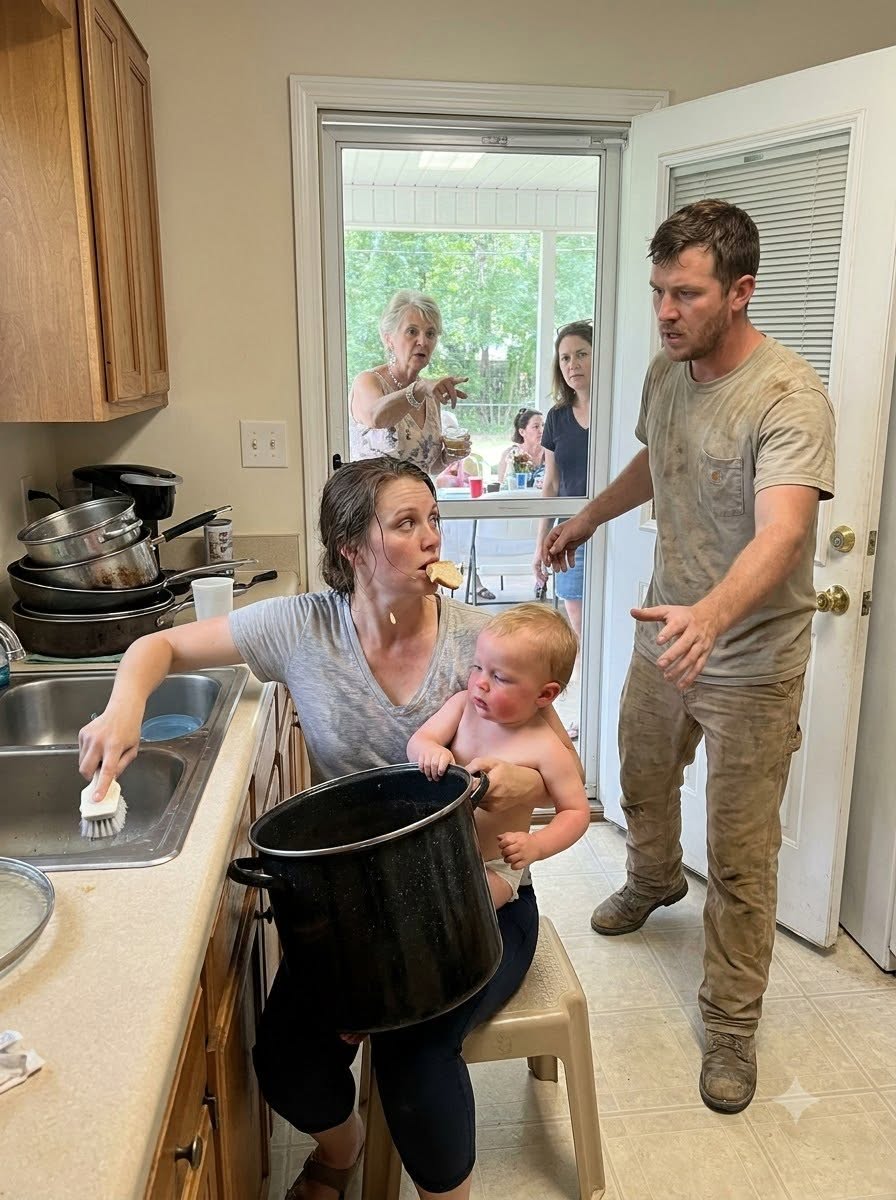
She made it sound as though my paycheck belonged to her and the party was proof of her authority. One of my aunts looked around the yard and asked where Amy was. “In the kitchen,” Teresa replied. Her tone was casual, almost bored. “I ordered her to prepare everything. She thinks she’s fragile just because she had a baby. A woman who’s financially supported should earn the food on her plate.” A few people looked down at their drinks. No one challenged her. Then Teresa raised her voice so everyone could hear her. “In this house, I’m the one who makes the rules. His wife is only good for giving birth and washing dishes.” The music kept playing. Someone near the table shifted uncomfortably, but nobody said Amy’s name. Nobody asked whether Frederick was all right. That silence told me something the party itself had not. This was not the first time Teresa had spoken about my wife that way in front of other people. It was simply the first time I had been there to hear it. I did not confront her in the yard. I walked through the back door and entered the kitchen. The difference between the two spaces was immediate. Outside, there was music, food, laughter, and enough liquor for a crowd. Inside, the air was hot and heavy with steam and grease. Dirty plates covered the counter. Large pots were stacked around the sink, and serving utensils were scattered across every open surface. Amy sat on a plastic stool beside the sink. She was holding Frederick against her chest with one arm while scrubbing a large pot with the other. A dry piece of bread was clenched between her lips because she had not been given enough time to sit down and eat. Her shirt was soaked with sweat. Her cheeks looked hollow. Her wrists were painfully thin. I had seen Amy every morning and every night, yet somehow I had not allowed myself to understand what I was looking at. I had explained away her loose clothes, her tired face, and the way she stopped talking whenever Teresa entered the room. I told myself she was adjusting to motherhood. I told myself the baby was not sleeping. I told myself that if something were truly wrong, Amy would tell me. But sitting there with bread between her teeth and our child balanced against her body, she looked like someone who had learned that asking for rest would only make things worse. Frederick’s breathing was fast. His eyes were glassy, and his face had the unfocused look of a baby who did not understand why his body felt wrong. The bread fell from Amy’s mouth when she saw me. “Connor,” she whispered, “your mother said I couldn’t stop yet. I still have to serve the coffee.” I crossed the kitchen and took Frederick from her arms. His skin was burning. For a moment, I could hear nothing except his shallow breathing and the muffled music outside. I reached for Amy’s hand. “We’re leaving.” She did not stand immediately. She looked toward the backyard instead of at me. “She’s going to be angry.” Those five words hurt more than anything Teresa had said. Amy was afraid to leave her own kitchen in her own home while holding our feverish son. She was not asking whether we should interrupt the party. She was not worried about being rude to guests. She was afraid of what my mother would do if she stopped washing dishes. I helped her to her feet. Her knees seemed unsteady, and she placed one hand on the counter before following me toward the door. I kept Frederick against my chest and walked them through the backyard. Conversations slowed as we passed. Some relatives stared at Amy’s damp shirt and exhausted face. Others looked at the baby. Teresa was still near the center table, but I did not stop to argue with her. I settled Amy into the passenger seat and made sure she could hold Frederick safely. Then I placed the birthday cake on the ground beside the car door. The box looked absurd sitting there near the curb while music played from the backyard. I had brought it home for a first birthday celebration. Now it sat unopened while my wife struggled to keep her eyes open and my son burned with fever. I pulled out my phone. Months earlier, I had saved a scan of the deed and every $3,000 transfer in a hidden folder labeled HOME. I originally created the folder because I traveled between job sites and wanted important household records available if I ever needed them. I had never expected to use those records against my own mother. The deed listed two owners clearly: Connor Bradley and Amy Bradley. Teresa’s name was nowhere on it. The transfer records showed exactly how much I had sent and when. They did not prove everything that had happened inside the house, but they proved one fact Teresa had spent months trying to blur. She did not own our home. She did not control my salary. She had been trusted to help us, not given authority over my wife. I called 911. I reported that people were inside my home without my permission, that my wife had been forced to work while caring for our sick baby, and that I feared for their safety. I also requested an ambulance. The dispatcher asked whether anyone had a weapon. I said I had not seen one. The dispatcher asked whether my wife and child were currently away from the people inside. I said they were in the car with me. Amy stared through the windshield while I spoke. She looked embarrassed, as though she had done something wrong by being sick, hungry, and afraid. I crouched beside the open passenger door and told her the only thing that mattered right then was getting her and Frederick checked. Behind us, the party continued for another few minutes. Then the first cruiser turned onto our street. The music stopped. The sudden silence traveled from the backyard through the house and out toward the driveway. Relatives lowered their cups and stared toward the flashing lights. Some stepped away from the tables. Others began gathering purses and jackets, but there were too many vehicles packed into the driveway for anyone to leave quickly. Teresa pushed through the crowd with her shoulders squared. She was still holding herself like the hostess of an event that had been unfairly interrupted. She demanded to know why the police were there. No one answered her immediately. Then she saw me standing beside Amy’s car with my phone in my hand. Her face hardened. “This is my house,” she screamed. “Tell them, Connor. Tell them who has been running this family.” The statement was not a misunderstanding. It was not a frightened woman choosing the wrong words under pressure. She wanted me to confirm her authority in front of the same relatives she had been entertaining with money meant for our household. She expected me to protect her version of the family, even while my wife sat exhausted in the car and my son needed medical attention. I opened the hidden folder on my phone. The nearest officer approached and asked who owned the property. Teresa answered before I could. She said she lived there, managed the home, paid the expenses, and had permission to invite anyone she wanted. I handed the officer my phone and showed him the scanned deed. My name and Amy’s name were clearly listed as the owners. I showed him the transfer records next. I explained that I had been sending Teresa $3,000 each month because she claimed the money was being used for groceries, bills, and childcare. The officer looked at the screen, then toward the backyard tables covered with food and alcohol. Teresa kept talking. She insisted that the money had been given to her and that no one had the right to question how she spent it. She said Amy was ungrateful. She said the party was for family. She said I was overreacting because my wife had turned me against my own mother. Each sentence made the situation clearer. Teresa was not concerned about Frederick’s fever. She did not ask whether an ambulance was coming. She did not ask why Amy looked as though she might collapse. She was focused entirely on proving that she still controlled the house, the money, and the story everyone would repeat after that day. Then movement near the front door caught the officer’s attention. My cousin Mason slipped out of the house with a thick folder hidden beneath his jacket. He had been inside while everyone else was watching the police in the driveway. The folder was too large to disappear under the fabric, and he kept one arm pressed tightly against it as he moved. The officer looked from my phone to the shape under Mason’s coat. Mason stopped. For the first time since I arrived, Teresa stopped talking. The officer turned toward my cousin and rested one hand near his belt. “Sir,” he said, “take your hands out where I can see them.”