My ten-year-old son complained about a simple stomachache, and for several days I treated it the way most parents would.
I gave him tea, checked his temperature, pressed the back of my hand to his forehead, and told myself that children get sick.
They catch viruses.
They eat something strange at lunch.
They wake up one morning looking pale and bounce back by dinner.
But Ethan did not bounce back.
He grew quieter.
That was the first thing I should have understood.
My name is Sarah Mitchell, and my son has always filled our house with noise.
He builds spaceships from shipping boxes in the garage, kicks a soccer ball against the backyard fence until a neighbor’s dog starts barking, and asks questions at bedtime that no adult could answer without searching the internet.
When Ethan is well, every room knows it.
When he is not, the silence arrives before the diagnosis.
The first complaint came on a Tuesday at 3:47 p.m.
Rain tapped the window above the kitchen sink while the microwave hummed behind me.
Ethan dropped his backpack beside the pantry and stood there with one hand pressed lightly against his stomach.
“Mom, it feels weird.”
I looked up from a grocery receipt.
“Too much junk food at lunch?”
“Maybe.”
He was ten, and ten-year-olds do not always have better language for pain.
I made peppermint tea, wrapped him in a blanket, and let him watch television on the couch.
By the next morning, he was arguing about socks and brushing his teeth with toothpaste on his shirt.
That ordinary little argument felt like proof that everything was fine.
It was not proof.
It was only a good hour.
The nausea returned that afternoon.
Then came the half-eaten lunch.
Then the soccer practice he skipped because running made his stomach “pull.”
Then the mornings when he stared at toast as if chewing would require more energy than he had.
I watched each symptom separately because separate things are easier to excuse.
A missed meal is nothing.
A tired day is nothing.
A stomachache after school is nothing.
Fear becomes real when the separate things begin standing beside one another.
By the second week, Ethan had stopped dragging toys across the hallway.
His hoodie sleeves stayed pulled over his hands.
He leaned his forehead against the cool car window on the ride home from school and answered questions with one word.
I asked whether someone was bothering him.
He said no.
I asked whether school was hard.
He said no.
I asked whether the pain was worse.
He looked at me for a second too long and said, “Not really.”
That was the first lie.
It was not a bad lie.
It was the kind children tell when they see worry on a parent’s face and decide, without being asked, that they should become easier to carry.
On day seventeen, I found him sitting on the edge of his bed at 6:18 a.m.
He was dressed for school, but his sneakers were untied and his hands rested motionless in his lap.
Weak morning light came through the blinds and made his face look gray.
“I don’t feel good, Mom.”
I called the pediatrician before the office opened.
By 10:05 a.m., a nurse was entering his symptoms into the clinic chart while a pulse oximeter blinked red on his finger.
The doctor listened to his stomach, pressed gently around his abdomen, and asked about fever, vomiting, bowel changes, appetite, and school.
Ethan answered politely.
He even smiled once.
The working theory was a virus.
The visit summary told us to use rest, fluids, and bland food.
It told us to call back if symptoms worsened.
I carried that paper home like it was permission to stop being afraid.
The blood work came two days later.
CBC.
Metabolic panel.
Liver enzymes.
The patient portal displayed most of the results in black text with the word normal beside them.
I read every line twice.
Then I read them again at 1:14 a.m. while Ethan slept down the hall.
The numbers looked calm.
My son did not.
By the third week, his jeans hung differently at the waist.
The shadows beneath his eyes deepened.
He stopped building forts.
He stopped kicking the soccer ball.
He stopped asking impossible questions.
There are moments when a parent’s instinct feels less like wisdom and more like guilt arriving early.
I knew something was wrong, but I did not yet know how wrong.
Thursday dinner began with grilled cheese and tomato soup.
It was 6:42 p.m.
Butter browned in the pan, the ceiling light buzzed, and rainwater from our shoes dried in dull marks near the back door.
Ethan had asked for that meal because it was the only thing that sounded possible.
He sat across from me and lifted his fork.
Then his face changed.
The fork dropped.
It struck the tile with a sharp metallic clatter, and Ethan folded over the table as if someone had pulled a wire inside him.
“Mom…”
His voice broke.
I had seen him cry from scraped knees, a broken toy, and the day we lost his stuffed dinosaur at a rest stop.
I had never heard pain tear through his voice like that.
I grabbed my keys from the counter.
I wrapped one arm around his shoulders and guided him to our old SUV.
The hazard lights blinked all the way to the emergency room, even though no one had told me to turn them on.
At the intake desk, a clerk printed a wristband and asked me to confirm Ethan’s birth date.
A form slid across the counter.
Ethan leaned against my side with both hands pressed to his stomach.
By 7:31 p.m., he was in an exam room.
By 8:09, the emergency physician had ordered an abdominal ultrasound.
By 8:26, a technician was spreading cold gel across his belly while I held his ankle through the blanket.
The exam room smelled like hand sanitizer, printer toner, and the paper sheet beneath him.
The ultrasound monitor threw a pale blue light across the technician’s face.
At first, she talked about soccer.
She asked Ethan what position he played.
“Midfield,” he said.
Then he added, “When I’m not broken.”
She smiled.
A minute later, she stopped.
Her hand slowed.
The probe paused.
The tapping of the keyboard changed from casual to exact.
“Is everything okay?” I asked.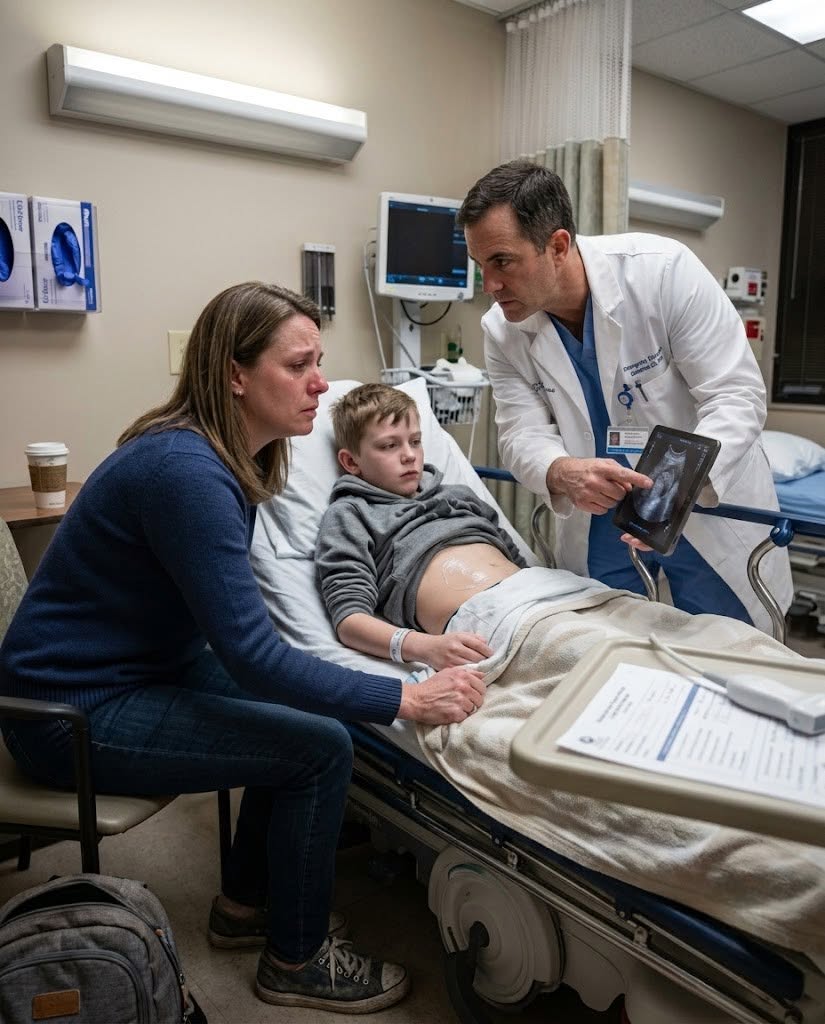 “The doctor will review the images with you.”
People in hospitals often speak in sentences designed to avoid panic.
Sometimes those sentences create it.
Twenty minutes later, the physician returned with printed images and a tablet.
He looked at Ethan.
He looked at me.
Then he looked back at the screen.
“Ma’am,” he said, clearing his throat. “Is Ethan’s father here?”
For one second, the question made no sense.
“What?”
“Can his father come in?”
“Why would you need his father?”
He set the printouts on the rolling tray.
The paper snapped softly as it flattened.
Ethan watched the doctor’s face, then mine.
“There are findings here that don’t immediately make sense,” the doctor said.
“What kind of findings?”
He turned the tablet toward me and pointed to a rounded gray area beside Ethan’s right kidney.
“There is a mass in his abdomen.”
The room did not spin.
That is how people describe shock in stories, but my room became painfully still.
I could see the dry skin beside the doctor’s thumbnail.
I could hear rubber wheels squeaking in the hallway.
I could smell the cold coffee I had forgotten beside my chair.
“What does that mean?” I asked.
“It means we need better imaging tonight,” he said. “The ultrasound cannot tell us exactly what this is.”
“Is it cancer?”
“I can’t answer that from this scan.”
“Then why did you ask for his father?”
His expression softened.
“Because I don’t want you hearing this alone.”
I stepped into the hallway and called David.
He answered on the second ring.
I said his name once, and he stopped whatever he had been doing.
“What happened?”
“They found something.”
That was all I could manage.
Twenty-three minutes later, David came through the double doors wearing his work jacket.
One boot was untied.
His truck keys were clenched in his fist.
He crossed the room in three steps, touched Ethan’s hair, and looked at me.
I handed him the scan.
The keys fell from his hand.
They struck the floor hard enough to make Ethan flinch.
David picked them up and apologized, though no one had accused him of anything.
That was how fear worked on us.
It made every small sound feel like a failure.
A radiology nurse arrived with a contrast-information sheet and a second wristband.
The top of the form was marked urgent.
She explained that the CT team had moved Ethan ahead of every noncritical case because the mass appeared to be pressing against nearby tissue.
There was also a small pocket of fluid near the kidney that the doctor wanted evaluated immediately.
David gripped the back of a plastic chair.
“Is this cancer?”
The doctor did not say yes.
He did not say no.
He said the next scan would give the specialists a clearer map.
At 9:17 p.m., Ethan was wheeled down the hall.
The fluorescent lights moved over his face in slow intervals.
I walked on one side of the bed.
David walked on the other.
Ethan looked at us and tried to smile.
“So I get to skip school tomorrow?”
David made a sound that was almost a laugh.
“Probably.”
“Cool.”
The CT room doors closed behind him.
I stood in the hallway with my arms folded across my chest because I did not know what else to do with them.
David stared at the floor.
We had been married for fourteen years.
We had held Ethan together through ear infections, one broken wrist, two school plays, three soccer seasons, and the death of my mother.
Nothing in those years had prepared us to wait outside a room where a machine was deciding how frightened we were allowed to be.
The scan took less than twenty minutes.
The waiting afterward felt longer than Ethan’s entire childhood.
At 10:06 p.m., the emergency physician returned with a radiologist on a video call.
The mass was real.
It involved a cluster of enlarged lymph nodes deep in Ethan’s abdomen rather than the kidney itself.
The fluid did not appear to be active bleeding, which was the first good sentence anyone had given us.
But the size and location meant he needed to be admitted and seen by pediatric oncology.
Ethan heard the word oncology.
His eyes moved from the screen to me.
“That’s cancer doctors, right?”
I wanted to lie.
I did not.
“Yes,” I said. “They’re the doctors who figure out what this is.”
“Am I dying?”
David turned away for half a second.
I leaned close enough for Ethan to feel my breath.
“No one has told us that,” I said. “What they told us is that they found the problem, and now we are going after it.”
That answer was not certainty.
It was the most honest promise I had.
The next morning brought more blood tests, another ultrasound review, and a consultation with a pediatric oncologist.
She did not rush.
She sat at eye level with Ethan and explained that a scan can show where something is, but only a biopsy can say what it is.
She drew a simple picture on the back of a blank form.
Ethan watched the pen.
David asked questions about anesthesia.
I asked about timing.
The biopsy was scheduled for that afternoon.
At 2:33 p.m., a nurse checked Ethan’s wristband for the third time and rolled his bed toward the procedure area.
He reached for my hand.
“Mom?”
“I’m here.”
“What if I wake up and you’re not?”
“I’ll be right outside.”
He squeezed once.
That small grip carried more fear than any scream could have.
The pathology result did not come immediately.
We waited through one night, then another morning.
Hospital time is measured in cart wheels, meal trays, medication checks, and the soft hiss of doors.
At 11:42 a.m. the following day, the oncologist entered with a folder held against her chest.
She sat down before she spoke.
The biopsy showed lymphoma.
The word landed hard, but it did not land alone.
She followed it with treatable.
She followed that with a plan.
Additional testing would determine the exact type and extent.
Chemotherapy would likely begin quickly.
The mass was serious, but Ethan was stable, and the team believed they had options.
David asked the same question three different ways.
“What are his chances?”
The doctor would not give us a clean number before staging was complete.
She did say that children can respond very well to treatment and that Ethan’s case would be reviewed by the full pediatric team.
We learned to live inside careful language.
Likely.
Promising.
Concerning.
Responsive.
No evidence of this.
No sign of that.
Every phrase became a rung on a ladder we climbed without seeing the top.
Treatment began four days later.
Ethan hated the taste of the medicine flush.
He hated the hospital food.
He hated being tired.
He hated the way adults lowered their voices when they thought he was asleep.
But he did not stop being Ethan.
He named the IV pole Gerald.
He taped a paper spaceship to the side of it.
He asked the oncologist whether cancer cells were “basically criminals with bad instructions.”
She told him that was not the worst description she had heard.
The first weeks were brutal in ordinary ways.
Laundry multiplied.
Meals went untouched.
Our calendar filled with appointments.
David learned which parking garage level had the shortest walk to the elevator.
I learned how to read lab results without pretending I understood more than I did.
Neighbors left casseroles on the porch.
Ethan’s teacher sent a stack of cards from his class.
His soccer coach brought a ball covered in signatures and left it beside the hospital bed.
None of those gestures fixed anything.
They kept us from falling through the hours.
After the second treatment cycle, the doctors repeated the imaging.
The mass had shrunk.
Not disappeared.
Not solved.
Shrunk.
That one word gave our house sound again.
Ethan laughed when David nearly cried in front of the oncologist.
He asked whether he could return to school before his hair grew back.
He said he wanted everyone to see his “battle head.”
Months later, another scan showed no active disease.
The doctor was careful to explain what remission meant and what follow-up would require.
There would be appointments.
There would be blood work.
There would be scans that brought back the smell of hand sanitizer and the blue light of that first room.
There would be fear hiding inside ordinary stomachaches for a long time.
But there would also be mornings.
There would be clean socks on the floor.
There would be questions about black holes.
There would be a soccer ball hitting the fence until the neighbor’s dog barked.
The house is never quiet when Ethan is okay.
I used to think that sentence was only about noise.
Now I know it is about presence.
It is about the scrape of a chair, the slam of a cabinet, the argument over breakfast, and the impossible questions asked when you are too tired to answer.
A mother learns the weight of silence before anyone else hears it.
She also learns not to waste the return of sound.
The stomachache was not simple.
The scan changed everything we thought we knew about our child’s health, our routines, and the future we had assumed would arrive without asking permission.
But the doctor’s question did not mark the end of our family.
It marked the moment the three of us stopped guessing and started fighting the thing that had been hiding in plain sight.
“The doctor will review the images with you.”
People in hospitals often speak in sentences designed to avoid panic.
Sometimes those sentences create it.
Twenty minutes later, the physician returned with printed images and a tablet.
He looked at Ethan.
He looked at me.
Then he looked back at the screen.
“Ma’am,” he said, clearing his throat. “Is Ethan’s father here?”
For one second, the question made no sense.
“What?”
“Can his father come in?”
“Why would you need his father?”
He set the printouts on the rolling tray.
The paper snapped softly as it flattened.
Ethan watched the doctor’s face, then mine.
“There are findings here that don’t immediately make sense,” the doctor said.
“What kind of findings?”
He turned the tablet toward me and pointed to a rounded gray area beside Ethan’s right kidney.
“There is a mass in his abdomen.”
The room did not spin.
That is how people describe shock in stories, but my room became painfully still.
I could see the dry skin beside the doctor’s thumbnail.
I could hear rubber wheels squeaking in the hallway.
I could smell the cold coffee I had forgotten beside my chair.
“What does that mean?” I asked.
“It means we need better imaging tonight,” he said. “The ultrasound cannot tell us exactly what this is.”
“Is it cancer?”
“I can’t answer that from this scan.”
“Then why did you ask for his father?”
His expression softened.
“Because I don’t want you hearing this alone.”
I stepped into the hallway and called David.
He answered on the second ring.
I said his name once, and he stopped whatever he had been doing.
“What happened?”
“They found something.”
That was all I could manage.
Twenty-three minutes later, David came through the double doors wearing his work jacket.
One boot was untied.
His truck keys were clenched in his fist.
He crossed the room in three steps, touched Ethan’s hair, and looked at me.
I handed him the scan.
The keys fell from his hand.
They struck the floor hard enough to make Ethan flinch.
David picked them up and apologized, though no one had accused him of anything.
That was how fear worked on us.
It made every small sound feel like a failure.
A radiology nurse arrived with a contrast-information sheet and a second wristband.
The top of the form was marked urgent.
She explained that the CT team had moved Ethan ahead of every noncritical case because the mass appeared to be pressing against nearby tissue.
There was also a small pocket of fluid near the kidney that the doctor wanted evaluated immediately.
David gripped the back of a plastic chair.
“Is this cancer?”
The doctor did not say yes.
He did not say no.
He said the next scan would give the specialists a clearer map.
At 9:17 p.m., Ethan was wheeled down the hall.
The fluorescent lights moved over his face in slow intervals.
I walked on one side of the bed.
David walked on the other.
Ethan looked at us and tried to smile.
“So I get to skip school tomorrow?”
David made a sound that was almost a laugh.
“Probably.”
“Cool.”
The CT room doors closed behind him.
I stood in the hallway with my arms folded across my chest because I did not know what else to do with them.
David stared at the floor.
We had been married for fourteen years.
We had held Ethan together through ear infections, one broken wrist, two school plays, three soccer seasons, and the death of my mother.
Nothing in those years had prepared us to wait outside a room where a machine was deciding how frightened we were allowed to be.
The scan took less than twenty minutes.
The waiting afterward felt longer than Ethan’s entire childhood.
At 10:06 p.m., the emergency physician returned with a radiologist on a video call.
The mass was real.
It involved a cluster of enlarged lymph nodes deep in Ethan’s abdomen rather than the kidney itself.
The fluid did not appear to be active bleeding, which was the first good sentence anyone had given us.
But the size and location meant he needed to be admitted and seen by pediatric oncology.
Ethan heard the word oncology.
His eyes moved from the screen to me.
“That’s cancer doctors, right?”
I wanted to lie.
I did not.
“Yes,” I said. “They’re the doctors who figure out what this is.”
“Am I dying?”
David turned away for half a second.
I leaned close enough for Ethan to feel my breath.
“No one has told us that,” I said. “What they told us is that they found the problem, and now we are going after it.”
That answer was not certainty.
It was the most honest promise I had.
The next morning brought more blood tests, another ultrasound review, and a consultation with a pediatric oncologist.
She did not rush.
She sat at eye level with Ethan and explained that a scan can show where something is, but only a biopsy can say what it is.
She drew a simple picture on the back of a blank form.
Ethan watched the pen.
David asked questions about anesthesia.
I asked about timing.
The biopsy was scheduled for that afternoon.
At 2:33 p.m., a nurse checked Ethan’s wristband for the third time and rolled his bed toward the procedure area.
He reached for my hand.
“Mom?”
“I’m here.”
“What if I wake up and you’re not?”
“I’ll be right outside.”
He squeezed once.
That small grip carried more fear than any scream could have.
The pathology result did not come immediately.
We waited through one night, then another morning.
Hospital time is measured in cart wheels, meal trays, medication checks, and the soft hiss of doors.
At 11:42 a.m. the following day, the oncologist entered with a folder held against her chest.
She sat down before she spoke.
The biopsy showed lymphoma.
The word landed hard, but it did not land alone.
She followed it with treatable.
She followed that with a plan.
Additional testing would determine the exact type and extent.
Chemotherapy would likely begin quickly.
The mass was serious, but Ethan was stable, and the team believed they had options.
David asked the same question three different ways.
“What are his chances?”
The doctor would not give us a clean number before staging was complete.
She did say that children can respond very well to treatment and that Ethan’s case would be reviewed by the full pediatric team.
We learned to live inside careful language.
Likely.
Promising.
Concerning.
Responsive.
No evidence of this.
No sign of that.
Every phrase became a rung on a ladder we climbed without seeing the top.
Treatment began four days later.
Ethan hated the taste of the medicine flush.
He hated the hospital food.
He hated being tired.
He hated the way adults lowered their voices when they thought he was asleep.
But he did not stop being Ethan.
He named the IV pole Gerald.
He taped a paper spaceship to the side of it.
He asked the oncologist whether cancer cells were “basically criminals with bad instructions.”
She told him that was not the worst description she had heard.
The first weeks were brutal in ordinary ways.
Laundry multiplied.
Meals went untouched.
Our calendar filled with appointments.
David learned which parking garage level had the shortest walk to the elevator.
I learned how to read lab results without pretending I understood more than I did.
Neighbors left casseroles on the porch.
Ethan’s teacher sent a stack of cards from his class.
His soccer coach brought a ball covered in signatures and left it beside the hospital bed.
None of those gestures fixed anything.
They kept us from falling through the hours.
After the second treatment cycle, the doctors repeated the imaging.
The mass had shrunk.
Not disappeared.
Not solved.
Shrunk.
That one word gave our house sound again.
Ethan laughed when David nearly cried in front of the oncologist.
He asked whether he could return to school before his hair grew back.
He said he wanted everyone to see his “battle head.”
Months later, another scan showed no active disease.
The doctor was careful to explain what remission meant and what follow-up would require.
There would be appointments.
There would be blood work.
There would be scans that brought back the smell of hand sanitizer and the blue light of that first room.
There would be fear hiding inside ordinary stomachaches for a long time.
But there would also be mornings.
There would be clean socks on the floor.
There would be questions about black holes.
There would be a soccer ball hitting the fence until the neighbor’s dog barked.
The house is never quiet when Ethan is okay.
I used to think that sentence was only about noise.
Now I know it is about presence.
It is about the scrape of a chair, the slam of a cabinet, the argument over breakfast, and the impossible questions asked when you are too tired to answer.
A mother learns the weight of silence before anyone else hears it.
She also learns not to waste the return of sound.
The stomachache was not simple.
The scan changed everything we thought we knew about our child’s health, our routines, and the future we had assumed would arrive without asking permission.
But the doctor’s question did not mark the end of our family.
It marked the moment the three of us stopped guessing and started fighting the thing that had been hiding in plain sight.