MY MOTHER SAID, “IF HE DROWNS, THAT’S HIS RESPONSIBILITY,” WHILE MY 4-YEAR-OLD SON FOUGHT THE CURRENT. THE NEXT TIME I FACED HER, I SET ROBERT’S TIME-STAMPED FISHING VIDEO ON THE CAMPGROUND TABLE—IT SHOWED HER PUSHING NOAH UNDERWATER AND HOOKING HIS SWIM TRUNKS ON A ROCK TO CLAIM HE HAD DROWNED. WHEN I PRESSED PLAY, SHE TURNED PALE AND STARTED TREMBLING.
The river smelled like wet stone, pine sap, and the faint smoke drifting down from the campground.
Its roar swallowed every smaller sound.
Shoes scraped across gravel somewhere behind me.
My husband called my name.
A cooler lid knocked in the wind.
None of it mattered once I heard my four-year-old son cry from the middle of the current.
“Mama! Help me!”
Sunlight broke across the water in bright, harmless-looking pieces.
The river looked almost beautiful.
It was not.
My name is Amanda Carter, and I had been a pediatrician for ten years by the time my family took that camping trip.
My work had trained me to notice the detail other people tried to explain away.
A bruise that did not match the story.
A fever that climbed at the wrong hour.
A child who looked at an adult before answering a simple question.
I had spent years telling parents to trust the quiet alarm in their bodies when something felt wrong.
Then I ignored my own.
My husband, Thomas, is an architect.
He is careful in the way people become careful when their job depends on measurements, load-bearing walls, and the consequences of one bad assumption.
Our son, Noah, was four.
He carried a plastic Tyrannosaurus almost everywhere.
The dinosaur slept beside his pillow, sat near his cereal bowl, rode in the back seat, and came with us to the campground tucked in his fist.
When we unloaded the car, I crouched in front of him and tapped the dinosaur’s plastic head.
“Don’t lose him.”
Noah hugged it to his chest.
“I won’t. He’s strong.”
That sentence returned to me later with a cruelty I still cannot describe.
My mother, Patricia, had asked for the family trip.
My sister, Emily, made the call.
She said Patricia was getting older.
She said it was time to stop living inside old arguments.
She said Noah deserved memories with his grandmother.
Her voice was warm, reasonable, almost tender.
That was always Emily’s skill.
She could wrap pressure in the language of peace until refusing her made you sound like the cruel one.
I almost said no.
Thomas knew enough about my childhood to understand why.
He also knew that part of me still wanted one ordinary family weekend, the kind other people seemed to have without rehearsing every conversation in advance.
A fire.
Hot dogs.
Coffee in paper cups.
A child falling asleep in a camp chair while adults talked quietly under the trees.
Nothing dramatic.
Nothing to survive.
So I agreed.
I told myself that distance had softened Patricia.
I told myself Emily had grown up.
I told myself James, Emily’s husband, would not bring old resentment into a weekend centered on a child.
I wanted peace more than I trusted the pattern.
That was my mistake.
Patricia had hit me when I was a child.
She did it behind closed doors, then behaved beautifully in public.
Emily learned early that safety came from pleasing her.
She was the obedient daughter.
I was the difficult one.
The sensitive one.
The one who remembered too much.
At eighteen, I left.
I went to college, then medical school, then residency.
I built a life where no one could tell me that pain was discipline or fear was respect.
Even after all that, Patricia’s voice could still make some old part of me feel twelve years old.
Families do that.
They teach you the shape of a cage so early that years later, you can step back inside without noticing the door.
I kept speaking to Emily because I wanted to believe one relationship from that house could be saved.
There was another wound in our family, one that Patricia carried like both a tragedy and a weapon.
Thirty years earlier, my seven-year-old brother had drowned in a river during the minute she looked away.
Afterward, she feared rivers and obsessed over them at the same time.
She talked about water as though it had intentions.
She said rivers punished weakness.
She said children had to learn respect before the current taught it to them.
Whenever I challenged her, she accused me of judging a grief I could not understand.
I was a child when my brother died.
I understood more than she knew.
There was also James.
Three years before the camping trip, I had testified in a medical malpractice case.
The patient’s family deserved the truth.
The chart was clear.
The timeline was clear.
The hospital wanted caution.
James, representing the defense, wanted certainty where none existed and silence where the facts were uncomfortable.
I gave honest testimony.
My testimony helped cost him the case.
He never forgave me.
Afterward, he stopped pretending.
At holidays, he made small comments about doctors who thought they were smarter than everyone else.
He asked Thomas whether I brought a stethoscope to family dinner so I could diagnose the gravy.
Emily laughed too hard.
Patricia told me I should have protected family.
The patient was not their family, apparently.
James was.
That was the moral math in the house where I grew up.
Loyalty meant helping the person closest to you avoid consequences.
Truth was betrayal.
On the first day at the campground, everything looked ordinary enough to make me feel foolish for worrying.
Thomas stacked firewood.
James worked the grill.
Emily arranged snacks on the picnic table.
Patricia sat in a folding chair and watched Noah play near the tents.
Noah drove his plastic dinosaur through the dirt and made soft roaring sounds.
Then Patricia called him over.
“Give Grandma a hug.”
He went because he was four and because we had taught him to be kind.
She held him against her for a beat too long.
When she released him, she smiled.
The expression reached her mouth but not her eyes.
A few minutes later, Emily crouched beside him.
“I wish I had a little boy like you,” she whispered.
Noah looked at me.
Not because he understood the sentence.
Because he heard something in her voice.
I felt the warning.
I did nothing.
By the second afternoon, the air had warmed.
The river sounded louder from camp, fed by snowmelt farther up the mountain.
Shortly before 2:00 p.m., Emily walked over while I was sorting groceries at the picnic table.
“Can I take Noah down to the river?”
I looked up.
“For what?”
“I’ll teach him to swim.”
“No.”
The answer came out before I had time to soften it.
“The current is too fast.”
Emily rolled her eyes.
Patricia stood from her chair.
“You’re smothering him, Amanda.”
“I’m keeping him safe.”
“I taught you when you were three.”
“You did not teach me in a current like that.”
Her face changed.
It was small, but I saw it.
The warmth disappeared.
“Stop raising him to be weak.”
Emily laughed.
“Don’t be a helicopter mom.”
I looked at Thomas.
He glanced toward the river trail, then back at me.
“They’ll all be there,” he said carefully. “Your mom, Emily, James.”
He was not dismissing me.
He was trying to lower the temperature.
I knew that.
But the old pressure was already working.
Patricia stared at me as though my refusal proved every accusation she had ever made.
Emily waited with that patient little smile.
Noah stood between us holding his dinosaur.
“Can I go, Mama?”
I should have trusted the first answer.
Instead, I bent down and adjusted the collar of his shirt.
“Stay close to the bank.”
“I will.”
“Listen to Dad if he comes down.”
“I will.”
“Be careful.”
Emily answered for him.
“Of course.”
They walked away with Noah between them.
James followed a few steps behind.
I watched until the trees hid them.
Then I returned to the groceries and tried to act like a woman who had made a normal decision.
Thirty minutes later, I had not opened half the bags.
The campfire smoke kept blowing into my eyes.
The cooler lid knocked against the plastic rim each time the wind shifted.
Noah’s empty chair sat beside the picnic table.
His dinosaur was not there.
I looked toward the trail.
“I’m going down,” I said.
Thomas did not argue.
“I’m coming.”
We walked fast.
Then faster.
The river’s roar grew until conversation became impossible.
When we reached the bank, Patricia and Emily were standing above the water.
James was not with them.
Noah was not beside them.
I felt the entire world narrow.
“Where is he?”
Emily looked at me and smiled.
“He’s getting special training.”
For one second, I did not understand.
Then I saw movement in the middle of the river.
A small hand.
A dark head.
My son’s arms broke the surface as the current dragged him sideways.
“Mama!”
His voice barely reached me.
“Help me!”
I ran.
Patricia caught my forearm.
Her fingers closed hard enough to stop my first step.
“No.”
I stared at her.
“He needs to learn.”
“Let go of me.”
Emily stood a few feet away, watching Noah fight the water.
“He’ll make it back.”
She laughed when she said it.
Not loudly.
That made it worse.
Patricia tightened her grip.
“If he drowns, that’s his responsibility.”
The sentence was so monstrous that for one stunned heartbeat, my mind refused to process it.
Noah was four.
He still needed help pulling on one boot when he was tired.
He slept with a plastic dinosaur.
He believed grown-ups meant safety.
A child learns danger from the adults who call it a lesson.
I tore free.
Patricia’s nails scraped my skin.
I shoved past her and jumped.
The cold was immediate.
It hit my ribs, filled my shoes, pulled at my jeans, and stole the breath from my chest.
I tried to angle toward Noah.
The current spun me.
I saw his head disappear.
Then surface.
Then disappear again.
“Noah!”
Behind me, Thomas was shouting into his phone.
Emily screamed that I was making everything worse.
Patricia yelled something about letting the rescue team handle it, as if she had not been holding me back seconds earlier.
I kicked toward the last place I had seen my son.
The water shoved me sideways.
My hand closed on nothing.
I went under.
Stone struck my knee.
When I surfaced, two responders were coming in from downstream.
They reached me before I reached Noah.
I fought them.
I begged.
I told them my son was right there.
One responder locked an arm around my chest while the other pulled us toward shore.
By the time my feet touched gravel, Noah was gone.
The next hours broke into pieces.
Radios.
Ropes.
Wet uniforms.
People moving along both banks.
Thomas answering questions he could barely understand.
Patricia crying.
Emily repeating that it had been an accident.
James reappearing and saying he had gone back toward camp to get help.
I remember looking at his dry shoes.
I remember wondering why I noticed that.
Then training took over.
Observation first.
Sequence.
Motive.
Evidence.
The county rescue crew completed its first sweep as afternoon light turned gray.
Their incident report logged Noah as missing, presumed swept downstream.
A responder found one item caught on a rock near the bend.
Noah’s swim trunks.
They photographed them before removing them.
Nothing else was found.
No shirt.
No shoes.
No plastic dinosaur.
No body.
That should have felt like hope.
At the time, it felt like the river had erased him.
That night, the tent zipper rattled in the wind.
Thomas sat beside me with both hands over his face.
Neither of us slept.
Around us, the campground went quiet in the uncomfortable way public places go quiet around private disaster.
A lantern clicked off.
A car door shut.
Someone whispered near the restrooms.
Patricia cried loudly enough for other campers to hear.
Emily came to our tent twice.
Both times she said the same thing.
“It was an accident.”
The second time, I asked, “Why were his trunks on that rock?”
She stopped.
Only for a second.
Then she said the current must have pulled them off.
I pictured the photograph.
The fabric was hooked high and neat.
The current below it was violent.
The explanation did not fit the evidence.
As a doctor, I knew drowning did not always follow a clean timeline.
I also knew when an injury had been arranged to tell a false story.
The same instinct applied here.
The trunks looked placed.
I hated myself for thinking it.
Then I hated myself for almost refusing to think it.
Not grief.
Not yet.
Observation first.
Sequence.
Motive.
Before sunrise, I reread the incident report by flashlight.
I wrote down every sentence Patricia, Emily, and James had said.
I marked the times I remembered.
Emily asked for Noah shortly before 2:00 p.m.
Thomas and I reached the river around thirty minutes later.
James was missing when we arrived.
He returned after the rescue response had begun.
His shoes were dry.
At 7:10 a.m., Thomas and I returned to the river.
Mist sat low over the water.
The rocks were dark with spray.
We started at the campground and worked downstream, asking every person we saw whether they had been near the river around 2:00 p.m.
Most had heard the rescue call.
A few had seen responders.
No one had seen Noah.
Then we found an older man seated near a bend with a folding chair, a tackle box, and a small tripod.
His name was Robert.
He was a retired teacher.
He looked from my face to Thomas’s, then toward the river.
“I heard about your boy.”
My throat closed.
“Were you here yesterday?”
He nodded.
“I record my fishing.”
He touched the tripod.
“Yesterday, I recorded something else.”
My knees weakened so quickly that Thomas caught my elbow.
Robert picked up his phone.
“I didn’t know what I was seeing at first,” he said. “You need to watch all of it.”
The video had a timestamp.
The first frame showed the riverbank.
Emily stood behind Noah near the water.
Noah’s plastic dinosaur was not visible.
Patricia stepped into view.
She put her hands on his shoulders.
Even before the worst moment, I could see that Noah was resisting.
His feet slid on the wet stones.
He turned his face toward the trail, toward the direction of camp.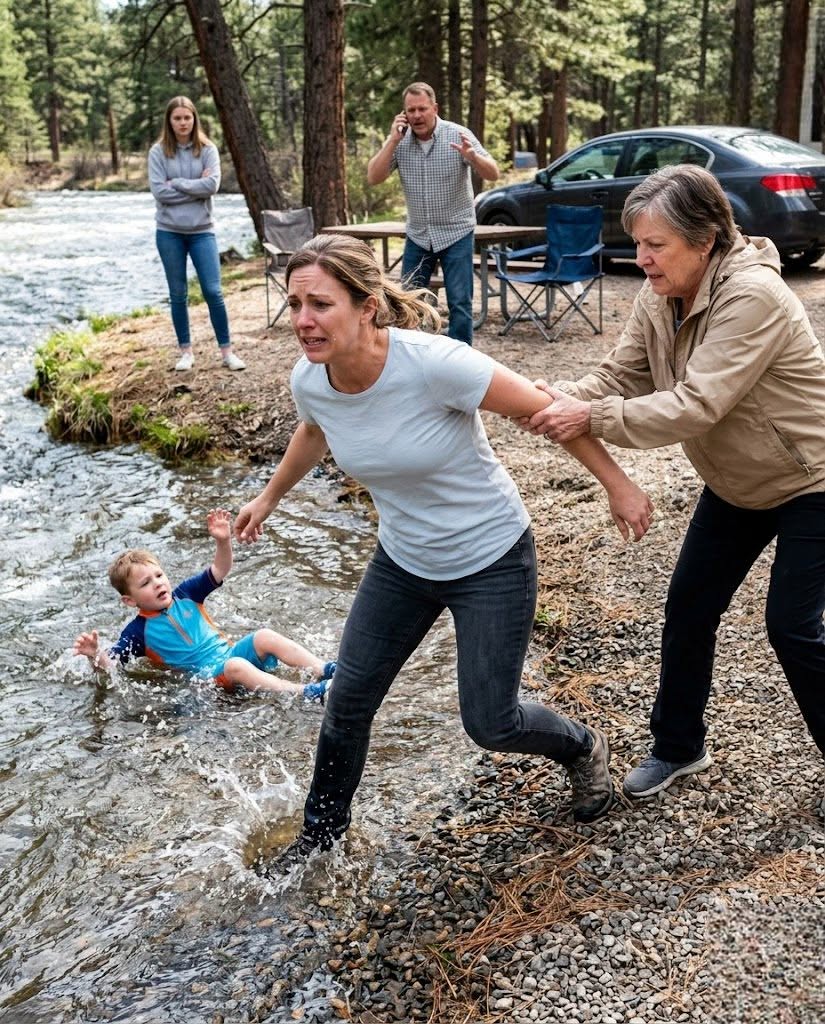 Toward me.
Then Patricia pushed his head beneath the surface.
The audio was rough under the river noise, but her voice came through.
“This is training. You have to become strong.”
Thomas made a sound beside me that I had never heard from him before.
It was not a word.
It was the sound of a father watching someone hurt his child while the past refused to change.
Robert paused the video.
My whole body shook.
“Keep going.”
He looked at me carefully.
“There’s more.”
“Play it.”
“A man pulled your boy out,” Robert said. “Your son was alive when they carried him away.”
Alive.
The word did not feel gentle.
It cut.
Hope had teeth because it brought back every possible way we could still lose him.
Robert enlarged the next frame.
James was lifting Noah.
My son’s body sagged against him, but his face was turned outward.
Emily moved beside them.
Patricia stayed near the rock.
Then Emily held up Noah’s swim trunks.
I stopped breathing.
On-screen, Patricia pointed to the same rock where the rescue team would later find them.
The sequence was unmistakable.
Noah went into the water.
James pulled him out.
James carried him toward a car.
Emily brought the trunks back.
Patricia selected the rock.
The evidence had not washed there.
They had placed it.
Thomas leaned closer to the phone.
“Where does the car go?”
Robert looked at me.
“Mrs. Carter, watch what they do after that.”
He tapped the screen once but did not start it.
“Watch where your son goes.”
My thumb hovered over the play icon.
Behind us, the river kept moving as if nothing had happened.
On Robert’s phone, the timestamp waited.
And somewhere beyond the final frozen frame, my son was still alive when the people I called family drove him away—
Toward me.
Then Patricia pushed his head beneath the surface.
The audio was rough under the river noise, but her voice came through.
“This is training. You have to become strong.”
Thomas made a sound beside me that I had never heard from him before.
It was not a word.
It was the sound of a father watching someone hurt his child while the past refused to change.
Robert paused the video.
My whole body shook.
“Keep going.”
He looked at me carefully.
“There’s more.”
“Play it.”
“A man pulled your boy out,” Robert said. “Your son was alive when they carried him away.”
Alive.
The word did not feel gentle.
It cut.
Hope had teeth because it brought back every possible way we could still lose him.
Robert enlarged the next frame.
James was lifting Noah.
My son’s body sagged against him, but his face was turned outward.
Emily moved beside them.
Patricia stayed near the rock.
Then Emily held up Noah’s swim trunks.
I stopped breathing.
On-screen, Patricia pointed to the same rock where the rescue team would later find them.
The sequence was unmistakable.
Noah went into the water.
James pulled him out.
James carried him toward a car.
Emily brought the trunks back.
Patricia selected the rock.
The evidence had not washed there.
They had placed it.
Thomas leaned closer to the phone.
“Where does the car go?”
Robert looked at me.
“Mrs. Carter, watch what they do after that.”
He tapped the screen once but did not start it.
“Watch where your son goes.”
My thumb hovered over the play icon.
Behind us, the river kept moving as if nothing had happened.
On Robert’s phone, the timestamp waited.
And somewhere beyond the final frozen frame, my son was still alive when the people I called family drove him away—