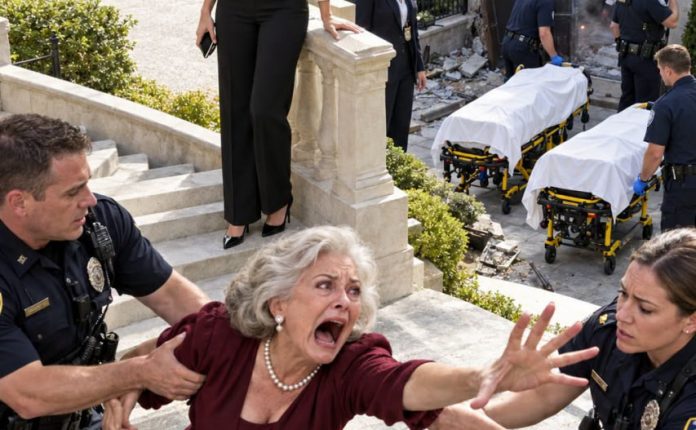
At nine forty-two on a Thursday night, I watched my mother-in-law interfere with the ventilation beneath my house.
For several seconds, I tried to make the picture mean something else.
Evelyn Hart was sixty-eight. She wore a cream cardigan with pearl buttons and kept birthday cards in a kitchen drawer arranged by month. She disliked ladders, cold rooms, and any household task that might damage her manicure.
Yet there she stood, two steps above the cellar floor, pressing material against a ventilation grille.
She climbed down carefully.
Then she moved toward the service wall.
“Don’t,” I said to the screen.
There was nobody in my study to hear me.
The environmental dashboard had sent an irregular reading to my tablet. Nothing dramatic: a warning that equipment had not responded as expected. In an underground structure built long before modern monitoring systems, irregular readings sometimes meant a faulty sensor or a contractor moving a cart.
I opened the camera application expecting an ordinary inconvenience.
Instead, Evelyn looked up at the camera, paused, and continued.
That pause bothered me almost as much as what followed.
She knew the camera existed. She had helped choose its brass-colored cover because she thought a white housing looked cheap against the stone.
Apparently, she believed nobody would be watching.
I started a recording.
My first attempt failed because my finger shook and closed the wrong window. I tried again, watched the recording indicator appear, and saved a second copy to the account I used for company documents.
On the screen, Evelyn handled an old emergency fuel connection near the service wall.
I could see where her hands went. I could not see exactly what they did.
That distinction would later occupy hours of interviews.
At the time, I understood only that she had no business being there.
I called the private company that monitored our cellar equipment and environmental alarms.
“I think someone has tampered with the ventilation,” I told the operator. “There may be a problem with the old fuel connection.”
“Are you reporting an active leak?”
“I don’t know. I’m upstairs.”
“If you suspect an active gas emergency, leave and call emergency services.”
I should have done that immediately.
Instead, I looked at the dashboard, where no separate gas alarm had appeared, and let the absence of one warning outweigh the evidence in front of me.
“I need the cellar put into maintenance lockout,” I said. “Nobody should enter until someone checks it.”
The operator entered a request.
He explained that the system would need confirmation from the door controller and that a technician would have to inspect the equipment.
What I retained was simpler.
Request entered.
Someone would handle it.
I had built a business by understanding qualifications buried in contracts. That evening, frightened and unwilling to believe what I had seen, I stripped the qualifications from a sentence because I wanted certainty.
Evelyn left the cellar.
She wiped her hands on her cardigan before stepping out of view.
I sat with the phone against my ear after the operator disconnected.
Then Daniel called from the hall.
“Claire?”
I minimized the camera application.
My husband came into the study carrying warm milk in the blue mug my father had bought me at a roadside pottery stand.
“You’re still at this?”
He glanced at the spreadsheet on my screen.
“Some of us have distributors who expect their orders to match their invoices.”
“Unreasonable people.”
Usually, I would have laughed.
Daniel had always been good at making work feel briefly ridiculous.
When we met, he managed regional sales for a small beverage distributor. He knew how to remember a buyer’s daughter’s name and how to recover a conversation after somebody said no.
I knew soil, production schedules, debt, and what happened when a harvest arrived two days ahead of the crew.
We had seemed useful to each other.
Later, I mistook that usefulness for something more durable.
He placed the mug beside my hand.
“Drink something. You’ve barely eaten.”
“I ate.”
“You moved food around.”
He draped a cashmere cardigan over my shoulders.
I noticed the pale residue at the cuff of his pajama trousers when he leaned beside my chair.
A little white smear, no larger than a coin.
On the screen, Evelyn had wiped something similar from her fingers.
My stomach tightened.
Daniel followed my gaze and brushed at the fabric.
“What?”
“Nothing.”
“You look ill.”
“Dinner didn’t agree with me.”
He rubbed my shoulder, thumb moving in the familiar place beside my neck.
Every nerve in my body seemed to pull away from that small pressure.
“Your stomach again?”
“Probably.”
“Take a shower. I adjusted the hot water earlier.”
I looked at him.
He had mentioned the water heater twice that week, although we had a maintenance contractor and he usually treated household equipment as someone else’s department.
“Thank you.”
“And stay out of the cellar tomorrow.”
He said it lightly.
“You’ve been down there every day. The bottles aren’t going to run away.”
The reserve cellar belonged to the business, although it sat beneath my home. My parents had stored their first serious vintage there when I was still young enough to believe wine came from barrels already wearing labels.
Over fifteen years, I had repaired walls, upgraded equipment, replaced unsuitable storage, and bought back bottles my father once sold cheaply to cover wages.
Daniel knew what the room meant to me.
He also knew how often I entered it.
“I’ll try,” I said.
“Promise?”
I picked up the mug without drinking.
“Let me finish this invoice.”
He kissed the top of my head.
After he left, I watched the doorway for several seconds.
Then I poured the milk into the study sink, rinsed nothing, and left the mug beside it.
I did not know whether there was anything wrong with the milk.
I knew I no longer trusted a gesture simply because it was familiar.
In our dressing room, I turned on the shower.
The water struck the tile loudly enough to cover the sound of the safe.
My passport lay above a folder marked FAMILY.
Daniel had written that label.
I remembered watching him do it after my hospitalization the previous year. Pneumonia had taken nearly two weeks from my life and left me exhausted for months.
He had handled insurance calls while I learned to walk around the garden without stopping at the bench.
“You shouldn’t have to manage every detail,” he had said.
I had been grateful.
Inside the folder, the increased policy amount matched my memory.
The beneficiary designation did not.
My parents’ names were gone.
Daniel’s name stood alone.
One hundred percent.
At the bottom was a version of my signature convincing enough to make me sit on the dressing-room stool.
I turned the page toward the light.
The final stroke curved downward.
Mine curved up.
I had spent years signing permits, shipping documents, loan agreements, and payroll approvals. The little hook at the end of Hart was an impatient habit I had never managed to lose.
Someone had copied the shape of my name without understanding the movement.
I photographed the document.
Then I photographed the policy number, the date, every page that might later matter.
For a moment, I considered calling my father.
He would come.
That was precisely why I did not.
He was seventy-three, stubborn, and recovering from knee surgery. If I told him Daniel had forged an insurance form while Evelyn tampered with the cellar, he would drive straight to my house and demand answers before I could finish explaining.
I needed help that would not announce itself in the driveway.
I returned the folder and closed the safe.
When I reached the bedroom, Daniel was propped against the pillows with a book open across his stomach.
“Better?”
“A little.”
He held the blanket back for me.
I lay down.
The bedside clock changed from ten forty-eight to ten forty-nine while I watched it.
Daniel turned a page.
Finally, he switched off his lamp.
In the darkness, he mentioned a buyer.
“Graham’s coming tomorrow evening.”
“Graham who?”
“Linton. From the hotel group.”
I knew Graham Linton. He disliked last-minute arrangements and never came to Napa without sending an assistant’s itinerary.
“He didn’t email me.”
“It’s informal.”
“What does he want?”
“A look at the reserves. Maybe that old Bordeaux.”
I stared at the outline of the window.
Daniel named the bottle.
It lived in the deepest section, beyond the tasting alcove.
“Could you bring it up in the morning?”
A few minutes earlier, he had asked me to avoid the cellar.
Now he needed me in its farthest corner.
“You just told me to stay out.”
“One bottle, Claire. I meant stop spending your whole day down there.”
He sounded faintly amused, as if I had caught him in a harmless inconsistency.
I had no spa appointment.
I invented one anyway.
“Actually, I’m going out tomorrow morning.”
“Where?”
“The spa.”
“You didn’t mention it.”
“I booked it today.”
“Before breakfast?”
“I’ll leave the access card. You can get your own wine.”
Silence settled between us.
I had meant the sentence as a refusal.
I believed the maintenance lockout would make the card useless. By morning, I intended to be somewhere Daniel could not overhear a telephone call.
His hand found mine beneath the blanket.
“Of course.”
I kept my fingers still.
He fell asleep, or performed sleep convincingly enough that I could not tell the difference.
I lay awake.
Once, I checked the monitoring application. The cellar request showed as pending. I interpreted that as a process underway, rather than a reason to leave immediately.
That was another mistake.
Fear had not made me decisive. It had made me bargain with information.
If the lockout completed, I could leave quietly.
If Daniel did not know I had seen the footage, I could preserve the evidence.
If Evelyn had merely damaged something, perhaps I would not have to believe the worst.
I moved my access card from my wallet to the dressing table beside my keys.
Then I copied the photographs and recording to a second account.
At four, I began composing a message to our outside accountant, Nina Patel.
Please call me somewhere private tomorrow. Do not discuss this with Daniel.
I saved it without sending.
At five, the vineyard outside our windows became a gray arrangement of wires and posts.
I must have slept then.
When my phone vibrated at six ten, Daniel’s side of the bed was empty.
“Mrs. Hart? My name is Marisol. I’m reviewing an unresolved equipment incident from last night.”
I sat upright.
She asked whether somebody had physically secured the cellar.
“I requested a lockout.”
“I can see the request. We don’t have confirmation from the controller.”
“What does that mean?”
“It means you cannot assume the door is secured.”
Her voice sharpened when I mentioned the fuel connection.
“Please leave the building. If there is any possibility of gas, call emergency services from outside. Don’t inspect it yourself.”
I looked toward the dressing room.
The card was gone.
Daniel’s charger was missing from the wall.
I pulled on yesterday’s trousers and shoes without socks. My hands would not cooperate with the zipper.
At the bedroom door, I called his name.
No answer.
The house had the peculiar silence of an early morning when someone else is already awake.
A light burned over the kitchen island.
A drawer stood open beside the refrigerator.
I did not stop to close it.
On the back landing, I heard a mechanical hum beneath the ordinary sound of the refrigerator. Something was running below.
I went outside.
The cold reached me all at once.
I called emergency services from the gravel drive and gave the dispatcher the address twice because I stumbled over the first attempt.
“There may be gas in the reserve cellar. Somebody tampered with equipment last night.”
“Is everyone out of the building?”
“I’m trying to locate my husband.”
“Do not go back inside.”
I called Daniel from my other line.
No answer.
I sent a message.
Do not enter the cellar. Possible gas. I have called emergency services.
The message changed to read.
Then Evelyn appeared on the garden path.
Her slippers were wet with dew. She wore the same cream cardigan.
“Why are you outside?”
“Where’s Daniel?”
“At the office.”
“The office isn’t open.”
“He has keys.”
“Have you spoken to him?”
She looked past me at the house.
Something struck the cellar door from the other side.
Not loudly.
A dull impact, followed by a scrape.
Evelyn reached for my phone.
“Let me speak to him.”
“The dispatcher?”
“Daniel.”
“You said he was at the office.”
The dispatcher told me to move farther away.
I repeated it.
Evelyn did not move.
I called Daniel again.
His phone rang somewhere below the kitchen windows.
I watched Evelyn hear it.
She turned so abruptly that her slipper caught on the gravel.
“That’s his work phone.”
“It’s the number I called.”
Across the drive, beside the delivery entrance, stood Lila Reed’s blue car.
I recognized the dent over the back wheel.
Three months earlier, Lila had backed into a loading bollard while bringing us coffees. She had cried because she could not afford the repair.
Daniel told me we should give her a bonus.
Lila coordinated distributor visits and maintained the sales calendar. She kept spare chargers in her desk and remembered birthdays better than I did.
She was supposed to be visiting her sister.
“Why is Lila here?”
Evelyn answered without looking.
“I don’t know.”
The dispatcher asked again whether anyone remained inside.
“My husband may be downstairs. Another employee may be with him.”
Evelyn gripped my sleeve.
“You told him to go down there?”
“He asked for wine. I told him to get it himself.”
Her mouth opened.
Nothing came out.
“What did you do?” I asked.
A siren sounded beyond the vines.
I took several steps toward the service path, searching for another way to make someone inside hear me.
The dispatcher stopped me.
I obeyed.
That fact would become something I examined in bed, in interviews, in the grocery store while reaching for ordinary things.
I stayed outside.
I wanted them to come out.
I wanted to live.
Evelyn suddenly moved toward the house.
I caught her cardigan.
The explosion threw us both onto the gravel.
I did not hear it as a single sound.
There was pressure, breaking glass, the ugly crack of something heavy giving way. Then there was a high ringing that seemed to exist inside my teeth.
Dust covered my tongue.
A piece of glass lay beside my hand.
For a moment, I thought it was ice.
Evelyn was trying to stand.
“Daniel?”
Smoke pushed through the broken kitchen windows.
My phone was still connected.
I told the dispatcher we were outside, although she had asked whether we were hurt.
A firefighter reached us.
He guided me backward with one hand while speaking into his radio.
Evelyn caught his sleeve.
“Was there a woman with my son?”
He looked at her.
“Ma’am, step back.”
“Was there?”
“We don’t know who is inside yet.”
I tried to tell him about the camera recording.
He told me to sit.
I sat on the low wall beside the drive, the wall my father had rebuilt after a delivery truck clipped it.
Blood ran from a shallow cut on my wrist.
Evelyn walked in a tight circle, saying Daniel’s name.
The firefighters moved with a concentration that frightened me more than shouting would have.
Nobody offered reassurance.
A paramedic shone a light into my eyes.
“Can you tell me your name?”
“Claire Hart.”
“Do you know where you are?”
“My house.”
She glanced toward the smoke.
“All right. Keep looking at me.”
I wanted to tell her I knew the room below every broken window. I knew the shelves and the floor marks and the little recess where my father once kept a radio.
Instead, I told her there might be two people downstairs.
She said the crews knew.
The hours that followed arrived in fragments.
A blanket with a rough edge.
A police officer asking who lived on the property.
Evelyn refusing to be examined.
My father’s truck stopping crookedly beyond the cordon.
My mother getting out before it had fully stopped.
I had not called them. Our foreman, Ben Ortega, had heard the emergency vehicles and contacted my father.
Mom knelt beside me.
“What happened?”
I looked at her face and began to shake.
Not cry.
Shake, hard enough that the paramedic steadied the blanket around my shoulders.
Dad stood behind her with his hands open and empty.
“Where’s Daniel?”
I could not answer.
A detective introduced herself sometime after eight.
Elena Ruiz had short dark hair and a notebook with a bent cover. She spoke to me where we could see the house without standing in the middle of the response crews.
She asked what I had noticed before the explosion.
I told her about the footage.
Then I told her about the policy.
She did not interrupt.
“Where is that recording now?”
I showed her.
She watched the first seconds, paused it, and asked whether I would preserve my phone without deleting or changing anything.
“Yes.”
“Did you confront Mrs. Hart?”
“Outside.”
“Before that?”
“No.”
“Did you tell your husband what you saw?”
“No.”
I heard how that sounded.
“I thought I needed to get away without warning him.”
She wrote something.
“Tell me exactly what you said about the wine.”
I did.
I did not soften it.
I had told Daniel to get his own bottle.
Ruiz asked whether I knew he had entered the cellar.
“Not until I heard his phone.”
“And the woman?”
“I saw her car.”
“Did you see either of them go downstairs?”
“No.”
She nodded once.
Farther down the drive, Evelyn sat beside another officer.
She was speaking quickly now.
Her hands moved constantly.
Once, she pointed toward me.
By late morning, the crews had recovered two people.
No one used the word rescued.
Ruiz told me privately.
A man and a woman.
Formal identification would follow.
I looked at Lila’s car, still parked beside the delivery entrance with its wheels turned slightly toward the house.
Her sister was expecting her.
Or perhaps her sister knew nothing about a visit.
That small uncertainty seemed suddenly unbearable.
“Did they suffer?”
Ruiz’s expression changed.
“I can’t answer that yet.”
I appreciated her for not inventing mercy.
Evelyn began shouting when another officer approached her.
“No. Daniel is at the office. You need to check the office.”
Then she looked at me.
“You sent him.”
My mother stood up.
Ruiz raised a hand.
“Mrs. Hart, we need to speak separately.”
Evelyn kept looking at me.
“You told him to fetch that bottle.”
I had no answer that could make the morning different.
By afternoon, an attorney my father had known for years arrived at the hotel where the police suggested we wait.
Ruth Moreno wore a navy jacket over a wrinkled shirt and carried a canvas bag instead of a briefcase.
She listened to my account.
When I finished, she asked the question I had been asking myself.
“Why didn’t you leave when you saw the recording?”
“I don’t know.”
“Tell me what you believed, not what you think you should have believed.”
I told her about the lockout.
The missing gas alarm.
The request marked pending.
The way I had wanted one more fact before admitting that the people in my house might be trying to hurt me.
Ruth folded her hands.
“We work with what happened.”
Late that afternoon, Ruiz called.
The monitoring company had preserved its records.
There had been another call after mine.
An authorized household contact had contacted them at eleven three.
The caller said I had mistaken routine work for a problem.
He requested that the incident be treated as a household misunderstanding.
“Who?” I asked, although I already knew.
“Your husband.”
Ruth reached across the hotel desk and put the call on speaker.
Ruiz continued.
“There’s something else you need to hear.”
She played a short section of audio.
Daniel’s voice filled the little room.
“My wife’s exhausted. Please don’t call her again tonight. I’ll take responsibility for the cellar.”
END PART 1