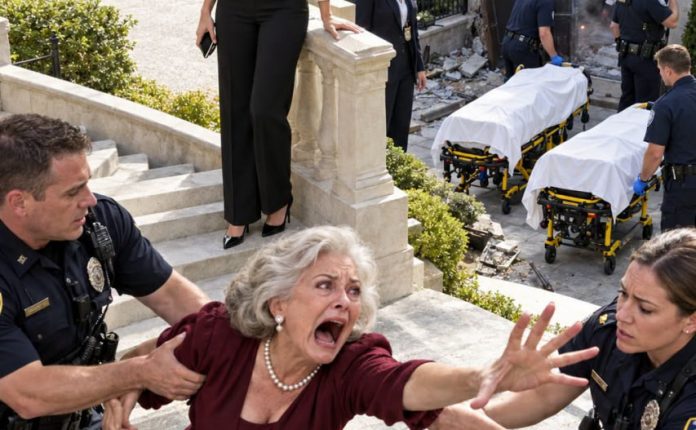
The first time I saw Evelyn after her arrest, she asked whether I was satisfied.
We were in a courthouse corridor.
Ruth had arranged our arrival carefully, but a hearing ran late and a door opened sooner than expected.
Evelyn stood between her attorney and a deputy.
Her hair had grown out at the roots. Without the careful styling, I could see how thin it was above her temples.
“Well?” she said.
The deputy told her to keep moving.
“Are you satisfied now?”
I looked at the woman who once corrected the placement of my wedding flowers because she thought the arrangements hid Daniel’s face.
“No.”
That seemed to anger her more than any accusation could have.
She turned toward her attorney.
“She’s enjoying this.”
Ruth guided me into a waiting room.
I sat with my hands between my knees until the trembling passed.
By then, nearly five months had gone by.
Five months of temporary housing, interviews, inspections, banking forms, and waking with my jaw clenched so tightly that eating hurt.
The house remained uninhabitable.
The production buildings survived.
So did most of the vineyard.
Those facts sounded like good news when people said them.
They were good news.
They simply did not answer the question my body asked whenever a door shut behind me.
Can you get out?
I began seeing a therapist on Tuesdays.
At first, I treated the appointments as another task to complete correctly.
I arrived with notes.
I explained the timeline without crying.
I asked how long the nightmares usually lasted.
She asked what happened in them.
“The door won’t open.”
“Are you inside the cellar?”
“Sometimes.”
“Other times?”
“I’m upstairs. I know they’re below me. I can’t find my phone.”
We worked from there.
I learned that remembering a detail and punishing myself with it were not the same activity.
I had to learn that repeatedly.
The prosecution did not ask me to pretend I had acted perfectly.
Neither did Ruth.
My first call should have been to emergency services.
I should have left the house.
I should not have assumed that entering a maintenance request meant a door had become secure.
Those truths remained even after the evidence established what Daniel and Evelyn had intended.
Accepting them hurt.
It also gave me something solid.
I could regret my decisions without accepting responsibility for theirs.
That sentence sounded easy when Ruth first said it.
Months later, I could occasionally believe it before breakfast.
The case against Evelyn developed from several independent sources.
The camera recording showed her movements.
Physical findings established deliberate interference with the cellar’s safety systems and a propane release inconsistent with ordinary use.
Records showed that Daniel had intervened after my call.
Messages established that he and Evelyn had discussed my movements, the bottle request, and the story they expected other people to accept afterward.
The investigators did not need a precise explanation for every second underground to establish those things.
They could not identify the exact instant when an ordinary electrical event or damaged equipment had ignited the accumulated gas.
They said so.
They also could not identify with certainty which person read my warning on Daniel’s phone.
The message had been opened.
A call had rung.
Someone had moved near the cellar entrance.
Beyond that, they refused to build a confident narrative from damaged objects.
I valued their restraint more than I could explain.
After months of people supplying motives and dialogue to moments they had never witnessed, an unanswered question could feel like a form of respect.
Other questions did receive answers.
There had been no buyer appointment.
Graham Linton was in Chicago that week.
He had never requested the Bordeaux.
The milk contained nothing suspicious.
My pneumonia had been pneumonia.
Those findings mattered because suspicion, once admitted into a marriage, tries to occupy every memory.
I did not want to spend the rest of my life inventing crimes to fill its rooms.
Daniel had done enough.
The insurance company confirmed the beneficiary change had been fraudulently submitted.
Its investigation became part of the evidence.
The increased coverage I had knowingly approved was real.
The later designation was not mine.
The financial picture took longer to untangle.
Nina traced the company payments.
Some money could be recovered.
Some had disappeared into losses, fees, and debts Daniel had accumulated outside the vineyard.
The damage was serious.
It was not fatal to the business.
For the first time, I understood how often people had used my ability to recover as permission to harm me.
Claire will manage.
Claire will work it out.
Claire has the vineyard.
Nobody had asked whether I wanted another emergency to survive.
I changed financial controls.
No one person could approve certain payments, change access permissions, and reconcile the same records.
Nina stopped apologizing when she asked me for written confirmation.
Ben complained about the extra purchasing form exactly once.
Then he read the new process, signed it, and said, “Fair enough.”
We did not hold a meeting about trust.
We built procedures that did not require trust to do every job.
Lila’s part in the events was more complicated than either defending or condemning her allowed.
Her messages established the affair.
They also showed that she helped prepare false invoices and assisted Daniel with documents tied to the fraudulent beneficiary request.
She knew I had not agreed to the life he promised her.
Whether she understood the full plan involving Evelyn remained uncertain.
There were messages about my being gone.
Some referred to divorce.
Others were harder to read.
The prosecutor did not claim certainty where the evidence did not support it.
I asked the same of myself.
Hannah met me once at a café outside town.
She brought a small cardboard box.
Inside were a company key, a scarf I had lent Lila, and a notebook containing distributor passwords.
“The police have seen all of it,” she said.
“Thank you.”
She put both hands around her cup.
“I keep remembering her at sixteen.”
I knew what she was asking without wanting to ask it.
I would remember Lila at thirty-two, carrying folders into my kitchen.
Hannah would remember a girl.
Both people had existed.
“I’m not going to argue with you about who you lost,” I said.
Her eyes filled.
“I won’t ask you to forgive what she did.”
We finished our coffee.
We did not become friends.
That, too, was an honest ending.
The reason Daniel and Lila entered the cellar emerged from messages recovered from both devices.
He had discovered that the red notebook was missing from the drawer in my study.
He remembered I had carried it below after reconciling a reserve delivery.
He wanted it before Nina could see it.
Lila offered to help him find the entries and remove the supporting papers she had left in an alcove cupboard during a distributor event.
They arranged to meet early.
Daniel believed the dangerous part of the plan had not yet begun.
Evelyn had told him she had only prepared the room.
That was a lie.
Her own messages later made clear that she had acted sooner than their agreed schedule.
She did not trust Daniel to follow through.
She believed that if the preparations were complete, he would stop hesitating.
She believed I would enter after breakfast.
She believed her son would remain somewhere else.
Those beliefs did not turn her conduct into an accident.
They explained why her plan consumed the person she thought she was protecting.
Daniel warned her not to change the time.
Then he went downstairs without verifying what she had done.
His final messages to Lila were impatient, ordinary, almost absurd beside what followed.
Come before she wakes.
We’ll be out in ten.
Investigators found evidence that their early meeting had included an intimate encounter.
The condition of their clothing was one piece among others.
It was not the cause of the explosion.
It was not punishment.
It was evidence of what they were doing while I stood outside trying to reach them.
I needed that distinction.
People kept offering me a kind of revenge I had never asked to receive.
“They got what was coming,” a woman said in the grocery store.
She touched my elbow as though comforting me.
I moved my arm.
“No.”
She looked startled.
“I only meant—”
“I know.”
Then I took my basket to another aisle.
I did not want Daniel alive because I forgave him.
I wanted him alive because dead people could not answer the questions their survivors were forced to carry.
Because his mother had made me a widow while trying to make him one.
Because two families had received calls that morning.
Because I had heard his phone ring below my kitchen and spent months wondering whether he had heard mine.
The trial began eleven months after the explosion.
By then, Evelyn’s attorney had developed a clear argument.
She had intended property damage.
Daniel had concealed the severity of the plan from her.
My wine instruction had altered events.
My delay in calling emergency services showed that I had not believed the cellar was dangerous.
The defense did not have to make every claim fit comfortably beside every other.
It only had to persuade the jury that the prosecution had not proved its case.
I understood that.
Understanding did not make listening easier.
Evelyn sat at the defense table with a box of tissues beside her.
On the first day, she wore the pearl earrings she had worn to my wedding.
I noticed before I could stop myself.
The prosecutor opened with the sequence rather than a description of her character.
What she did.
What Daniel did.
What I reported.
What the records preserved.
The courtroom screens showed the cellar.
For the first time since that night, I watched the full recording without touching the controls.
Evelyn climbed.
Pressed.
Looked toward the camera.
Continued.
People shifted in the jury box.
One juror put down his pen.
The recording had no soundtrack dramatic enough to prepare anyone for what it meant.
That was its strength.
It showed a woman making choices.
Marisol testified about the unresolved incident.
She explained the distinction between a request and a completed command.
She explained the fault she found during review and why she called me.
The defense asked whether her company’s response had been adequate.
She answered carefully.
An internal review had identified weaknesses.
Procedures had been changed.
The company had preserved the record of those failures as well as the call Daniel made.
Nobody in that courtroom could honestly say one mistake explained everything.
There had been several.
Some were errors.
Some were deliberate.
The jury’s job was to understand the difference.
When my turn came, the clerk asked me to swear that I would tell the truth.
I looked at the witness stand’s small microphone.
A loose thread hung from the cuff of my jacket.
I tucked it under with my thumb.
The prosecutor asked how long I had been married.
Seven years.
What Daniel did at the company.
Business development.
Where Evelyn lived.
The guest cottage.
Ordinary answers built the shape of the life around the crime.
Then we reached the night itself.
I described the camera feed.
The call.
The milk.
The residue on Daniel’s trousers.
The policy.
The invented spa appointment.
My voice remained steady until the prosecutor asked what I expected would happen when Daniel tried to retrieve the bottle.
“I believed he would find a locked cellar.”
“Did you want him to enter a dangerous room?”
“No.”
“Did you know the lockout had completed?”
“No. I assumed it had.”
“Was that assumption correct?”
“No.”
She let the answer remain plain.
Then she played my emergency call.
I had not listened to the whole thing before.
My own voice sounded younger.
I gave the address.
Asked about my husband.
Read the warning I had sent him.
Told Evelyn to move.
When the explosion struck, there was a sound from the speakers that made several people flinch.
Then my voice returned.
We’re outside.
Please tell them there are two people.
I looked at the table in front of me until the recording ended.
The defense attorney was courteous.
That frightened me more than aggression would have.
“You had suspicions about your husband that night.”
“Yes.”
“You found a document you believed he forged.”
“Yes.”
“You saw my client interfere with equipment.”
“Yes.”
“Yet you remained in the house.”
“Yes.”
“And you told your husband to go to the cellar.”
“I told him to get his own wine when he asked me to retrieve it.”
“Those were your words?”
“Yes.”
He paused.
“You understood there might be danger.”
“I understood something was wrong.”
“But not enough to leave.”
“I made the wrong decision.”
He looked toward the jury.
I could see where he wanted the sentence to settle.
I continued before he asked another question.
“I was frightened. I was trying to protect myself without alerting them. I relied on a system I had not verified. Those are the decisions I made.”
“And now two people are dead.”
The prosecutor stood.
The judge spoke before I fully heard the objection.
We paused.
The question was reframed.
Did I regret telling Daniel to retrieve the bottle?
“Yes.”
“Do you believe your words influenced his going downstairs?”
“I don’t know what influenced him most. I know what I said.”
“And what you did.”
“Yes.”
I would not offer the certainty he wanted.
I would not invent certainty in my own defense either.
On redirect, the prosecutor returned to the messages.
Daniel had asked me to retrieve the bottle after discussing that request with Evelyn.
He had canceled the urgency of my monitoring call.
He had removed my card.
He had arranged to meet Lila before I woke.
My warning reached his phone before the explosion.
The evidence remained larger than the sentence the defense wanted to isolate.
That evening, I sat in Ruth’s car while rain collected on the windshield.
“I sounded weak.”
“You sounded honest.”
“I gave him things to use.”
“He had them already. They happened.”
I watched a woman cross the car park holding a coat over her head.
“I don’t know how to stop wishing I had done it differently.”
“You may not stop wishing.”
Ruth started the engine.
“You can stop treating the wish as a verdict.”
Evelyn testified two days later.
She said Daniel had asked her to assist with maintenance.
She said she had not understood the connection she touched.
She said she loved me.
At that, I looked down.
Not because I might cry.
Because I was afraid of what my face would do.
The prosecutor asked about messages discussing my movements.
Evelyn said Daniel often talked about schedules.
The prosecutor asked about the changed beneficiary.
Evelyn said Daniel handled financial matters.
Then the voice message played.
I need this to look like an accident, Mother.
Evelyn pressed a tissue to her mouth.
The prosecutor waited.
“What did your son mean by that?”
“He was upset.”
“About what?”
“The marriage.”
“Why would an unhappy marriage require the cellar to look like an accident?”
Her attorney objected.
The judge allowed a narrower question.
The prosecutor asked what Evelyn understood would happen when I entered the reserve section.
Evelyn stared at the screen.
Then she said, “She wasn’t supposed to send him.”
The courtroom became very quiet.
The prosecutor did not raise her voice.
“That wasn’t my question.”
Evelyn began crying.
“My son is dead.”
“Yes.”
“She’s sitting there.”
I felt my mother’s hand close around mine.
The judge called a brief recess.
Nobody needed to describe Evelyn as mad.
What she revealed was more coherent, and more terrible, than that.
She had imagined an outcome in which I disappeared and Daniel continued.
Even after all the evidence, my continued existence felt to her like the mistake.
The jury deliberated through most of two days.
I spent the first repairing a broken invoice process with Nina.
I spent the second walking between the hotel window and the desk.
When Ruth called, I could not make my hands work around my shoes.
Mom tied them for me.
I was forty-two years old.
She knelt anyway.
The verdicts were guilty.
The attempted killing of me.
The killings resulting from the deliberate act that took Daniel and Lila’s lives.
The other findings blurred while the clerk continued reading.
Evelyn sat without moving.
I did not feel joy.
I felt the exhaustion of a muscle finally allowed to loosen.
At sentencing, I spoke from a page because I did not trust myself to remember.
I said Daniel had betrayed me.
I said Lila had participated in harm whose full boundaries I might never know.
I said neither fact entitled anyone to make their deaths into entertainment.
Then I looked at Evelyn.
“You keep saying I sent him downstairs. I have said what I regret, under oath, where everyone could hear it. You still haven’t said what you intended to happen to me.”
She watched me.
I lowered the page.
“I am not going to spend the rest of my life answering that question for you.”
Her sentence meant she would spend the remainder of her life in prison.
Afterward, a reporter asked whether I had forgiven her.
“No.”
“Do you think you ever will?”
“I’m going home.”
At the time, home was a rented house with uneven kitchen drawers.
It was enough.
The property reconstruction took another year.
I did not rebuild the reserve room exactly as it had been.
Some bottles could be saved.
Many could not.
Insurance addressed physical losses, within the limits of its processes. Civil claims and estate administration moved slowly. Fraud complicated matters. Money returned in portions that never matched the neat totals in Nina’s original report.
I learned to stop expecting one payment or one document to mark the end.
The company remained ours.
The employees kept their jobs.
My parents moved back into their own house after deciding I was tired of having my father rearrange every tool within reach.
I was.
I also cried after they left.
Both things were true.
Daniel’s belongings occupied a storage room for months.
Eventually, I opened the boxes.
I kept photographs from before I met him, sent family objects to a relative, donated usable clothes, and discarded the cardigan he had placed around my shoulders.
The blue mug survived.
At first, I wanted it gone too.
Then I remembered my father buying it from a potter who apologized for the uneven glaze.
Daniel did not get to own every object he had touched.
I washed it.
I put it back in the cupboard.
On the first anniversary of the verdict, Ben asked whether I wanted the day cleared.
“No. We have a bottling run.”
He nodded.
At lunch, I went alone to the rebuilt part of the house.
The new stairs were wider.
The lighting was better.
Every safety system had been inspected independently.
I still paused at the top.
For a long time, I had believed recovery would announce itself as fearlessness.
Instead, I went downstairs afraid and came back up.
I did it again the next week.
Later, with someone beside me.
Later still, alone.
I kept the surviving corner of my red notebook in a file.
Not framed.
Not displayed.
Beside the investigators’ photographs and the records I hoped never to need again.
Its missing pages had once seemed like the center of everything.
What mattered now was that my accounts no longer depended on a notebook only I could understand.
On an ordinary Friday evening, nearly three years after the explosion, my parents came for dinner.
Dad brought bread.
Mom complained that he had eaten the end in the car.
I opened a bottle from our newest vintage.
Not a rare one.
Not something worth saving for people who had to be impressed.
We ate at the kitchen table with the back door open to the garden.
When Mom asked for another glass, I stood.
For half a second, I waited for somebody to offer to get it for me.
Then I crossed the kitchen and took the bottle from the counter.
Behind me, my father was arguing that the missing end of the loaf had been very small.
My mother told him she had evidence.
I laughed before I thought about it.
The sound surprised all three of us.
Nobody pointed that out.
I poured the wine, sat down, and let the conversation continue.
END PART 3
Disclaimer: This fictional story was created with AI assistance for entertainment. Names, characters, dialogue, and events are fictional. Any resemblance to actual people or events is coincidental.