For a moment after the recording stopped, I could still hear Daniel saying my wife.
He had used that phrase with hotel receptionists, mechanics, buyers, and people who approached our restaurant table to compliment a bottle.
My wife built this place.
My wife knows every vine.
My wife’s exhausted.
The same small claim could carry pride, affection, or a request to stop listening to me.
Ruth asked Ruiz to preserve the complete call.
“It’s already been secured,” the detective said.
“Was the lockout canceled?” Ruth asked.
“The incident priority was changed. There was also a controller fault. We’re establishing the sequence.”
Marisol had found the unresolved fault during a morning review.
That was why she called.
Not because the system had worked cleanly.
Because one person had noticed that a record did not make sense.
I asked whether I could thank her.
“Later,” Ruth said gently.
She waited until the call ended before turning back to me.
“You need to write down everything you remember while it’s fresh.”
“I’ve told them.”
“Memory changes under pressure. Write what you recall now. Include what you’re unsure about.”
I filled eleven hotel stationery pages.
At the bottom of the last sheet, I wrote:
I thought he would find a locked door.
Then I crossed out thought and wrote believed.
Ruth told me not to destroy the first version.
That distinction mattered to her.
It began to matter to me too.
My parents stayed in the adjoining room.
Mom brought toast from downstairs and did not ask why I could manage only the corner.
Dad spent much of the evening near the window, speaking quietly to Ben about crews, access roads, and whether the fire had affected the production building.
He needed something he could keep from falling apart.
So did I.
At eight, I asked for my laptop.
Ruth shook her head.
“No accounts tonight unless there’s an immediate business emergency.”
“There may be.”
“Then we do it with your accountant.”
We called Nina Patel.
Nina had managed the vineyard’s outside accounts for six years. She wore reading glasses on a chain and had never once accepted Daniel’s habit of calling every unexplained expense relationship development.
I told her there had been an explosion.
“I know,” she said. “Ben called.”
“There’s more.”
She went silent while I explained the beneficiary form and Daniel’s call.
Then she asked, “Does he still have authority to move company funds?”
I looked at Ruth.
That was the first practical question of my widowhood.
Not flowers.
Not arrangements.
Access.
Ruth and Nina worked through what could be restricted immediately and what required the bank’s formal process.
I answered questions until my voice became flat.
Daniel had signing authority on one operating account, limited purchasing authority, and access to sales records.
Lila administered distributor schedules, prepared expense packets, and helped collect documentation for insurance renewals.
“She helped with our household policy?” I asked.
Nina paused.
“I don’t know about household matters. But she handled the last company renewal package.”
I remembered Lila standing in our kitchen holding a folder.
Daniel had asked me to sign several pages before a lunch meeting.
I had told him I wanted time to read them.
He had laughed and said nobody was buying the moon.
I had read them anyway.
Or thought I had.
After the call, I went into the bathroom and locked the door.
I did not vomit.
I stood above the sink with both hands braced on the counter, waiting for my body to decide what to do.
Through the wall, I heard Dad ask Mom whether he should get me something from the pharmacy.
She said, “Let her have five minutes.”
He waited four before knocking.
The next morning, Ruiz confirmed the identities.
Daniel Hart.
Lila Reed.
She did not tell me how they were dressed.
I learned that from the preliminary incident report Ruth reviewed with me several days later.
The deceased were a partially undressed adult man and adult woman.
The wording was dry.
That made it worse.
I read it twice.
Ruth stopped turning the pages.
“You don’t have to go through all of this now.”
“I do.”
“We can separate what matters today from what can wait.”
“My husband died with someone who worked for me.”
“Yes.”
“People are going to turn that into the whole story.”
Ruth did not reassure me that they would be kinder than that.
“We’ll keep the evidence whole.”
By then, people were already posting photographs of the smoke.
Someone described Daniel as a devoted husband who had died trying to save a colleague.
Someone else said the vineyard’s owner had escaped an explosion minutes after sending two employees underground.
Facts and inventions traveled together.
I turned off my notifications.
Evelyn did not.
On the second afternoon, she gave a short interview beyond the property gate.
I saw it because a supplier sent the clip to Ben, asking whether deliveries should stop.
Evelyn wore black.
She held Daniel’s childhood photograph.
“My son was a good man,” she said. “He went into that cellar because Claire asked him to.”
The interviewer asked about Lila.
Evelyn pressed the photograph against her chest.
“I don’t know why that woman was there.”
That woman.
Two days earlier, Lila had been the girl who always remembered Evelyn’s tea.
I watched the clip without sound the second time.
Her face looked old in a way I had never seen.
I felt pity before anger.
Then I hated myself for the pity.
Ruth said both could exist.
“You aren’t required to decide on one feeling.”
Police had already interviewed Evelyn.
They had not publicly announced an arrest.
Ruiz told Ruth they were still collecting physical findings, electronic records, and the history of the household’s fuel system.
The recording showed tampering.
It did not, by itself, establish everything that had happened afterward.
I found the slowness intolerable.
Then I remembered how quickly I had wanted certainty the night before the explosion.
I said nothing.
On Monday, the surviving company managers gathered in the production building.
Ben had cleared a table beside the bottling line.
The machinery was off. Without its usual noise, every scrape of a chair seemed too loud.
Thirty-one people worked for us during the year, more at harvest.
Some had known Daniel longer than I had.
Several had worked beside Lila every day.
They looked at me carefully.
I had a healing cut on my wrist and bruises along my shoulder. My mother had persuaded me to wear a cardigan because the bruises made her wince.
I took it off before standing.
“There’s an active investigation,” I said. “I cannot explain all of it today.”
A forklift beeped in the yard.
I waited.
“Daniel and Lila are dead. Their families deserve accurate information, and so do you. Please don’t repeat claims you cannot verify.”
One of the shipping clerks raised her hand halfway.
“Are we closing?”
“No.”
“Can you promise?”
That question deserved more than reassurance.
“We have reserves. Nina is reviewing the accounts. Ben and I will meet payroll and keep you informed about any changes that affect your work.”
A few shoulders dropped.
Then someone at the back said, “Was Lila with him?”
I knew what he meant.
“I won’t discuss private details here.”
“But it affects—”
“What affects your employment,” I said, “will be discussed openly. Nobody’s grief is going to become a staff meeting.”
My voice shook on the last sentence.
I let it.
Afterward, Ben found me beside the loading doors.
“You did fine.”
“I almost cried.”
“You can do two things.”
He handed me a paper cup of coffee.
It was too hot.
I held it anyway.
That evening, Lila’s sister called.
Her name was Hannah.
Lila had shown me photographs of them together at the coast. They had the same wide-set eyes, but Hannah’s voice was lower.
“I know this isn’t a good time,” she began.
“There isn’t one.”
“No.”
We were both quiet.
Then she said, “She wasn’t coming to see me.”
I closed my eyes.
“Thank you for telling me.”
“I didn’t know about your husband.”
“I believe you.”
“I don’t know if you should.”
There was something painfully honest about that.
Hannah had found messages on a tablet Lila left in her apartment. She had contacted police before calling me.
“I’m not asking you to forgive her,” she said.
“I don’t know what she did yet.”
“Neither do I. Not all of it.”
We did not comfort each other.
We stayed on the line long enough to understand that neither of us would be using the other as a shield.
When we hung up, I cried for the first time.
Not dramatically.
I sat on the hotel floor with a towel against my face because the tissues hurt my nose.
I cried for a woman I had trusted to arrange a buyer’s lunch.
For the ordinary mornings when Daniel had carried two coffees past my office toward hers.
For how many details could exist in plain sight without explaining themselves until afterward.
The affair was easier to understand than the rest.
That made it a dangerous thing to focus on.
Betrayal offered a familiar story.
The investigation was showing me something worse.
Nina found the first unexplained transfer on Tuesday.
A payment to an outside consulting company appeared to cover introductions to overseas distributors.
The attached invoice contained a mailing address belonging to a rented mailbox.
Daniel had approved it.
Lila had assembled the packet.
Several more followed.
Some paid real vendors at inflated amounts. Some had supporting emails that Nina could not match to actual shipments.
The total was not enough to destroy the vineyard.
It was enough to explain Daniel’s sudden interest in refinancing.
“He asked me about a property-backed loan in August,” Nina said.
“He told me it was an expansion proposal.”
“It never reached the planning stage.”
“Why didn’t you tell me?”
“I sent questions to your company email. There are responses from your account.”
I stared at the conference table in Ruth’s office.
“I didn’t answer them.”
“I know that now.”
The answers were short.
Approve preliminary review.
Daniel has discussed this with me.
Proceed through sales.
Someone had used my account or arranged messages that appeared to come from it.
I had been traveling during two of those exchanges.
During another, I had been at home with a fever.
Ruth asked for copies and preserved the access records before we went further.
I began keeping a list of things I had signed and things I remembered refusing.
It grew until the categories stopped feeling reliable.
That was when I remembered my red notebook.
I kept it in the tasting alcove below the house.
It contained reserve-bottle movements, private purchases, and handwritten notes I did not put into the sales system until I had reconciled them.
In the previous month, I had written questions about several consulting charges.
Daniel knew I used it.
Two weeks before the explosion, he had suggested that I stop leaving paper records in a damp room.
I told Nina.
She looked up sharply.
“What questions?”
I described them.
She asked me to reconstruct the entries as closely as I could.
I remembered amounts better than dates.
One charge had irritated me because it came to an even forty thousand dollars.
Another carried the name of a distributor who had died the year before.
I had underlined that one twice.
“Did you confront Daniel?”
“I asked what it was.”
“What did he say?”
“That Lila had attached the wrong contact.”
Nina put down her pen.
“Did you tell him you intended to reconcile the notebook?”
“Yes.”
The room became very still.
By then, the investigators had recovered our access-control records.
My card opened the cellar entrance shortly after six.
The courtyard camera recorded Lila’s arrival before that.
Daniel met her at the delivery entrance.
They carried no emergency equipment.
He carried the card.
She carried a bag.
A few minutes earlier, an interior camera showed Daniel leaving my study.
Not our bedroom.
My study.
I asked what he had taken.
Ruiz would not speculate.
Later, technicians recovered enough of the damaged notebook to identify its red cover among debris from the tasting alcove.
It had been moved from its usual drawer.
That fact alone did not explain why Daniel and Lila went downstairs.
Their messages did.
Those took longer.
I resented every day until I saw how carefully the investigators worked to avoid turning a suspicion into a conclusion before it could stand.
On Thursday, Ruiz called Ruth about Evelyn.
“She has agreed to a further identification appointment,” she said. “There may be questions afterward.”
Evelyn had resisted accepting the identification evidence.
She insisted that Daniel could not have been downstairs.
His recovered belongings were not enough.
She wanted to see him.
I was not present at the medical examiner’s office.
For months, I knew that scene only from reports and testimony.
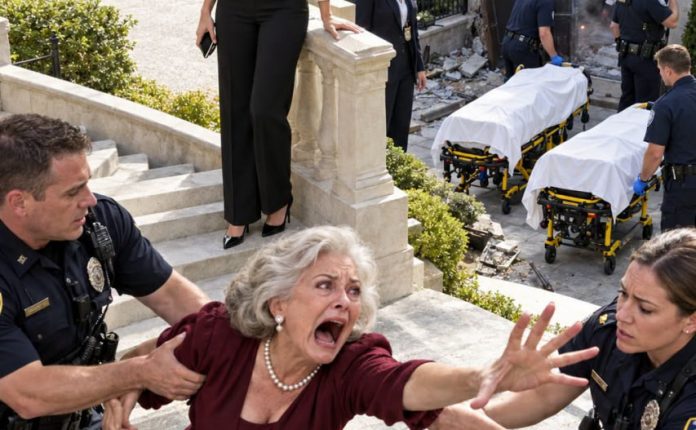
Evelyn viewed her son’s body with a support worker beside her.
She touched the edge of the sheet and asked why his glasses were missing.
They had been recovered separately.
Then, during a follow-up discussion about the second victim, investigators showed her an identification photograph of Lila.
Evelyn pushed her chair away.
“She wasn’t supposed to be there.”
The support worker asked whether she needed a break.
Evelyn pointed at the photograph.
“Daniel said she would be gone before morning.”
Ruiz asked what she meant.
Evelyn began crying.
Then she grew angry.
At Daniel.
At Lila.
At me.
The sequence mattered because her later account was that she had been too confused to know what she was saying.
At one point, she asked whether I had changed the wine request because I knew.
“Knew what?” Ruiz asked.
Evelyn stopped answering.
The interview ended when she requested counsel.
By evening, police had taken her into custody.
Ruiz told me before the announcement.
My mother was washing a mug in the hotel bathroom because she disliked leaving dishes for housekeeping.
She turned off the water when she heard me say Evelyn’s name.
“What are they charging her with?” Ruth asked.
Ruiz described the allegations without promising an outcome.
The deaths.
The attempt against me.
The tampering.
I looked at Mom.
She pressed the wet mug against her chest.
For a moment, I was twelve again, watching her hear that a summer storm had destroyed a season’s work.
Except this time, weather had nothing to do with it.
Evelyn’s first statement through her attorney blamed confusion, defective equipment, and my decision to send Daniel downstairs.
Then the surveillance footage became public through the court process.
Not all of it.
Enough.
The image of her standing beneath the ventilation grille replaced the photograph she had carried at the gate.
People who had called her a grieving mother began calling her other things.
I did not feel vindicated watching strangers become cruel in a different direction.
I felt tired.
One afternoon, a news van parked beyond the vineyard entrance.
The reporter asked whether I felt justice had been served.
There had not even been a trial.
I said, “Please move so our delivery truck can get through.”
The clip aired anyway.
Nina’s investigation continued beside the criminal case.
The consulting company belonged to an associate Daniel had used before our marriage.
Payments had helped cover losses from private ventures he never disclosed to me.
He had also promised Lila a role in a new business.
There were apartment searches.
Flight searches.
Messages about a life after Napa.
At first, I assumed after Napa meant after a divorce.
Then Ruth asked me to come to her office.
Ruiz joined us.
She brought copies of records the investigators were now able to discuss.
The affair had lasted eighteen months.
The financial misconduct had begun earlier.
The beneficiary request had been submitted using documents I had not signed.
The insurer had retained records beyond the paper copy in our safe.
I was not imagining the downward stroke.
But the document was no longer the worst evidence.
Daniel and Evelyn had exchanged messages through a second account he used for family matters.
Some were ordinary.
Groceries.
A prescription pickup.
A photograph of a chair Evelyn wanted.
Then the subject changed.
Claire is asking about the consulting payments.
She won’t agree to another loan.
If she sees the notebook against Nina’s figures, she’ll have everything.
There were gaps.
Deleted messages recovered from one device but not another.
Dates that required explanation.
Ruiz laid out only what investigators could authenticate.
Daniel had not merely failed to notice his mother’s behavior.
He had helped arrange access around a scheduled equipment inspection.
He had supplied the explanation they planned to use if anyone asked why the cellar systems had been disturbed.
The pale residue on his trousers came from work he had assisted with earlier that evening.
My recollection could not prove that.
The messages and recovered materials could.
“What did he think would happen?” I asked.
Ruiz looked at me for a long moment.
“We have a voice message.”
Ruth moved her chair closer.
The recording was short.
Daniel sounded irritated.
Not frightened.
“Don’t change the time again. She’ll go down after breakfast when I ask for the bottle. I need this to look like an accident, Mother. Nothing else.”
I heard the air conditioner above Ruth’s door.
A car passed outside.
Somebody in the next office laughed and then stopped.
“Play it again,” I said.
Ruth touched my arm.
“You don’t have to.”
“I heard him ask me for the wine. I need to hear what he said before that.”
Ruiz played it again.
This time, I understood why Daniel’s hand had gone still beneath the blanket.
He had not been surprised by an errand.
He had been listening to his plan fail to place me where he wanted me.
END PART 2